
Last updated: 28 September 2026. Coverage figures and prices as of September 2026; civil-suit counts read on 23 September 2026. In this update we corrected a state-ranking sentence, reworded lines that read as predictions, and added official pendency context and a fuller methodology.
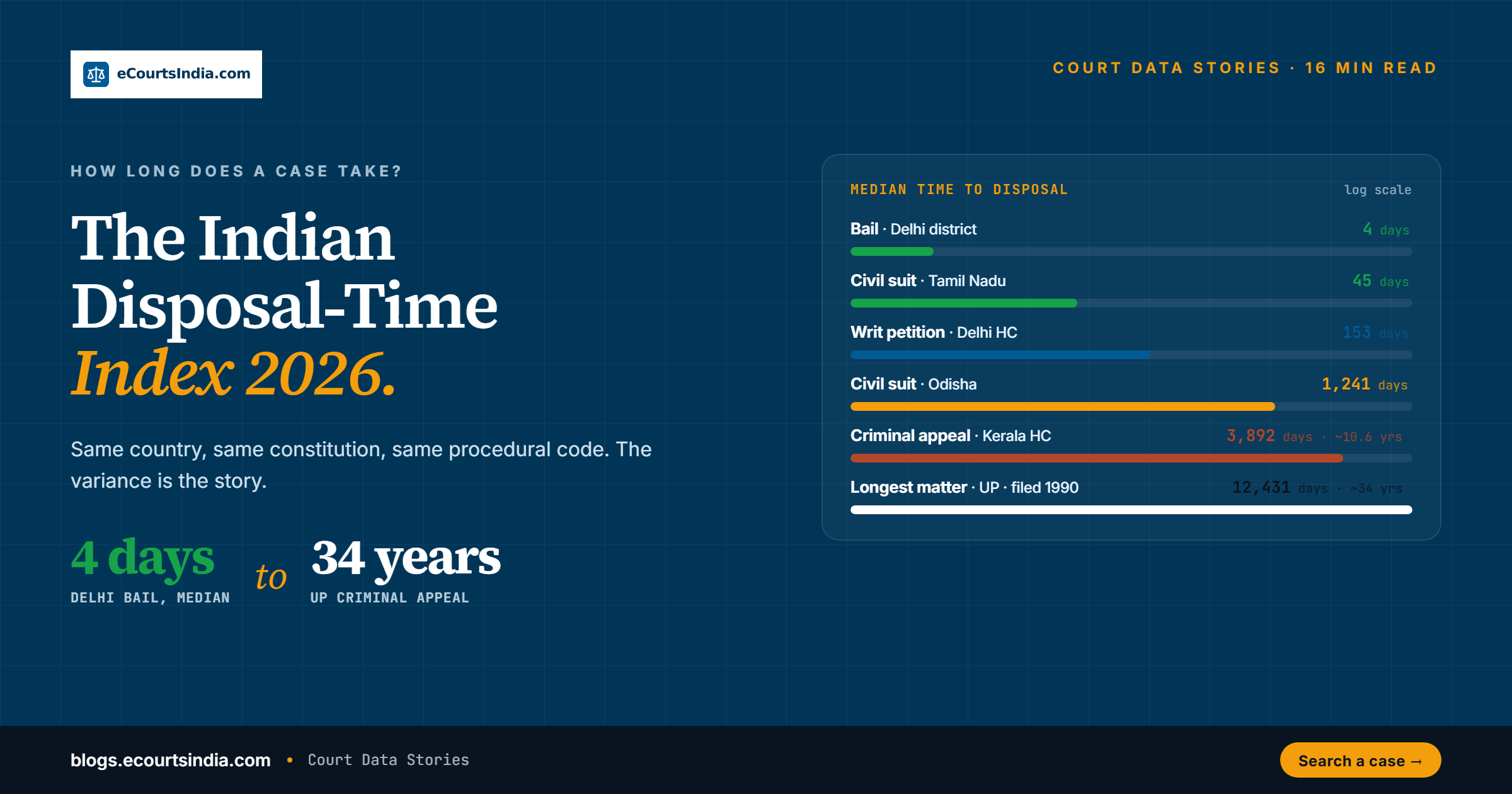
How long a court case takes in India depends on the court, the state and the case type. In eCourtsIndia’s April 2026 sample, bail applications decided in 2024 took a median of 4 to 13 days in the district courts measured. Civil suits coded CS and decided in 2025 took a median of 30 days in Tamil Nadu but 1,587 days in Odisha.
These are medians for cases already decided, not a prediction for any single case. eCourtsIndia is a private platform, not the Government’s eCourts portal (ecourts.gov.in).
Every Indian litigant, sooner or later, asks the same question: how long is this going to take? Lawyers answer it from anecdote. Newsrooms answer it through one or two viral cases. Official dashboards show how many cases are pending and for how long. They do not show how long cases that ended actually took, by state and case type. This index adds that view.
This post is our attempt at that number. In April 2026 we sampled 3,308 disposed cases from the eCourtsIndia search index, spread across 14 High Courts and 12 states at the district court tier. For each case we have the filing date, the decision date, the court, the case type, and the duration to the day. In September 2026 we added a second layer: medians for every civil suit decided in 2025 in eight states, computed over the full set of disposed cases rather than a sample. The medians, the percentile spreads and the outliers are below, with the method, the limitations and a downloadable copy of the April dataset.
If you have read our 498A study, the format will feel familiar. Real cases, real numbers, replicable from a public CNR list.
Key takeaways
- Bail moves in days at the district tier: a median of 4 days in Delhi district courts, 11 in Maharashtra and 13 in West Bengal (April 2026 sample, cases decided in 2024).
- Civil suits are where states diverge. For suits coded CS and decided in 2025, the median was 30 days in Tamil Nadu and 1,587 days in Odisha, across every disposed suit in the index. Tamil Nadu’s CS code includes many suits that close soon after filing.
- High Court criminal appeals carry the oldest backlog. The Kerala High Court median for appeals decided in 2024 was 3,892 days, because courts are still closing appeals filed a decade ago.
- Disposal time is not pendency. A state can close what it closes quickly and still carry a large backlog.
- You can re-run these queries through eCourtsIndia search, the API or the MCP server. The index is refreshed from eCourts, so results may differ slightly from the April 2026 CSV.
Bail applications decided in Delhi district courts in 2024 took a median of 4 days. A civil suit decided in Odisha in 2025 took a median of 1,587 days. Criminal appeals decided by the Kerala High Court in 2024 took a median of 3,892 days from filing to decision, more than ten years. Same country and the same central laws, yet the timelines differ widely. The variance is the story.
How we measured disposal time
The April dataset is a stratified sample of disposed cases drawn from eCourtsIndia‘s index as it stood in April 2026. The index now holds 32 crore+ case records from the Supreme Court of India, all 25 High Courts and their benches, district and taluka courts in all 36 states and Union Territories that publish on the eCourts network, and 18 tribunal and commission types. We restricted the universe to cases where the case status is DISPOSED (see what disposed and other case statuses mean) and where both filingDate and decisionDate are present. The duration we report is simply decisionDate minus filingDate, in days. We sanity-checked the numbers by pulling three random CNRs and recomputing the difference manually. All three reconciled to the day.
We sampled across two cohorts:
- The 2024 disposal cohort. All cases decided during calendar year 2024, regardless of when they were filed. This tells you what the courts were closing.
- The 2020 filing class. Cases filed in 2020 that had been disposed of by April 2026. This tells you how the class of 2020 has fared so far. Cases from that class still pending are not counted.
For the High Court tier we took up to 100 sample cases per (High Court x case type x cohort) cell. For the district tier we filtered by state (the exact filter is under “How to reproduce this analysis”). Six case types are in scope: writs (WP_C), bail (BA), anticipatory bail (ABA), criminal appeal (CRL_A), civil suit (CS) and motor accident claims (MACA). We pulled 3,308 disposed cases; after dropping records with missing disposal dates, 3,296 rows remained. Some cases appear in both cohorts because they were filed in 2020 and disposed in 2024.
The September refresh is different in kind. For civil suits decided in 2025, we did not sample: we took every disposed CS record per state, sorted by duration, and read the median and 75th percentile directly. Those figures were pulled on 23 September 2026. The sample tables from April are kept as they were, so the two sets should be read as separate snapshots, not as a year-on-year trend.
Terms used in this index
- Disposal time: the number of days between the filing date and the decision date recorded for a case that has been disposed of. It measures cases that have ended, not cases still pending.
- Median: the middle case. Half the decided cases took less time and half took more.
- 25th and 75th percentile (P25, P75): the points that one in four and three in four decided cases finished within.
- Disposed and pending: a disposed case has been decided or closed. Pendency is the number of cases filed but not yet decided on a given date.
- CNR: the 16-character Case Number Record the eCourts system gives each district court and High Court case (see what a CNR number is).
- Case-type codes: WP_C = writ petition (civil); BA = bail application; ABA = anticipatory bail application; CRL_A = criminal appeal; CS = civil suit; MACA = motor accident claims (at the High Court, appeals from Claims Tribunal awards). Bombay HC (Appellate) = the Appellate Side of the Bombay High Court.
How long does a bail application take?
In this sample, bail applications were the fastest-moving files. Among bail applications decided in 2024, a Delhi district court bail application closed in a median of 4 days. Maharashtra district courts took 11 days and West Bengal district courts 13 days. The High Courts were slower: Kerala High Court bail applications had a median of 24 days, the Bombay High Court 175 days and the Allahabad High Court 266 days.
| Court | Tier | n | Median | P25 | P75 |
|---|---|---|---|---|---|
| Delhi district courts | District | 74 | 4d | 1d | 10d |
| Maharashtra district courts | District | 88 | 11d | 6d | 23d |
| West Bengal district courts | District | 96 | 13d | 8d | 22d |
| UP district courts | District | 32 | 12d | 6d | 21d |
| Kerala HC | HC | 100 | 24d | 13d | 42d |
| Bombay HC (Appellate) | HC | 100 | 175d | 58d | 277d |
| Allahabad HC | HC | 100 | 266d | 85d | 628d |
The pattern is clear. Bail at the magistrate or sessions level moves in days. Bail at the High Court adds weeks to months. That is not the High Courts being slow on bail; bail at the High Court is a different animal, often filed only after the lower courts have refused, and often bundled with anticipatory bail variants and connected matters that take time to argue.
The class of 2020 tells a sterner story. Bail applications filed in the Bombay High Court in 2020 that were ultimately disposed had a median duration of 406 days. When bail goes the long way at the High Court, it can take more than a year.
Our reading of the sample: for most ordinary bail applications, the system works. District-level bail files in Maharashtra and Delhi were decided within two weeks at the median. The long waits sit elsewhere.
How long do writ petitions take in the High Courts?
Article 226 of the Constitution lets every High Court issue writs to any person or authority, including the Government, to enforce fundamental rights and for other purposes. In theory the same power; in practice, very different speeds.
For writ petitions decided in 2024, the sample median was 153 days at the Delhi High Court, 35 days at the Kerala High Court, 692 days at the Andhra Pradesh High Court and 227 days at the Meghalaya High Court. Same legal remedy, four different speeds.
Two factors likely explain much of the gap. First, the volume mix. Delhi’s mix appears to include a heavy share of service matters and short government writs that are disposed of quickly, alongside a long tail of land and tax writs that take years. One likely reason for Kerala’s short median is that many short writs at the Kerala High Court are disposed of at the first hearing, with a direction to the authority to reconsider. Contrast the Karnataka High Court writ KAHC010353612020 from our verification sample, a land-record petition that waited four years before being disposed of in one sitting once the State agreed to act.
Second, the legacy stack. The Hon’ble High Court of Andhra Pradesh was set up on 1 January 2019, when the common High Court at Hyderabad was divided, and it took over a large stock of older cases. Its median reflects older cases still working through the system.
The class of 2020 shows the other side. For Delhi High Court writs filed in 2020 and since disposed, the median was 106 days but the 75th percentile was 582 days. That spread matters more to litigants than the median: the slower quarter of those writs took 582 days or more. To follow a writ yourself, see our guide to High Court case status.
How long does a civil suit take in India?

Civil suits at the district tier are where the variance between states becomes impossible to ignore. We now have two views: the full 2025 picture from the index as read on 23 September 2026, and the April 2026 sample of suits decided in 2024.
Every civil suit decided in 2025 (full count, 8 states)
The table below uses every disposed record with case type CS decided in calendar 2025, per state, as held in the eCourtsIndia index on 23 September 2026. The median and 75th percentile are exact positions in the sorted list, not estimates from a sample.
| State | Suits decided in 2025 | Median (days) | P75 (days) |
|---|---|---|---|
| Tamil Nadu | 31,881 | 30 | 111 |
| West Bengal | 1,24,435 | 301 | 954 |
| Madhya Pradesh | 23,750 | 328 | 644 |
| Gujarat | 52,100 | 433 | 1,535 |
| Uttar Pradesh | 95,220 | 852 | 1,352 |
| Maharashtra | 1,15,853 | 1,174 | 2,536 |
| Rajasthan | 36,867 | 1,283 | 2,630 |
| Odisha | 12,992 | 1,587 | 2,944 |
The order at the ends has held. Tamil Nadu still has the shortest median for suits coded CS, by a wide margin: half of the CS suits decided there in 2025 closed within a month of filing. Odisha still has the longest, with a median of more than four years and a 75th percentile of about eight. The middle has moved around compared with the April sample: Uttar Pradesh looks faster on the full 2025 data (852 days against 1,232 in the 2024 sample of 42 cases), and Maharashtra looks slower (1,174 days against 456 in a sample of 93). Small samples swing, which is exactly why we ran the full count.
A word on Tamil Nadu. A median of a month does not mean a contested title suit ends in a month. The CS code in Tamil Nadu district courts covers many short matters that are decreed on admission, compromised or withdrawn soon after filing. The short median tells you how much of the docket closes early. It does not tell you how long a fully contested trial takes, and it should not be read as Tamil Nadu’s courts being faster at deciding contested suits.
April 2026 sample: civil suits decided in 2024
| State | n | Median (days) | P25 | P75 |
|---|---|---|---|---|
| Tamil Nadu | 61 | 45 | 16 | 64 |
| West Bengal | 93 | 210 | 127 | 300 |
| Karnataka | 47 | 291 | 134 | 447 |
| Madhya Pradesh | 100 | 293 | 190 | 701 |
| Gujarat | 100 | 370 | 248 | 856 |
| Maharashtra | 93 | 456 | 78 | 1,394 |
| Kerala | 100 | 477 | 276 | 673 |
| Rajasthan | 93 | 1,028 | 273 | 2,565 |
| Uttar Pradesh | 42 | 1,232 | 342 | 1,430 |
| Odisha | 100 | 1,241 | 530 | 2,421 |
In the April sample, Odisha (1,241 days) and Uttar Pradesh (1,232 days) sat at the slow end, a pattern that DAKSH and the India Justice Report have also described at a higher level. The 2020 filing class for UP civil suits had a median of 1,127 days for those disposed by April 2026, though suits from that year still pending in April 2026 are not counted, so the true median is longer.
If you are advising a client on a contract dispute, this is the spread to note: a suit coded CS in Tamil Nadu had a median of about a month, while the same kind of suit in Rajasthan or Odisha took three and a half to four and a half years at the median in 2025, and seven to eight years at the 75th percentile. Forum is not just a legal question. It is also a question of time.
Why do criminal appeals take so long in the High Courts?
If we had to pick one category that defines India’s pendency problem, it is criminal appeals at the High Court tier: appeals from sessions court convictions and acquittals, where many of the longest-running individual cases sit.
| Court | n | Median | Notes |
|---|---|---|---|
| Allahabad HC | 100 | 287d | Shortest median in the table; case-type coding not yet checked (see Methodology) |
| Madras HC (Chennai) | 100 | 994d | About 2.7 years |
| Bombay HC (Appellate) | 36 | 2,275d | About 6 years; P25 already at 5.3 years; small sample (n = 36) |
| Andhra Pradesh HC | 99 | 2,780d | About 7.6 years |
| Kerala HC | 100 | 3,892d | About 10.7 years; pre-2015 backlog still being closed |
An earlier version of this table included a Gujarat High Court row (2020 filing class, 58 cases, median 28 days). A 28-day median is not credible for regular criminal appeals and most likely reflects a case-type mapping issue in that court’s records, so we have removed it.
The median of 3,892 days at the Hon’ble Kerala High Court does not mean every new appeal filed there will take more than ten years. It means many of the appeals closed in 2024 were filed in 2013 or earlier. Like several other courts, Kerala is working through a pre-2015 backlog while taking new filings. This is one reason pendency can stay high even when disposal rates rise.
A few cases stand out in the long tail. The longest in our sample is UPCD120000321990, a criminal appeal filed in 1990 and disposed in August 2024: 12,431 days, or just over 34 years. The next longest, APHC010284502008, is a motor accident compensation matter from Andhra Pradesh filed in 1998 and disposed in 2024 (9,637 days). These are not glitches. They are real long-pending matters that the system finally cleared.
How long do motor accident claims take?
The Motor Vehicles Act, 1988 lets Claims Tribunals follow a summary procedure (section 169) and requires the amount awarded to be deposited within 30 days (section 168(3)), but it sets no deadline for deciding the claim itself. The Supreme Court has also pushed, in orders since 2021 in Bajaj Allianz General Insurance Co. v. Union of India (W.P.(C) No. 534 of 2020), for time-bound handling of motor accident claims, with short reporting windows for the police and fixed timelines for detailed reports and claim filing. The data shows where reality sits.
In the April sample, the Maharashtra district median for motor accident claims decided in 2024 was 1,012 days, with a 75th percentile of 1,655 days. The Andhra Pradesh High Court median for MACA appeals was 3,244 days, with a 75th percentile of 5,794 days.
One reason: motor accident claims are appealed, sometimes remanded, and then sent for execution, with each leg adding time. When we look at disposal at the High Court, we are usually looking at the appeal, not the original tribunal award. For a claimant weighing an insurer’s offer, how long past appeals took is worth discussing with an advocate, alongside what the statute provides.
Which states had the shortest and longest medians?

On civil suits, the state with the shortest median for suits coded CS is Tamil Nadu, in both the 2024 sample and the full 2025 data (read the Tamil Nadu caveat above before comparing). West Bengal is next in both, followed by Madhya Pradesh in 2025 (Karnataka edges it in the 2024 sample). Northern states are usually framed as the slow ones. On the 2025 figures, Uttar Pradesh sits in the middle (852 days). Maharashtra (1,174 days), Rajasthan (1,283 days) and Odisha (1,587 days) are the three slowest. We have not built a combined ranking across case types, because our bail and motor accident cells do not cover the same states.
At the bail end, the district courts we measured in Delhi, Maharashtra, West Bengal and Uttar Pradesh all decided bail within two weeks at the median. The slow spots are civil suits in Odisha, Rajasthan and Maharashtra, and criminal appeals at the Kerala and Andhra Pradesh High Courts. Allahabad’s 287-day criminal appeal median is the shortest in the table, but whether its CRL_A code includes shorter matters has not been checked. A short disposal median also says nothing about how many cases remain pending. Disposal speed and pendency are different metrics, and this index measures the first.
The cheque bounce docket shows the same thing. As we found in Cheque Bounce in India: Inside the Section 138 Litigation Crisis and Cheque Bounce at Scale, a Section 138 file in a fast magistrate court can close in months. The bottleneck is not the courtroom; it is everything around it. Family property disputes are the opposite case, running for years at the median, as the Family Property Dispute Index shows.
Five cases that show the range
Aggregate medians hide the texture. Here are five real disposed cases from the April dataset, picked across the spread. Each is identified by its CNR, so you can open the record yourself (see how a CNR is structured).
- The 9-day Madras High Court writ. HCMA010000902024 (a writ petition against a municipal corporation). Filed 2 January 2024, disposed 11 January 2024. Dismissed as withdrawn at the admission stage in a one-paragraph order. This is what fast looks like.
- The 1,449-day Karnataka High Court writ. KAHC010353612020 (a writ petition against the State of Karnataka). Filed November 2020, disposed November 2024. A petition to correct land records (a ‘durasthi’ petition), disposed of with a direction after 1,449 days.
- The 1,542-day Delhi High Court commercial petition. DLHC010164182020 (GMR Hyderabad Vijayawada Expressways v. NHAI). A high-value commercial dispute that took 4.2 years to reach a final order.
- The 2,333-day Rajasthan High Court contempt batch. RJHC010500782018 (contempt petitions against the Rajasthan State Road Transport Corporation). Filed July 2018, disposed December 2024. A retiral-dues contempt petition heard with a large batch of similar RSRTC petitions. From filing to disposal took 6.4 years.
- The 12,431-day UP criminal appeal. UPCD120000321990. Filed in 1990 and disposed in August 2024.
How does this compare with official pendency data?
This index measures cases that have ended. Official dashboards measure cases still waiting. More than 5.6 crore cases were pending across India’s district courts, High Courts and the Supreme Court in 2026, according to the Government’s replies in Parliament in March and July 2026.
On 28 September 2026, the National Judicial Data Grid showed 14,81,407 of 65,19,545 pending High Court cases (about 23%) as more than 10 years old. The National Judicial Data Grid (NJDG) is the Government’s public dashboard of pending and disposed cases, built under the eCourts project; its counts change daily. eCourtsIndia is a private platform, not the Government’s eCourts portal (ecourts.gov.in).
In July 2026 the Government told the Rajya Sabha that 81,275 district-court cases and 26 Supreme Court cases had been pending for more than 30 years (Bar & Bench report). A court can close many cases quickly and still carry a long queue, which is why both views matter. For where India’s pending cases sit, see our district-court analysis.
What these numbers mean for litigants
The usual question, “what is the average time for a case in India?”, gives a meaningless answer because the variance is enormous. The useful questions are sharper:
- What have similar cases taken recently in my state? The medians and percentiles here describe cases already decided in 2024 and 2025. They are a planning range, not a prediction for your case. Ask your advocate about your own matter.
- How long did the slower cases take? The 75th percentile shows how long the slower quarter of decided cases took. For a CS suit decided in Odisha in 2025, that was more than eight years.
- How far apart are the states? For suits coded CS and decided in 2025, the gap between the Tamil Nadu and Odisha medians was more than 1,500 days. Part of that gap reflects what each state files under CS.
Time also has a money value. At an 8 percent annual discount rate (an illustrative example), a ₹1,00,000 claim paid three years out is worth about ₹79,400 today. The same claim paid 45 days out is worth about ₹99,050. On these numbers, the state a suit is decided in, with the same legal remedy, can change the value of the claim by close to 20 percent.
Where a suit can be filed is fixed by law (sections 15 to 20 of the Code of Civil Procedure, 1908) and by any jurisdiction clause in the contract. Speak to an advocate before choosing a forum.
Add that discount up across every pending matter in the country and delay stops being a private cost. It becomes a national one, which we size in what judicial delay costs India.
How to track your own case
Medians are for planning. For a case that is already filed, the useful number is the next date. You can check your court case status online free on the official eCourts Services portal. On eCourtsIndia you can find your matter by CNR, party name or advocate, add it to your dashboard and let the AI Clerk watch it: a WhatsApp or email alert goes out when a hearing date changes or an order is uploaded. Tracking costs ₹5 per case per month and alerts ₹0.50 per delivered alert on each channel; search is free (prices as of September 2026, see ecourtsindia.com/pricing). This step-by-step guide shows the setup. The Android and iOS apps and the Chrome extension show tomorrow’s listings for the cases you follow.
Will the BNSS timelines speed up criminal cases?
From 1 July 2024, the Bharatiya Nyaya Sanhita 2023, the Bharatiya Nagarik Suraksha Sanhita 2023 and the Bharatiya Sakshya Adhiniyam 2023 replaced the IPC, CrPC and Indian Evidence Act for fresh matters. The new procedure code adds statutory timelines at several stages: committal proceedings within 90 days of cognizance, which the Magistrate may extend for a period not exceeding 180 days for reasons recorded in writing (BNSS s.232), a discharge application within 60 days of committal (BNSS s.250), and charges framed within 60 days of the first hearing on charge (BNSS s.251 in Sessions trials; s.263 in warrant cases before a Magistrate). For the old and new section numbers side by side, see our CrPC to BNSS section mapping.
Most criminal cases decided in 2024 began under the CrPC. The BNSS timelines apply to criminal cases only, so the civil-suit figures are not affected by them. The first real test of whether the BNSS timelines change criminal disposal medians will come as the first wave of BNSS-era files closes, from late 2026 into 2027. If the new timelines work, this study becomes a useful before-and-after baseline.
How to reproduce this analysis
The April dataset is downloadable as CSV. Every row is a real disposed case, with its CNR, filing date, decision date, computed duration and cohort.
To rerun the queries yourself, use the eCourtsIndia search (see the search filters on eCourtsIndia), the API (23 endpoints; ₹200 free credits on signup, no card required, as of September 2026) or the MCP server from an assistant such as Claude. Filter by case type, state or court code and decisionYear. For the district tier we used the location filter courtLocationPaths=0/<STATE>, which scopes results to the courts within a given state. For the 2025 civil-suit table we filtered to case type CS, court level DC, one state at a time and decision year 2025, sorted by caseDurationDays ascending, and read the record at the halfway and three-quarter positions of the result count. The developer quickstart walks through authentication and parameters, and the eCourtsIndia API guide covers the endpoints. Students can start with our guide to empirical research with Indian court data. The index is refreshed from eCourts, so results may differ slightly from the April 2026 CSV.
Methodology and limitations
- Dataset: disposed cases from eCourtsIndia’s index of records published on the eCourts network, in 14 of the 25 High Courts and in district courts in 12 states and UTs (see how we collect and count court data).
- Sample: 3,308 disposed cases (one CNR each) pulled in April 2026, up to 100 per court, case type and cohort cell; 3,296 rows used after dropping records with missing disposal dates. Six case types: WP_C, BA, ABA, CRL_A, CS and MACA.
- Cohorts: cases decided in calendar 2024; cases filed in 2020 and disposed of by April 2026; and, as a full count rather than a sample, every district-court suit coded CS and decided in calendar 2025 in eight states.
- Data as of: April 2026 for the sample; 23 September 2026 for the 2025 civil-suit count. Official comparison figures: NJDG, read on 28 September 2026; Government replies in Parliament, March and July 2026.
- Definitions: disposal time = decision date minus filing date as recorded, in days; disposed = decided or closed on the as-of date. See “Terms used in this index” above.
- Precision: sample cells range from 30 to 100 cases. Medians from cells of 30 to 100 cases carry wide uncertainty, often several hundred days for civil suits, so treat small gaps between courts as noise. The smallest cells here (UP district bail, 32; Bombay HC criminal appeals, 36; UP civil suits, 42; Karnataka civil suits, 47) are the least precise. The 2025 civil table is a full count, so sampling error does not apply to it, but coding differences still do.
- Disposed cases only: cases still pending are not counted, so case types that stay pending longest look shorter than they are. The 2020 filing class in particular counts only cases that finished by April 2026.
- Case-type codes differ by state: some states file most original suits under other codes, which is why Karnataka and Kerala drop out of the 2025 table. Tamil Nadu’s CS code covers many short matters closed soon after filing. A Gujarat criminal-appeal row was removed as a likely mapping issue, and Allahabad’s criminal-appeal coding has not yet been checked. Always check the code mix before comparing states.
- Coverage: 14 of 25 High Courts are in the sample. Bihar, Punjab and Haryana, Calcutta and several north-eastern High Courts are not in the April cut. Figures are state-level, not district-level, and a state median hides large differences between districts.
- Source data: covers only courts that publish on eCourts; records can lag the court’s own register, and errors in source data carry through.
- Disposal time is not pendency: a state can close what it closes quickly and still carry a large backlog. NJDG covers pendency; this index covers disposal time.
- Reproduce it: the April CSV and the query steps are under “How to reproduce this analysis”.
Median times describe cases already disposed in our sample. They do not predict how long any individual case will take. Being named in a court record does not mean a person or company did anything wrong. eCourtsIndia is a private platform, not the Government’s eCourts portal (ecourts.gov.in). Spotted an error? Write to support@ecourtsindia.com.
We had planned a Phase 2 district breakout and an NCLT companion piece. The insolvency side has since been covered in The NCLT Scorecard, and NCLT and NCLAT cases are now searchable alongside the courts, as explained in NCLT and NCLAT Case Status on eCourtsIndia.
Guides in this series
Entities
- Bank litigation index
- Conglomerate litigation map
- Union ministries litigation index
- PSU litigation index
- Maharashtra government-body census
- BMC court cases
Topics
- Family and property dispute durations
- Cheque-bounce cases under Section 138
- Election petition outcomes
- IBC recovery by NCLT bench
- PMLA bail data
- 498A court data
- Supreme Court divorce and alimony judgments
- India’s divorce rate and DV data
Economics
A final word
The Indian justice system is not slow everywhere, all the time, in every kind of case. It is slow in particular places, for particular case types, for particular reasons. “Indian courts are backlogged” is true at one altitude and useless at another. This index gives you the next altitude down: where the system works, where it does not, and how long similar cases have taken.
The data is real, the CNRs are clickable and the method is on the page. If you find a number you cannot reproduce, write to support@ecourtsindia.com and we will fix it.
Frequently Asked Questions
How long do court cases take in India?

It depends on the court, the state and the case type. In eCourtsIndia’s April 2026 sample of cases decided in 2024, bail applications in the district courts measured took a median of 4 to 13 days, while criminal appeals at the Kerala High Court took 3,892 days. Civil suits coded CS and decided in 2025 ranged from a 30-day median in Tamil Nadu to 1,587 days in Odisha. You can look up any case through case search on eCourtsIndia.
How long does a bail application take in India?
Usually days in a district court and weeks to months in a High Court. In eCourtsIndia’s April 2026 sample of bail applications decided in 2024, the median was 4 days in Delhi district courts, 11 in Maharashtra and 13 in West Bengal. High Court medians ranged from 24 days at the Kerala High Court to 266 days at the Allahabad High Court. These describe decided cases, not a prediction for any one application.
How long does a civil suit take in India?
From about a month to more than four years at the median, depending on the state. Across every district-court suit coded CS and decided in 2025, the median was 30 days in Tamil Nadu, 328 in Madhya Pradesh, 852 in Uttar Pradesh, 1,174 in Maharashtra, 1,283 in Rajasthan and 1,587 in Odisha (eCourtsIndia index, 23 September 2026). Tamil Nadu’s short median partly reflects suits decreed on admission, compromised or withdrawn soon after filing, so it is not a measure of contested trials. Litigants can look up their own matters using the litigant case search.
Why do criminal appeals take so long in the High Courts?
Many appeals decided now were filed a decade or more ago. In eCourtsIndia’s sample of criminal appeals decided in 2024, the median time from filing to decision was 3,892 days at the Kerala High Court and 2,780 days at the Andhra Pradesh High Court. On the National Judicial Data Grid, 14,81,407 pending High Court cases (23%) were more than 10 years old on 28 September 2026.
Can I find out how long my own case will take?

No study can predict one case. The medians here describe cases already decided, and your matter depends on its facts, the court’s workload, adjournments and any appeal. Your advocate is the best guide. To follow your case, check its status free on the official eCourts Services portal (services.ecourts.gov.in); our guide shows how to check your court case status online. You can also search it on eCourtsIndia, a private platform, and set alerts for new dates and orders (see case tracking prices).
Is the Disposal-Time Index official government data?
No. The index is eCourtsIndia’s own analysis of case records that courts publish on the eCourts network, read in April and September 2026. eCourtsIndia is a private legal-technology platform. It is not affiliated with the Government of India, the Supreme Court of India or its e-Committee. Official pendency figures are published on the National Judicial Data Grid (njdg.ecourts.gov.in). Developers can reproduce the figures through the eCourtsIndia API.
Sources and verification
Official and primary sources first. Every aggregate number in the sample tables is reproducible from the CSV, and every CNR cited opens on eCourtsIndia.
- National Judicial Data Grid: High Courts dashboard (read 28 September 2026). Checked 28 September 2026. Supports the High Court pendency and 10-year figures.
- National Judicial Data Grid (pendency, not disposal): njdg.ecourts.gov.in. Checked 28 September 2026.
- Department of Justice: Lok Sabha reply on pendency and judge strength (March 2026). Checked 28 September 2026.
- Bar & Bench: Rajya Sabha reply on cases pending over 20 and 30 years (28 July 2026). Checked 28 September 2026.
- India Code (official): Bharatiya Nagarik Suraksha Sanhita, 2023; Motor Vehicles Act, 1988; Code of Civil Procedure, 1908; Constitution of India. Section text read on IndiaCode by eCourtsIndia: BNSS s.232, s.250, s.251, s.263; MV Act s.168, s.169; Article 226. Checked 28 September 2026. IndiaCode by eCourtsIndia is a private structured republication; the Gazette and competent issuing authority remain authoritative.
- eCourts Services: official case status. Checked 28 September 2026.
- India Justice Report: indiajusticereport.org. Checked 28 September 2026.
- DAKSH court pendency research: dakshindia.org, and Access to Justice Survey: decoding delays in civil cases (2016). Checked 28 September 2026.
- eCourtsIndia: Pricing (tracking, per-channel alerts) and eCourtsIndia API (signup credits). Prices as of September 2026. Checked 28 September 2026.
- April 2026 dataset: disposal-time-index-2026-data.csv
- CNRs cited in this post: HCMA010000902024, KAHC010353612020, DLHC010164182020, RJHC010500782018, MHAH140015122020, UPCD120000321990, APHC010284502008
- Earlier method (498A study): 498A by the numbers
- Developer quickstart for the eCourtsIndia API: eCourtsIndia API quickstart