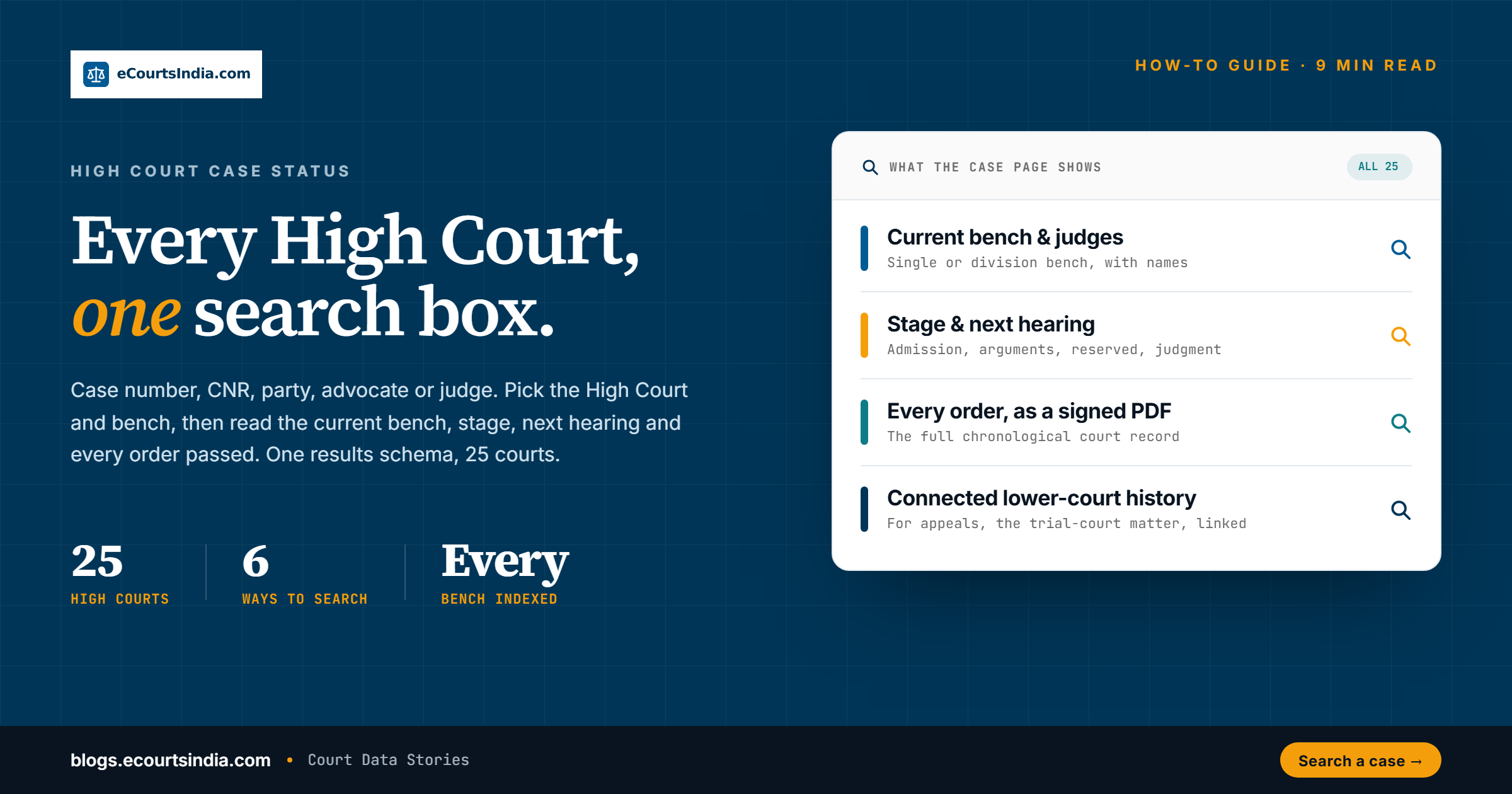
To check a High Court case status in India, use the official High Court Services portal (hcservices.ecourts.gov.in) or search all 25 High Courts at once on eCourtsIndia, a private platform. Search by CNR (Case Number Record), case number and year, party name or advocate name. Then choose the High Court and bench and open the case page.
eCourtsIndia is a private platform, not the Government’s eCourts portal (ecourts.gov.in).
You can check the status of a case in any of India’s 25 High Courts, from Allahabad and Bombay to Madras, Kerala and Gauhati, on eCourtsIndia.com/search. Type a party name, advocate name, case number or CNR, narrow the results to the High Court and bench you want, and open the case page to see the judges, status, hearing dates and orders on record. eCourtsIndia holds 5 crore+ High Court case records (as of September 2026) under one search box, so you do not need to learn 25 different court websites.
Last updated: 28 September 2026

Key takeaways
- All 25 High Courts and their benches, including Aurangabad and Nagpur (Bombay), Madurai, Lucknow, Dharwad and Kalaburagi, sit in one search. Searching is free.
- Search by party, advocate, case number (number/year) or the 16-character alphanumeric CNR.
- Each bench has its own court code (for example HCBM04 for Nagpur), and each case’s CNR belongs to that one court. An appeal to the Supreme Court gets a new CNR.
- For High Court item numbers, check the court’s own cause list. Use eCourtsIndia for the record, orders and alerts.
- Track a case for ₹5 a month and get WhatsApp and email alerts at ₹0.50 each per channel, paid from credits (50 free a month, as of September 2026).
How do I check a High Court case status in India?
There are two free routes: the Government’s own High Court Services portal and app, which cover one High Court at a time, and eCourtsIndia, which searches all 25 High Courts together.
On the official High Court Services portal
Go to the High Court Services portal (hcservices.ecourts.gov.in), run under the Government’s eCourts project. Select the High Court and bench, open Case Status, and search by CNR, case number, filing number, party name, advocate name, FIR number, Act or case type. Enter the captcha to see the result.
On the eCourts Services app
The Government’s eCourts Services app, for Android and iOS, is linked from ecourts.gov.in and also shows High Court case status.
On eCourtsIndia: all 25 High Courts in one search
- Go to ecourtsindia.com/search.
- Type what you know into the single search box: a party name, an advocate’s name, a case number as number/year (it is matched against both the registration and the filing number), or a CNR.
- Use the filters to narrow the results to the High Court and bench you want, plus case type, year or status if the name is common. Or start from a bench link in the table below, which opens search already filtered to that court.
- Open the matching case to see the full record: judges, status, hearing dates and orders.

Full-text search reaches inside order text too, so a phrase from an order can find the case. The eCourtsIndia Search Guide explains every filter and query operator, and our guide on how to search by a party’s name covers common names and spelling variants.
Which High Courts and benches are covered?
All 25 High Courts are covered: Allahabad, Andhra Pradesh, Bombay, Calcutta, Chhattisgarh, Delhi, Gauhati, Gujarat, Himachal Pradesh, Jammu & Kashmir and Ladakh, Jharkhand, Karnataka, Kerala, Madhya Pradesh, Madras, Manipur, Meghalaya, Orissa, Patna, Punjab & Haryana, Rajasthan, Sikkim, Telangana, Tripura and Uttarakhand. Where a High Court sits in more than one place, each bench carries its own court code. The table below lists the benches with separate codes in the live court-code list and links each one straight into search.
| High Court | Seats and benches (court code, click to search) |
|---|---|
| Allahabad | Prayagraj (UPHC01), Lucknow Bench (UPHC02) |
| Bombay | Mumbai, appellate and original sides (HCBM01, HCBM02), Aurangabad, now Chhatrapati Sambhajinagar (HCBM03), Nagpur (HCBM04). Kolhapur circuit bench (from 18 August 2025) and the Goa bench at Porvorim: no separate code in search yet, see the note below the table |
| Calcutta | Kolkata (WBCHCA, WBCHCO), Jalpaiguri (WBCHCJ), Port Blair (WBCHCP) |
| Gauhati | Guwahati (GAHC01), Kohima (GAHC02), Aizawl (GAHC03), Itanagar (GAHC04) |
| Jammu & Kashmir and Ladakh | Srinagar (JKHC01), Jammu (JKHC02) |
| Karnataka | Bengaluru (KAHC01), Dharwad (KAHC02), Kalaburagi (KAHC03) |
| Madhya Pradesh | Jabalpur (MPHC01), Indore (MPHC02), Gwalior (MPHC03) |
| Madras | Chennai (HCMA01), Madurai (HCMD01) |
| Rajasthan | Jodhpur, principal seat (RJHC01), Jaipur (RJHC02) |
| Single-seat High Courts | Andhra Pradesh (APHC01), Chhattisgarh (CGHC01), Delhi (DLHC01), Gujarat (GJHC24), Himachal Pradesh (HPHC01), Jharkhand (JHHC01), Kerala (KLHC01), Manipur (MNHC01), Meghalaya (MLHC01), Orissa (ODHC01), Patna (BRHC01), Punjab & Haryana (PHHC01), Sikkim (SKHC01), Telangana (HBHC01), Tripura (TRHC01), Uttarakhand (UKHC01) |
The Kolhapur circuit bench of the Hon’ble Bombay High Court began sitting on 18 August 2025. The Goa bench moved to a new building at Porvorim in March 2021. Matters from these two benches did not appear under a separate court code in eCourtsIndia search when we checked on 28 September 2026. For a Kolhapur or Goa matter, search by party name or case number and filter to the Bombay High Court as a whole, or use the official High Court Services portal. If a case is genuinely missing, you can report it through Add a Missing Case.
As of September 2026, the Allahabad High Court at Prayagraj is the largest single court in the eCourtsIndia index, followed by the Madras principal seat and Punjab & Haryana. Each holds tens of lakhs of pending and disposed case records. For district courts and tribunals as well, see our directory of Indian courts.
What does a High Court case status page show?
- Case type and numbers: writ petition, criminal appeal, civil revision, second appeal, letters patent appeal and so on, with the filing and registration numbers and dates.
- Acts and sections invoked, where the court records them (IPC or BNS sections, constitutional articles, statutes).
- Parties and advocates on both sides.
- Judges hearing the matter, which tells you whether it is before a single judge or a division bench (see single bench, division bench and full bench).
- Status and dates: current status, and the first, last and next hearing dates.
- Orders and judgments on record, in date order.
- Lower-court details: where the High Court records the subordinate court’s case number and court, they appear as text on the page. Search that number to open the trial-court record, which has its own CNR.
- Filing details: as High Court records move to the newer structured format, some pages also show the e-filing number and date, filing type, litigant type and structured party lists.
Click View Orders on the case page to see every order on record; each order has its own page. There you can download the order PDF as published by the court (₹2) or get an AI summary of the order (₹2), paid from credits, or request the order text. The download is the court’s published PDF, not a certified copy. When you need to file an order in another proceeding, courts still expect a certified copy from their copying section. See how to download court orders and judgments for the details. The Case Status Dictionary decodes all 71 status values you may see.
How to read the page
A High Court status page packs in more than most first-time users realise. The header has the case number, filing date, registration date and case type. Then come the parties, the counsel, the status and the hearing history, and finally the orders. Reading it top to bottom takes a minute and gives you the complete picture.
Most people glance at the next date and close the tab. It is worth reading the whole page. The hearing history often holds procedural hints that change how you approach the next date. An entry directing that the matter be listed on a particular board, or at the top of the board, shows the bench wants it heard on that date. A note that affidavits are not yet filed tells you a party still has to file, so check which side it is. These small details are sitting there in plain English.

How do you handle case-type variations across High Courts?
Each High Court runs its own case-type labels. Delhi numbers a civil writ W.P.(C), Bombay uses WP, Madras uses W.P. A criminal appeal may be Crl.A. in one court and CRA in another. eCourtsIndia maps these to standard codes (WP_C for a civil writ, CRL_A for a criminal appeal, and 269 codes in all, as of September 2026), so a case-type filter works the same way in every court. The Case Type Encyclopedia explains the common ones.
If you are unsure what an old case was registered as, search by party or advocate and pick the match, or use the CNR. The CNR is a 16-character alphanumeric code: the first six characters identify the court (for example DLHC01 for the Delhi High Court), followed by a six-digit serial and the four-digit year. Within one High Court, the CNR, the filing number and the registration number all point to the same matter. Across courts they do not: when a High Court decision is appealed to the Supreme Court, the appeal gets a fresh CNR there. Our CNR Number Decoded guide walks through the format.
Can you research a High Court judge?
Yes. Search by judge name to pull up matters heard by a particular judge, or open the judge’s page in the judge directory, which lists the cases before sitting and retired judges. Advocates use it to read recent orders in the same case type before arguing before a bench; researchers use it to study output judge by judge. Our guide on researching judge profiles and court patterns shows the method.
What about High Court cause lists?
Each High Court publishes its own daily and supplementary cause lists with item numbers and court halls. On eCourtsIndia the cause-list directory has a High Court section inside each state (for example Delhi High Court) listing benches and judges, but dated, item-by-item High Court listings are not consistently available there yet. As of September 2026, dated lists on eCourtsIndia cover district and taluka courts. So for your item number, use the High Court’s own cause list, and use eCourtsIndia for the record, orders and alerts. Our guide to reading a cause list explains items, boards and rosters, and this note explains what happens when a judge is on leave.
What if I cannot find my High Court case?
A newly filed matter may show only a filing number until the registry clears any defects and registers it. Search by that filing number or by party name. Very old matters may not be digitised. Check the High Court’s own website or the official High Court Services portal, and if the case has a CNR that eCourtsIndia has not fetched yet, you can request a missing case.
How do you get alerts on a High Court case?
Add the case to a client in your eCourtsIndia dashboard and switch on WhatsApp and email alerts; you will be told when a new hearing date, order or status change is recorded. As of September 2026, tracking costs ₹5 per case per month and each alert costs ₹0.50 per channel, paid from your eCourtsIndia credits (see current pricing). Every account gets 50 free credits a month, paid plans start at ₹250 + 18% GST a month, and unused credits never expire. Our step-by-step guide shows how to enable case alerts. Advocates can track many High Court matters from one dashboard.
The same search and alerts are in the Android app and the iOS app, and the Chrome extension shows tomorrow’s listings for tracked cases with an update badge.
How do I get a certified copy of a High Court order?
A downloaded order is for reference. For filing in court, apply for a certified copy to the High Court’s copying section or through its online certified-copy service. The process and fees vary by High Court, so check the court’s website.
Is eCourtsIndia the official source?
No. eCourtsIndia is a private legal-technology platform. It is not affiliated with, associated with, or endorsed by the Government of India, the Supreme Court of India or its e-Committee, or any court. Official High Court case information is published on hcservices.ecourts.gov.in and each High Court’s website. eCourtsIndia’s data comes from each High Court’s public records and the national eCourts system, presented through one interface instead of 25 different websites. The underlying record remains the High Court registry’s. For a formal pleading, rely on a certified copy from the court.
Search any High Court case in India. All 25 High Courts and their benches, by party, advocate, case number or CNR. Free to search.
Three cases where a status check is urgent
One, you have filed a writ and want to know whether the defects are cured and the matter registered. A search on the filing number tells you. Two, a family member heard there was a hearing today and wants to know what happened. The case page shows the latest hearing and, once uploaded, the order. Three, you are a journalist following a public interest matter and need to confirm the next date before you publish.
Before records went online, each of these meant a visit to the registry. Now each can be checked online in a few minutes. That has not removed the need for good counsel, but it has ended the information monopoly that made counsel the only source of basic facts about a case. Clients are better informed, and lawyers can spend their time on argument rather than phone updates.

Practical habits that save time
- Save the case page link (ecourtsindia.com/cnr/ followed by the CNR) for every active matter.
- Turn on alerts so a new date or order finds you, instead of relying on a calendar reminder.
- Check the High Court’s own cause list the evening before a listed date.
- Read the latest order the day after every hearing. If the wording is hard to follow, here is how to understand your case status in plain English.
Together these take a few minutes a week and help you avoid common slips, like missing a date because a list moved or not knowing that a stay has been granted. If your matter goes up on appeal, our guide on Supreme Court case status picks up from there, and how to check your court case status online covers district courts.
High Court pendency at a glance
As of 28 September 2026, the National Judicial Data Grid (NJDG) showed 65,21,413 cases pending in India’s High Courts: 45,25,093 civil and 19,96,320 criminal (NJDG High Courts dashboard, read on 28 September 2026). NJDG is the Government’s public dashboard of pending and disposed cases, built under the eCourts project, and its counts change daily.
As of 1 May 2026, India’s High Courts had 797 working judges against a sanctioned strength of 1,122, leaving 325 posts vacant (Department of Justice vacancy statement).
Published by the eCourtsIndia Data Team. General information, not legal advice. Spotted an error? Write to support@ecourtsindia.com.
Frequently Asked Questions
How do I check a High Court case status in India?

Use the official High Court Services portal (hcservices.ecourts.gov.in) or the eCourts Services app. Choose the High Court and bench, then search by CNR, case number, party name or advocate name. You can also search all 25 High Courts together on eCourtsIndia search, a private platform, and filter the results by court and bench. The case page shows status, hearing dates and orders. Searching is free on both.
Which High Courts and benches are covered?
All 25 High Courts are covered. Benches such as Aurangabad and Nagpur (Bombay), Madurai (Madras), Lucknow (Allahabad), Dharwad and Kalaburagi (Karnataka), Indore and Gwalior (Madhya Pradesh), Jaipur (Rajasthan) and Kohima, Aizawl and Itanagar (Gauhati) have their own court codes. Use a code such as HCBM04 in search to open one bench directly. For the Kolhapur and Goa benches of the Bombay High Court, search the Bombay High Court as a whole.
Can I check High Court case status without a CNR?
Yes. Search by case type, number and year, by filing number if the case is not yet registered, or by party or advocate name. On eCourtsIndia search, type the name or number into the search box and filter to the High Court and bench. If the name is common, add the case type or year. Once you find the case, save its CNR for next time.
Does a CNR stay the same when a High Court case goes to the Supreme Court?
No. A CNR is issued by one court and identifies the case only in that court. When a High Court decision is challenged in the Supreme Court, the appeal or SLP gets a new CNR starting with SCIN01. Follow the dispute across courts by party names and case numbers. Our CNR Number Decoded guide explains the format.
Can I see a High Court’s daily cause list on eCourtsIndia?
The cause-list directory has a High Court section in each state with its benches and judges, but dated item-by-item High Court listings are not consistently available yet. As of September 2026, dated lists on eCourtsIndia cover district and taluka courts. For a High Court item number, check the court’s own cause list, and use eCourtsIndia for the case record and alerts. See our cause list guide.
How do I get alerts on a High Court case?

Add the case to a client in your eCourtsIndia dashboard and switch on WhatsApp and email alerts with a verified mobile number. You will hear when a new hearing date, order or status change is recorded. As of September 2026, tracking costs ₹5 per case per month and each alert costs ₹0.50 per channel, paid from credits, with 50 free credits every month. Follow the case alerts guide.
Is eCourtsIndia the official High Court website?
No. eCourtsIndia is a private legal-technology platform. It is not affiliated with, associated with, or endorsed by the Government of India, the Supreme Court of India or its e-Committee, or any court. It organises public court records, including those published on eCourts. Official High Court case information is on hcservices.ecourts.gov.in and each High Court’s website. For any filing, rely on a certified copy issued by the court.
Sources
- eCourts: High Court Services (case status search for each High Court and bench). Checked 28 September 2026.
- eCourts Services portal (links to High Court Services, NJDG and the eCourts Services app). Checked 28 September 2026.
- National Judicial Data Grid: High Courts dashboard (pending cases read on 28 September 2026). Checked 28 September 2026.
- Department of Justice: Sanctioned strength, working strength and vacancies of Judges in the Supreme Court and High Courts (as on 1 May 2026). Checked 28 September 2026.
- Wikipedia: Bombay High Court (Kolhapur circuit bench from 18 August 2025; Goa bench building at Porvorim inaugurated 27 March 2021; secondary source). Checked 28 September 2026.
- eCourtsIndia: Pricing (plans, tracking, alerts and per-order prices). Checked 28 September 2026.