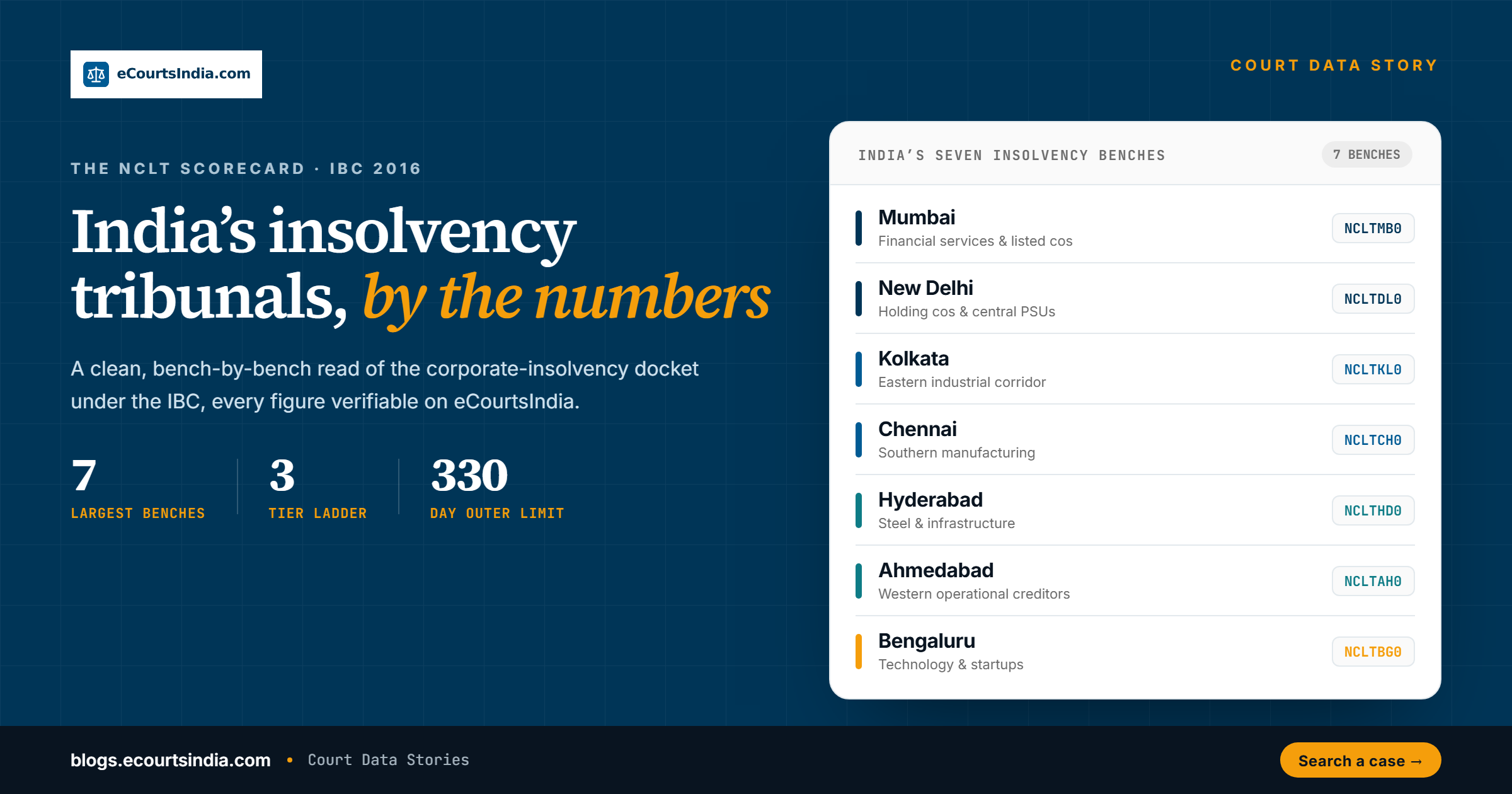
Last updated: 23 September 2026. Every bench, case-type and marquee figure re-pulled from the eCourtsIndia index on this date. The scorecard now covers all 15 NCLT bench locations, New Delhi has overtaken Mumbai as the busiest bench, and the Reliance Communications row adds up.
On 23 September 2026 the eCourtsIndia index held 2,54,042 National Company Law Tribunal records across all 15 bench locations, 78,419 of them pending. New Delhi is now the busiest bench with 64,779 records, ahead of Mumbai at 60,373. Under the Insolvency and Bankruptcy Code, 2016, the index holds 42,237 company petitions to start insolvency, 1,29,578 interlocutory applications filed inside ongoing insolvency processes, and 17,567 insolvency appeals at the NCLAT. This scorecard breaks the numbers down bench by bench, with every figure verifiable on eCourtsIndia.

Key takeaways
- 2,54,042 NCLT records across 15 bench locations, 30.9% pending.
- New Delhi (64,779) and Mumbai (60,373) together hold 49.3% of all NCLT records.
- Interlocutory applications (1,29,578) outnumber insolvency petitions (42,237) by about three to one. That is where the process slows down.
- Fresh IBC petitions peaked at 10,941 in 2019 and have held near 4,000 a year since the pandemic suspension.
- Search any bench free on eCourtsIndia, and read our NCLT and NCLAT case status guide to open a single matter.
What the IBC does, in one paragraph
The Insolvency and Bankruptcy Code, 2016 created a single, time-bound process for resolving distressed corporate debt. A financial creditor such as a bank or NBFC files under Section 7. An operational creditor such as a vendor or employee files under Section 9. The corporate debtor itself can file under Section 10. If the petition is admitted, an interim resolution professional takes over the company, the Section 14 moratorium freezes other proceedings, the committee of creditors meets, and a resolution plan is put to a vote. If no plan is approved within the Section 12 outer limit of 330 days, including litigation time, the company goes into liquidation. The NCLT is the trial forum for this process, the NCLAT hears appeals, and the Supreme Court sits above both.
The full bench scoreboard
The first version of this scorecard covered only the seven largest benches. This one covers all 15 NCLT bench locations indexed on eCourtsIndia. Totals include every NCLT record at the bench, company-law petitions as well as insolvency matters. Pending plus disposed equals the total for every row, because NCLT records carry only those two status labels in the index.
| Bench | Court code | Total records | Disposed | Pending | Pending share | Live search |
|---|---|---|---|---|---|---|
| New Delhi | NCLTDL0 | 64,779 | 41,364 | 23,415 | 36.1% | search |
| Mumbai | NCLTMB0 | 60,373 | 40,927 | 19,446 | 32.2% | search |
| Kolkata | NCLTKL0 | 24,102 | 17,347 | 6,755 | 28.0% | search |
| Chennai | NCLTCH0 | 21,197 | 15,022 | 6,175 | 29.1% | search |
| Hyderabad | NCLTHD0 | 16,576 | 12,376 | 4,200 | 25.3% | search |
| Ahmedabad | NCLTAH0 | 14,604 | 10,676 | 3,928 | 26.9% | search |
| Bengaluru | NCLTBG0 | 12,494 | 9,110 | 3,384 | 27.1% | search |
| Allahabad | NCLTAL0 | 6,863 | 4,514 | 2,349 | 34.2% | search |
| Jaipur | NCLTJP0 | 6,477 | 4,860 | 1,617 | 25.0% | search |
| Kochi | NCLTKC0 | 5,463 | 4,517 | 946 | 17.3% | search |
| Chandigarh | NCLTCG0 | 4,792 | 3,237 | 1,555 | 32.4% | search |
| Indore | NCLTIN0 | 4,514 | 2,990 | 1,524 | 33.8% | search |
| Amaravati | NCLTAR0 | 3,692 | 2,914 | 778 | 21.1% | search |
| Cuttack | NCLTCT0 | 3,546 | 2,693 | 853 | 24.1% | search |
| Guwahati | NCLTGW0 | 1,327 | 997 | 330 | 24.9% | search |
| Additional court codes | NCLTDL1 to DL6, CG1 to CG4 and others | 3,243 | 2,079 | 1,164 | 35.9% | n/a |
| All NCLT benches | 2,54,042 | 1,75,623 | 78,419 | 30.9% |
New Delhi and Mumbai sit far above the rest because the country’s corporate headquarters and financial-services firms cluster in the two cities. Together they hold 49.3% of all NCLT records. New Delhi also carries the heaviest backlog in absolute terms, with 23,415 pending, and a pending share of 36.1%, against 32.2% in Mumbai. Kolkata, Chennai, Hyderabad, Ahmedabad and Bengaluru form a second tier that serves their regional industrial corridors. Kochi clears its docket fastest among the mid-sized benches, with only 17.3% pending.
In April 2026 this post reported Mumbai at 49,941 and New Delhi at 49,771. Both grew as the index filled in, and New Delhi grew faster. The April seven-bench total was 1,82,517. The same seven benches now hold 2,14,125 records.

The case-type universe
| IBC case type | Code | Total | Disposed | Pending | Live search |
|---|---|---|---|---|---|
| Company Petition (IBC admission) | CP_IBC | 42,237 | 25,868 | 16,369 | search |
| Interlocutory Application (within CIRP) | IA_IBC | 1,29,578 | 98,106 | 31,472 | search |
| NCLAT insolvency appeal | CAPP_AT_INS | 17,567 | 11,400 | 6,167 | search |
The 1,29,578 interlocutory applications are the layer most observers miss. Every insolvency process generates dozens of them: applications by suspended directors, by guarantors, by operational creditors disputing how their claims were classified, by homebuyers and by bidders. That is where most of the day-to-day work of the IBC happens, and where delay builds up. A process that runs far past the Section 12 limit usually does so because of an application logjam, not because the plan vote stalled.
The company-law side of the tribunal is smaller but real. Across the NCLT benches the index also holds 16,559 company petitions under the Companies Act (CP_CA), 11,384 company applications (CA_CA) and 7,077 applications filed by liquidators. The Case Type Encyclopedia decodes each of these codes.
Filing trend: the 2019 peak and the post-pandemic plateau
| Year | Fresh CP_IBC petitions | Note |
|---|---|---|
| 2017 | 780 | First full year of the IBC |
| 2018 | 4,234 | Operational creditors turn to Section 9 |
| 2019 | 10,941 | Peak filing year |
| 2020 | 4,727 | Section 10A suspension from 5 June 2020 |
| 2021 | 4,302 | Suspension ends for defaults after 25 March 2021 |
| 2022 | 4,250 | Stabilised |
| 2023 | 3,770 | Slight decline |
| 2024 | 4,030 | Steady state |
| 2025 | 3,761 | Full year |
| 2026 (to 23 Sep) | 1,438 | Partial year |
2019 was the peak, at 10,941 petitions. The Section 10A suspension, brought in by the Insolvency and Bankruptcy Code (Amendment) Ordinance promulgated on 5 June 2020, barred fresh insolvency applications for defaults arising on or after 25 March 2020, the day the national lockdown began. It was extended so that the bar covered defaults up to 25 March 2021. Filings fell by more than half. Since then the system has settled at roughly 3,700 to 4,300 fresh petitions a year.
Marquee insolvencies, by court footprint
| Entity | Total court records | Disposed | Pending | Other statuses | Live search |
|---|---|---|---|---|---|
| Reliance Communications | 3,316 | 2,728 | 469 | 119 | search |
| DHFL | 2,445 | 1,829 | 601 | 15 | search |
| Bhushan Steel | 2,337 | 1,814 | 458 | 65 | search |
| Essar Steel | 1,212 | 857 | 293 | 62 | search |
These are headline IBC cases, and each carries a long tail of related matters across the NCLT, the NCLAT, the Supreme Court and the High Courts: writ challenges by guarantors, disputes with trade unions, and claims by minority shareholders. The Bhushan Steel resolution, through Tata Steel’s acquisition in 2018, set an early precedent on the binding force of a resolution plan. Essar Steel, resolved through ArcelorMittal’s acquisition after the Supreme Court’s November 2019 ruling on creditor priority, clarified how the committee of creditors’ commercial wisdom is treated. Reliance Communications has been in insolvency proceedings for years, and its footprint of 3,316 records is still 14.1% pending. DHFL, the first financial services company resolved under the special IBC route for such firms, carries 601 pending records.
Reliance Capital, which an earlier version of this post mentioned in passing, now has a completed resolution: the NCLT Mumbai bench approved IIHL’s plan in February 2024 and the acquisition closed in 2025. Its court footprint is covered in The Conglomerate Litigation Map.

Which financial creditors show up most
| Lender | NCLT records (all benches) | Disposed | Pending | Top benches |
|---|---|---|---|---|
| State Bank of India | 6,266 | 3,811 | 2,455 | New Delhi (1,077), Mumbai (1,040), Hyderabad (977) |
| HDFC Bank | 1,147 | 645 | 502 | New Delhi (321), Mumbai (204), Ahmedabad (191) |
State Bank of India appears in 6,266 NCLT records, the largest financial-creditor footprint in the tribunal. Its three busiest benches, New Delhi, Mumbai and Hyderabad, carry similar volumes, with Hyderabad reflecting the historical concentration of stressed infrastructure and power assets in the south. HDFC Bank appears in 1,147 NCLT records, a small number next to its twenty lakh court records overall, because its retail book is recovered through Section 138 complaints and SARFAESI rather than insolvency petitions. Our Bank Litigation Index covers the full picture for eight lenders, including their Debt Recovery Tribunal dockets.
Sample cases verified for this post
CNR NCLTMB0042532019 is a company petition under the IBC at the Mumbai bench, filed on 11 November 2019 by Hubtown Solaris Maintenance against Bharat Agri Fert and Realty, and still pending. CNR NCLTHD0014612020 is a company petition at the Hyderabad bench, Dell Global B.V. against Omics International, filed in February 2020 and disposed on 17 January 2022. CNR NCLAD38096292023 is an insolvency appeal at the NCLAT in New Delhi, filed in November 2023 and still pending. Any reader can open the orders in each through eCourtsIndia case search.
Tribunal records do not always come with a court-issued CNR. eCourtsIndia generates a 16-character tribunal CNR for 14 tribunals, including the NCLT and NCLAT, so each matter can be tracked and alerted on like any court case. Our explainer on how the tribunal CNR is minted covers the format. For live tracking, eCourtsIndia’s AI Clerk follows a case for Rs 5 a month and sends WhatsApp or email alerts when it is listed or an order is uploaded.
Where the money goes: the IBBI recovery numbers
Court-record counts are a process measure. Recovery in rupees is reported by the Insolvency and Bankruptcy Board of India. On IBBI data reported for the period to September 2025, creditors had realised about Rs 3.99 lakh crore under approved resolution plans against admitted claims of about Rs 12.31 lakh crore, roughly 32 percent. Resolution timelines on average still run well past the 330-day outer limit. The rupee values are not in the eCourtsIndia data, so for that layer the IBBI’s quarterly newsletter at ibbi.gov.in is the primary source.
What this scorecard does not say
It does not say which bench is best. Benches differ in case mix, industrial geography and the number of members sitting. New Delhi and Mumbai handle the largest and most contested filings, and a bench’s pending share reflects that mix as much as its pace. The scorecard does not capture petitions dismissed at the admission stage as a separate category, and it cannot see out-of-court restructurings that never reach the tribunal.
Related data stories
The IBC layer connects to the lender footprint in the Bank Litigation Index and to the corporate footprint in The Conglomerate Litigation Map. The cheque bounce docket in Cheque Bounce in India is the small-ticket counterpart of the IBC, with Section 138 doing for small debts what insolvency does for large ones. The NCLT and NCLAT case status guide walks through searching any bench, and the GC portfolio monitoring playbook turns these queries into a weekly board view.
Replication and methodology
Every figure comes from the eCourtsIndia MCP server or API on 23 September 2026. Bench totals: search_cases(courtCodes="NCLTDL0,NCLTMB0,...", facets="courtCode,caseStatus,caseType") across all 41 NCLT court codes, and the same call with caseStatuses="PENDING" for the pending column. Country-wide IBC types: search_cases(caseTypes="CP_IBC", facets="caseStatus,filingYear") and equivalents for IA_IBC and CAPP_AT_INS. Marquee insolvencies: search_cases(litigants="Reliance Communications", facets="caseStatus"). Lender footprint: search_cases(litigants="State Bank of India", nameMatchMode="phrase", courtCodes=<all NCLT codes>). Keep facets switched on, because a results-only call can report an approximate total for very large result sets.
Verification links
- NCLT New Delhi docket: https://ecourtsindia.com/search?cc=NCLTDL0
- NCLT Mumbai docket: https://ecourtsindia.com/search?cc=NCLTMB0
- NCLT Kolkata docket: https://ecourtsindia.com/search?cc=NCLTKL0
- NCLT Chennai docket: https://ecourtsindia.com/search?cc=NCLTCH0
- NCLT Hyderabad docket: https://ecourtsindia.com/search?cc=NCLTHD0
- NCLT Ahmedabad docket: https://ecourtsindia.com/search?cc=NCLTAH0
- NCLT Bengaluru docket: https://ecourtsindia.com/search?cc=NCLTBG0
- Country-wide CP_IBC: https://ecourtsindia.com/search?ct=CP_IBC
- Country-wide IA_IBC: https://ecourtsindia.com/search?ct=IA_IBC
- NCLAT insolvency appeals: https://ecourtsindia.com/search?ct=CAPP_AT_INS
- Reliance Communications: https://ecourtsindia.com/litigant?lit=reliance+communications
- DHFL: https://ecourtsindia.com/litigant?lit=dhfl
- Bhushan Steel: https://ecourtsindia.com/litigant?lit=bhushan+steel
- Essar Steel: https://ecourtsindia.com/litigant?lit=essar+steel
- SBI litigant search: https://ecourtsindia.com/litigant?lit=state+bank+of+india
The NCLT now carries more than 2.5 lakh indexed records, and nearly a third are still pending. The Insolvency and Bankruptcy Code is no longer a niche statute. It is core commercial-court infrastructure.
Frequently Asked Questions
How many cases have India’s NCLT benches handled?
On 23 September 2026 the eCourtsIndia index held 2,54,042 NCLT records across all 15 bench locations, 78,419 of them pending. Under the IBC there are 42,237 company petitions to start insolvency and 1,29,578 interlocutory applications inside ongoing processes. You can open any bench’s docket on eCourtsIndia case search using its court code.
Which NCLT bench handles the most cases?

New Delhi, with 64,779 records, ahead of Mumbai at 60,373. Together they hold about half of all NCLT records because corporate headquarters and financial firms cluster in the two cities. Kolkata (24,102), Chennai (21,197) and Hyderabad (16,576) follow. Our NCLT and NCLAT case status guide shows how to search each bench.
What is the difference between Section 7, 9 and 10 petitions under the IBC?
A financial creditor such as a bank files under Section 7, an operational creditor such as a vendor or employee files under Section 9, and the company itself files under Section 10. Once a petition is admitted, the Section 14 moratorium freezes other proceedings while the committee of creditors considers a resolution plan. Search live petitions by type on eCourtsIndia.
Which lender appears in the most NCLT cases?
State Bank of India, named in 6,266 NCLT records across all benches on 23 September 2026, 2,455 of them pending. Its busiest benches are New Delhi, Mumbai and Hyderabad. HDFC Bank appears in 1,147, because its retail book is recovered mainly through cheque bounce and SARFAESI cases. See the Bank Litigation Index for the full lender picture.
Why did IBC filings drop in 2020?
The Section 10A suspension, introduced by an ordinance on 5 June 2020, barred fresh insolvency applications for defaults from 25 March 2020 and was extended to cover defaults up to 25 March 2021. Fresh company petitions fell from 10,941 in 2019 to 4,727 in 2020 and have since held near 4,000 a year. Track current filings on eCourtsIndia.
How long does the IBC process take and how much is recovered?

The Code sets a 330-day outer limit, but many processes run longer, largely because of interlocutory applications. On IBBI data to September 2025, creditors realised about Rs 3.99 lakh crore against admitted claims of about Rs 12.31 lakh crore, roughly 32 percent. Every court-record count in this scorecard can be reproduced on eCourtsIndia case search.