As of 23 September 2026, eCourtsIndia’s index held 2,98,741 Indian court records that mention partition, and 83,496 of them (27.9 percent) were marked pending. It also held 59,058 probate petitions, 4,524 of them pending. Partition suits often run for years because every heir must be a party and the decree passes through several stages.
Last updated: 28 September 2026. Counts as on 23 September 2026. This update describes the example cases without party names, corrects how we read the filing date of the oldest appeal, adds the limits of the Vineeta Sharma rule, probate and partition decrees, and adds a methodology section. The 23 September update re-ran the headline counts, corrected the pending share (about one in four, not one in three), explained why the four search buckets overlap, replaced an example case that turned out to be a motor accident appeal, and removed claims the data could not support.

Every Indian family argument that ends in court ends in the same place. A file. A registration number. A first hearing. A second appeal. And then a long, often generational wait. The argument may be about half an acre of paddy in Andhra, a flat in Mumbai bought with a father’s pension, a Punjabi grandmother’s will, or a mutation entry that never got changed in 1967. The case file does not care. It just sits.
This post is a count of those files. As on 23 September 2026, the eCourtsIndia index holds 2,98,741 court records that mention partition, of which 83,496 are marked pending in the index. It also holds 59,058 Probate Petitions and a very large number of records that mention succession. The first version of this index, run on 27 April 2026, is kept below as a dated snapshot so the method stays reproducible. The numbers come from the same index that powered our 498A study and the Disposal-Time Index 2026, and every claim has a CNR (the 16-character Case Number Record that identifies a case across Indian courts) or a query behind it.
Key takeaways
- Partition is the most stable of our four measures: 2,98,741 records mentioned it on 23 September 2026, and 27.9 percent were marked pending.
- In the April snapshot, partition, succession and probate records together were about 24 percent pending, roughly one in four. Probate Petitions, mostly from Maharashtra, clear fast (under 8 percent pending); succession and partition do not.
- The four search buckets overlap, and the TS case-type code mostly means Title Suit in West Bengal, Bihar and Assam, so adding them into one total overstates the caseload.
- The longest family partition appeal we found was a second appeal in the Hon’ble Calcutta High Court, registered in 1978 and dismissed for default in December 2025.
- The DAKSH Access to Justice Survey (2016) found that 66.2 percent of civil cases in its sample, about two-thirds, were land or property disputes.
Nearly 3 lakh records in the eCourtsIndia index mention partition, and more than 83,000 of them are marked pending. Probate petitions move quickly; partition and succession do not. Across the three, about one family property record in four was pending in our April count. The oldest partition appeal we traced was pending for more than 46 years before it was dismissed because nobody appeared to press it.
What we counted, and how
The eCourtsIndia index holds 32 crore+ case records from the Supreme Court of India, all 25 High Courts, district and taluka courts in all 36 states and Union Territories that publish on the eCourts network, and 18 tribunal and commission types, along with 125 crore+ orders and judgments (September 2026). eCourtsIndia is a private platform, not the Government’s eCourts portal (ecourts.gov.in). For this index we ran a small set of queries against the same public search anyone can use. The partition figure, for instance, is what you get if you go to ecourtsindia.com, search for “partition” and read the total. Our post on how we collect and count court data explains the index itself.
We sliced the records along four dispute types that cover most of what people mean when they say “family property is in court”:
- Partition suits. Civil proceedings to divide ancestral or jointly held property among co-heirs under the succession law that applies to the family, such as the Hindu Succession Act, 1956, Muslim personal law, or the Indian Succession Act, 1925 for Christians and Parsis. They appear under case types such as OS, CS, RFA, FA, RSA and SA depending on the stage.
- Succession matters. Inheritance disputes, succession certificates under section 372 of the Indian Succession Act, 1925, and heir disputes under the Hindu Succession Act, 1956.
- Probate and testamentary matters. Probate Petitions (case type PP): will validity challenges, executor petitions and contested probate.
- Mutation and revenue-record disputes. Cases where a court is asked to stop or direct a change in revenue records after a death, transfer or partition.
Three cautions apply. First, partition and succession are full-text searches, so they count every record whose case details or order text contain the word. A probate matter can mention succession and partition, and so the buckets overlap. Second, the index keeps adding order text, so full-text counts grow faster than the underlying caseload. Third, the case-type code TS is not a clean count of testamentary suits: on 23 September 2026, of 14,14,365 TS records, 6,70,398 were in West Bengal, 5,27,206 in Bihar and 1,24,605 in Assam, where TS means Title Suit. Only about 25,704 were in Maharashtra, where testamentary suits sit in the Bombay High Court. Our guide to case-type codes such as TS, PP, OS and RSA explains why the same code can mean different things. The April version of this post added a TS figure into its headline total. We no longer do.
Key terms
- Partition suit: a civil suit asking a court to divide jointly held property among co-owners or co-heirs and give each a separate share.
- Preliminary and final decree: the preliminary decree declares each party’s share. The final decree records the actual division.
- Coparcener: a member of a Hindu Mitakshara joint family who has a right by birth in coparcenary property. Since the 2005 amendment, daughters are coparceners too.
- Probate: a court’s certificate that a will is valid, which lets the executor act on it.
- Mutation: an update to land revenue records after a death, sale or partition, made by the revenue authority.
- Dismissed for default: a case closed because the party who brought it did not appear. It is not a decision on the merits.
How many family property cases are pending in India?
On 23 September 2026, 2,98,741 court records in eCourtsIndia’s index mentioned partition, and 83,496 (27.9 percent) were marked pending. The table sets that against the April snapshot and the other two buckets.

| Bucket | 27 April 2026 | Pending then | 23 September 2026 | Pending now |
|---|---|---|---|---|
| Partition (full-text) | 2,56,210 | 58,489 (22.8%) | 2,98,741 | 83,496 (27.9%) |
| Succession (full-text) | 1,36,156 | 46,291 (34.0%) | 8,01,300 | 1,80,450 (22.5%) |
| Probate Petitions (case type PP) | 57,114 | 3,919 (6.9%) | 59,058 | 4,524 (7.7%) |
A note on “pending”: the status shown is the one in eCourtsIndia’s index on the date given. Status updates can lag the court’s own record, so read pending counts as an upper bound. See what “pending” and “disposed” mean.
Partition is the largest bucket and the most stable of our four measures: 2,98,741 records mentioned it on 23 September 2026, and 27.9 percent were marked pending. It is still a full-text count, so part of its growth since April comes from new order text. The reason for its size is structural. Much Indian land is still held jointly, in name or in practice, by people related to each other. The moment one of them sells, dies, remarries or moves out of the village, somebody else feels their share slipping. Then they file.
Why the succession count jumped between April and September
The succession figure needs care. Between April and September the full-text count jumped from about 1.4 lakh to about 8 lakh. The caseload did not grow five-fold in five months. What changed is that far more order text is now indexed, and “succession” appears in many orders that are not inheritance disputes at all. Read the succession row as an upper bound on the conversation around inheritance, not as a count of succession suits. In April, before that expansion, succession records were 34 percent pending against 22.8 percent for partition, which fits what practitioners see: succession files need genealogy, death certificates and often a parallel revenue proceeding before the civil court can move.
Why Probate Petitions look fast
Probate behaves differently. Of 59,058 Probate Petitions, only 4,524 are marked pending. In April, 44,905 of the 57,114 Probate Petitions then indexed were registered in Maharashtra. Other states file probate under different case-type codes, so this row mostly describes Maharashtra.
The law explains part of it. Under section 213 of the Indian Succession Act, 1925, probate is compulsory for wills made by Hindus, Buddhists, Sikhs and Jains of the classes in section 57. These include wills made within the ordinary original civil jurisdiction of the Bombay and Madras High Courts, or dealing with immovable property there. For Parsis, the rule covers wills made within the original civil jurisdiction of the High Courts at Bombay, Calcutta and Madras. It does not apply to wills made by Muslims or Indian Christians. Mumbai therefore sends many more wills to court than most of India does.
So how much of the family property caseload is pending? Using the April snapshot, partition, succession and probate together came to 4,49,480 records, of which 1,08,699 were pending: 24.2 percent, about one in four. An earlier version of this post said one in three; that was wrong. With the September partition and probate counts the share is similar, at about 25 percent for those two buckets together.
Which states have the most partition records?

We cannot rank states reliably. In the April snapshot we sorted partition records by the state tag, but only a subset of records carries one, especially among older High Court records. This is the shape of the tagged subset rather than a full count. Maharashtra led with 5,627 tagged records, followed by Karnataka (2,891), Delhi (2,213) and Tamil Nadu (2,108).
| State | Tagged partition records (27 Apr 2026) | Main courts |
|---|---|---|
| Maharashtra | 5,627 | Bombay HC and district civil courts |
| Karnataka | 2,891 | High Court of Karnataka, Dharwad and Kalaburagi benches |
| Delhi | 2,213 | Delhi HC and district civil courts |
| Tamil Nadu | 2,108 | Madras HC and Madurai bench |
| Punjab | 1,875 | Punjab and Haryana HC |
| Telangana | 1,674 | Telangana HC |
| Bihar | 1,359 | Patna HC and district civil courts |
| West Bengal | 1,294 | Calcutta HC, Appellate Side |
| Uttar Pradesh | 1,148 | Allahabad HC and Lucknow bench |
| Rajasthan | 963 | Jodhpur principal seat and Jaipur bench |
| Odisha | 838 | Orissa HC at Cuttack |
| Gujarat | 731 | Gujarat HC at Ahmedabad |
These 12 states account for 22,721 tagged records, about 9 percent of the 2,56,210 partition records in the April snapshot. The other 91 percent carry no state tag, so this is not a state ranking.
Maharashtra’s lead may reflect how its records are tagged as much as how often families litigate. We have not tested why. Beyond that, the partition story is geographically spread: family land disputes turn up wherever there is family land. The “missing” large states in this table, including much of the north, are a tagging artefact, not an absence of disputes.
How does a partition suit move through the courts?
A partition suit passes through several stages, and each one can take years. The path is familiar to every district lawyer:
- A suit for partition is filed before a civil judge. Pleadings, evidence and added parties follow, often for years.
- The court declares each party’s share in a preliminary decree under Order XX Rule 18 of the Code of Civil Procedure.
- The property is then divided, by a court commissioner or, for revenue-paying agricultural land, by the Collector, and a final decree follows.
- Either side can file a first appeal and then a second appeal in the High Court, which is admitted only on a substantial question of law.
- A special leave petition in the Supreme Court can follow if either side chooses to go further. If the case is sent back on remand, the clock restarts.
- Once a final decree is drawn, execution under Order XXI is a separate proceeding that can take years of its own.
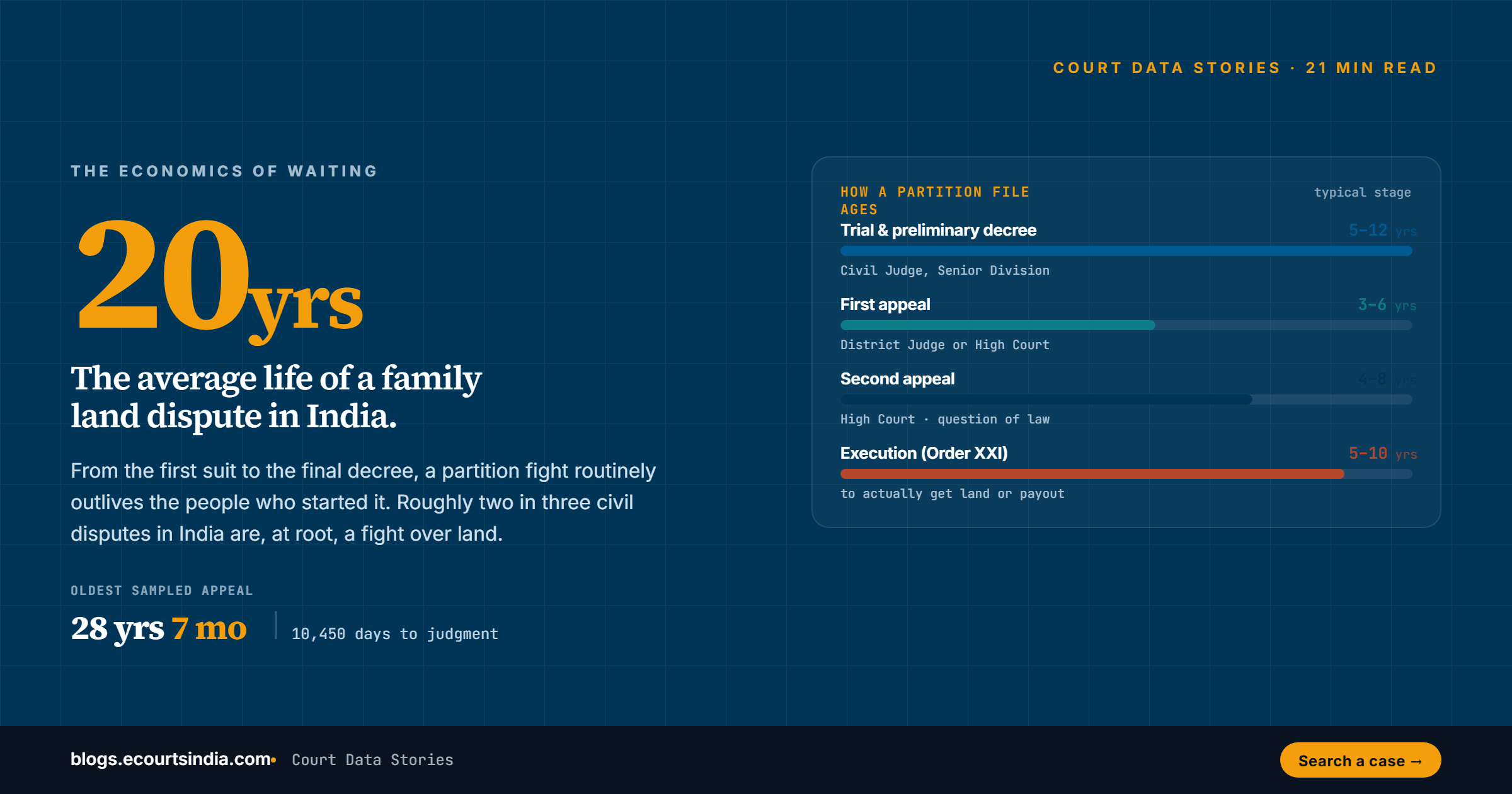
We are not going to put a single average on that process, because no reliable one exists. What the records do show is that decades-long appeals are a class, not folklore. Searching High Court records decided in 2025 for the phrase “suit for partition” and sorting by age, the top of the list was dominated by Calcutta High Court first and second appeals recorded as filed in the 1970s. For some of these older records the filing-date field may not match the year in the case number, as in the first example below. The Disposal-Time Index found the same long tail for civil suits in general: for suits decided in 2025, the median in Odisha was 1,587 days, and family partition appeals sit well beyond that.
How long do partition cases take? Five example cases
We picked five disposed cases from the index. We describe them without party names, because these are private family matters. Each record is linked by its CNR (see what a CNR number is), and anyone can read the orders.
- The partition appeal nobody pressed. WBCHCA0004951978 (a partition second appeal, Hon’ble Calcutta High Court). A Second Appeal, SA 853 of 1978, categorised as a partition matter. Its filing and registration numbers carry the year 1978, although the record also shows a date of 3 October 1972. It was listed on 25 November 2025 and dismissed for default on 4 December 2025, when no one appeared to press it. The record shows two further orders in January 2026. Measured from the 1972 date in the record, that is 19,420 days. Measured from 1978, it is still more than 46 years. It ended not with a judgment on the merits but with a dismissal for default.
- The 28-year possession appeal (not a family case). APHC010231782001 (a second appeal, Hon’ble Andhra Pradesh High Court). A property possession second appeal, filed 28 September 1996. The record classifies it as a possession dispute over immovable property and does not show a family dispute. We include it to show how long High Court second appeals can wait. The first hearing in the High Court took place on 1 March 2016, almost twenty years after filing. After 18 orders and 23 hearings, judgment was delivered on 9 May 2025. Total duration: 10,450 days.
- The 2-day senior citizen eviction. DLHC010092442019 (a writ petition, Hon’ble Delhi High Court). A writ petition filed 30 January 2019 and decided 1 February 2019. Justice Vibhu Bakhru upheld the eviction of an adult son and his wife from their mother’s property. The son claimed the property was ancestral and pointed to an oral family settlement. The court found that bare oral pleadings could not establish ancestral status, and that the Delhi senior-citizen rules, as amended, allowed a parent to seek eviction from their property. Later judgments on a daughter-in-law’s right of residence may affect similar cases today. Two days at the High Court, on a question family lawyers had argued for years.
- The 778-day probate appeal. DLHC010044512012 (a probate first appeal, Hon’ble Delhi High Court). A first appeal under the Indian Succession Act, 1925, filed 24 January 2012 and decided 12 March 2014, with a review petition disposed in 2015. Justice Valmiki J. Mehta sent the will back to the trial court for fresh evidence on attestation. It shows why probate, even when it looks uncontested on paper, can take years once a disinherited heir objects with substance.
- The 11-year Karnataka partition. KAHC030077552012 (a family property appeal, Hon’ble High Court of Karnataka, Kalaburagi bench). Filed 3 December 2012 and decided 1 February 2024. Twenty-eight hearings, four interlocutory applications, a daughter’s stridhan claim, an adverse possession defence by co-heirs and an oral gift dispute under section 123 of the Transfer of Property Act. The kind of case that never makes headlines and fills every district civil court.
An earlier version of this list included a Telangana High Court appeal (HBHC010146432001) described as a family ancestral property dispute. On re-checking the record, it is a civil miscellaneous appeal under the Motor Vehicles Act against a lorry owner, a motor accident claim, and it has been replaced.
What did the Vineeta Sharma judgment change for daughters?
On 11 August 2020, a three-judge bench of the Hon’ble Supreme Court in Vineeta Sharma v. Rakesh Sharma, (2020) 9 SCC 1, held that daughters acquire coparcenary rights in Hindu Mitakshara joint family property by birth under section 6 of the Hindu Succession Act, 1956, as amended in 2005, and that the right does not depend on whether the father was alive on 9 September 2005. The judgment overruled the 2015 view in Prakash v. Phulavati and brought many long-pending partition matters back into play.
There are limits. Partitions made by registered deed or court decree before 20 December 2004 remain valid, and so do sales, gifts and wills that took effect before that date. The rule covers Mitakshara coparcenary property, not a parent’s self-acquired property.
The index shows the ripple. In the April snapshot (27 April 2026), records mentioning “Vineeta Sharma” by name totalled 6,190, with 4,400 disposed, 918 pending and 424 explicitly allowed. The other 872 records carry no disposed or pending status in the index. Records mentioning “coparcener” stood at 3,772 on the same date. Both figures are floors: many post-2020 partition orders apply the judgment without naming it.
What the index cannot tell you is who is filing. Case records do not carry a gender field for parties, so we cannot say from this data whether more daughters are now suing for their share. That question needs reading the orders themselves. What the law does tell you is that where a family’s Mitakshara coparcenary property was never partitioned, a daughter may have a claim to a share, subject to the limits above.
Why is a mutation order rarely the end of a family dispute?
In the April snapshot, a full-text search for “mutation” and “family” returned 14,091 records. These are court records, not routine mutations at the tehsildar’s office, and most appear to be contested ones, where one heir sought a mutation and another went to court to stop it. The leading tagged states were Maharashtra (2,345), Karnataka (2,211), Punjab (1,817), Telangana (1,053) and Himachal Pradesh (735). About 93 percent (13,037 of 14,091) were disposed, but a disposed mutation case often only means the writ or appeal is over; the entry goes back to the revenue authority, and the heir who lost is back where they started. Our guide to revenue courts and Boards of Revenue covers that side of the system. In Maharashtra, entries in the record of rights carry a presumption of correctness under section 157 of the Maharashtra Land Revenue Code, 1966, which is why a decades-old entry can anchor a present-day dispute.
For a litigator, the lesson is that a mutation petition is rarely the end of the matter. If the underlying property dispute is unresolved, the mutation order will be challenged, remanded and challenged again. Anyone advising a client to “just get the mutation done” should also be costing in the partition or succession suit that will follow.
Why family property cases are slower than other civil cases
The Disposal-Time Index shows how wide the spread is for civil suits in general: for CS suits decided in 2025, the median was 30 days in Tamil Nadu and 1,587 days in Odisha. Tamil Nadu’s short median reflects what is coded CS there, not contested title suits. Family property cases are the long tail of that distribution, and three structural features push them there.
First, the number of necessary parties is enormous. In a partition suit, every legal heir, including those born after filing, every purchaser, every mortgagee and every tenant in possession has to be on record. A grandfather dies leaving four sons. One son dies during the suit, leaving three children. One of those children dies, leaving two. By the time the court catches up, four parties have become fifteen, each needing fresh service, each entitled to be heard and each able to challenge an adverse order.
Second, the evidence is layered. Title often passed orally or was only partly recorded. Revenue records say one thing, the family pedigree another, the witness who could testify is dead, and the document that would settle it, say a 1956 partition memorandum, is with a party who has no reason to produce it.
Third, settlement is harder than it looks. In commercial litigation a settlement is a number. In family property it is a redistribution the parties must live with while sharing a boundary wall and family occasions. Courts can refer disputes to mediation under section 89 of the Code of Civil Procedure, and High Courts and many district courts run court-annexed mediation centres, but partition matters are among the hardest to settle.
Land disputes are not a niche. The DAKSH Access to Justice Survey, based on interviews with more than 9,000 litigants in 300 district courts across 24 states between November 2015 and February 2016, found that 66.2 percent of civil cases in its sample, about two-thirds, were land or property disputes, across every income group. The figure is often attributed to NITI Aayog, but the original source is DAKSH.
For scale: India’s district and subordinate courts had about 4.98 crore pending cases, including 81,275 cases more than 30 years old, the Government told the Rajya Sabha in July 2026 (Bar & Bench, 28 July 2026).
What can shorten a family property case?
Settlement is the fastest exit. Courts can refer a suit to mediation under section 89 of the Code of Civil Procedure. Parties can also settle at a Lok Adalat. Under section 21 of the Legal Services Authorities Act, 1987, a Lok Adalat award is deemed a decree of a civil court. It is final and binding, no appeal lies against it, and the court fee is refunded when a pending case referred by the court settles there.
National Lok Adalats are held several times a year. Ask your advocate whether your matter is suitable.
What this means for litigants and lawyers
Three takeaways for anyone with a partition or succession matter on their plate.
First, plan for the long haul. If the property is truly contested and the parties cannot agree, the case may run for many years. Make sure nominations, wills, succession certificates and registered deeds are in place, so that your heirs are not the next set of parties on the cause list. A nomination on a bank account or shares is not always the same as a right to inherit. Ask an advocate which of these steps apply to your family.
Second, value a settlement against your file’s actual stage, not the national average. A case that has just cleared second-appeal admission is structurally different from one still waiting for a preliminary decree. Look up the file, read the last few orders and price your expectations accordingly.
Third, after Vineeta Sharma, daughters and their advisers should re-examine any family partition that was never completed. If the family holds Mitakshara coparcenary property and it was not partitioned by registered deed or court decree before 20 December 2004, a daughter may have a claim to a share. Sales, gifts and wills that took effect before that date are protected, and a parent’s self-acquired property follows different rules. Speak to an advocate before acting. For related family law questions, our posts on domestic violence cases and divorce and on how Supreme Court judges approach matrimonial law cover the adjacent ground.
How to follow your own family property case
The national numbers are context. For your own matter, the useful facts are the next date and the last order, and you can check your court case status online free. Search the case by CNR, party name or advocate on eCourtsIndia (our guide shows how to search court cases by party name), add it to your dashboard, and let the AI Clerk watch it: a WhatsApp or email alert arrives when the date changes or an order is uploaded. Tracking costs ₹5 per case per month and each alert ₹0.50 per channel (as of September 2026, see pricing). This guide shows the setup step by step. If an old family suit does not appear in the index, use Add a Missing Case. To find a civil or property lawyer, start with bar-card verified advocates or our guide to finding a lawyer in India. The statutes cited here, from the Hindu Succession Act to the Code of Civil Procedure, are free to read section by section on IndiaCode by eCourtsIndia.
Replicating this analysis
Every number here can be re-run through the eCourtsIndia search, the API (23 endpoints, ₹200 of free credits on signup as of September 2026) or the MCP server. Counts change as records and order text are added, so your total may differ from ours. The queries were:
query="partition"with thecaseStatusfacet, for the partition total and pending count.query="succession"with thecaseStatusfacet, for the succession bucket.caseTypes="PP"for Probate Petitions, andcaseTypes="TS"with thestateCodefacet to see why TS is not a testamentary-suit count.query="Vineeta Sharma",query="coparcener"andquery="mutation family"for the April figures on those topics.query="\"suit for partition\"", High Court level, decision year 2025, sorted bycaseDurationDaysdescending, to find the oldest appeals.
Example cases were then checked one by one against the full case record. The developer quickstart walks through authentication and parameters, and our starter kit for empirical research with Indian court data covers study design.
Methodology and limitations
- Dataset: court records in eCourtsIndia’s index of eCourts records whose case details or indexed order text mention partition or succession, plus case type PP (Probate Petitions), and the April topic queries listed above.
- Sample: all records returned by each query. Counts are court records, not families or disputes.
- Data as of: counts dated 27 April 2026 or 23 September 2026 as marked. Official comparison figure: Rajya Sabha reply, July 2026.
- Definitions: “pending” is the status shown in eCourtsIndia’s index on the as-of date. Status updates can lag the court’s own record, so pending counts are an upper bound. A full-text count includes every record where the word appears, which may include some non-family matters.
- Snapshots, not frozen totals. The index keeps adding records and order text, so counts change.
- Overlapping buckets. Partition and succession are full-text counts and overlap with each other and with probate. We do not add them into a single total.
- Case-type codes vary by state. TS means Title Suit in some states and testamentary suit in others; similar issues affect other codes, including PP.
- State tagging is partial. The state table covers 22,721 tagged records, about 9 percent of the April partition count. Many older High Court records carry no state tag.
- Old filing dates. For some older High Court records, the filing-date field does not match the year in the case number. The oldest appeal in this post carries 1978 filing and registration numbers but a 1972 date, so we give both readings.
- Coverage. The index covers courts that publish on the eCourts network. Revenue courts and Boards of Revenue may sit outside these records.
- Outcome detail. The index records status (disposed, pending, allowed, dismissed) but not always the kind of decree. Reading the orders, as we did for the five cases, fills that gap.
- No party gender field. We cannot measure from this data how many plaintiffs are daughters or sisters.
- Reproduce it: see the queries under “Replicating this analysis”.
Being named in a court record does not mean a person or company did anything wrong. We describe the example cases without party names; the CNR links let readers check the record. Spotted an error? Write to support@ecourtsindia.com.
A final word
India’s family property caseload is not only a slow-court problem. It reflects how Indian families hold land, how the personal laws are written, and how a country of 1.4 billion people with a deep culture of joint ownership produces a long tail of disputes. The system can be faster and fairer, and the 2020 Vineeta Sharma judgment and court-annexed mediation are moving it in that direction.
For now, nearly 3 lakh records in the index mention partition, about a quarter of the family property records are marked pending, and some appeals have been pending for more than four decades. The case file does not care how long a family has waited. The CNRs above are real and the data is public.
Frequently Asked Questions
How many family property cases are pending in India?

There is no single agreed count, because courts do not file these disputes under one case type. In eCourtsIndia’s index on 23 September 2026, 2,98,741 court records mentioned partition and 83,496 of them were marked pending. The index also held 59,058 probate petitions, 4,524 of them pending. These are records that mention the word, so they overlap and may include some non-family matters. You can re-run any count on the case search.
How long does a partition suit take in India?
There is no reliable national average. A partition suit moves through a preliminary decree, a final decree, first and second appeals and then execution, and each stage can take years. For context, civil suits coded CS that were decided in Odisha in 2025 had a median of 1,587 days. The oldest partition appeal we traced, in the Hon’ble Calcutta High Court, was pending for more than 46 years before it was dismissed for default in December 2025. See the Disposal-Time Index for state medians.
What did the Vineeta Sharma judgment change for daughters?
In Vineeta Sharma v. Rakesh Sharma (11 August 2020), a three-judge bench of the Supreme Court of India held that a daughter is a coparcener in a Mitakshara Hindu joint family by birth, like a son, whether or not her father was alive on 9 September 2005. Partitions by registered deed or court decree, and sales, gifts and wills, made before 20 December 2004 are protected. The rule covers coparcenary property, not a parent’s self-acquired property. Read section 6 of the Hindu Succession Act.
Is probate compulsory in India?
Not everywhere. Under section 213 of the Indian Succession Act, 1925, read with section 57, probate is compulsory for certain wills by Hindus, Buddhists, Sikhs and Jains, including wills made in, or dealing with immovable property in, the original civil jurisdiction of the Bombay and Madras High Courts. For Parsis it covers the original civil jurisdiction of the High Courts at Bombay, Calcutta and Madras. It does not apply to wills made by Muslims or Indian Christians. Ask an advocate about your case.
Can I verify the numbers in this report myself?

Yes. Every count comes from a search on eCourtsIndia’s public case search, and each example case links to its CNR page, where the orders can be read. Counts change as new records and order text are added, so your total may differ from ours. Developers can re-run the queries through the eCourtsIndia API. Always check the details against the court’s own record or a certified copy before relying on them.
Is eCourtsIndia the official eCourts website?
No. eCourtsIndia is a private legal-technology platform. It is not affiliated with, associated with, or endorsed by the Government of India, the Supreme Court of India or its e-Committee, or any court. The official eCourts portal is ecourts.gov.in, and the National Judicial Data Grid is at njdg.ecourts.gov.in. eCourtsIndia indexes public court records so they are easier to search.
Sources
- India Code (Government of India): official text of central Acts. Checked 28 September 2026 (the site now redirects to indiacode.gov.in). The Gazette and the official India Code text remain authoritative over any republication.
- National Judicial Data Grid (pendency). Checked 28 September 2026.
- eCourts Services, the official eCourts portal. Checked 28 September 2026.
- Indian Kanoon: Vineeta Sharma v. Rakesh Sharma, Supreme Court of India, full text (11 August 2020). Checked 28 September 2026.
- IndiaCode by eCourtsIndia: Hindu Succession Act, 1956, section 6. Checked 28 September 2026. Supports the daughters’ coparcenary rule and the 20 December 2004 proviso.
- IndiaCode by eCourtsIndia: Indian Succession Act, 1925, section 213 and section 57. Checked 28 September 2026. Supports the probate rule.
- IndiaCode by eCourtsIndia: Code of Civil Procedure, Order XX Rule 18. Checked 28 September 2026. Supports the preliminary decree and Collector partition.
- IndiaCode by eCourtsIndia: Legal Services Authorities Act, 1987, section 21. Checked 28 September 2026. Supports the Lok Adalat award rules.
- DAKSH: Access to Justice Survey 2016 and DAKSH: Decoding Delays, Part I: Civil Cases (15 October 2016). Checked 28 September 2026. Supports the 66.2 percent land or property figure.
- Bar & Bench: 26 cases pending in Supreme Court for 30+ years, 558 cases for 20+ years: Centre in Rajya Sabha (28 July 2026). Checked 28 September 2026.
- eCourtsIndia search portal: counts read on 27 April and 23 September 2026.
- Example cases: WBCHCA0004951978, APHC010231782001, DLHC010092442019, DLHC010044512012, KAHC030077552012. Checked 28 September 2026.
- Companion analysis on 498A: 498A by the numbers
- Companion analysis on disposal times: The Indian Disposal-Time Index 2026