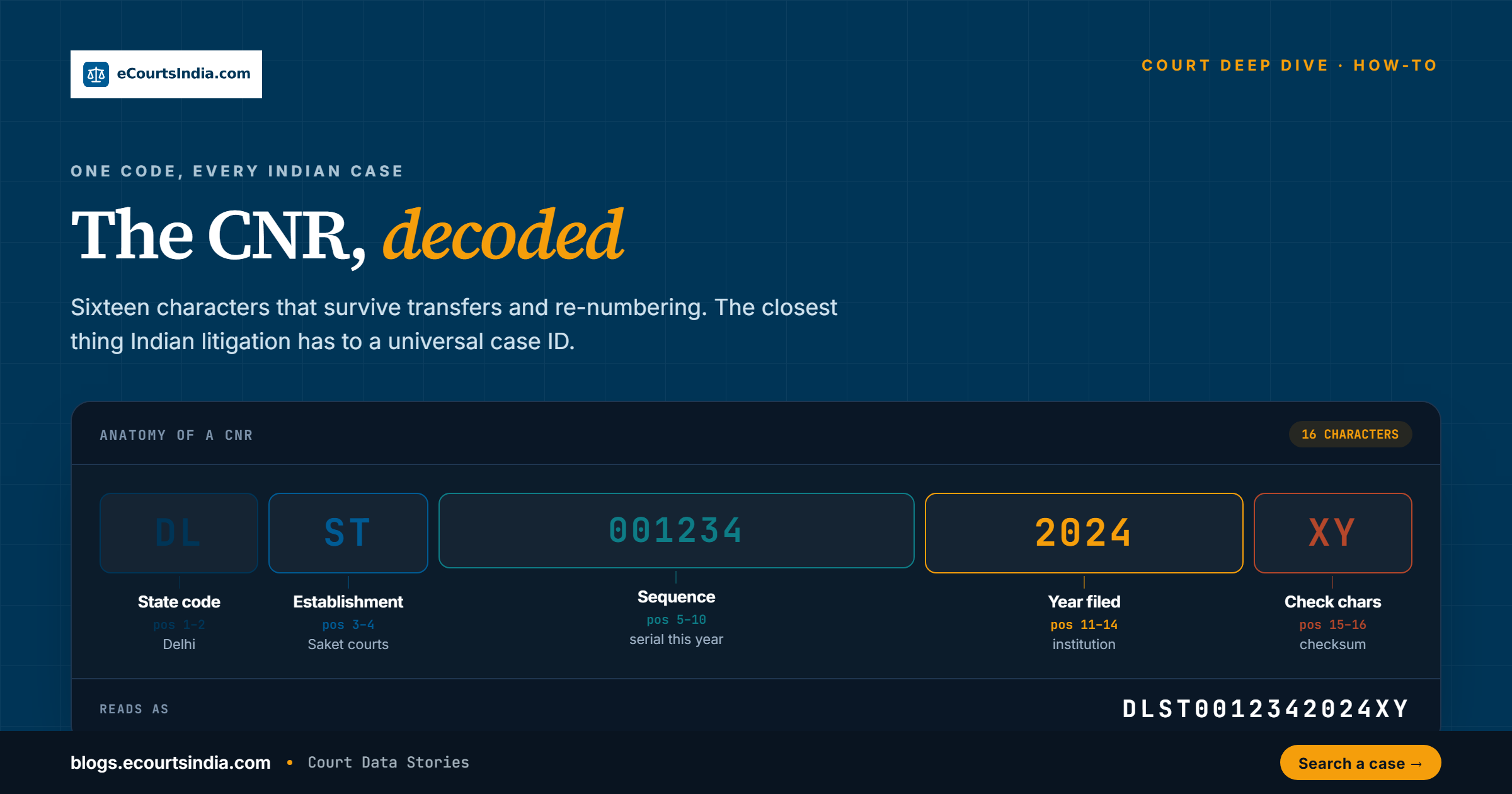
A CNR (Case Number Record) is the 16-character code that the eCourts Case Information System gives a district court or High Court case when it is filed, for example DLHC010351552024. It stays with that case in that court. You can use it to check status free on services.ecourts.gov.in, the eCourts Services app, by SMS, or on eCourtsIndia, a private platform.
Each character means something: a CNR like DLSE020085262026 tells you the state, the district, the exact court, a running serial and the year before you open anything. This guide explains what a CNR is, how to find yours, how to read all 16 characters, and how to use it on the official eCourts services and on eCourtsIndia to track a case. eCourtsIndia is a private platform, not the Government’s eCourts portal (ecourts.gov.in).
Last updated: 28 September 2026

Key takeaways
- CNR = Case Number Record, a 16-character alphanumeric ID for a district court or High Court case, issued by the eCourts Case Information System (CIS).
- The layout is state (2) + district (2) + establishment (2) + serial (6) + year (4). The first six characters are the court code, the same value you pass to
cc=on eCourtsIndia search. - The serial is not your case number. W.P.(C) 8371 of 2024 in the Delhi High Court carries the CNR DLHC010351552024.
- Supreme Court cases have CNRs too. The Supreme Court’s website searches by CNR, and in eCourtsIndia’s records these CNRs start SCIN01. Tribunals do not issue CNRs, so eCourtsIndia generates its own CNR-style ID for cases from 14 tribunals, explained in our tribunal CNR guide.
- Find it on the filing receipt, any order or notice, from your advocate, or by searching your name on eCourtsIndia litigant search. Check status free on services.ecourts.gov.in, the eCourts Services app or by SMS, or open
ecourtsindia.com/cnr/followed by the CNR and switch on alerts.
What is a CNR number?
A CNR (Case Number Record) is the unique 16-character identifier that the eCourts Case Information System assigns to a case when it is filed, so the same case can be found on any eCourts-linked portal without knowing its court, case type or year.
Before CIS, a case was known only by its court’s own case number, which is unique only inside that court. A civil suit at Tis Hazari looked nothing like a sessions case in Bengaluru, and the only way to find a matter was to know the court, the case type and the year. The CNR added one national ID on top.
The CNR comes from the Case Information System (CIS), the case-management software built by the National Informatics Centre (NIC) for district courts and High Courts under the eCourts project, which the e-Committee of the Supreme Court oversees. It sits alongside the case number and works on the official eCourts services for district courts and High Courts: services.ecourts.gov.in, hcservices.ecourts.gov.in, the eCourts Services app and SMS. The same CIS data feeds the National Judicial Data Grid (NJDG), which publishes pendency statistics but does not look up individual cases. eCourtsIndia also uses the CNR as the key for every case page.
If you know the CNR, you can open the case, read orders, check the next hearing date and see the advocates on record without knowing anything else about it. That is why lawyers store it, why court notices print it, and why most tracking tools, including our plain-English case tracker for litigants, start from it.
What do the 16 characters of a CNR mean?

Take a real record from the index, DLSE020085262026, a matter before the Chief Metropolitan Magistrate, South East district, at Saket Court in Delhi (see what a Chief Metropolitan Magistrate court does). Here is how it breaks down.
| Positions | Field | Meaning | In DLSE020085262026 |
|---|---|---|---|
| 1 to 2 | State code | Two-letter state or union territory code | DL, Delhi |
| 3 to 4 | District code | Two-character code for the district within the state | SE, South East district |
| 5 to 6 | Establishment code | Two characters for the specific court establishment in that district | 02, Chief Metropolitan Magistrate, Saket |
| 7 to 12 | Serial | Six-digit running serial within that establishment | 008526 |
| 13 to 16 | Year | Four-digit year in which the case was filed | 2026 |
Read left to right, the first six characters tell you exactly which court the case sits in. That six-character prefix is the court code eCourtsIndia uses in search, so ecourtsindia.com/search?cc=DLSE02 lists every case we hold for that court. Establishment codes are usually two digits, but not always: some courts use a letter, such as TSHM0A, a special magistrate’s court in Hyderabad, so do not assume positions 5 and 6 are numeric.
The serial is not the case number
This trips people up more than anything else. The six-digit serial counts cases at that establishment, and it has no fixed relationship to the number printed on the cause list. The Delhi High Court record DLHC010351552024 is W.P.(C) 8371 of 2024, yet its serial is 035155. So you cannot build a CNR from a case number, and you should never guess one. Search for the case and copy the CNR from the record.
Three numbers get mixed up. The filing number is given when papers are filed. The registration (case) number, such as CS 234/2024, is given when the court registers the case. The CNR is the national ID. In the Delhi record DLSE020085262026, the serial 008526 matches the filing number 8526/2026, while the registration number is 4432/2026 (eCourtsIndia record, checked September 2026).
How districts and courts are coded: a Delhi example
Positions 3 and 4 are the district, not a court building. Delhi shows the pattern clearly because its eleven districts share a handful of court complexes. The codes below come from the live court-code list on eCourtsIndia, and our Delhi district courts guide maps every complex.
| Court code | Court | Complex |
|---|---|---|
DLCT01 | District and Sessions Judge, Central | Tis Hazari |
DLCT02 | Chief Metropolitan Magistrate, Central | Tis Hazari |
DLCT03 | Senior Civil Judge cum Rent Controller, Central | Tis Hazari |
DLCT04 | Principal Judge, Family Court, Central | Tis Hazari |
DLST01 | District and Sessions Judge, South | Saket |
DLST02 | Chief Metropolitan Magistrate, South | Saket |
DLSE02 | Chief Metropolitan Magistrate, South East | Saket |
Big cities elsewhere follow the same logic with their own codes. Mumbai’s City Civil Court is MHCC01 and the City Sessions Court MHCC02. The rule is the same everywhere: two letters of state, two characters of district, two of establishment.
The example CNRs on this page were re-checked on eCourtsIndia’s case pages on 28 September 2026. They were chosen because they are not family, sexual-offence or juvenile matters.
State codes in positions 1 and 2
| Code | State / UT | Code | State / UT |
|---|---|---|---|
AN | Andaman & Nicobar Islands | AP | Andhra Pradesh |
AR | Arunachal Pradesh | AS | Assam |
BR | Bihar | CG | Chhattisgarh |
CH | Chandigarh | DD | Daman and Diu |
DL | Delhi | GA | Goa |
GJ | Gujarat | HP | Himachal Pradesh |
HR | Haryana | JH | Jharkhand |
JK | Jammu & Kashmir | KA | Karnataka |
KL | Kerala | LD | Lakshadweep |
LW | Lakshadweep | ML | Meghalaya |
MH | Maharashtra | MN | Manipur |
MP | Madhya Pradesh | MZ | Mizoram |
NL | Nagaland | OD | Odisha |
PB | Punjab | PY | Puducherry |
RJ | Rajasthan | SK | Sikkim |
TN | Tamil Nadu | TR | Tripura |
TS | Telangana | UK | Uttarakhand |
UP | Uttar Pradesh | WB | West Bengal |
High Court codes: DLHC01, HCBM01, HCMD01
High Court CNRs use a different prefix. Instead of a state and district, the first six characters are the High Court’s own bench code, such as DLHC01 for Delhi, HCBM01 for the Bombay High Court at Mumbai or HCMD01 for the Madras High Court’s Madurai Bench. The full list of High Court and bench codes is in our India courts directory, and our guide to High Court case status and bench codes covers all 25 High Courts.
Do Supreme Court and tribunal cases have a CNR?
Yes for the Supreme Court. The Hon’ble Supreme Court of India’s own website lets you search case status by CNR Number on sci.gov.in, alongside searches by diary number, case number, AOR code, party name and court. In eCourtsIndia’s records, Supreme Court CNRs start SCIN01, followed by the diary number padded to six digits and the year. For example, SCIN010394252025 is the Special Leave Petition (Civil) filed under diary number 39425 of 2025. Our Supreme Court case status guide shows how to look one up.
Tribunals are different. The NCLT, the ITAT, the NGT and the rest run their own registries and do not issue CNRs. So eCourtsIndia generates its own 16-character CNR-style ID for cases from 14 tribunals and commissions: NCLT, NCLAT, ITAT, CAT, CESTAT, DRT, DRAT, SAT, TDSAT, APTEL, consumer commissions on e-Jagriti, GSTAT, NGT and AFT. The same tribunal case always gets the same ID. The tribunal does not issue it, so quote the tribunal’s own case number in any filing.
A GSTAT Patna appeal gets the ID GTLPTAP000792026 (see GSTAT case status), and an NCLT Delhi filing gets NCLTDL0000012024 (see NCLT and NCLAT case status). You can build one yourself with the tribunal CNR generator, and the tribunal CNR specification publishes the full derivation for every tribunal, bench and case type.
How do I find my CNR number?
You almost certainly already have it somewhere. Check these in order:
- Filing receipt. The slip from the filing counter or the e-filing acknowledgment carries the CNR.
- Any order or notice. Court orders, summons and notices usually print the CNR in the header.
- Your advocate. Every advocate keeps the CNR for their matters, so ask.
- Search by name. If you have lost every document, search your name in the litigant search or use case search with the court and year, then read the CNR from the case page. The litigant search guide shows the URL shortcuts.
- The cause list. Some courts print the CNR on the cause list, but many print only the case number. Our guide on how to read a cause list explains what each column means.
How do I check case status with a CNR?
On the official eCourts services
The CNR works on the Government’s free eCourts services, run under the e-Committee of the Supreme Court:
- District courts: enter the CNR on the eCourts Services portal at services.ecourts.gov.in.
- High Courts: use hcservices.ecourts.gov.in and enter the 16-character CNR without hyphens or spaces.
- Mobile: the official app is called eCourts Services, for Android and iOS.
- SMS: send ECOURTS, a space and your CNR to 9766899899 (ecourts.gov.in, checked September 2026).
- Supreme Court: use the CNR Number search on sci.gov.in.
- No internet? Many court complexes have an eSewa Kendra (facilitation centre) where staff can look up the CNR for you.
eCourtsIndia, a private platform, uses the same CNR to open the case with its orders, history and alerts in one place, as below.
On eCourtsIndia
The fastest way to pull up a case is the direct path https://ecourtsindia.com/cnr/{your_16_character_code}. You get a case page with the parties, advocates, hearing history, next date, and the orders and judgments the court has published. High Court and district court records also carry richer fields where the court provides them, such as the e-filing number and date, litigant type, interim applications and transfer history. Search, cause lists and directories are free.
From the case page you can read the order text, get an AI summary of the order in plain language (₹2) or download the order PDF (₹2). The download is the court’s published PDF, not a certified copy. AI summaries can contain errors, so read the order itself before relying on it. eCourtsIndia’s free plan gives 50 credits a month, and paid plans start at ₹250 + 18% GST a month for 500 credits. Unused credits carry forward (pricing as of September 2026). See eCourtsIndia pricing for the details.
Track a case and get alerts
To keep watching a case, add it to tracking and switch on alerts. You get WhatsApp and email notifications when an order, hearing date or status changes. Tracking costs ₹5 per case per month and ₹0.50 per alert on each channel (as of September 2026). The case alerts guide walks through setup, and the case status dictionary explains every status you might be alerted about. For developers, tribunal CNR-style IDs work with the same case and refresh API calls as court CNRs (see the eCourtsIndia API guide).
You can also check a CNR on your phone with the eCourtsIndia apps for Android and iOS, and the eCourtsIndia Chrome extension (listed in the store as “eCourts India”) shows your upcoming hearings, cause-list listings and case-update alerts from the browser toolbar. These are eCourtsIndia’s own apps. The Government’s official app is called eCourts Services.
If you manage a portfolio of matters, the CNR is the best key to store. Party names get spelled differently across orders and case numbers change on conversion, but the CNR stays fixed for that case at that court, which makes it the best reference to store in a spreadsheet or case-management system.
Is a CNR the same as a case number?
No. A case number, such as WP(C) 1234/2024 or CS 234/2024, is the court’s own registration number and shows the case type and year. The CNR is a separate, machine-friendly ID. Both point to the same case, but only the CNR is designed to be unique across the whole eCourts system. That is also why the case status guide recommends searching by CNR whenever you have it.
A CNR is also not an FIR number, which is a police record (see how to check FIR status online), and not a Supreme Court diary number, although the Supreme Court’s CNR is built from one.
Does the CNR change on appeal or transfer?
On appeal, yes. Each court assigns its own CNR. When a district court decision is appealed to the High Court, the appeal is a new case with a new CNR starting with the High Court’s code, and a Special Leave Petition in the Supreme Court gets an SCIN01 CNR of its own. The higher court’s record usually shows the lower court’s case details, which is how you trace a dispute up the hierarchy.
A case moved to another court within the same district usually keeps its CNR, and the case page records the transfer. If a case moves to another district, check the new court’s record, because it may carry a new CNR.
Common CNR mistakes

- Mixing up zero and the letter O, or one and I. State and district codes are letters, establishment codes are usually digits but can contain a letter, and the serial and year are always digits.
- Copying only part of it. A CNR must be all 16 characters to resolve. Dashes or spaces added for readability should be removed.
- Building a CNR from the case number. The serial is not the case number, so a constructed CNR will point to the wrong case or to nothing.
- Case sensitivity. CNRs are uppercase. Lowercase input still works, but store CNRs in capitals.
What if my CNR does not work?
- Check the format. Exactly 16 characters, no spaces, no confusion between O and 0.
- Very old cases. Matters decided before a court moved onto the CIS may not have a CNR. Search by party name, court and year instead.
- Not indexed yet. Fresh filings can take a little time to appear. If a case still does not show up, ask us to fetch it through Add a Missing Case.
- It is a tribunal matter. Tribunals do not issue CNRs, so use the CNR-style ID from eCourtsIndia’s tribunal CNR generator, and quote the tribunal’s own case number in any filing.
Why the CNR matters beyond one case
Most research on Indian court data depends on the CNR. Pendency studies, lender and employer checks, and due diligence on a company all need to stitch records from many portals into one view per case, and the CNR is what makes that join reliable. The same idea powers the due diligence workflows on the eCourtsIndia API, where the CNR is the key for fetching, refreshing and monitoring cases in bulk.
Across 32 crore+ case records on eCourtsIndia (September 2026), from the Supreme Court and all 25 High Courts to district and taluka courts in all 36 states and Union Territories, the CNR is the key that ties each case’s hearings, orders and parties together. For 14 tribunals, eCourtsIndia’s own CNR-style ID does the same job.

Spotted an error on this page? Write to support@ecourtsindia.com.
Frequently Asked Questions
What is a CNR number?
A CNR (Case Number Record) is a 16-character code that identifies one court case. The eCourts Case Information System (CIS) gives it to district court and High Court cases when they are filed, and the Supreme Court’s website also searches cases by CNR. It works like a PNR on a train ticket: quote it and the right case opens, whatever the court, case type or year. You can paste it into eCourtsIndia search.
What does each part of the 16-character CNR mean?
For a district court case, characters 1 and 2 are the state (DL for Delhi), 3 and 4 the district (SE for South East), 5 and 6 the court establishment (02), 7 to 12 a six-digit running serial and 13 to 16 the year. High Court and Supreme Court CNRs start with a six-character court code instead, such as DLHC01, HCBM01 or SCIN01. The first six characters are the court code used in eCourtsIndia search.
How do I find my CNR number?
Look at the filing receipt or e-filing acknowledgment, or the header of an order, summons or notice. Your advocate will also have it. If you have none of these, search for the case by party name, case number or advocate on services.ecourts.gov.in or on eCourtsIndia litigant search, then copy the CNR from the case page.
How do I check my case status with a CNR number?
Enter the CNR on the official eCourts Services portal (services.ecourts.gov.in), on hcservices.ecourts.gov.in for High Court cases, or in the eCourts Services app. You can also SMS ECOURTS, a space and the CNR to 9766899899. For Supreme Court cases, use the CNR Number search on sci.gov.in. eCourtsIndia, a private platform, also opens indexed cases free at ecourtsindia.com/cnr/ followed by the CNR. Our case status guide explains each route.
Is the CNR the same as the case number?
No. The case number, such as W.P.(C) 8371/2024, is the court’s own registration number and shows the case type and year. The CNR is a separate 16-character ID, and its six-digit serial is not the case number: that writ petition’s CNR is DLHC010351552024. So you cannot build a CNR from a case number. An appeal in a higher court also gets a new CNR. Both open the same case on eCourtsIndia.
Do Supreme Court and tribunal cases have a CNR?
Yes for the Supreme Court. Its website searches case status by CNR Number, and in eCourtsIndia’s records these CNRs start SCIN01, followed by the diary number padded to six digits and the year. Tribunals such as the NCLT, ITAT and NGT do not issue CNRs. eCourtsIndia generates its own 16-character CNR-style ID for cases from 14 tribunals, explained in the tribunal CNR guide. In any filing, quote the tribunal’s own case number.
What do I do if my CNR does not resolve?
Check that it is exactly 16 characters with no spaces, and that you have not confused O with 0 or I with 1. Older cases may predate the CIS, and fresh filings can take a little time to be indexed. For tribunal matters, use eCourtsIndia’s tribunal CNR generator. If an indexed court case still does not open, request it through Add a Missing Case.

Related reading on blogs.ecourtsindia.com: the India courts directory for every court and bench code, the tribunal CNR specification, the machine-readable court directory, plus the case status dictionary, case type encyclopedia and bench types explained.
Sources
- eCourts, e-Committee of the Supreme Court of India: official services and case status by SMS (ECOURTS, space, CNR to 9766899899). Checked 28 September 2026.
- High Court Services (eCourts): case status by 16-character CNR Number. Checked 28 September 2026.
- Supreme Court of India: case status by CNR Number. Checked 28 September 2026.
- eCourtsIndia: tribunal CNR specification (14 tribunals, IDs generated by eCourtsIndia). Checked 28 September 2026.
- eCourtsIndia: pricing (plans, tracking, alerts, AI summaries, order downloads). Checked 28 September 2026.
- Example records on eCourtsIndia: DLSE020085262026, DLHC010351552024 and SCIN010394252025. Checked 28 September 2026.