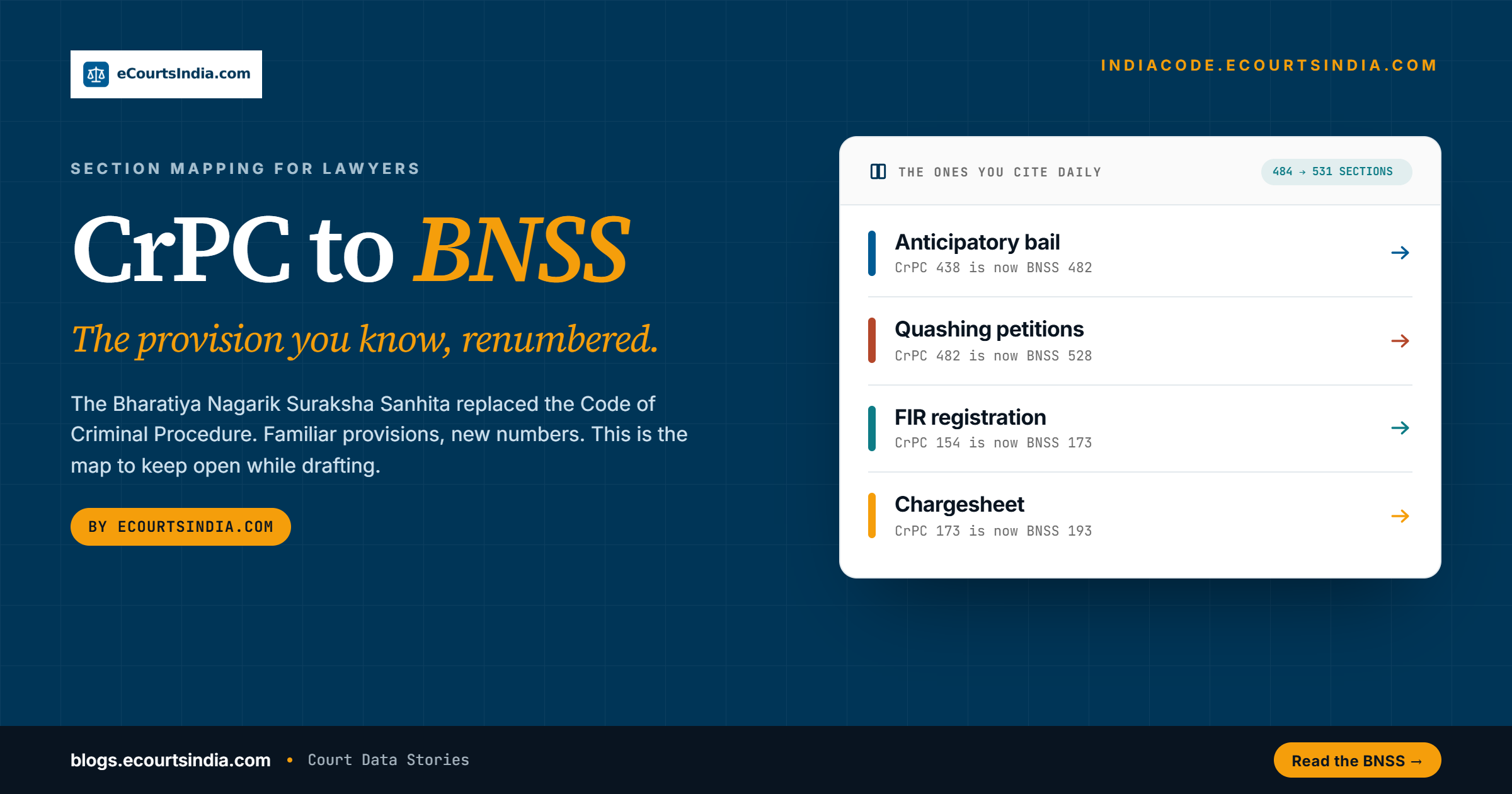
CrPC 154 is now BNSS 173. The CrPC 41A notice now sits in BNSS 35(3) to 35(6). CrPC 438 is now BNSS 482. CrPC 125 is now BNSS 144. CrPC 482 is now BNSS 528. Those are the conversions a criminal practice types every day. The Bharatiya Nagarik Suraksha Sanhita, 2023 (BNSS) replaced the Code of Criminal Procedure, 1973 (CrPC) on 1 July 2024, and matters pending on that date continue under the CrPC. This page is the lawyer-first map, with every important row linking to the side-by-side page on IndiaCode by eCourtsIndia, plus the trial-stage sections and the BNSS time limits that change how you run a file. IndiaCode by eCourtsIndia is a free republication of India’s Acts by eCourtsIndia (ecourtsindia.com), an independent, non-government platform. The Government’s India Code portal and the Gazette remain the official sources. Read how IndiaCode by eCourtsIndia differs from the Government’s India Code.
Last updated: 12 October 2026

Key takeaways
- From 1 July 2024, the BNSS governs new cases. Matters pending on that date continue under the CrPC (section 531(2)(a)). High Courts differed in 2024 on fresh applications in older cases, so check your High Court’s current position.
- A Magistrate must now hear the accused before taking cognizance of a complaint (BNSS 223(1)), except in Section 138 cheque-bounce complaints, where the Supreme Court directed in 2025 that no summons need issue to the accused at the pre-cognizance stage.
- IndiaCode by eCourtsIndia compares the 500 CrPC sections in its text with the BNSS: 452 carried over almost unchanged, 37 close with changes, 7 distant and 4 with no close match. Sections added to the CrPC from 2005 onwards, such as 41A and 436A, are not in that comparison yet and are mapped separately in the tables below. Re-checked on 12 October 2026.
- The mapping is measured, not official: confirm every citation against the bare Act. CrPC 154 is now BNSS 173. It carries over its core, with two additions covered below, so re-read it before you file.
- The BNSS adds hard time limits the CrPC never had: documents to the accused within 14 days, charge within 60 days, judgment within 30 days of arguments (45 at most).
- Old orders cite CrPC numbers and new ones cite BNSS. When you search case law on eCourtsIndia, search both numbers.
How to use these tables. For a pending matter, read the CrPC as amended up to 30 June 2024 from a current bare Act. The IndiaCode CrPC (text being updated) does not yet include many amendments made from 2005 onwards, such as sections 41A, 173(1A), 357A and 436A, so those lettered sections are mapped from section headings.
Which code applies after 1 July 2024: CrPC or BNSS?
Offences committed before 1 July 2024 are charged under the IPC (BNS section 358). Appeals, applications, trials, inquiries and investigations pending on that date continue under the CrPC as it then stood (BNSS section 531(2)(a)). New cases follow the BNSS.
In July 2024 the Rajasthan, Punjab and Haryana, Kerala and Delhi High Courts took different views on fresh applications in older cases, and Punjab and Haryana referred the question to a larger bench (LiveLaw report, 20 July 2024). Check the current position in your High Court before filing.
Arrest and notice: where did CrPC 41 and 41A go?
CrPC 41 is now BNSS 35. CrPC 41A is not a separate IndiaCode comparison URL, because IndiaCode’s CrPC text does not yet include it; the notice language now sits in BNSS 35(3) to 35(6). Section 35(3) says the police officer shall issue a notice to appear where arrest is not required, 35(5) protects a person who keeps complying, and 35(6) allows arrest if they stop complying. One genuinely new safeguard sits in 35(7): for an offence punishable with less than three years, a person who is infirm or above sixty cannot be arrested without the prior permission of an officer not below the rank of Deputy Superintendent of Police.
| CrPC | BNSS | What it is |
|---|---|---|
| 41 | 35 | Arrest without warrant, and notice to appear (35(3) to 35(6)) |
| 46 | 43 | Arrest how made |
| 50 | 47 | Grounds of arrest and right to bail |
| 57 | 58 | Not detained more than 24 hours |
FIR and investigation: CrPC 154, 156(3) and 167 in the BNSS
The FIR section keeps its core but gains two things a practitioner will meet quickly. Information can now be given by electronic communication, and it must be signed within three days by the person who gave it. And for a cognizable offence punishable with three years or more but less than seven, the officer in charge may, with the permission of a DSP-rank officer, hold a preliminary enquiry within fourteen days before deciding whether to investigate. If you act for a complainant, that is the window to watch. If the police station is in one of the dozen or so states and UTs covered by eCourtsIndia Crime Reports, you may find the FIR PDF there. The collection holds 20 lakh+ FIR PDFs. These are collected records, not every FIR registered. Our guide to checking FIR status online covers the rest of the route.
| CrPC | BNSS | What it is |
|---|---|---|
| 154 | 173 | FIR. Adds FIR by electronic communication and a 14-day preliminary enquiry for some 3-to-7-year offences. |
| 156 | 175 | Power to investigate. 175(3): Magistrate-ordered investigation (old 156(3)) needs an application supported by affidavit under 173(4); 175(4) is new, for complaints against public servants. |
| 157 | 176 | Procedure for investigation. 176(3): a forensic expert is to visit the scene for offences punishable with seven years or more, from the date the State Government notifies (within five years). A State without the facility may notify another State’s. |
| 161 | 180 | Witness statements |
| 164 | 183 | Confessions and statements |
| 167 | 187 | Remand. Outer limits of 90 days (offences punishable with death, life or ten years or more) and 60 days (other offences), after which default bail follows. |
| 173 | 193 | Police report / chargesheet. The informant or victim must be told the progress of the investigation within 90 days. |
| 91 | 94 | Summons to produce a document or other thing |
| 102 | 106 | Police power to seize property |
| 165 | 185 | Search by police officer. Read with BNSS 105, which requires search and seizure to be recorded by audio-video means. |
The biggest remand change is in BNSS 187(2). The Magistrate may authorise police custody of up to 15 days in total, in whole or in parts, at any time during the first 40 days of a 60-day detention period or the first 60 days of a 90-day period. The overall limits stay at 60 and 90 days, after which default bail follows.
Bail, cognizance, maintenance and quashing
| Practice | CrPC | BNSS |
|---|---|---|
| Bail in bailable offences | 436 | 478 |
| Anticipatory bail | 438 | 482 |
| Bail (Magistrate, non-bailable) | 437 | 480 |
| High Court / Sessions bail | 439 | 483 |
| Maximum detention of undertrials | 436A | 479 |
| Cognizance | 190 | 210 |
| Examination of complainant. New: no cognizance without hearing the accused (223(1) proviso; not required in Section 138 NI Act complaints after Sanjabij Tari, 2025); safeguards for complaints against public servants (223(2)) | 200 | 223 |
| Issue of process | 204 | 227 |
| Accused examination | 313 | 351 |
| Maintenance | 125 | 144 |
| Section 144 order | 144 | 163 |
| Appeal from conviction | 374 | 415 |
| Revision | 397 | 438 |
| Quashing / inherent powers | 482 | 528 |
Does BNSS 223 require hearing the accused before cognizance?
Yes, in most complaint cases. Under BNSS 223(1), a Magistrate cannot take cognizance on a complaint without first giving the accused an opportunity of being heard. For complaints against a public servant, 223(2) also requires the officer’s version and a report from their superior first.
There is one important exception. For cheque-bounce complaints under Section 138 of the Negotiable Instruments Act, 1881, the Supreme Court in Sanjabij Tari v. Kishore S. Borcar (September 2025, 2025 INSC 1158) directed that there is no requirement to issue summons to the accused under Section 223 at the pre-cognizance stage. Section 138 complaints make up a large share of the complaint cases before Magistrates, so the exception matters in daily practice.
In a quashing petition governed by the BNSS, name both codes in the cause title, for example: “Petition under Section 528 of the Bharatiya Nagarik Suraksha Sanhita, 2023 (corresponding to Section 482 of the Code of Criminal Procedure, 1973)”. For how such petitions fare in one offence category, see 498A quashing outcomes in court data.
Trial stage: documents, discharge, charge, judgment
This is the part most mapping tables skip, and it is where the BNSS changed the most in practice. The section numbers moved by twenty to forty places, and several of them now carry a deadline.
| Stage | CrPC | BNSS |
|---|---|---|
| Supply of police report and documents to the accused | 207 | 230 |
| Supply of statements in complaint cases triable by Sessions | 208 | 231 |
| Commitment to the Court of Session | 209 | 232 |
| Discharge (Sessions trial) | 227 | 250 |
| Framing of charge (Sessions trial) | 228 | 251 |
| Discharge (warrant case on police report) | 239 | 262 |
| Framing of charge (warrant case) | 240 | 263 |
| Power to try summarily | 260 | 283 |
| Procedure for summary trials | 262 | 285 |
| Plea bargaining (chapter) | 265A onwards | 289 to 300 |
| Adjournments | 309 | 346 |
| Compounding of offences | 320 | 359 |
| Judgment | 353 | 392 |
| Language and contents of judgment | 354 | 393 |
| Victim compensation scheme | 357A | 396 |
Which CrPC sections have no BNSS equivalent?
The Government’s BNSS to CrPC comparative table (NCRB-credited, hosted by UP Police) marks several CrPC sections as deleted. They include sections 8 and 16 to 19 on metropolitan areas and Metropolitan Magistrates, and sections 355 and 404 on Metropolitan Magistrates’ judgments and statements. The BNSS has no metropolitan tier. The same table also marks sections 10, 27, 144A and 153 as deleted. See Chief Metropolitan Magistrate courts after the BNSS.
BNSS time limits, in one table
Diary these deadlines. Each limit below is summarised from the BNSS text. Open the section to read the exact words. Some are new, and a few continue what the CrPC already required; the last column says which.
| BNSS section | Time limit | What it applies to | New in BNSS? |
|---|---|---|---|
| 173(1) | 3 days | An FIR given by electronic communication must be signed by the informant within three days | Yes |
| 173(3) | 14 days | Preliminary enquiry for cognizable offences punishable with 3 years or more but less than 7, with DSP-rank permission | Yes |
| 187(3) | 60 or 90 days | Total custody during investigation before default bail (90 days for offences punishable with death, life or ten years or more) | Carried over from CrPC 167(2) |
| 193(2) | 2 months | Investigation of the listed rape offences under the BNS and the listed POCSO offences, from the date the information was recorded | Extended (CrPC 173(1A) covered rape offences; POCSO added) |
| 193(3) | 90 days | Police must inform the informant or victim of the progress of the investigation | Yes |
| 230 | 14 days | Magistrate to supply the police report and documents to the accused, and to the victim if represented by an advocate, from production or appearance of the accused | Yes |
| 232 | 90 days; the Magistrate may extend it, for reasons recorded in writing, for a period not exceeding 180 days | Committal proceedings, from the date of taking cognizance | Yes |
| 250(1) | 60 days | Discharge application in a Sessions case, from the date of commitment | Yes |
| 251(1)(b) | 60 days | Framing of charge in a Sessions case, from the first hearing on charge | Yes |
| 258(1) | 30 days (up to 45) | Sessions judgment, from the completion of arguments | Yes |
| 262(1) | 60 days | Discharge application in a warrant case, from supply of documents under section 230 | Yes |
| 346(1) | 2 months | Inquiry or trial of the listed rape offences, from the filing of the chargesheet | Carried over from CrPC 309(1) proviso |
| 392(1) | 45 days | Outer limit for pronouncing judgment after the trial ends, in any criminal court of original jurisdiction | Yes |
| 396(5) | 2 months | Legal Services Authority to complete its enquiry on victim compensation | Carried over from CrPC 357A(5) |
| 479(1) | One-half, or one-third for a first-time offender | Share of the maximum sentence an undertrial may spend in detention before release (not for offences punishable with death or life) | Partly new (one-third for first-time offenders; one-half was CrPC 436A) |
A practical note. These are directions to courts and police, and the consequences of missing them are still being worked out in the High Courts. When you argue a missed deadline, find the orders that have already dealt with it. On eCourtsIndia search, try phrases such as "section 258 BNSS" or "section 230 of BNSS", which run through the full text of orders and judgments.
What changed in bail under BNSS 479?
Bail numbering is the most expensive thing to get wrong in a hurry, so here it is in one place. Bail in bailable offences moved from CrPC 436 to BNSS 478. Magistrate bail in non-bailable offences moved from 437 to 480. Anticipatory bail moved from 438 to 482, and the special powers of the High Court and Sessions Court moved from 439 to 483.
BNSS 479, the successor to CrPC 436A, sets the maximum period an undertrial can be detained. It does not apply where death or life imprisonment is one of the punishments for the offence. Read all of it before you apply:
- 479(1): an undertrial detained for up to one-half of the maximum sentence for the offence is to be released on bail. This rule carries over from CrPC 436A.
- First proviso (new): a first-time offender, someone never convicted before, is to be released on bond after one-third.
- Second proviso: after hearing the Public Prosecutor, and for reasons recorded in writing, the court may order continued detention beyond one-half, or release on bail bond instead of his bond.
- Third proviso: no undertrial may be detained for longer than the maximum sentence for the offence.
- Explanation: detention caused by delay in the proceedings on the part of the accused does not count.
- 479(2): where investigation, inquiry or trial in more than one offence or in multiple cases is pending against the person, the person shall not be released on bail by the Court, subject to the third proviso.
- 479(3): the jail superintendent must apply to the court in writing as soon as the one-half or one-third period is complete.
If you handle bail work in special statutes, our note on PMLA bail under Section 45 shows how a special law’s twin conditions sit on top of the general bail sections.
How to search case law across the changeover
An order passed in 2023 cites CrPC 482. The same kind of petition filed in 2025 cites BNSS 528. A search for one number will not find the other. So on eCourtsIndia, run two separate phrase searches: "482 CrPC" and "528 BNSS", and do the same for bail ("439 CrPC", then "483 BNSS"). Do not combine them with OR: at the time of writing (October 2026), an OR query on eCourtsIndia behaves like AND and returns only orders that cite both numbers. The search reads the full text of orders, so the phrase does not need to be in the case title. Once you have the order you are relying on, download it for your file. Our eCourtsIndia search guide covers phrase searches and filters.
Three habits that save time:
- For a quashing petition before a metropolitan court or its High Court, read our guide to Chief Metropolitan Magistrate courts for the codes you will filter on.
- Once you have found the matter, set a WhatsApp or email case alert so the next listing reaches you without a daily check of the portal.
- For the offence side of the same file, use the IPC to BNS mapping and our list of 50 important BNS sections with bail and triable-by columns.
To follow a matter after you file, see how to check the status of a criminal case.
Full 500-row table: indiacode.ecourtsindia.com/crpc-to-bnss/. How the site itself works, and why the mapping is measured rather than official, is covered in the IndiaCode launch article.
Read next
- IndiaCode launch article
- IPC to BNS mapping
- IPC to BNS video walkthrough
- CrPC to BNSS full table
- Pull CrPC to BNSS equivalents through the eCourtsIndia API
IndiaCode by eCourtsIndia is a private structured republication; the Gazette and competent issuing authority remain authoritative.
Frequently Asked Questions
What is the BNSS equivalent of CrPC 482?
CrPC 482, the High Court’s inherent power used for quashing, is now Section 528 of the BNSS. Do not confuse it with BNSS 482, which is the new anticipatory bail section (old CrPC 438). In a petition, write both codes, for example “Section 528 BNSS (corresponding to Section 482 CrPC)”, and search case law under both numbers.
What is the BNSS section for anticipatory bail?
Anticipatory bail under old CrPC 438 is now Section 482 of the BNSS. Regular bail in bailable offences moved from 436 to 478, Magistrate bail in non-bailable offences from 437 to 480, and the special powers of the High Court and Sessions Court from 439 to 483. The undertrial detention limit in old 436A is now BNSS 479.
What is the BNSS equivalent of CrPC 154 (FIR)?
BNSS 173. It keeps the old core and adds two things: information can be given by electronic communication, but must be signed within three days by the informant; and for cognizable offences punishable with three to seven years, the officer may hold a preliminary enquiry within 14 days, with permission from a DSP-rank officer, before registering.
Where is the CrPC 41A notice in the BNSS?
Inside BNSS 35, sub-sections (3) to (6). The police must issue a notice of appearance where arrest is not required, a person who complies is not to be arrested unless the officer records reasons, and failure to comply allows arrest. Sub-section (7) adds a new safeguard: for offences under three years, an infirm person or one above sixty cannot be arrested without DSP-rank permission.
Is a pre-cognizance hearing under BNSS 223 needed in cheque bounce cases?
No summons is needed. BNSS 223(1) generally bars a Magistrate from taking cognizance on a complaint without hearing the accused. But for Section 138 Negotiable Instruments Act complaints, the Supreme Court in Sanjabij Tari v. Kishore S. Borcar (September 2025) directed that no summons need issue to the accused under Section 223 at the pre-cognizance stage. Other complaint cases still need the hearing.
What are the remand limits under BNSS 187?
BNSS 187 replaces CrPC 167. Police custody can total 15 days, taken in parts, during the first 40 days of a 60-day detention period or the first 60 days of a 90-day period. Overall detention during investigation is capped at 90 days for offences punishable with death, life or ten years or more, and 60 days for others; after that, default bail follows.
What new time limits does the BNSS set for criminal trials?
Documents to the accused within 14 days (s.230), committal within 90 days extendable to 180 (s.232), discharge applications within 60 days (ss.250, 262), charge in Sessions cases within 60 days of the first hearing on charge (s.251), Sessions judgment within 30 days of arguments, extendable to 45 (s.258), and judgment in any trial court within 45 days of the trial ending (s.392).
Does the CrPC still apply after 1 July 2024?
Yes, for older matters. Under BNSS section 531(2)(a), any appeal, application, trial, inquiry or investigation pending immediately before 1 July 2024 continues under the CrPC as it then stood, and offences committed before that date are still charged under the IPC. High Courts took different views in 2024 on fresh applications in old cases, so check your High Court’s current position.
Sources
- PIB: highlights of the new criminal laws (30 July 2024). Checked 28 September 2026.
- PIB: new criminal laws, including BNSS section 479 (10 December 2024). Checked 28 September 2026.
- UP Police: corresponding section table of the BNSS with the CrPC (NCRB-credited) (July 2024). Checked 28 September 2026. Supports the mappings and the deleted sections.
- Indian Kanoon: BNSS section 531, repeal and savings. Checked 28 September 2026.
- Indian Kanoon: CrPC sections 173, 309 and 357A as amended. Checked 28 September 2026. Supports the “New in BNSS?” column.
- Supreme Court of India, Sanjabij Tari v. Kishore S. Borcar, Criminal Appeal 1755 of 2010, 2025 INSC 1158 (September 2025), on Section 223 BNSS in Section 138 complaints: case record on eCourtsIndia; Verdictum report. Checked 12 October 2026.
- LiveLaw: High Court rulings on the CrPC to BNSS transition (20 July 2024). Checked 28 September 2026.
- IndiaCode by eCourtsIndia: BNSS text, section by section and the CrPC to BNSS comparison table (private republication). Checked 28 September 2026.