No. A case under the Protection of Women from Domestic Violence Act, 2005 can give protection, residence, money, temporary custody and compensation, but it does not end the marriage or start a divorce. To end the marriage, a spouse files a separate divorce petition under their personal law, such as Section 13 or 13B of the Hindu Marriage Act, 1955.
Last updated: 28 September 2026
If you want the marriage legally ended, you usually need to file a separate divorce petition under the law that applies to your marriage. The domestic violence case, usually an application under section 12 of the Protection of Women from Domestic Violence Act, can continue separately and decide protection, residence, financial relief, temporary child custody and compensation. You can read bare Acts section by section to see the exact text.
This article makes a reform argument: when one spouse tells a court that the home is unsafe, or the other spouse is forced into years of litigation over that allegation, the legal system should offer a fast, separate route out of the marriage. A violence complaint should not automatically prove guilt or automatically grant divorce. But the State should not use delay as a substitute for reconciliation.
This is general information and a policy argument, not personal legal advice. The correct case and court depend on your personal law, marriage and facts. eCourtsIndia is a private platform, not the Government’s eCourts portal (ecourts.gov.in).

The five facts to remember
- A DV case and a divorce case do different jobs. One seeks protection and relief from violence. The other ends the legal marriage.
- You can remain married for years while several cases continue. A DV case, cruelty case, maintenance case and divorce case may all run at the same time.
- The familiar “1% divorce rate” is easy to misuse. It is mainly a snapshot of people currently recorded as divorced or separated. It is not the percentage of marriages that will eventually end.
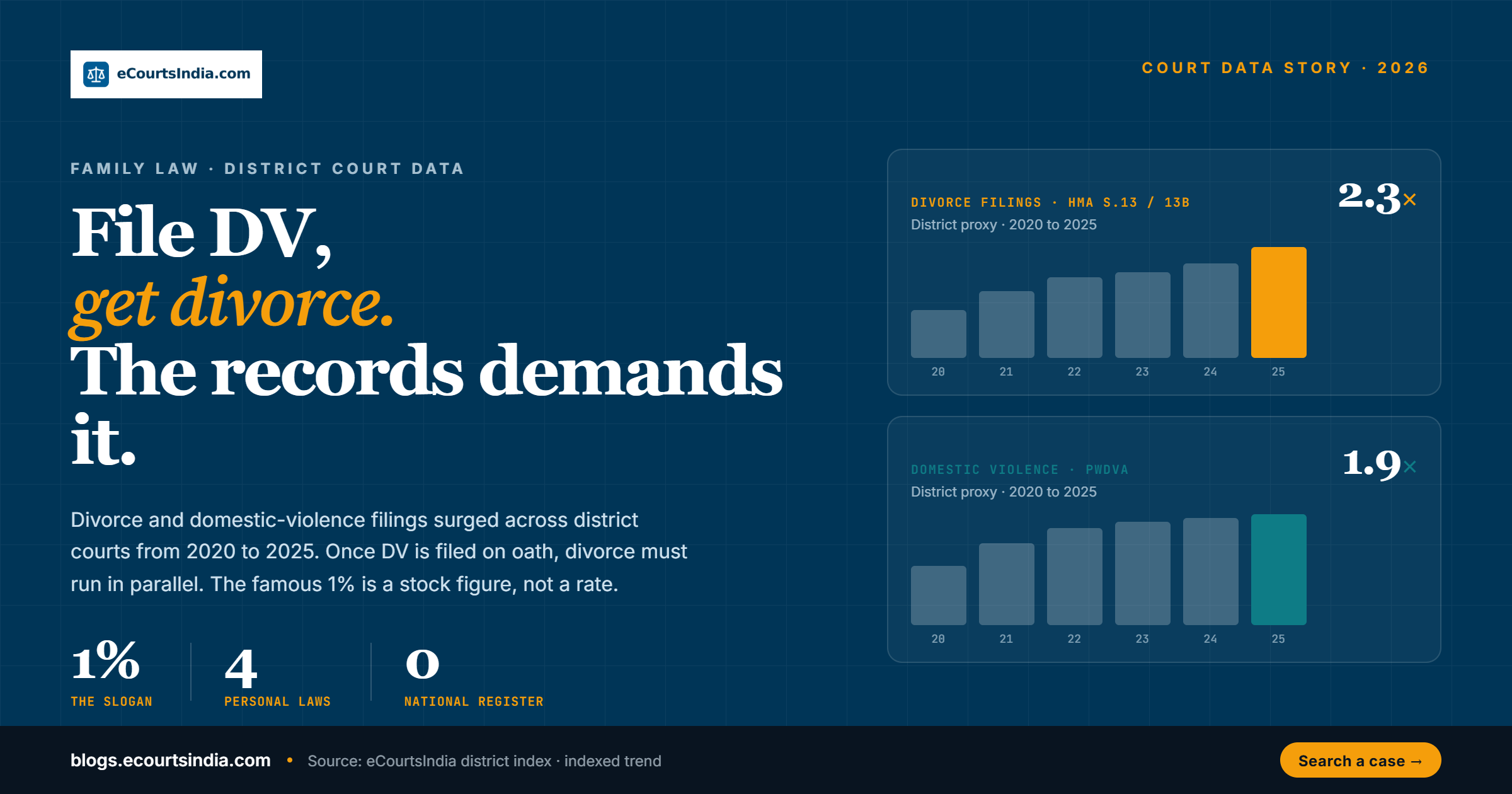
- The court workload is not tiny. In the 17 states and UTs measured here, Hindu Marriage Act (HMA) section 13-related files rose from 1.53 lakh in 2020 to 3.18 lakh in 2025. Part of that rise reflects a low, COVID-affected 2020 base.
- DV cases move much more slowly. Sixty-one per cent of the DV cases in this 2020 to 2025 set were still pending when the index was read on 13 August 2026, compared with 27% of the divorce files.
What should a person do today?
- If you are in immediate danger: call 112 (the national emergency number) or the 181 Women Helpline, or contact the police or a trusted local support organisation. Do not wait for a divorce case to make you safe.
- If you need protection, residence or financial relief: ask a family-law advocate (you can find one in the verified advocate directory) or the District Legal Services Authority about remedies under the Protection of Women from Domestic Violence Act.
- If you want the marriage to end: ask whether you also need a separate divorce petition. A DV application does not replace it.
- If both spouses agree to separate: ask about mutual-consent divorce, for Hindu marriages under section 13B of the Hindu Marriage Act. The requirements and timing depend on the law and facts that apply to you.
- Preserve records: keep complaints, medical documents, messages, bank records, court papers and every case number. Do not rely on memory after litigation starts.
- Track the cases separately: each case may have its own court, number, orders and hearing dates, so note down what a CNR number is for each one. The official eCourts Services portal (services.ecourts.gov.in) shows case status free. You can also search by CNR, party or advocate on eCourtsIndia, then track each case for new orders and hearing dates on WhatsApp or email (₹5 per case a month, alerts ₹0.50 per channel, September 2026; see current prices).
- If a police case was registered: an FIR under section 85 of the Bharatiya Nyaya Sanhita (section 498A of the IPC before 1 July 2024) may be available through Crime Reports, which holds 12 lakh+ FIR PDFs from 13 states and union territories. These are collected records, not every FIR registered. You can also check FIR status online.
Do not file a false DV case to obtain a faster divorce. A false statement can damage real victims, expose the person making it to legal consequences and make every connected dispute harder. If the objective is divorce, ask directly for divorce.
DV, divorce and a cruelty case are not the same
| Legal route | Law and section | What it can deal with | Does it end the marriage? |
|---|---|---|---|
| Domestic Violence Act case | DV Act s.12 (application); ss.18-22 (reliefs) | Protection, residence, money, temporary custody and compensation | No |
| Divorce petition | Personal law, e.g. HMA ss.13, 13B | Whether the legal marriage should end; connected financial and child issues may also arise | Yes, if the court grants divorce |
| Cruelty complaint or FIR | s.85 BNS (s.498A IPC before 1 Jul 2024) | Alleged criminal cruelty by a husband or relatives | No |
| Maintenance case | e.g. s.144 BNSS (formerly s.125 CrPC); DV Act s.20 | Financial support | No |
This distinction is the central problem. The law can spend years deciding protection, money or criminal responsibility while leaving the couple legally married. The adults may already live apart. The relationship may be over in every practical sense. The certificate remains.
A dead marriage does not become healthy because the court kept it legally alive for five more years.
What the court data shows
India does not publish one clean annual register of marriages and divorces. Court labels also differ by state (see how case types are labelled). We therefore use 17 jurisdictions (16 states and Delhi) where the relevant district-court labels are reliable enough to compare. This is not an all-India count.

| Year | HMA s.13-related files | DV Act cases |
|---|---|---|
| 2020 | 1,53,096 | 49,312 |
| 2021 | 2,25,649 | 67,186 |
| 2022 | 2,60,892 | 78,412 |
| 2023 | 2,78,030 | 83,292 |
| 2024 | 2,91,081 | 86,163 |
| 2025 | 3,18,039 | 92,354 |
HMA divorce files rose from 1.53 lakh in 2020 to 3.18 lakh in 2025. Part of that rise reflects a low base, because courts worked under COVID-19 restrictions for much of 2020. Measured from 2021, HMA files rose about 41% (2,25,649 to 3,18,039) and DV Act cases about 37% (67,186 to 92,354).
Separately, the National Crime Records Bureau’s Crime in India 2024 recorded 1,20,227 cases of cruelty by husband or relatives, 27.2% of all crimes against women that year. That is a national police series, so it should not be added to this 17-jurisdiction court table. For what happens to those cruelty cases once they reach court, see 498A by the Numbers.
Mutual-consent section 13B files rose from 65,691 in 2020 to 1,57,362 in 2025. The remaining HMA search records rose from 87,405 to 1,60,677. We do not call that remainder a clean “contested divorce” count because it may include other HMA records.

The harder fact: DV cases remain open much longer
Among records that closed in 2020 to 2025, the median divorce matter closed in about 10 months and the median closed DV Act case took about two years. These times cover only cases that have closed. Most DV cases in the set are still open, so the typical DV case is likely to take longer.
The divorce figure also mixes two different routes. Mutual-consent petitions under Section 13B, a large share of the divorce files, usually wait at least six months before the second motion. Contested petitions follow a different path.
The law expects much faster action on DV applications. Under Section 12(4) and 12(5) of the DV Act, a Magistrate should ordinarily fix the first hearing within three days of receiving an application and must try to decide it within 60 days of that hearing. Long waits are common in family disputes, but DV cases stand out: the Indian Disposal-Time Index 2026 shows how long different case types take across states.

| Time taken to close | Divorce matters | DV Act cases |
|---|---|---|
| Within 1 year | 62.1% | 25.7% |
| 1 to 3 years | 28.1% | 40.8% |
| More than 3 years | 9.9% | 33.5% |
There is also a large live backlog. Of the HMA divorce files from 2020 to 2025 in this set, 4,19,271, or 27%, were still pending when the index was read on 13 August 2026. Of 4,56,719 DV Act cases, 2,77,228, or 61%, were still pending.
That is not a technical inconvenience. It is years of uncertainty about safety, money, children, reputation and the future. Delay hurts a genuine survivor. Delay also hurts a person facing an allegation that is false or cannot be proved. A slow system does not become fair merely because it is slow to everyone.
Does this data prove that DV cases are misused?
No. Filing numbers and case duration cannot tell us which allegation is true, false, exaggerated, settled or abandoned.

The court index usually records a case as pending or disposed. “Disposed” can mean many things: an order, withdrawal, settlement, non-appearance or another form of closure. The searchable fields do not reliably separate those outcomes. Low conviction in criminal cruelty cases is also not automatic proof that complaints were false. Cases may end after settlement, quashing, changed testimony or failure of proof.
But the data does show a system vulnerable to pressure: a case may be relatively easy to begin, expensive to defend and painfully slow to finish. That structure can be exploited. It can also trap a real victim who urgently needs relief. We should be able to admit both facts without pretending that every complainant is a liar or every allegation is true.
Is India’s divorce rate really 1%?

Figures around 1% usually come from a census or household survey. They count people who are currently recorded as divorced, separated or deserted. The “1%” itself is a commonly cited estimate without a clear primary source, and India publishes no official annual divorce rate.
The best-documented national count is Census 2011. It recorded about 13.6 lakh divorced people, 0.24% of the married population. A further 0.61% of married people were recorded as separated, so the two together come to about 0.85%.
That is a status snapshot. It is not:
- the number of divorces granted in one year;
- the percentage of marriages that will eventually end;
- the number of couples living apart without a decree;
- the number of DV, maintenance or cruelty cases; or
- proof that 99% of marriages are happy.
The National Family Health Survey (NFHS-5, 2019-21) reported that 29.3% of ever-married women aged 18 to 49 had ever experienced physical or sexual violence by a husband. This does not mean 29.3% should divorce, and it cannot be divided by a divorce or separation figure. It does destroy one comforting story: a low recorded divorce figure is not reliable evidence of safe marriages. It may also reflect social pressure, financial dependence, informal separation and the difficulty of obtaining a legal exit. Money and property often keep couples tied up in court long after they separate, a pattern the Family Property Dispute Index 2026 traces across 5.1 lakh files.
A rough case-pressure estimate (not a divorce rate)
One marriage can create more than one court file. Our sample suggests about 1.15 HMA files per couple. After applying that factor, the 17-jurisdiction set contains about 2.21 lakh unique HMA couples per year on average.
India has no complete annual marriage register. We estimated annual new marriages from the Ministry of Health and Family Welfare’s population projections, then used 40% as a rough “court-using” or non-rural slice. Against that limited denominator, unique HMA couples equal 5.62% on the six-year average and 7.03% in 2025. The 40% is our assumption, not an official figure, and a different share would change the result in proportion.
That is not India’s divorce rate. It covers only selected HMA court files in 17 states and UTs. A case filed in 2025 may come from a marriage performed many years earlier. The 40% denominator is an assumption, not an official count. The value of this estimate is to show scale, not to manufacture a precise national rate.

| State or UT | Unique HMA couples per year | Estimate: HMA couples as % of assumed court-using marriages (not a divorce rate) |
|---|---|---|
| Punjab | 15,784 | 15.2% |
| Haryana | 14,112 | 12.7% |
| Himachal Pradesh | 3,051 | 12.4% |
| Delhi | 9,782 | 12.1% |
| Kerala | 12,353 | 11.9% |
Punjab’s 15.2% does not mean that 15.2% of all Punjabi marriages ended in divorce that year. It means the estimated annual number of unique HMA couples in the 2020 to 2025 court files equals about 15.2% of our estimated court-using new-marriage base. The numerator and denominator come from different marriage years, so this is a pressure gauge, not a true divorce rate.
What the law already allows when a marriage has broken down
Current law already offers some routes out. Cruelty is a ground for divorce under Section 13(1)(ia) of the Hindu Marriage Act, 1955. The Hon’ble Supreme Court of India has held that filing a false criminal complaint against a spouse can amount to cruelty (K. Srinivas v. K. Sunita, 19 November 2014).
Spouses who agree can seek mutual-consent divorce under Section 13B. The Supreme Court has held that its six-month waiting period can be waived in suitable cases (Amardeep Singh v. Harveen Kaur, (2017) 8 SCC 746, 12 September 2017). The problem is delay, not the absence of any legal route.
Opinion: a linked divorce track for violence cases (not current law)
This is not current law. A DV filing should not itself dissolve a marriage. Instead, when spouses enter serious violence or cruelty litigation, the court system should quickly ask whether either person wants the marriage ended and, if so, open or direct them to a linked divorce track.
If the allegation is true
The survivor needs safety, money where legally due and a realistic exit. Years of pressure to reconcile with an alleged abuser are not neutral. They preserve the legal shell of the very relationship said to be dangerous.
If the allegation is proved false
The accused person may have lost years, money, work and reputation. Proven false statements should have consequences under the law. That person should not also be forced to remain married to the complainant merely because the system moved slowly.
If the case remains undecided for years
This is the everyday failure. The DV case is pending. Maintenance is pending. A cruelty case may be pending. The spouses live apart. Nobody has been vindicated, but nobody can move on either. Permanent uncertainty is not justice.

Safeguards are essential
- No automatic finding of guilt. A complaint is an allegation until evidence is tested.
- No automatic divorce merely because a complaint was filed. At least one spouse must ask to end the marriage, and the other spouse must receive notice and a hearing.
- Keep the cases legally separate. Divorce should decide marital status. The DV case should decide protection and civil relief. A criminal case should decide criminal responsibility. The Supreme Court has repeatedly dealt with how these threads interact, as our review of recent Supreme Court judgments on divorce, alimony and 498A shows.
- Do not make the divorce wait for every other case to finish. Otherwise one slow case can hold the entire family dispute hostage.
- Protect children on evidence. Custody and contact should turn on safety and the child’s welfare, not on slogans about preserving a marriage.
- Penalise deliberate falsehood, not unsuccessful claims. Failure to prove an allegation is not automatically proof that it was fabricated.
- Control adjournments. Courts should impose realistic timelines and costs for avoidable delay.
Protect the survivor. Hear the accused. Decide the evidence. But stop pretending that compulsory marital status is a solution.
Methodology and limitations
- Jurisdictions included (16 states and Delhi): Andhra Pradesh, Chhattisgarh, Delhi, Gujarat, Haryana, Himachal Pradesh, Karnataka, Kerala, Madhya Pradesh, Maharashtra, Punjab, Rajasthan, Tamil Nadu, Telangana, Uttarakhand, Uttar Pradesh and West Bengal.
- Not included: the other 19 states and Union Territories. In Odisha, Bihar, Jharkhand, Assam and Jammu & Kashmir, the indexed HMA labels were checked and were not reliable enough for this comparison.
- Unit: court case files, not people, couples or marriages, except where the 1.15 adjustment below is applied.
- Divorce search: district-court records matching the Hindu Marriage Act with section 13, 13B, 013B, 013A or divorce language. The ranking is primarily a section 13/13B HMA measure; it does not add every personal law.
- Unique couples: 15,26,787 files were divided by 1.15 files per couple, based on a manual spot-check of distinctive-name couples with duplicate petitions, cross-petitions or refiling. No couple, party or case number is published in this article.
- DV search: statute name combined with application or complaint language. We did not use a loose local case-type label because some courts use “DV” for unrelated matrimonial files.
- Pending shares: calculated from files, without the 1.15 unique-couple adjustment. Pending means not disposed when the index was read on 13 August 2026.
- Time to close: records with a closing date in 2020 to 2025 and a usable duration. Open cases are excluded, so typical durations are understated, especially for DV cases. A closed case is not necessarily a successful claim or a finding of falsehood.
- Marriage estimate: based on the Ministry of Health and Family Welfare’s 2011 to 2036 population projections for the 20 to 24 age cohort, interpolated to 2023. The 40% court-using slice is a proxy, not an official statistic.
- Limitations: covers only courts that publish on eCourts; records can lag the court’s own register; 2020 filings were depressed by COVID-19 court restrictions; the HMA count excludes other personal laws, while the DV Act applies to all communities, so the two series are not like for like; index coverage may be better in later years; the 1.15 factor and the 40% share are estimates.
- Data date: eCourtsIndia index retrieved 13 August 2026.
- Further reading: to run a similar study, see our guide to research with Indian court data.
Frequently Asked Questions
Does filing a domestic violence case automatically start a divorce?
No. A domestic violence application under Section 12 of the Protection of Women from Domestic Violence Act, 2005 goes to a Magistrate. It can lead to protection, residence, monetary, custody and compensation orders (Sections 18 to 22). None of these ends the marriage. A spouse who wants a divorce must file a separate petition under their personal law, for example Section 13 or 13B of the Hindu Marriage Act, 1955.
Can a DV case continue after divorce?
It can. A divorce decree settles marital status; it does not by itself end a pending DV case or erase claims about past violence. The Hon’ble Supreme Court has held that a domestic relationship under the Act can be a past one, and the woman need not be living with the respondents when she applies (Prabha Tyagi v. Kamlesh Devi, 12 May 2022). In practice, couples often close DV, maintenance and divorce cases together in one settlement recorded by the court. Ask a family-law advocate how this applies to your case.
Should I wait for the DV case to finish before filing for divorce?
Usually there is no legal need to wait. The DV case and a divorce petition are separate and can run at the same time. DV cases are often slow: in eCourtsIndia’s data for 17 states and UTs (read 13 August 2026), about 61% of DV Act cases filed from 2020 to 2025 were still pending. Ask a family-law advocate how the timing affects your own case.
Does a pending DV case prove that domestic violence happened?
No. A DV application records an allegation and a request for relief. The Magistrate decides only after considering evidence from both sides, and interim orders are not final findings. Equally, a case that is withdrawn, settled or dismissed is not proof that the complaint was false. Court records show that a case exists and how far it has moved, not who is right.
Is India’s divorce rate really only 1%?
India publishes no official annual divorce rate. The familiar figure of about 1% is a snapshot of people currently recorded as divorced or separated. Census 2011 counted about 13.6 lakh divorced people, 0.24% of the married population, and a further 0.61% of married people as separated. It is not the share of marriages that end, and it says nothing about how many marriages are unhappy.
How can I check my DV or divorce case online?
Use the 16-character CNR, case number, party name or advocate name on the official eCourts Services portal (services.ecourts.gov.in) or app, which is free. Our guide explains how to check a court case status online. eCourtsIndia, a private platform, also offers free search at ecourtsindia.com/search, a free cause-list search and paid alerts on WhatsApp or email. Some courts show fewer details online for matrimonial cases, so check with the court registry or your advocate if a case is missing.
Read next
- 498A by the Numbers: What 16.2 Lakh Court Records Reveal
- Supreme Court on Divorce, Alimony and 498A: What Recent Judgments Show
- Search Indian court cases on eCourtsIndia
Sources
- IndiaCode by eCourtsIndia: Protection of Women from Domestic Violence Act, 2005, Section 12 (Application to Magistrate) (Act in force 26 October 2006). Checked 28 September 2026. Supports the 3-day first hearing and 60-day disposal target, and lists Prabha Tyagi v. Kamlesh Devi (12 May 2022).
- IndiaCode by eCourtsIndia: Hindu Marriage Act, 1955, Section 13 (Divorce). Checked 28 September 2026. Supports cruelty as a ground and lists K. Srinivas v. K. Sunita (19 November 2014).
- IndiaCode by eCourtsIndia: Hindu Marriage Act, 1955, Section 13B (Divorce by mutual consent). Checked 28 September 2026. Supports the six-month second-motion window and lists Amardeep Singh v. Harveen Kaur (12 September 2017).
- ThePrint: coverage of the National Crime Records Bureau’s Crime in India 2024. Checked 28 September 2026. Supports 1,20,227 cases of cruelty by husband or relatives (27.2% of crimes against women).
- Economic and Political Weekly: Suraj Jacob and Sreeparna Chattopadhyay, Marriage Dissolution in India (Census 2011) (13 August 2016). Checked 28 September 2026. Supports the Census 2011 divorce and separation figures.
- The Wire (LiveWire): Divorce Rates Are Increasing. Checked 28 September 2026. An example of the commonly cited, unsourced “about 1%” divorce-rate figure.
- International Institute for Population Sciences and Ministry of Health and Family Welfare: National Family Health Survey (NFHS-5), 2019-21, spousal violence tables.
- Ministry of Health and Family Welfare, Population Projections for India and States 2011 to 2036, Table 18.
- eCourtsIndia district-court index, retrieved 13 August 2026 (see Methodology and limitations).
IndiaCode by eCourtsIndia is a private structured republication; the Gazette and competent issuing authority remain authoritative.