Last updated: 28 September 2026
The complete Indian court case status reference
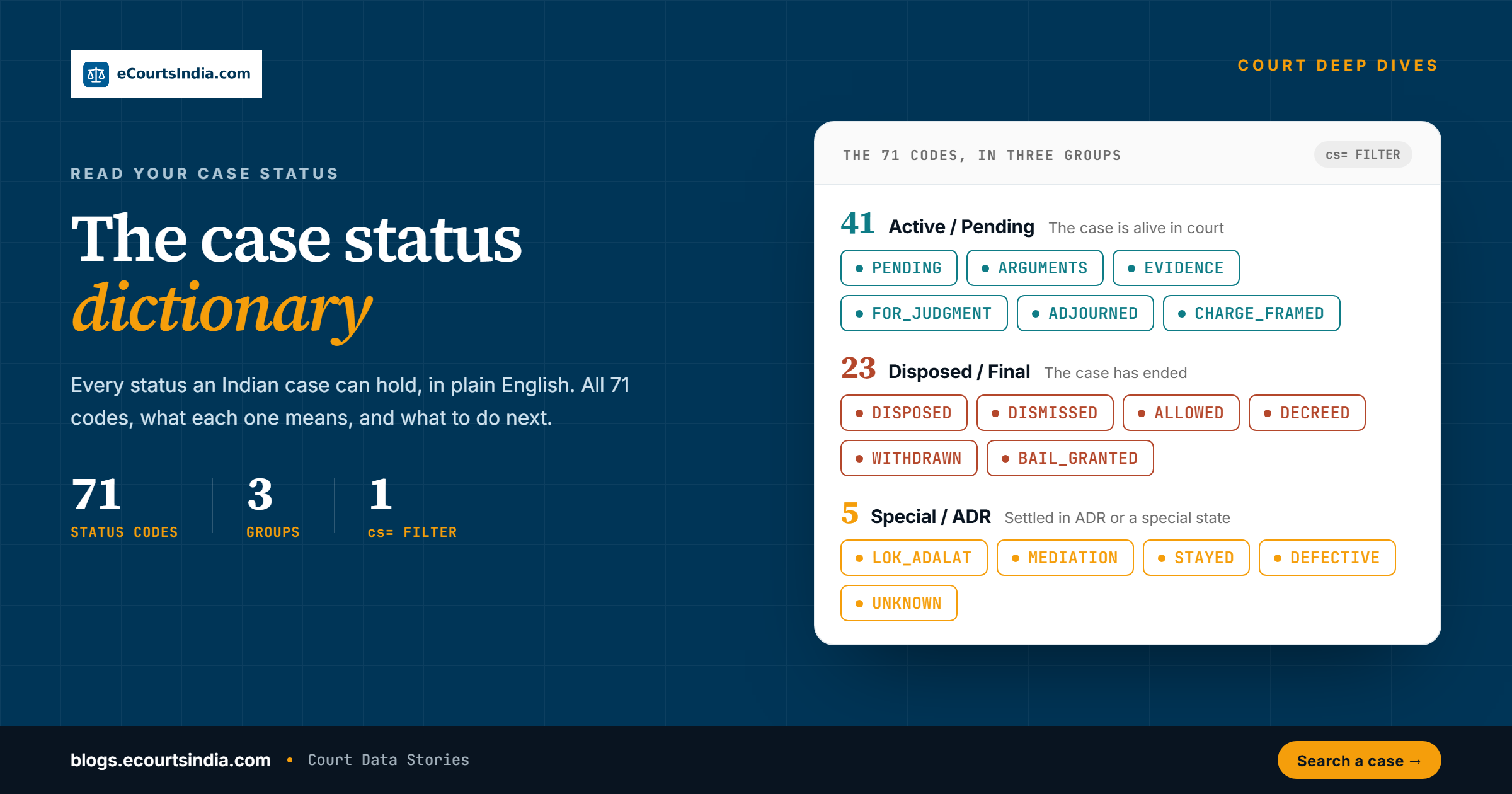
A court case status tells you where a case stands. Official eCourts pages show whether a case is pending or disposed and, for many courts, a stage such as evidence or arguments. Indian courts do not publish one official list of status codes: each court records status and stage in its own words. eCourtsIndia maps that wording to 71 standard codes of its own, in three groups: active or pending, disposed or final, and special or ADR. eCourtsIndia is an independent, non-government platform, not the Government’s eCourts portal (ecourts.gov.in).
When you open a case on eCourtsIndia.com, on the official eCourts Services portal (services.ecourts.gov.in) or on a High Court or Supreme Court website, you see a status such as pending or disposed and often a stage such as evidence or arguments. The National Judicial Data Grid (NJDG), maintained by the National Informatics Centre, publishes the same data as totals, not case by case. Our explainer on how the eCourts system works covers each part.

These 71 codes are eCourtsIndia’s standard labels, not the court’s own words. The wording on official portals varies from court to court, and the official record prevails where the two differ. The Supreme Court and each High Court also use their own terms; see our guides to Supreme Court case status and High Court case status for all 25 High Courts.
This dictionary defines each status, explains what it means for your case, and tells you what usually happens next.
Watch: Case Status Dictionary: What Indian Court Case Statuses Mean
Read the video transcript
Pending, disposed, reserved, part heard. What does your court case status really mean? Courts word their statuses differently, so eCourtsIndia maps them to 71 standard codes in three groups: active or pending, disposed or final, and special, like Lok Adalat or mediation. Disposed means the case has ended. Dismissed means the court refused the relief. And reserved means the hearing is over and the judgment will come later. Every search result shows its case status. Filter by status, combined with a search term, to find, say, pending partition suits. When your status changes, note the next date, read the latest order, confirm the cause list, and turn on alerts. Look up any status and track your case at eCourtsIndia.com.
Quick Answer
eCourtsIndia’s case status codes fall into three groups: Active / Pending (case is alive in court), Disposed / Final (the matter before that court has ended one way or another), and Special / ADR (the case has gone to Lok Adalat or mediation, or is in a special state such as defective or unknown). Each code describes where a case stands or how it ended. Search any Indian case by status on ecourtsindia.com/search using the st= parameter. If you have a CNR, open the case directly and read its current status; our guide on how to check court case status online walks through every route.
Active and Pending Statuses
These statuses indicate the case is alive in court and proceedings are ongoing.
| Status Code | Meaning | What it means for you |
|---|---|---|
| PENDING | Case is pending | The case is alive. Check the next hearing date and the latest order on the case page. |
| ADMITTED | Case admitted to court | The court has accepted the case for hearing. Usually notice goes to the other side next, followed by replies and hearing dates. |
| ARGUMENTS | Oral arguments in progress | Final arguments are being heard. After this the court usually reserves or pronounces judgment. |
| PART_HEARD | Case partially heard | Hearing has started and continues on the next date, usually before the same judge or bench. |
| HEARING | Hearing scheduled or ongoing | The case is listed for hearing. Confirm the date and court number on the cause list and attend or instruct your advocate. |
| EVIDENCE | Evidence stage | Witnesses are being examined; trial in progress |
| TRIAL | Trial in progress | Full trial on merits underway |
| FIRST_HEARING | First hearing scheduled or completed | The initial appearance of parties; preliminary directions given |
| APPEARANCE | Appearance | Matter listed for appearance or filing of appearance by the parties. |
| NOTICE_ISSUED | Notice issued to parties | The court has asked the other side to respond. The next date is usually for their appearance or reply. |
| FOR_ADMISSION | Pending for admission | Case awaiting the court’s decision on whether to admit |
| FOR_JUDGMENT | Pending for judgment | Arguments are closed and judgment is awaited. Watch the cause list for the pronouncement date. |
| RESERVED | Reserved | Hearing is over and the judgment or order will be pronounced later. Watch the cause list for the pronouncement date. |
| FOR_ORDERS | Pending for orders | Awaiting a procedural order from the court |
| FOR_STEPS | Pending for next steps | Party is required to take some procedural step (for example file documents) |
| REGISTERED | Case registered with court | Case has been entered in the court register |
| LISTED | Case listed for hearing | Scheduled on a cause list for a specific date |
| MENTIONED | Case mentioned in court | Counsel orally asked the court for something, usually urgent listing or an early date. |
| FILED | Case filed | Plaint or petition has been filed but not yet registered |
| READY_FOR_REGISTRATION | Ready for registration | Case has cleared filing scrutiny and is queued for registration |
| ADJOURNED | Case adjourned | Hearing postponed to a future date |
| COMPLIANCE_PENDING | Compliance of orders pending | Party required to comply with a prior order |
| CONTEMPT_PENDING | Contempt proceedings pending | Contempt case initiated and being heard |
| CURATIVE_PENDING | Curative petition pending | Last-stage post-review remedy in the Supreme Court is pending |
| EXECUTION_PENDING | Execution of order pending | Decree awaiting enforcement |
| LPA_PENDING | Letters Patent Appeal pending | Appeal within the same High Court, from a Single Judge to a Division Bench. |
| MAINTENANCE_PENDING | Maintenance case pending | Section 125 CrPC / Section 144 BNSS or Family Court maintenance application pending |
| PIL_PENDING | Public Interest Litigation pending | PIL admitted and under hearing |
| REVIEW_PENDING | Review petition pending | Review of earlier order or judgment pending |
| SERVICE_PENDING | Service of documents pending | Notice or summons not yet served on opposite party |
| PENDING_AFTER_NOTICE | Pending after notice issued | Notice has gone to the other side; the court is waiting for them to appear or reply. |
| PENDING_BEFORE_NOTICE | Pending before notice issued | Fresh filing awaiting first judicial order |
| INTERIM_ORDER_PASSED | Interim order passed | The court has passed a temporary order, such as a stay or an interim direction, until the case is decided. |
| FRAMING_OF_ISSUES | Issues being framed | Court is identifying the disputed points for trial |
| PLAINTIFF_EVIDENCE | Plaintiff evidence stage | Plaintiff leading witnesses |
| DEFENCE_EVIDENCE | Defence evidence stage | Defendant or accused leading witnesses |
| PROSECUTION_EVIDENCE | Prosecution evidence stage | Public prosecutor leading witnesses in criminal trial |
| CROSS_EXAMINATION | Cross-examination in progress | Opposing counsel testing a witness |
| COUNTER_AFFIDAVIT_FILED | Counter affidavit filed | Respondent has filed reply |
| REJOINDER_FILED | Rejoinder filed | Petitioner has replied to respondent’s reply |
| WRITTEN_STATEMENT_FILED | Written statement filed | Defendant has filed WS in a civil suit |
| CHARGE_FRAMED | Charge framed | Criminal charge formally framed: Section 251 BNSS (Section 228 CrPC) in Sessions trials, or Section 263 BNSS (Section 240 CrPC) in warrant cases before a Magistrate. Prosecution evidence usually follows. |
| SUMMONS_ISSUED | Summons issued | Accused or respondent summoned to court |
| STAYED | Proceedings stayed by order of higher court or by the same court | Case is paused but remains pending until the stay is vacated |
st= parameter on eCourtsIndia search.Disposed and Final Statuses
These statuses mean the matter before that court has ended. For bail and transfer, only the application or that court’s part ends; the main case continues. Remedies such as appeal, review or execution may still be available.
| Status Code | Meaning | What it means for you |
|---|---|---|
| DISPOSED | Case disposed | The case has ended. Read the final order to see how. If you want to challenge it, ask your advocate about appeal or review time limits. |
| DISMISSED | Case dismissed | The court refused the relief, on merits or on a procedural ground. Read the order for the reason. An appeal, review or restoration may be possible within time limits. |
| ALLOWED | Petition allowed | The court granted the relief sought. Get a copy of the order and follow up on compliance or execution if the other side does not act. |
| PARTLY_ALLOWED | Petition partly allowed | Some reliefs were granted and some refused. Read the order to see which. |
| DECREED | Decree passed | Civil suit ended with a decree in favour of plaintiff |
| WITHDRAWN | Case withdrawn | The plaintiff or petitioner took the case back. Check the order for any liberty to file again. |
| COMPROMISE | Case settled by compromise | Parties settled; court recorded the settlement |
| TRANSFERRED | Case transferred to another court | The case has moved to another court and continues there. Check the new court’s case page and cause list. |
| REMANDED | Case remanded to lower court | Appellate court sent case back for fresh decision |
| CLOSED | Case closed | Case administratively closed |
| DISMISSED_AS_WITHDRAWN | Dismissed as withdrawn | The case ended because the petitioner withdrew it. Check whether the order gives liberty to file afresh. |
| DISMISSED_IN_DEFAULT | Dismissed in default | Dismissed because the plaintiff or petitioner did not appear when the case was called. In a civil suit, the plaintiff can apply to restore it by showing sufficient cause (Order IX Rule 9 CPC). Act quickly; time limits apply. |
| DISMISSED_NO_COSTS | Dismissed without costs | Dismissal without order on costs |
| ALLOWED_NO_COSTS | Allowed without costs | Relief granted but no costs awarded |
| NOT_ADMITTED | Not admitted | Case not taken up on merits |
| REJECTED | Petition rejected | Plaint or petition rejected at threshold |
| INFRUCTUOUS | Case infructuous | Nothing is left to decide because events overtook the case. Read the order; a fresh case may be needed if the problem returns. |
| ABATED | Case abated | The case ended because a party died and no legal representative was brought on record in time. In a civil suit, the legal representative can apply to set the abatement aside (Order XXII Rule 9 CPC); ask an advocate. |
| JUDGMENT | Judgment delivered | The court has pronounced its judgment. Read it to see the outcome. |
| RULE_ABSOLUTE | Rule absolute | The court confirmed its earlier show-cause order (rule nisi). In writ matters this usually means the petition was allowed. |
| RULE_DISCHARGED | Rule discharged | The court withdrew its show-cause order. In writ matters this usually means the petition was dismissed. |
| BAIL_GRANTED | Bail granted | Bail granted on the bail application. Release follows once the bail bond and conditions are met. The main case continues. |
| BAIL_REJECTED | Bail rejected | Bail application refused. The main case continues; your advocate can advise on a fresh application or a higher court. |
Special and ADR Statuses
| Status Code | Meaning |
|---|---|
| LOK_ADALAT | People’s Court settlement under the Legal Services Authorities Act, 1987 |
| MEDIATION | Referred to mediation or conciliation. Attend the sessions. If there is no settlement, the case usually returns to court. |
| DEFECTIVE | Case defective; filing requirements not met |
| UNKNOWN | Status could not be ascertained. Check the official record on ecourts.gov.in or the court’s own website. |
What should I do when my case status changes?
- Note the next date and the court number.
- Read the latest order on the case page. If the language is hard to follow, see how to get your case explained in plain English.
- Confirm the listing on the cause list the day before.
- Tell your advocate and keep a copy of the order.
- Turn on alerts so you hear about the next change.
How to use these statuses on eCourtsIndia.com
You can filter any case search on eCourtsIndia by one or more of these codes using the st= parameter. Multiple codes can be comma-separated in a single parameter. Combine the status with a search term, party name or court code; a status on its own returns nothing. Examples:
- Pending partition suits: ecourtsindia.com/search?q=partition&st=PENDING
- Disposed partition suits: ecourtsindia.com/search?q=partition&st=DISPOSED
- Hearing started or judgment awaited: ecourtsindia.com/search?q=cheque&st=PART_HEARD,RESERVED,FOR_JUDGMENT
- Lok Adalat and mediation: ecourtsindia.com/search?q=motor&st=LOK_ADALAT,MEDIATION
Search results show the names of parties. Being named in a court record does not mean a person or company did anything wrong. Always read the latest order.
This list is a snapshot of eCourtsIndia’s standard status list, which is updated as court and tribunal coverage expands. For the current set of status codes (alongside case types, court codes and benches), see the API enums documentation, or fetch them programmatically with GET https://webapi.ecourtsindia.com/api/partner/enums using your API key.
When a status changes: alerts, summaries and the apps
A status code is most useful when you hear about it the day it moves. If you track a case on eCourtsIndia, a change such as RESERVED to JUDGMENT, or PENDING to DISPOSED, is exactly the kind of update that triggers a WhatsApp or email alert, along with a new hearing date or a fresh order. At the time of writing (October 2026), tracking costs ₹5 per case per 30 days and each delivered alert ₹0.50 per channel, paid from eCourtsIndia credits. Search stays free. The case alerts guide shows the setup in a few steps, and lawyers watching many matters can use the pending cases dashboard.
When a case reaches a final status, the order is what matters. Open the order on the case page and ask the AI Clerk for a plain-language summary (₹2) or download the order (₹2), as of September 2026; see pricing for the plans. AI summaries can contain errors, so read the order itself before acting on it. You can check any status on the go with the eCourtsIndia apps for Android and iOS. To find cases in a given status across courts, the eCourtsIndia search guide shows how to combine st= with court, case type and date filters.
Related reading
- India Courts & eCourts Access Directory
- Case Type Encyclopedia: 260+ Case Type Codes Explained
- CNR Number Decoded
- Bench Types in Indian Courts Explained
- How to Enable Case Alerts for Any Court Case in India

Frequently Asked Questions
What does pending mean in a court case?
Pending means the case is still alive in that court and waiting for its next step, such as service of notice, evidence, arguments or judgment. It covers every stage between registration and final decision, so a pending case may be moving quickly or sitting idle. Check the next date and the latest order on the case page to see which.
What is the difference between disposed and dismissed?
Disposed is the umbrella term for any case that has ended in that court, whatever the result. Dismissed is one way it can end: the court refused the relief, on merits or on a procedural ground. Every dismissed case is disposed, but a disposed case may also have been allowed, withdrawn, settled or found infructuous. The final order tells you which.
What does reserved for judgment mean?
The hearing is over and the judge will pronounce the judgment or order on a later date. No further arguments are expected unless the court reopens the matter. There is no fixed deadline, so watch the cause list and the case page for the pronouncement date; the status then changes to a final one such as allowed, dismissed or disposed.
What does part heard mean?
Part heard means the court has started hearing the matter but did not finish on that date. It continues on the next date, usually before the same judge or bench, because a judge who has heard part of the arguments normally completes the hearing. If the judge is transferred, the matter may have to be heard afresh.
Can a case dismissed in default be restored?
Yes. In a civil suit dismissed because the plaintiff did not appear, the plaintiff can apply under Order IX Rule 9 of the CPC to set the dismissal aside by showing sufficient cause. The application must be filed within 30 days of the dismissal under Article 122 of the Limitation Act, so speak to your advocate immediately.
What does infructuous mean in court?
A case becomes infructuous when events overtake it and nothing is left to decide. For example, a challenge to a government notification becomes infructuous if the notification is withdrawn before the hearing. The court closes the matter without deciding the merits. If the problem comes back, a fresh case may be needed.
Does a stay mean the case is closed?
No. A stay pauses the proceedings by court order, usually from a higher court, but the case stays pending throughout. Nothing moves until the stay is vacated or the higher court decides the challenge. Check which court passed the stay, and track the next date in that court as well as the original one.
How do I get an alert when my case status changes?
Open your case on eCourtsIndia, click Enable alerts and map it to a client, then switch on WhatsApp or email. You hear about status changes, new dates and new orders. At the time of writing (October 2026), tracking costs ₹5 per case per 30 days and ₹0.50 per delivered alert per channel.
Sources
- National Judicial Data Grid (NJDG): pending and disposed case totals, designed, hosted and maintained by the National Informatics Centre. Checked 28 September 2026.
- eCourts Services and ecourts.gov.in: official case status for district and taluka courts. Checked 28 September 2026.
- Supreme Court of India: official case status for Supreme Court matters. Checked 28 September 2026.
- Uttar Pradesh Police: BNSS and CrPC comparative table (Section 251 BNSS and Section 228 CrPC; Section 263 BNSS and Section 240 CrPC, framing of charge). Checked 28 September 2026.
- IndiaCode by eCourtsIndia: Section 251 BNSS, Section 263 BNSS, Order IX Rule 9 CPC and Order XXII Rule 9 CPC. An independent structured republication; the Gazette and the official text on India Code remain authoritative. Checked 28 September 2026.
- Wikipedia: Rule nisi (rule nisi, rule absolute). Checked 28 September 2026.
- eCourtsIndia API documentation (enum reference, caseStatus) and eCourtsIndia pricing. Checked 28 September 2026.


