Last updated: 23 September 2026. Each of the five shapes of case intelligence is now mapped to a feature that is live on eCourtsIndia, with prices and links, and an unverifiable survey citation has been removed.
The Indian court portal was built to answer one question. What is the status of a specific case? You type a CNR, you enter a captcha, you read a status page. That answers the lookup question for one matter at a time. It is the right design for a public records system that has to handle millions of one-case queries every day at predictable cost.
The next decade of Indian legaltech is not about better one-case lookup. It is about a different question that the government portal was never built to answer. Not “what is the status of this case” but “what is happening across all the cases that affect this person or company”. That second question is case intelligence, and the product class that answers it is what comes after the portal. Much of it now exists, and this post shows where.

What case lookup does and does not do
Case lookup answers the status of a single matter, while case intelligence answers what is happening across every case tied to an entity. The government portal handles the one-case question well. The product class that comes next pulls records together, resolves names to entities and analyses patterns at portfolio scale, which the public portal was never designed to do.
Key takeaways
- Case lookup is a one-matter transaction. Case intelligence works across a portfolio, an entity or a whole category of cases.
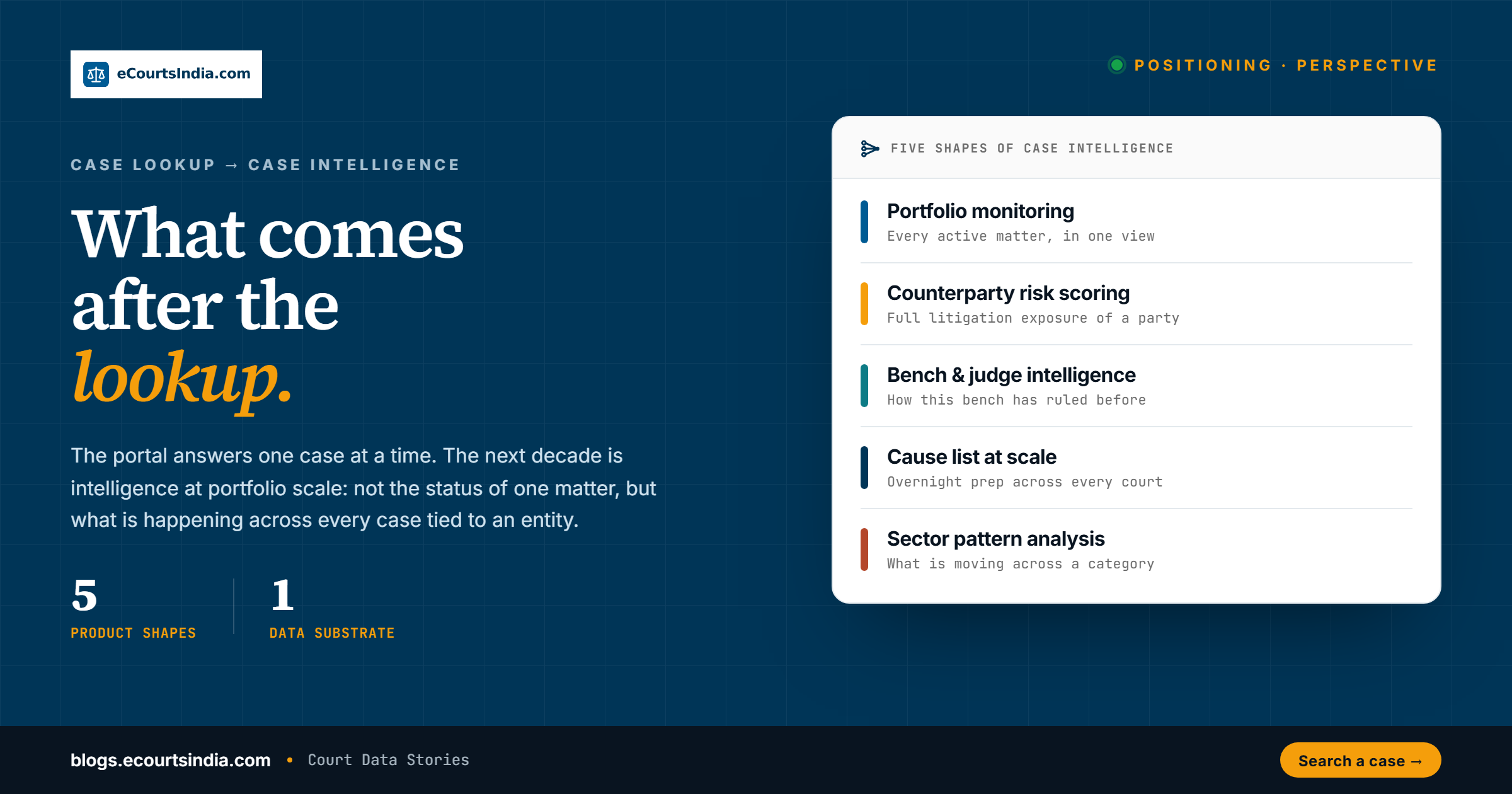
- There are five practical shapes: portfolio monitoring, counterparty risk checks, bench and judge research, cause-list intelligence, and sector pattern analysis.
- All five now run on one data layer: 32 crore+ case records and 125 crore+ orders and judgments on eCourtsIndia, across the Supreme Court, all 25 High Courts, district and taluka courts in all 36 states and union territories, and 18 tribunal and commission types.
- Monitoring is priced for individual lawyers: tracking costs Rs 5 per case per month, with WhatsApp or email alerts at Rs 0.50 each.
- Intelligence differs from legal research: it runs continuously on live matters rather than being opened occasionally for precedent.
Case lookup is the basic transaction. The user knows one matter, identifies it by CNR or case number, and asks for the current status. The answer is hearing dates, parties, advocates, the last order and the next listing. The transaction is complete in a single response.
Case lookup answers a specific kind of question. Is my matter listed tomorrow? Has an order been uploaded? Who is the opposing counsel? What is the next hearing date?
Case lookup does not answer the questions that decide value at portfolio scale:
- What is the full litigation exposure of this company across India?
- Which advocates have appeared against this opposing counsel before, in which courts, and with what outcomes?
- How has a particular bench of the Allahabad High Court at Lucknow handled cheque bounce matters?
- Which of my 200 active matters are listed in the next seven days?
- When did anyone last file a writ petition naming this state department, and what happened?
- Are there parallel proceedings against the same party in two different courts, possibly argued by different lawyers in unrelated firms?
- How long do partition suits take in Patna compared with Pune?
These are case intelligence questions. They sit at portfolio scale. They need entity resolution, search across courts, historical depth and pattern analysis. The one-case lookup model cannot deliver them, by design and by intent.
Why the portal was not built for intelligence
It is worth being honest about this. The eCourts services portal is the right design for what it is. A public records system needs to answer one case at a time, behind a captcha to prevent bulk extraction, on infrastructure sized for millions of small queries. The architecture optimises for predictable cost per query and resistance to abuse.
That architecture does not fit intelligence at scale. Intelligence needs bulk access, structured outputs, entity resolution across spelling variations, and programmatic access with predictable contracts. Each of those is a different design choice from the one a public records portal makes.
We set out the wider architecture in The Operating System for Indian Law. The public portal is the foundation. The intelligence layer is built on top, by private actors who can invest in the structured aggregation work the public layer was not built to do. The relationship is complementary. The public substrate stays cheap and abuse resistant. The intelligence layer sits on top and serves the use cases the portal cannot.

What case intelligence actually looks like, and what is live today
The product class is broad. Here are five concrete shapes, each with the part of eCourtsIndia that already does it.
1. Portfolio monitoring
A General Counsel, a senior partner or an in-house legal operations lead wants one view of every active matter against the company or for a client, with next hearing dates, recent orders and advocates. The old answer was a Friday spreadsheet. The current answer is a watchlist. On eCourtsIndia you add cases to the dashboard, group them by client, and the AI Clerk watches them every day. When a hearing date moves or a new order lands, a WhatsApp or email alert goes out, and the order can be summarised by AI. Tracking costs Rs 5 per case per month, alerts Rs 0.50 each and an AI order summary Rs 2. The setup is shown step by step in How to Enable Case Alerts for Any Court Case in India. Teams that prefer to work inside Claude can run the same check as a prompt, as described in Litigation Portfolio Monitoring for General Counsel.
2. Counterparty risk checks
A bank, an insurer, a fintech or a background verification firm wants the litigation exposure of a borrower, applicant, vendor or counterparty, across all of India and every type of matter. This is the dataset version of the idea in Why India Needs a CIBIL for Litigation. It now ships as LegalCheck, an identity-first legal background check that matches a person or company to their court records rather than returning every namesake. We explained how it works in the LegalCheck launch post. For firms building their own screening flows, the eCourtsIndia API has 23 endpoints and Rs 200 of free credits on signup, and this guide walks through a due diligence engine built on it.
3. Bench and judge research
An advocate preparing for a hearing wants to know how the bench has handled similar matters, how often it adjourns, and what its recent orders look like. That knowledge used to live in the memory of senior partners. Judge pages at ecourtsindia.com/judge now list a judge’s cases and orders across the index, and the search can be filtered by judge name. How to Research Judge Profiles and Court Patterns shows the workflow. Pattern data is a starting point for preparation, not a prediction of any individual outcome.
4. Cause-list intelligence
A firm with two hundred active matters across forty courts wants tomorrow’s listings checked overnight, sorted by courtroom and item number. We described the pattern in The 5 AM Cause List Problem. Daily cause lists for district and taluka courts are free on ecourtsindia.com/causelist, with 7 crore+ entries indexed. The eCourtsIndia Chrome extension flags tomorrow’s listings for the cases you follow, and the MCP server lets an assistant such as Claude run the whole check in one request.
5. Sector pattern analysis
A regulator, a journalist, a policy researcher or an academic wants to see what is happening across a category: PMLA, Section 138, family disputes, insolvency, election petitions. The data stories on this blog are examples of the product class, including PMLA Bail After Vijay Madanlal Choudhary, The Election Petition Graveyard, Cheque Bounce at Scale and The Indian Disposal-Time Index 2026. Each one is built from filters and facets that anyone can re-run through the search, the API or the MCP server.
| Shape of intelligence | Question it answers | Live on eCourtsIndia | Cost |
|---|---|---|---|
| Portfolio monitoring | What changed across my matters? | Dashboard watchlists, client grouping, AI Clerk tracking, WhatsApp and email alerts | Rs 5 per case a month, Rs 0.50 per alert, Rs 2 per AI order summary |
| Counterparty risk checks | What is this person or company’s litigation exposure? | LegalCheck, litigant search, API | Search free; LegalCheck partner API Rs 99 pay-as-you-go or Rs 33 with subscription |
| Bench and judge research | How does this bench deal with matters like mine? | Judge pages, judge filter in search | Free |
| Cause-list intelligence | What is listed tomorrow? | Free cause lists, Chrome extension, MCP server | Free cause lists; API usage billed on credits |
| Sector pattern analysis | What is happening across a category? | Search facets, API, MCP server, published data stories | Search free; API Rs 200 free credits on signup |
Five shapes, one substrate underneath. The same structured court data layer powers each.
Why this is a different product class from research
It is worth separating case intelligence from legal research, because the established Indian legaltech category, led by databases such as Manupatra and SCC Online, sits in the research lane.
Legal research is about precedent. You read judgments, build arguments around them and file briefs that cite them. The user is preparing for a hearing or writing a memo. The product is a search tool over a curated database of mostly appellate decisions.
Case intelligence is about ongoing matters and the entities behind them. You watch a portfolio, spot risk and measure patterns over time. The product is an alerting and reporting layer over a live, structured dataset of active and disposed matters.
These are different jobs. Research can largely ignore the district court tier because precedent value there is limited. Intelligence cannot, because that is where most of the activity is: about 26 crore of the 32 crore+ records on eCourtsIndia are district and taluka court cases. Research is opened occasionally. Intelligence runs in the background and tells you what changed.
The implication is that research databases and intelligence platforms will be judged as separate categories. Both can be valuable. They serve different jobs, different users and different budgets.
Why the intelligence layer is the bigger category
Three reasons it is structurally larger than research.
The buyer pool is wider. Research is bought mainly by lawyers preparing for appellate work. Intelligence is bought by lawyers, in-house counsel, banks, insurers, background verification firms, RegTech vendors and corporate diligence teams. Every organisation that has to track or assess litigation exposure is a potential buyer.
The use is continuous, not occasional. Research is opened a few times per matter. Intelligence runs daily. Recurring use means recurring revenue.
The data substrate compounds with use. Every entity resolved, every spelling variation captured and every court added makes the substrate sharper for the next user. Tribunals are a recent example: 18 tribunal and commission types, with 44 lakh+ records, now sit in the same search as the courts.
We made the wider market argument in India’s Legal AI Will Be a Ten Billion Dollar Category. The split between research and intelligence is part of that argument: intelligence is the half of the market that recurs.
What this means for product design
Three design implications follow.
The product has to support portfolio thinking. Not one CNR at a time, but a list, a client, an entity or a sector, with filters, client-based watchlists and update alerts.
The data layer has to be live. A weekly refresh is too slow for this product class. Daily at minimum, and faster for the next day’s cause lists. On eCourtsIndia any case can also be refreshed from the official court server on demand.
The agent layer has to be reachable. Many users will not learn a new interface. They will ask in plain language through Claude, ChatGPT or a similar assistant. The data has to be reachable through an MCP server so the assistant can fetch it without the user leaving her chat tool. The eCourtsIndia MCP server at mcp.ecourtsindia.com does this, and The AI Agent Layer for Indian Law sets out the architecture. Developers can start with How to Use the eCourtsIndia API.
Those three constraints define the product: portfolio views, live data, reachable by agents. The intelligence layer that wins is the one that holds all three to production grade.

What this means for eCourtsIndia
The next decade of Indian legaltech is not about better one-case lookup. The portal does that fine. It is about case intelligence at portfolio scale: lawyers monitoring two hundred matters at once, General Counsel running weekly risk briefs, banks checking counterparty litigation exposure, researchers watching sector patterns. eCourtsIndia is building the substrate that makes that possible, and most of the five shapes above are already usable today. Intelligence is the larger half of the category and the part that compounds.
If you want to try it on your own matters, search is free, the Android and iOS apps put tracking on your phone, and the AI Clerk free tier includes 50 credits a month. If a case you need is not in the index yet, use Add a Missing Case.
TL;DR
- The government portal answers one-case lookup at a time. That is the right design for a public records system.
- The next product class is case intelligence at portfolio scale: a different question, a different architecture and a different buyer pool.
- Five concrete shapes: portfolio monitoring, counterparty risk checks, bench and judge research, cause-list intelligence and sector pattern analysis. Each now maps to a live eCourtsIndia feature.
- Intelligence is a structurally larger category than research: wider buyer pool, recurring use and a substrate that compounds.
- Product design implication: portfolio views, live data and access for AI agents through MCP.
Sources
- National Judicial Data Grid pendency dashboard: njdg.ecourts.gov.in
- Model Context Protocol specification: modelcontextprotocol.io
- eCourtsIndia index figures (32 crore+ case records, 125 crore+ orders, 7 crore+ cause-list entries, 44 lakh+ tribunal records), checked 23 September 2026
- eCourtsIndia pricing: ecourtsindia.com/pricing, 23 September 2026
Read next: The Operating System for Indian Law and Why India Needs a CIBIL for Litigation.
Frequently Asked Questions
What is the difference between case lookup and case intelligence?

Case lookup answers the status of one matter at a time. You enter a CNR or case number and read the hearing dates, parties and last order. Case intelligence works at portfolio scale, resolving names to entities and searching across courts to show everything affecting a company or client. You can start with a free single lookup at ecourtsindia.com/search.
Why was the eCourts portal not built for intelligence at scale?
The eCourts services portal is a public records system. It answers one case at a time, sits behind a captcha to prevent bulk extraction, and runs on infrastructure sized for millions of small queries. Intelligence needs the opposite: bulk access, structured outputs, entity resolution and predictable contracts. That layer is reachable through the eCourtsIndia API, which has 23 endpoints.
What are the main shapes of a case intelligence product?
There are five: portfolio monitoring, counterparty risk checks, bench and judge research, cause-list intelligence and sector pattern analysis. On eCourtsIndia they map to watchlists with WhatsApp and email alerts, LegalCheck, judge pages, free cause lists with a Chrome extension, and search facets with the API and MCP server. The General Counsel version is covered in our portfolio monitoring playbook.
How is case intelligence different from legal research?
Legal research is about precedent. You read appellate judgments and build arguments around them, opening the tool occasionally for a hearing or memo. Case intelligence is about ongoing matters and the entities behind them. It runs continuously, watching portfolios and surfacing what changed. On eCourtsIndia you add cases to a client watchlist and get WhatsApp and email alerts, with tracking at Rs 5 per case a month. See pricing.
How much does case monitoring cost on eCourtsIndia?

Search, cause lists and the lawyer and judge directories are free. Tracking a case costs Rs 5 per month, each WhatsApp or email alert Rs 0.50, and an AI summary of a new order Rs 2. AI Clerk plans start with a free tier of 50 credits a month, and paid plans begin at Rs 250 + GST a month. Credits never expire. Details are at ecourtsindia.com/pricing.