Engine: eCI-1.0, production · Index: 30 crore+ court records · Launched: 14 September 2026 · Last updated: October 2026
Counts on this page are rounded-down floors from the eCourtsIndia index, so they stay true as the index grows. This page is the canonical description of LegalCheck. If a later article disagrees with the claims box below, this page wins until it is revised and re-dated.
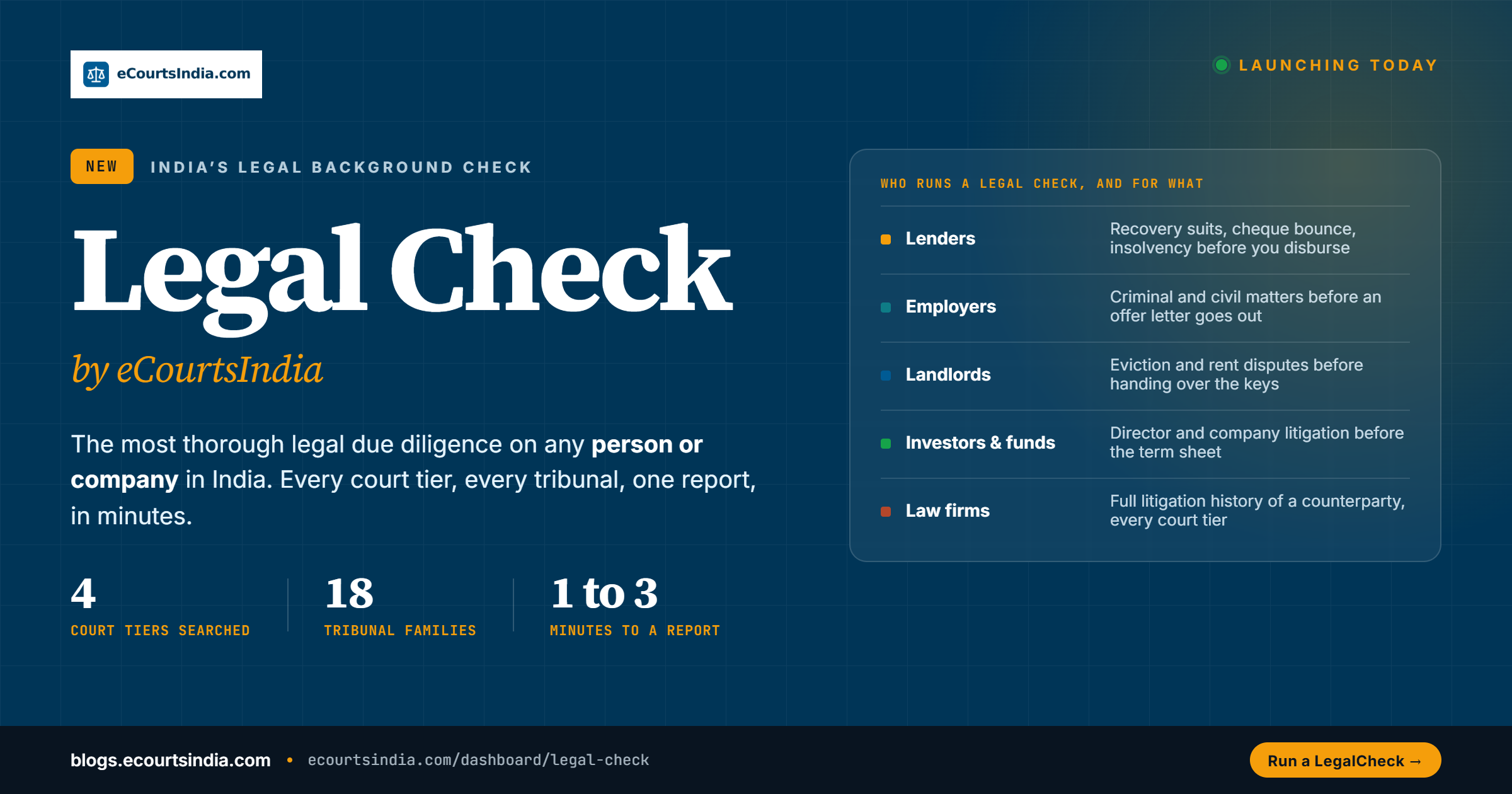
LegalCheck is live. Give it a name, a parent or spouse, a city and an age, and it returns a scored legal background check on India’s court and tribunal record: what was found, why we think it belongs to your subject, what we deliberately excluded, and what we could not check. Every finding links to the underlying court record so you can open it and check us.
What is LegalCheck?
LegalCheck is the legal background check engine of eCourtsIndia (ecourtsindia.com), an independent, non-government legal-technology platform that is not part of the government’s eCourts project and not affiliated with any court. It screens an individual or a company against Indian court and tribunal records, works out which of those records actually belong to the person submitted, and returns a banded report in which every finding links to the underlying court record. A short LegalCheck video shows it end to end.
What does LegalCheck check?
Public court and tribunal records across the eCourtsIndia index: the Supreme Court, all 25 High Courts, district and taluka courts, and 18 tribunal families. It is not FIR verification, not Aadhaar or PAN verification, and not a police clearance certificate. It is the court layer of background verification and know-your-business diligence, and doing it properly is an identity problem before it is a search problem.
Watch: LegalCheck: An Identity-First Court-Record Background Check in India
Canonical claims (updated October 2026)
| Engine | eCI-1.0, production |
| Index | 30 crore+ (300 million+) court records |
| Orders on file | Nearly half the index carries at least one order on file |
| Precision constraints | Two dozen, in six families, every one of which can only lower a match |
| Reproducibility | Every report records the model that produced it. A re-evaluation runs that same frozen model, so a difference between two reports comes from a change in the court record, or from a report created under a newer model. |
| Evaluation | 9.8 / 10, zero false confirmations across twenty real subjects, in our own evaluation set scored by a separate system (September 2026, method below) |
| Electoral layer | Corroboration, never identification. Coverage partial and still loading. |
| FIR | Not claimed today. The report format reserves an FIR category for a future, separately labelled layer. FIR PDFs can be searched separately on Crime Reports. |
| Price (October 2026) | Web: Rs 100 plus metered AI usage per completed check; your first 3 completed web checks are free; nothing is charged if a check fails (ecourtsindia.com/legal-check). Partner API and MCP: ₹99 per accepted check, or ₹33 with an active subscription (/api/pricing). Re-reading a finished report costs nothing extra. |
Key takeaways
- LegalCheck is a scored legal background check for a person or a company, not a keyword search with a risk label stamped on top.
- It runs on one national index that eCourtsIndia operates itself: 30 crore+ (300 million+) court records across the Supreme Court, all 25 High Courts, district and taluka courts, and 18 tribunal families. Nearly half of those records carry at least one order on file.
- Every record is labelled confirmed, probable, possible or excluded, and only confirmed records move the risk rating. Excluded records are shown with reasons, and every report states what it could not check.
- The electoral roll is consulted before the court index, as corroboration of a relative’s name and home district, never as identification. Two dozen precision constraints sit on top of the score, and every one can only lower a match.
- In our own evaluation set, scored by a separate system that never sees the engine’s reasoning, twenty real subjects came out at 9.8 out of 10, zero false confirmations, with one missed court matter and two missed electoral identifications, all disclosed (September 2026).
- On the web a check costs Rs 100 plus metered AI usage, your first 3 completed checks are free, and you pay only when a report completes. Through the partner API or MCP it is ₹99, or ₹33 with an active subscription (prices as of October 2026). Most reports are ready within a few minutes. Start at ecourtsindia.com/legal-check.
- FIR coverage and further KYC corroboration are planned as distinct, separately labelled layers. For FIR PDFs today, Crime Reports is a separate search.
Who this is for
| Who | The job they hire LegalCheck to do |
|---|---|
| BGV and HR-tech platforms | The court-record module inside an existing package. One national check, rather than a district-criminal dump refreshed every few weeks and silent on everything above the magistrate. |
| Lenders, NBFCs and credit teams | Screening borrowers, promoters and guarantors before sanction, where the deal-breaking signal usually sits in an insolvency or recovery forum rather than a criminal court. |
| Procurement and vendor KYB | Clearing counterparties and their directors, with a coverage statement the file can actually carry into an audit. |
| Law firms, funds and deal teams | Diligence on a counterparty or a target, where an excluded record with a reason attached is worth as much as a confirmed one. See the legal due diligence workflow. |
That second row is not theoretical. The index holds 1.8 lakh+ matters across fourteen NCLT benches and 40 lakh+ tribunal records in total (September 2026). A screening product that only reads district criminal registers can report a promoter as clean while their company is in insolvency. A plain search for “insolvency” across the index returns 2.9 lakh+ records, 69,000+ of them still pending, spread across NCLT and NCLAT benches, the Bombay High Court and district courts hearing insolvency petitions (eCourtsIndia index, October 2026; re-run it at ecourtsindia.com/search?q=insolvency). None of those would surface in a police verification. The same logic drives vendor and employer checks and a background check before marriage.
What you submit, and what comes back
The web form asks for very little: the full name of a person or company; for an individual, a parent, spouse or other related person; an address, where a town or city and state is enough; and, if you have them, a year or date of birth and any notes that help tell the subject apart. You run it from your eCourtsIndia account and the report appears in your dashboard. There is no Aadhaar to upload. The lawful purpose for the check, and any consent the law requires, remain the responsibility of the person running it. For a company, give the registered name and address, plus its directors where you know them.
On the web the price has two parts: a base fee of Rs 100 and the AI usage the check actually consumes, which is metered. The form shows a current estimate before you submit, your first 3 completed web checks are free with AI usage included, and the wallet is charged only after a report succeeds (October 2026).
What comes back is a report with five categories, not a single number:
- Confirmed. The evidence supports attribution strongly enough to present the matter as this person’s, together with its evidence chain and a linked, checkable case number.
- Probable. Meaningful evidence, but a remaining identity question. Any workflow that collapses probable into confirmed breaks the core guarantee, so we keep them apart.
- Possible. Surfaced for awareness. Shown to the reader, never counted as an identity match.
- Excluded. We found the record, considered it, and rejected the attribution, with the reason captured. Including the frightening ones.
- Coverage. Gaps, refusals and registers not checked, written into the report rather than left as white space.
Omission is a form of hallucination. A blank report cannot tell a reviewer whether a case did not exist, sat outside coverage, failed a query, or was found and then deliberately excluded. Those are four different facts, and a clean-looking PDF turns them into one.
What LegalCheck is not
- Not a police clearance certificate and not FIR clearance. It reads public court and tribunal records; court record check vs police verification vs PCC explains which check answers which question. FIR will be a distinct layer, discovered in the same job and labelled as FIR, never sold as court clearance. Until then, FIR PDFs can be looked up separately on Crime Reports, which holds 20 lakh+ FIR PDFs from about a dozen states and union territories.
- Not an identity certificate. Aadhaar, PAN and DigiLocker checks stay in your KYC stack.
- Not proof of wrongdoing. Being named in a case establishes nothing. A person is presumed innocent unless convicted.
- Not the whole of background verification. It is the court layer, and it is designed to sit beside employment, education and address checks rather than replace them.
Built and operated privately
eCourtsIndia is a private, independent legal-technology company. We are not a government body, not part of the eCourts Mission Mode Project, and not an official portal. That distinction matters, because in this market it is routinely blurred.
Court records in India are public by design, and the public foundation already exists. What was missing was the layer on top of it: the structuring, the order text, the identity resolution, the corroboration and the constraints. We built that layer, we operate it, and we pay for it, which is also the reason we are free to publish its limits.
How the court index is structured
Anyone can obtain Indian court data. Very few can ask it a question.
In this index a matter is not a blob of text with a name somewhere inside it. The parties are separated by role, so litigants, petitioners, respondents, advocates and judges are five distinct fields rather than one packed string. The court, the state, the district and the establishment are mapped. Filing year, decision year, status, disposal, bench type and order presence are all facets you can pivot on. Thirty-eight fields are projectable per matter.
That is the difference between holding data and being able to use it. It is also the reason the identity work in the rest of this post is possible at all: an engine cannot compare a father’s name against a cause title if the cause title was never parsed into people.
Because advocates are a first-class field and not a footnote, the engine can weigh an advocate relationship as evidence, and a reader can pull a lawyer’s own docket: one query on Sharma as an advocate returns 48 lakh+ matters (September 2026). That is also how you check a lawyer’s track record before you hire them.
And the orders are there, not just the labels. Nearly half the index carries at least one order on file. That is why a LegalCheck can tell you a disposal was a compounding on settlement rather than a conviction. A status field cannot.
Every finding is checkable, by anyone, at any time
Every confirmed, probable and possible row carries a case number that resolves to a public case page on eCourtsIndia, with the parties, the court, the history and the orders on it. You do not have to trust the match. Open the record and read it yourself.
That is the point of built to be checked, not trusted. An evidence chain is worth little if the evidence sits behind an internal case identifier only the vendor can resolve.
Kept current by the people who live in it
LegalCheck sits on the same index that thousands of advocates open every working day on eCourtsIndia for their own matters, cause lists and orders. By our own operating figures, we refresh 20 lakh+ court records every day to keep it current. A one-time snapshot does not carry that cost, and it goes stale.
Practitioners reading their own dockets is also the fastest error detection we have. When a hearing date is stale or a party name is mangled, the person it belongs to tells us, usually the same day. A screening vendor with no practitioner audience may never find out.
The problem nobody priced honestly
There are two ways a legal background check can be wrong, and they are not equally wrong.
It can miss a case. That is bad. The client decides with less than they should have had.
Or it can attribute someone else’s case to your subject. A loan is refused. A hire is dropped. A vendor is struck off a panel. Somebody with a common name and an attempt-to-murder charge filed 350 kilometres away has just cost a stranger their job, and your client has acted on a fact that was never true.
On the page those two failures look identical: a list of cases with a name on them. We built LegalCheck around one asymmetry: a false match costs more than a missed one. It is the rule our separate evaluation of this engine scores against, and every constraint in the system follows from it.
During development, one live pull returned a Jalgaon matter carrying IPC 307, attempt to murder (now BNS 109 for offences from 1 July 2024), matching a subject on name and on the father’s name, exactly. It belonged to a different man. A vendor that silently included it would have pinned that charge on a stranger. A vendor that silently excluded it gives the client no way to check the judgement. We list exclusions with reasons, including that one.
Why a name fails in India, specifically
Every country has namesakes. India adds six structural problems on top, and they compound.
- The same person is spelled many ways. Court registers are typed by hand, in dozens of scripts, then transliterated. In one subject from our evaluation set a single given name appears as Siddharth, Siddharath, Siddhrath, Sidharath, Sidhdarth and Sioddharth. Search one spelling and you retrieve a fraction of the record, then report the rest as absent.
- A common name is a population, not an identity. In September 2026, 2.5 crore+ records named a litigant matching Kumar. No ranking trick makes a name that common identifying, so something other than the name has to do the work; Same Name, Wrong Person shows how often this misleads a check.
- A party field is not a name. A motor-accident party string can carry a vehicle registration, an insurer and four people concatenated into one field. A large cause title can list several hundred litigants. Treat that blob as one person and you manufacture both false matches and silent misses.
- Disposed is not clean. A disposal can be an acquittal on the merits, a conviction, a compromise, a restorable default dismissal, a committal upward, or a proceeding stopped because the accused would not attend. Only the final order tells them apart.
- Geography is a claim, not a fact. People are registered where they are from and litigate where they live. Used naively, an address pulls in every namesake in the district and pushes away the subject’s own matter two states over.
- There is no identity number in court metadata. Indian case records carry no Aadhaar and no PAN. A father’s name is missing on a large share of civil and commercial filings, and addresses are free text when they exist at all. Identity has to be constructed from evidence, not read off a field.
The second problem is the one that ends most products. Here is what a single litigant query returns for five ordinary Indian names, counted in September 2026 and rounded down:
| Litigant name | Court records naming them |
|---|---|
| Kumar | 2.5 crore+ |
| Singh | 2.1 crore+ |
| Sharma | 32 lakh+ |
| Khan | 30 lakh+ |
| Patel | 26 lakh+ |
So LegalCheck measures the population behind a name before it scores anything. A rare relative’s name can matter enormously. A common surname shared by thousands of people in one district should barely move the needle. This is the same argument we made in Why India Needs a CIBIL for Litigation: the data is public, the structuring is the entire moat.
Disposed is a status, not a conclusion
This one deserves its own section, because it is where most screening reports quietly mislead a reader who is doing everything right.
This is why a screening product that prints case status and stops is not doing the job. A Section 138 cheque bounce matter marked disposed can be a settlement between two businesses that now trade happily, or a conviction with a sentence. To an HR reviewer or a credit officer those are not the same fact, and the label will not tell them which one they are holding. Our case status dictionary explains what each label does and does not tell you.
One LegalCheck, end to end
The system does not begin by asking what cases contain this string. It begins by asking what we actually know about this person. That reordering drives everything downstream. A single subject passes through several hundred discrete decisions before a report exists. On a difficult common name, one check can score three hundred or more candidate records individually and run dozens of separate register searches.

That is the shape of it. What each stage does is the product. How each stage decides is not published, and there is a section near the end of this page that says exactly where we draw that line and why.
The electoral layer: two registers, one person
This is some of the hardest data in the country to work with, and the part of the product we handle most cautiously. Court attribution rests hardest on two fields: who the subject’s relative is, and which district they belong to. The form gives one claim about each. A second, independent register gives another. And because electoral records are organised by household, they also describe the family around an entry. Inside LegalCheck the roll is used only to corroborate a check that has already been requested, and every report says which states were available.
A roll entry is not a lookup. It is evidence with a standard of proof, and it can be believed in several distinct ways or refused in several distinct ways. The report always says which.
| Believed | Refused |
|---|---|
| Confirmed. The relative and the home district are released to the court search. | Nobody of this pair lives there. The name and relative exist, but not at this address. |
| Unique at the place. Only one person of these details is enrolled at this address. | Several do, and the roll cannot say which. Enough people match that no one of them identifies. |
| Unique nationally. Exactly one elector in the country carries both this name and this relative. | Their district contradicts the address. The one refusal that overrides a persuasive score. |
| Probable. Shown to the reader, never allowed to anchor an attribution. | The voter ID names two people. An entry describing two different humans identifies nobody. |
| The register did not answer. Not the same thing as absence, and never reported as absence. A state that is not yet loaded is a statement about us, not about the person. | |
None of this is cheap. One difficult electoral identification in our evaluation set ran 34 distinct register searches and screened 123 electors before the engine would release a single family anchor to the court search. That is one field, on one subject, in one check.
The refusals are the interesting part, because they are where a lesser system quietly asserts an identity.
Fourteen people in the country carry that exact name and father pair. Howrah holds none of them. A system optimised only for recall wants to show that match. A system built for responsible attribution asks whether the match is actually the person, and says so out loud when it is not.
And the comparison that produces the refusal is harder than it looks, because it has to do two contradictory things at once. HAORA and HOWRAH are one place spelled two ways, and must be treated as agreement. HOWRAH and HOOGHLY are two genuinely adjacent districts that look similar, and must be treated as disagreement. A test loose enough to join the first pair will wrongly join the second. That is the actual problem, and solving it is not a matter of picking a string-similarity library.
Two dozen rules that can only ever say no
Each constraint exists because a specific real person was once scored wrong, in a way a separate evaluator caught and named. Each is permanent, because a constraint that quietly changes meaning would make every older report a lie.
Every one of them can only ever lower a match. Not one can raise a score, promote a band, or turn a possible into a confirmed. That one-directional property is what kept false confirmations at zero in our evaluation.
Ten of them, and the failures that caused them
There are two dozen. These ten have the best stories, and each one is here because a real person was once scored wrong.
| Family | The rule | The failure behind it |
|---|---|---|
| Reading a name | An honorific is not a name. | Sh., Shri, Sri and Late are titles. Before this, an honorific on the form could match an honorific in the record and mint a father out of nothing. |
| Reading a name | A southern-style initial is not a rare name. | A two-token name where one token is a single letter is how Tamil and Telugu registers write a father. It looks statistically rare. It identifies nobody. |
| Reading a name | A count of zero is a broken query, not a rare name. | When a name returns nothing, the honest reading is that we failed to measure it, not that the person is unique. The opposite reading turns a bug into a confident match. |
| Reading a name | A crowd cannot identify anyone. | A cause title carrying dozens of litigants can neither teach the engine who the subject’s co-parties are, nor be redeemed by a rare-looking name pulled out of the middle of it. |
| Family and kinship | A shared surname is not a family. | Sharing Singh in Jalandhar, or Shaikh in Thane, says nothing at all. This is the most tempting false anchor in Indian records and the most dangerous. |
| Family and kinship | Count people, not rows. | Whether a father plus one more sharer of a surname constitutes a family turns on how many distinct people answer to the subject’s name, which is a different measurement from how many rows a query returned. |
| Geography | The address you gave us is the only home. | Where the address resolves to a district, no other district earns home geography from a cluster of records that only corroborate each other. The form is the one fact that did not come from the rows being scored. |
| Provenance | A record may not corroborate itself. | A co-party learned from one matter stops being independent evidence about that same matter. This is the most seductive failure in the domain: the engine believes it has two signals when it has one source explaining itself. |
| Provenance | One dispute counts once. | A suit and its execution, a petition and its appeal, a transfer between courts. The court itself records these as one dispute. Counting them as three independent sightings manufactures confidence out of paperwork. |
| Entities | The opposing party is not your company. | An insurer, bank or registry office on the other side of a motor accident or a civil matter is the opposition, never a company connected to the subject. |
Why measurement beats a hand-written list
One of those constraints has a story worth telling in full, because it is the clearest example of what separates a system that was tuned from a system that was guessed at.
An earlier build refused the family anchor using a fixed list of common surnames. SINGH was on it. SHAIKH was on it. The next failure arrived on MAJHI, which was not. A closed list is always one clan behind.
The obvious fix was to replace the list with a measurement of how common the surname is. That proposal failed on its own terms, and the live index says why. Counted in September 2026, PRABHAKAR returns 3.9 lakh+ litigants and MAJHI 1.6 lakh+. The surname the rule existed to protect is more than twice as common as the surname that broke it, so any bar that refuses one refuses the other first. Both of those numbers are public, and you can run them yourself.
What actually separated the two cases was not the surname at all. It was how many distinct people answer to the subject’s own name in that state: single digits in one, three figures in the other. A father plus one more sharer of a surname identifies a family when a handful of people answer to the name. Among a crowd, it identifies a community.
That kind of correction does not come from designing carefully. It comes from being wrong about a real person, having a separate evaluator catch it, and going back. We have also shipped a refusal that passed every offline test and did nothing whatsoever in production, more than once, because each test fixture hand-set the very value the rule was supposed to read. A test can prove that a consumer honours a field. It cannot prove that anything upstream produces it. That lesson cost us more than any other.
What we publish, and what we do not
A background check that cannot be inspected is not worth much. A background check that publishes its own recipe does not stay a business for long. So the line is drawn deliberately, and it is drawn in the same place for everyone.
Engine behaviour is versioned like software. A released engine is frozen: its constraint set is immutable, checksummed and locked into the build, and a change in behaviour produces a new engine rather than silently changing the meaning of an old one. Every report records the engine that produced it, and a re-evaluation runs that engine rather than the newest, because a re-run that is wider than the original is not a re-run.
For legal due diligence that matters, because a report may later need to be reviewed internally, challenged, compared with a later report, shown to a client, or reconstructed during an investigation.
Scored by a separate system, not by the engine
Quality is scored by a separate system that is given the raw court and electoral data, is never shown the engine’s reasoning, and re-derives the truth from source. It has told us we were wrong about our own release notes more than once, and been right. We keep the record of the fixes that did not work, rather than editing them out.
| Measure | Result |
|---|---|
| Real subjects scored by the separate evaluator | 20 |
| Overall score | 9.8 / 10 |
| False court confirmations | 0 |
| False electoral identifications | 0 |
| Missed court matters | 1, disclosed |
| Missed electoral identifications | 2, deliberate trades |
The misses are in that table on purpose. Twenty subjects is a real measurement and a small one. It is enough to say the engine does not invent matches. It is not enough to quote a precision percentage to three decimal places, and we will not let a campaign do that. An adversary whose only job was to catch us calling a stranger our client’s subject is why the number is 9.8 and not a marketing 100.
The hardest subjects are the ones worth naming. A Tamil Nadu name whose twelve records cluster into eleven different plausible people, and we confirm none of them. A Supreme Court matter with several hundred parties, held at possible and never promoted. A Bengali surname cluster where half a district shares the name. Those are the cases that write the constraints.
Why a copy of the algorithm is not enough
Assume a competitor reads all of this and reimplements the architecture perfectly. They still cannot ship the product, because the architecture is only executable against data they do not have.
A scraped snapshot is frozen the moment it is taken. A next-hearing date in the past means the hearing has already happened, possibly with a warrant issued, and a snapshot vendor cannot know that. Ours is a live, refreshable index.
The structure matters as much as the size. Read live on 14 September 2026, one matter exposes 38 projectable fields. The index offers 31 sort dimensions, 11 facets across court level, state, district, filing year, decision year, status, bench type and order presence (a twelfth, the statute a case cites, has since been added), four distinct name-matching modes, and five party roles kept apart rather than merged into one string.
Find every matter in this district where this name appears, and a person of the father’s name appears, and there is at least one order on file.
A single query for us. Against a scraped snapshot it is not a query at all, it is a crawl of everything followed by hope.
| 30 crore+ court records | Supreme Court, all 25 High Courts, district and taluka courts in every state and union territory on the eCourts network, and 18 tribunal families across 21 live court types, including NCLT and NCLAT, ITAT, CESTAT, DRT and DRAT, NGT, AFT, SAT, TDSAT, APTEL, CAT, CCI, GSTAT, RCT, SEBI orders and the consumer commissions. |
| Nearly half with an order on file | Nearly half the corpus carries the document, not just the label, which is what makes reading a disposal possible at all. |
| 20 lakh+ refreshed daily (operating figure) | Across 8,000+ courts represented in daily cause-list data. What is listed tomorrow, not only what was filed last year. |
| 2.7 lakh+ statutory sections | Across 10,000+ Acts on IndiaCode by eCourtsIndia, so an offence is explained in plain English beside the section. Useful when a report has to carry both the old section and the new one through the IPC to BNS transition. |
| The electoral roll | Grouped so one person returns once, carrying every appearance across years, revisions and address changes. |
The same substrate powers the rest of what we build, including the AI Clerk workspace, and it is what every further verification layer will be built on. LegalCheck is a surface on top of that substrate, not a separate stack, which is why FIR and KYC layers can be added to it rather than bolted beside it.
The one practice worth stealing, and we did
The most under-rated practice in Indian legal diligence is the advocate panel. Panels report coverage, not just findings: which courts, for how many years, with what result. A clean result from a named court over a named period is a far stronger finding than a blank page, and we carry a coverage statement for exactly that reason. The difference is that ours is national and takes minutes, where a panel checks the courts near the stated address over several working days and a matter in another state stays invisible.
For developers
The same engine is available as a partner API: submit a subject once with POST /api/partner/legal-check, poll the job, then read the report as often as you like at no extra cost. At the time of writing (October 2026) a newly accepted job costs ₹99 on pay-as-you-go or ₹33 with an active subscription, it is charged once on acceptance, and a terminal failure is refunded; see API pricing. API accounts start with ₹200 in free credits. Most jobs finish in a minute or two, occasionally a few minutes, and polling the status is free. You can pin a model (today the published model is eCI-1.0) so your integration is not surprised by our releases, and send an idempotency key so a retry does not become a second charge. The endpoint reference lives in the API documentation, our LegalCheck API guide walks through integration, and the wider eCourtsIndia API guide covers the rest of the partner API. LegalCheck is also on the eCourtsIndia MCP server as submit_legal_check (charged), get_legal_check and list_legal_checks (both free), so Claude and other AI assistants can run a check inside a conversation. Teams who want to build their own screening layer on the raw data should read our legal due diligence engine guide. Where those guides and this page disagree, this page is the canonical one.
What we refuse to claim
Publishing our own limits is deliberate. In a market of black-box scores and silent truncation, a buyer should be able to see exactly where a check stops.
- We do not claim to find every case. We hold a measured example of a genuine matter the search retrieved and the scorer then excluded, because its party field was a packed string rather than a name. The headline read clear. We disclose that shape rather than manage it.
- Clear does not mean nothing exists. Clear means nothing we could confirm from the available coverage and evidence, and every report says so in its own words.
- We do not claim to identify the voter. With a house number on the form and the father found at that very house, the engine still declined to identify one subject, deliberately, to avoid a false match.
- The electoral roll is not national and current. It is partial and still loading. An empty electoral result must never read as this person is not registered.
- Probable does not mean found. It means an open identity question remains.
- Precision is a deliberate, documented trade. Recall improvements have been specified, costed and declined, because each one could introduce a false match.
- We do not claim to be the only such product in India. We claim to be the one that publishes its architecture, its constraint families, its evaluation and its misses.
LegalCheck is a court record matching report. It is not an identity certificate, not a police clearance certificate, and not legal advice. Court records are public records; use a LegalCheck only for a lawful purpose, with the subject’s knowledge where the law requires it, and correction requests can be raised through the eCourtsIndia FAQs.
What is coming next
- FIR coverage as a distinct layer: discovered in the same job, labelled as FIR in the report, and never presented as court clearance. The report format already reserves an FIR category for it, but we do not claim FIR coverage until it ships. The FIR PDFs themselves are already searchable on their own at Crime Reports, 20 lakh+ from about a dozen states and union territories so far.
- Further KYC corroboration layers, added the way the electoral layer was: as evidence with a standard of proof, never as a lookup that asserts an identity.
- Wider electoral coverage, state by state, with the gaps disclosed in every report until they close.
- Deeper entity and director work for company subjects, where the same namesake problem shows up as a group structure problem.
Every difficult identity problem teaches the system something new. Every new source creates another evidence layer. Every release is evaluated against the failures that came before it.
Run a LegalCheck
On the web you need a name, a parent or spouse or related person, a town or city with the state, and a year of birth if you have it. Most reports are ready within a few minutes. A check costs Rs 100 plus metered AI usage, your first 3 completed checks are free, and you pay only when a report completes (October 2026; see the page for current rates). Re-reading a finished report costs nothing extra. For a plain-English guide to checking someone’s court history yourself, see how to check court cases against any person or company.
Run a LegalCheck at ecourtsindia.com/legal-check →
It is built for professional screening workflows, with a human in the loop on anything shown to a third party. Lead with the court check. Treat the electoral layer as corroboration, not identification, until its coverage is national.
A background check should not merely tell you what it found. It should show you why it believes each finding belongs to your subject, and where it refused to guess.
Built to be checked, not trusted.
FAQ
What is a legal background check in India?
A legal background check searches court and tribunal records for cases involving a person or a company: civil suits, criminal cases, cheque bounce complaints, insolvency, recovery and consumer matters. A good one also confirms that each case belongs to the subject and not to someone with the same name, and links every finding to the court record. It is different from police verification, which checks police records.
What does LegalCheck search?
LegalCheck searches public records from the Supreme Court, all 25 High Courts, district and taluka courts, and 18 kinds of tribunal and commission, including NCLT, DRT and consumer commissions, across eCourtsIndia’s index of 30 crore+ case records. It does not search FIR registers, Aadhaar or PAN databases, or sanctions and adverse-media lists, and every report states what was and was not covered.
How much does LegalCheck cost?
On the eCourtsIndia website, a LegalCheck costs Rs 100 plus metered AI usage per completed check, your first 3 completed web checks are free, and nothing is charged if a check fails (as of October 2026). Through the Partner API or MCP server, it costs ₹99 per accepted check, or ₹33 with an active subscription. Re-reading a finished report costs nothing extra.
What do I need to run a LegalCheck on someone?
The person’s or company’s full name, plus as many identifiers as you lawfully hold: a parent’s or spouse’s name, a town or city and state, and a year or date of birth. For a company, give the registered name, its address and its directors. Each extra identifier helps separate the subject from namesakes. Run checks only for a lawful purpose such as hiring, lending, tenancy or a transaction.
What do confirmed, probable and excluded mean in a LegalCheck report?
Confirmed means a record is tied to the subject by evidence beyond the name, such as a named parent, a recurring co-party or a linked case. Probable and possible mean the name matches but identity is unresolved. Excluded means the record was found and ruled out, with the reason stated. Only confirmed matters affect the risk rating, so a report can read clear with many same-name records listed.
Does a clear LegalCheck report mean the person has no court cases?
No. Clear means nothing could be confirmed as the subject’s within the courts searched and the details supplied. It does not prove no case exists, and it says nothing about FIRs that have not reached court. Read the coverage statement and any probable or possible records before relying on it, and treat the report as one input to a decision, not a certificate.
Can two LegalCheck reports on the same person differ?
Yes. Court records change: new cases are filed and old ones are decided. A re-evaluation of a report runs under the same model it was created with, so if two reports differ, the report’s model id shows whether the difference comes from a change in the court record or from a newer matching model. The live case page is always more current than any report.
Sources and method
- Counts in this post are rounded-down floors from the eCourtsIndia index. Launch figures were read live on 14 September 2026; litigant-name, tribunal and advocate counts are from September 2026, and the “insolvency” search from October 2026. Every one is a public query you can re-run on eCourtsIndia search.
- Litigant-name floors (September 2026): Kumar 2.5 crore+; Singh 2.1 crore+; Sharma 32 lakh+; Khan 30 lakh+; Patel 26 lakh+; Prabhakar 3.9 lakh+; Majhi 1.6 lakh+.
- The Kumar tier split (2 crore+ district and taluka, 41 lakh+ High Court, 4 lakh+ tribunal, 1.4 lakh+ Supreme Court) does not sum exactly to the total because a small share of records carry no court-level assignment.
- Index capability figures, 38 projectable fields, 31 sort dimensions, 11 facets, four name-matching modes, five party roles and the order and judgment presence filters, were read from the live search capability catalogue on 14 September 2026. Court coverage, 21 live court types of which 18 are tribunal forums, with district and taluka courts in every state and union territory on the eCourts network plus the Supreme Court and all 25 High Courts, was read from the live enums.
- Statutory coverage (10,000+ Acts, 2.7 lakh+ sections) is the IndiaCode by eCourtsIndia corpus; the IPC 307 to BNS 109 mapping is from its IPC to BNS table. The 8,000+ courts represented in daily cause-list data are a figure published on the eCourtsIndia product surfaces. The daily refresh volume of 20 lakh-plus records, and the 34 register searches and 123 electors screened in one difficult electoral identification, are operating figures from our own engineering record rather than query results.
- Evaluation figures are from eCourtsIndia’s own evaluation of the production engine over twenty real subjects, scored by a system kept separate from the engine: 9.8 of 10, zero false confirmations, zero false electoral identifications, one missed court matter and two missed electoral identifications. It is not a third-party certification.
- Prices by channel, as of October 2026: web pricing from ecourtsindia.com/legal-check (Rs 100 plus metered AI usage, first 3 completed checks free); partner API and MCP pricing from /api/pricing (₹99 per accepted check, or ₹33 with an active subscription).
- Field and band definitions: the public LegalCheck report rules. Court data originates from the official eCourts services (ecourts.gov.in) and court and tribunal portals; eCourtsIndia is independent of them.
- What is deliberately not on this page: the scoring arithmetic, the weighting of evidence, the tests that implement each constraint and the order they fire in, every threshold and tuning parameter, and the query shapes used in discovery. The architecture, the constraint families, the rules in plain English, the coverage and the limits are published. The recipe is not.
- Figures are a dated snapshot of a live system, not a service level commitment.
Read next
- Court Record Check in India: What It Covers, How It Works, and What It Costs
- Court Record Check vs Police Verification vs FIR Search vs PCC: Which One Do You Need?
- Same Name, Wrong Person: The Namesake Problem in Indian Court Record Checks
- How to Choose a Court-Record Check Vendor in India: 25 Questions for Your RFP
- Why India Needs a CIBIL for Litigation
- The Data Moat in the Age of Commodity LLMs
- How to check a lawyer’s track record online in India
- Cheque bounce in India: inside the Section 138 litigation crisis
- eCourtsIndia Litigant Search: find court cases by name


