Last updated: 28 September 2026
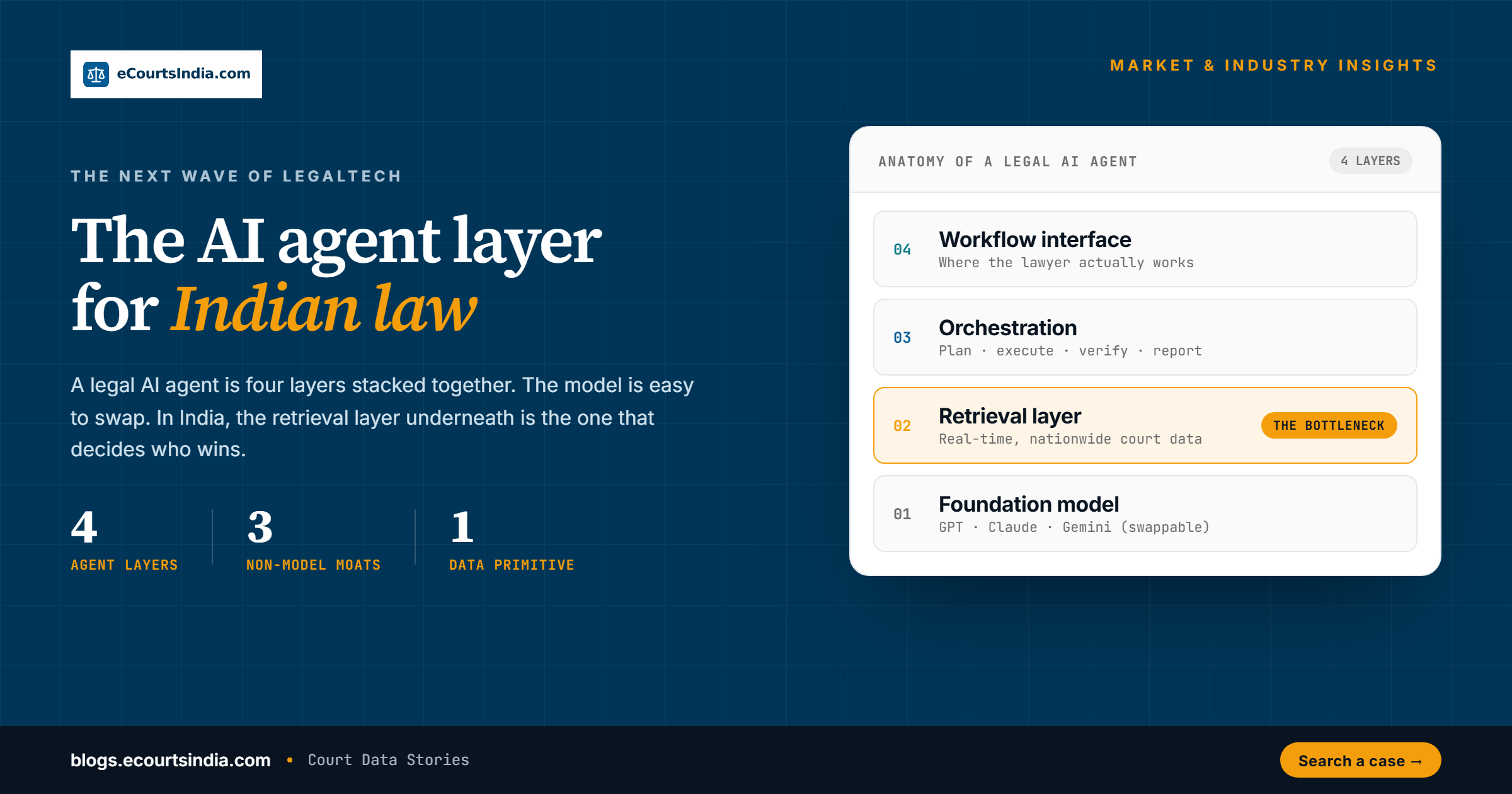
An AI legal agent for Indian law is built from four parts: a foundation model, a retrieval layer of court and statute data, an orchestration layer, and a workflow interface. In India the retrieval layer is the real bottleneck, because clean, current, nationwide court data is hard to get. The Model Context Protocol (MCP), an open standard now supported by Anthropic, OpenAI and Google, is a widely adopted way to wire that data into an agent.
Legal AI has moved from novelty to a line item in legal budgets. On 9 September 2026 Harvey raised USD 550 million at a USD 15.5 billion valuation, led by Diffusion and Lightspeed, up from USD 11 billion in March 2026 (Harvey). Hebbia raised a USD 130 million Series B led by Andreessen Horowitz in July 2024 (as reported).
Thomson Reuters completed its USD 650 million cash acquisition of Casetext, maker of CoCounsel, in August 2023. Clio completed its USD 1 billion acquisition of vLex in November 2025. The agent layer for legal work is real and well funded. The question for India is not whether the wave arrives, but what the Indian stack looks like when it does.

Key takeaways
- A legal agent is model + retrieval + orchestration + workflow. The model is the easiest part to swap.
- Many early legal AI failures are data failures: invented citations, missed recent orders, merged parties, missing district courts.
- MCP, open-sourced by Anthropic in November 2024 and now a Linux Foundation project, lets any compatible agent call an external data source through one shared contract.
- The eCourtsIndia MCP server exposes 39 tools (v4.46, September 2026) across four datasets: cases and orders, district and taluka cause lists, a free statute book of 10,000+ Acts, and the electoral roll.
- The global money is going to workflow companies such as Harvey. In India, whoever builds the workflow will still need a court-data layer underneath.
This post covers the anatomy of a legal agent, what MCP is, what is different about India, who is building, why the data layer is the bottleneck, what Indian courts say about AI, and the checklist an Indian legal MCP server has to meet.

What is an AI legal agent?
Strip away the marketing, and a legal AI agent is four things.
- A foundation model. GPT, Claude, Gemini or a fine-tuned variant. Any of these can be the reasoning engine, and Harvey has even started post-training its own.
- A retrieval layer. Access to case law, statutes, court records and the client’s own matter data. This is where court data lives.
- Orchestration. The prompts, guardrails and multi-step logic that let the agent plan, execute, verify and report.
- A workflow interface. Where the lawyer actually works: a document editor, a matter screen, a chat window, a review pane.
The foundation model is not the moat (an advantage competitors cannot easily copy). Builders switch models in an afternoon. The retrieval layer is a moat because it depends on data access and quality. Orchestration and workflow are moats because they depend on domain expertise and product work. In our view, the winners in each market will be strong on all three non-model layers. We argued the same point from the data side in data moats when LLMs are a commodity.
What is MCP and why does it matter for legal AI?
The Model Context Protocol is an open standard that lets an AI model call external tools and data sources through a shared contract, so an agent can reach current court data without custom scraping or a bespoke integration. Anthropic published the specification in November 2024. In December 2025 Anthropic donated MCP to the Agentic AI Foundation, a Linux Foundation project whose members include OpenAI, Google and Microsoft.
It is a contract, like HTTP, not a product. Anyone can build a server that speaks MCP and anyone can build a client that calls it. Claude supports it natively, and OpenAI and Google have added MCP support to their agent tooling since. For a legal team, the practical effect is that the AI tool they already use gains the ability to answer questions about real Indian matters. Our MCP 101 for legal teams is the longer primer, and the step-by-step connect guide shows the setup in Claude.
How is Indian law different for AI agents?
- The corpus is large. Over 5.6 crore cases were pending across Indian courts in July 2026, about 4.99 crore of them in district and taluka courts, according to the Law Ministry’s reply in the Lok Sabha. Our own index holds 32 crore+ case records and 125 crore+ orders and judgments, and much of India’s case law is multilingual.
- The public data layer is open. The Government’s eCourts services, the National Judicial Data Grid (NJDG) dashboards and High Court websites publish case status, orders and cause lists free of charge, though there is no official public bulk API. That lowers the cost of getting data for Indian builders. eCourtsIndia is a private platform, not the Government’s eCourts portal (ecourts.gov.in).
- The language question is real. Orders in many states are in regional languages. A national agent has to handle Hindi, Marathi, Tamil, Telugu, Bengali and more. That is an obstacle today and a moat for whoever solves it.
- The professional context varies widely. A Supreme Court senior counsel’s day looks nothing like a district court solo practitioner’s. One agent will not fit both. Vertical agents by court tier, matter type and buyer are more likely to win.
- Tribunals matter. Much commercially important litigation sits in the NCLT, DRTs, ITAT and consumer commissions. These tribunals run their own portals, outside the regular court system and the official eCourts CNR numbering. Their orders can still reach the High Courts or the Supreme Court, often after a further appeal to a body such as the NCLAT or DRAT. eCourtsIndia assigns its own 16-character CNR-style ID to cases from 14 tribunals, including these four.
Who is building legal AI agents?
We name names carefully and only from public information.
| Company | What it does | Public signal |
|---|---|---|
| Harvey | Legal AI workflows for law firms and in-house teams; publicly multi-model | USD 550 million at USD 15.5 billion valuation (Sep 2026); used by 80% of Am Law 100 firms (company claim) |
| Hebbia | Agentic document analysis for finance and legal work | USD 130 million Series B led by Andreessen Horowitz (Jul 2024) |
| Legora | Collaborative AI platform for lawyers; offices include Bengaluru | USD 550 million Series D at USD 5.55 billion valuation (Mar 2026) |
| LexisNexis Protégé | Agentic AI assistant inside Lexis+ | Lexis+ with Protégé replaced Lexis+ AI in the US (Feb 2026) |
| Thomson Reuters CoCounsel | Legal AI assistant built from the Casetext acquisition | Casetext acquired for USD 650 million in cash (completed Aug 2023) |
| Clio and vLex | Practice management plus legal research and AI | Clio acquired vLex for USD 1 billion (completed Nov 2025) |
| Anthropic | Frontier model maker with an open-source legal plugin for Claude | Plugin skills to review contracts, triage NDAs, check compliance, assess risk and prepare for meetings |
| Lucio (Bengaluru) | AI workspace for lawyers | Funding figures not independently verified |
| LegitQuest, CaseMine | AI-assisted research on Indian case law | Live products on Indian judgments |
| SpotDraft, Lawrbit | Contract management and regulatory compliance software with AI features | Live products for in-house teams |
Whoever wins on orchestration and workflow, every one of them will need clean Indian court data to serve Indian matters. That is where the next decade of the category compounds. For the investor view, see why Indian legal AI is a ten billion dollar category and our read of the Clio and vLex deal.
Why is court data the bottleneck for legal AI in India?
A legal AI agent is only as reliable as its retrieval layer. In practice, many failures in early legal AI start with the data rather than the model.
- The agent cites a case that does not exist. Grounding retrieval in a verified corpus reduces this risk, but does not remove it. A May 2024 Stanford study found retrieval-based legal research tools still hallucinated on more than 17% of test queries, so every citation still needs checking. We tested which AI assistants get Indian court answers right.
- The agent misses a recent adverse order because its data was refreshed a month ago.
- The agent merges two parties with similar names because the data had no entity resolution. See same-name false positives in court records.
- The agent cannot see district or taluka courts, or tribunals, because its retrieval layer only covers the Supreme Court and High Courts.
Every one of these makes an agent dangerous in legal work, not just unhelpful. A lawyer cannot send a client a memo citing cases that do not exist. A partner cannot sign off on due diligence built on a litigation profile that missed half the states. The fix is architectural: the retrieval layer has to be current, authoritative and national. Our map of India’s court data stack shows where that data comes from. A foundation model does not provide it. A purpose-built data platform does, which is why we built the eCourtsIndia MCP server.

What must an Indian legal MCP server do?
Building an MCP server is easy. Building one that is useful for Indian legal work is hard. Here is the minimum bar, and where the eCourtsIndia server stands on each point in version 4.46 (September 2026).
| Requirement | Why it matters | eCourtsIndia MCP today |
|---|---|---|
| Unified entities | One advocate or company should be one handle, across courts and spellings | Parties, petitioners, respondents, advocates and judges are separate searchable fields across the whole index |
| Cross-court search | One call, across courts and tribunals | search_cases covers the Supreme Court, all 25 High Courts, district and taluka courts, and 18 tribunal and commission types |
| Freshness on demand | Court data goes stale fast | refresh_case, and bulk_refresh_cases for up to 50 CNRs per request; a case typically lands in 2 to 10 minutes |
| Structured orders | An order is an object, not just a PDF | Orders as text through get_order_markdown, AI analysis of an order, and the statute provisions a case cites |
| Cause-list integration | No lawyer workflow works without tomorrow’s board | check_cnr_causelist checks up to 100 CNRs in one call; cause lists cover district and taluka courts, not High Courts or tribunals |
| Grounding in the statute | Agents should quote the law, not remember it | A statute book of 10,000+ Acts (911 Central, 9,175 State, most State Acts read by OCR from scanned gazettes) and 2.69 lakh+ sections, with IPC to BNS, CrPC to BNSS and IEA to BSA mappings; these tools use no credits |
| Profiles | Judges, advocates and litigants linked to their cases | Search by judge, advocate or litigant name; public judge pages list the same matters |
| Clear dataset boundaries | Mixing datasets is a common agent error | Four datasets kept apart: cases and orders, cause lists, statutes, and the electoral roll, each with its own codes |
| Predictable access | Agents need auth and pricing they can reason about | OAuth sign-in at mcp.ecourtsindia.com/mcp; data tools are credit-metered, lookups and the statute book are free |
Two items are still open, and we would rather say so. Regional-language text in older scanned orders is not yet uniformly searchable, and High Court and tribunal cause lists are not in the cause-list dataset. An agent built on any Indian court-data source should be told about gaps like these, so it can say “not in the data” rather than “no hearing”.
The statute book deserves a note. It is also available as a keyless public API, which our IndiaCode search and JSON API guide documents, so developers can ground an agent in bare Act text without an account.
Example: a weekly litigation brief for an in-house team
Illustrative example: take an in-house counsel at a mid-sized Indian NBFC who asks Claude for a weekly brief on all active litigation against the company. The company is hypothetical, but every step uses real tools.
Without a data connection, Claude can only write a template, because its knowledge stops at its training cutoff. With the eCourtsIndia MCP server connected, Claude searches for matters where the company is petitioner or respondent, gets back CNRs, statuses, next hearing dates, advocates and the latest orders, and checks the district-court matters against upcoming cause lists in one batch. It then writes the brief the General Counsel actually needs: which matters are listed this week, which had new orders, where the bench changed, and which new filings appeared.
The lawyer did not write a query or learn a new tool. The model does the reasoning, MCP connects it to data, and court records are what it reasons over. We walk through this in detail in the General Counsel portfolio playbook, and the solo-practice version is One Advocate, Nine Courts, One Claude Window. The morning cause-list version is in the 5 AM cause list problem.
What changes for advocates, in-house teams, founders and enterprises
- For the practising advocate: the workflow moves from many portals to one window, and we explain why data, not adoption, is the bottleneck for Indian lawyers. If you would rather not assemble your own agent, the AI Clerk is eCourtsIndia’s own agent for lawyers (meet the AI Clerk). The free plan includes 50 credits a month, and paid plans start at ₹250 + 18% GST a month (as of September 2026).
- For in-house counsel: the Friday spreadsheet becomes a prompt, and new filings against the company surface within days rather than at the next hearing.
- For legal AI founders: building on an existing court-data API is far cheaper than maintaining your own scrapers. Engineering time goes to product, sales and language support instead of portal maintenance.
- For enterprise buyers: BGV firms, lenders and insurers move from manual lookups to API and MCP integration, or use a finished product such as LegalCheck. Developers can start from the LegalCheck API for background checks.
What do Indian courts’ AI rules mean for agent users?
On 3 June 2026 the Hon’ble Supreme Court of India published draft Regulations for Use of Artificial Intelligence in Courts, 2026, for public comment. The draft would require advocates to declare when they used AI. It also says no judicial outcome may rest on algorithmic decision-making alone.
In November 2025 the Hon’ble Supreme Court’s Centre for Research and Planning released a white paper on AI in the judiciary. It calls for a human in the loop and records fake-citation incidents, including in a Karnataka trial court and a recalled ITAT order.
The Hon’ble Kerala High Court’s policy of 19 July 2025 bars the district judiciary under its control from using AI tools to arrive at any findings, reliefs, orders or judgments.
For anyone using a legal agent in India, the practical rule is simple: treat AI output as a draft, verify every citation against the court record, and disclose AI use where rules require it.
What this means for eCourtsIndia
Disclosure: eCourtsIndia sells the API, MCP server and AI Clerk described in this section.
Our role is to supply the court and statute data that agents need. We maintain the retrieval layer others can build on: 32 crore+ case records, 125 crore+ orders and judgments, 34 lakh+ advocate profiles built from case records, 82,000+ judge profiles and a statute book. These are exposed through a REST API with 23 endpoints and ₹200 in free signup credits (as of September 2026), and through the MCP server. We also ship one agent of our own, the AI Clerk, for lawyers who want a finished product rather than a stack.
If you are building a legal agent for India, our advice is simple. Do not try to own the foundation model. Pick a model, invest in orchestration and workflow, and build on a data layer you can verify. That approach has drawn large investments in legal AI abroad, and we think it suits India too. The broader architecture is in The Operating System for Indian Law.
Connect the eCourtsIndia MCP server to your agent, read the API documentation, or search any case free at ecourtsindia.com/search.
Related reading
- MCP 101 for Legal Teams
- Connect the eCourtsIndia MCP to Claude
- Reading the Clio-vLex Deal
- From PDFs to APIs
- Three Legaltech Whitespace Plays for 2026-27
Frequently Asked Questions
What are the four parts of an AI legal agent?

A legal AI agent is four layers: a foundation model such as GPT, Claude or Gemini, a retrieval layer holding case law, statutes and court data, an orchestration layer that plans and verifies steps, and a workflow interface where lawyers actually work. The model is easy to swap, so the retrieval and workflow layers carry the real value. Build retrieval on the eCourtsIndia API.
Why is the data layer the bottleneck for legal AI in India?
Many early legal AI failures are data failures as much as model failures. An agent might cite a case that does not exist, miss a recent adverse order, merge two parties with similar names, or skip district courts and tribunals when its retrieval layer is incomplete. Current, verified records reduce these errors, but lawyers still need to check citations. Our From PDFs to APIs guide explains the data side.
What is the Model Context Protocol (MCP)?
MCP is an open standard that lets an AI assistant call external tools and data sources through one shared contract. Anthropic open-sourced it on 25 November 2024. OpenAI and Google added support in 2025, and in December 2025 MCP became a founding project of the Agentic AI Foundation under the Linux Foundation. For lawyers, it lets an assistant such as Claude query current court records instead of relying on memory. Our MCP 101 for legal teams explains it in plain English.
What must an Indian legal MCP server provide?
It needs unified entities across courts, one search across courts and tribunals, on-demand refresh, orders as structured text, cause-list checks, statute grounding, judge and advocate profiles, clear dataset boundaries and predictable authentication and pricing. As of September 2026, the eCourtsIndia MCP server (version 4.46) has 39 tools across cases, cause lists, a free statute book and the electoral roll. Connect it using the MCP setup guide.
How much is Harvey worth?
Harvey, the US legal AI company, raised USD 550 million at a USD 15.5 billion valuation on 9 September 2026, in a round led by Diffusion and Lightspeed. That was up from USD 11 billion in March 2026. Harvey says 80% of Am Law 100 law firms use it. For Indian builders, our reading is that much of the value sits in workflow and data, not in the model itself. Search Indian court data free on eCourtsIndia.
How can developers get current Indian court data for an AI agent?

Developers can use the eCourtsIndia REST API, which has 23 endpoints and gives ₹200 in free credits on signup (as of September 2026), as our eCourtsIndia API guide shows. They can also connect an MCP-compatible assistant to the eCourtsIndia MCP server with OAuth sign-in, using the MCP connect guide. Case status is also free on the official eCourts Services portal. eCourtsIndia is a private platform, not the Government’s eCourts portal (ecourts.gov.in).
Do Indian courts allow lawyers to use AI tools?
There is no blanket ban, but courts are setting rules. On 3 June 2026 the Supreme Court of India published draft Regulations for Use of Artificial Intelligence in Courts, 2026, for comment. The draft would require advocates to declare AI use and says no judicial outcome may rest on algorithmic decision-making alone. Treat AI output as a first draft and verify every citation against the record.
Sources
- Supreme Court of India: draft Regulations for Use of Artificial Intelligence in Courts, 2026 (notice) (3 June 2026). Checked 28 September 2026.
- Kerala High Court: Policy Regarding the Use of AI Tools in District Judiciary (19 July 2025). Checked 28 September 2026.
- Kashmir Life: report of the Law Ministry’s Lok Sabha reply on pendency (data as of 28 July 2026) (August 2026). Checked 28 September 2026.
- eCourts Services (e-Committee, Supreme Court of India): official case information portal. Checked 28 September 2026.
- National Judicial Data Grid (NJDG): pendency dashboards. Checked 28 September 2026.
- Stanford HAI: AI on Trial, legal models hallucinate in 1 out of 6 (or more) benchmarking queries (23 May 2024). Checked 28 September 2026.
- Anthropic: Introducing the Model Context Protocol (25 November 2024). Checked 28 September 2026.
- Model Context Protocol specification (modelcontextprotocol.io). Checked 28 September 2026.
- Linux Foundation: formation of the Agentic AI Foundation (9 December 2025). Checked 28 September 2026.
- Harvey: raises USD 550 million at a USD 15.5 billion valuation (9 September 2026). Checked 28 September 2026.
- Harvey: raises at a USD 11 billion valuation (March 2026). Checked 28 September 2026.
- Harvey: post-training update. Checked 28 September 2026.
- Wikipedia: Hebbia (USD 130 million Series B, 2024, citing Bloomberg and VentureBeat). Checked 28 September 2026.
- Legora: raises USD 550 million Series D (10 March 2026). Checked 28 September 2026.
- LawNext: LexisNexis launches Lexis+ with Protégé, replacing Lexis+ AI (24 February 2026). Checked 28 September 2026.
- Thomson Reuters: completes acquisition of Casetext (17 August 2023). Checked 28 September 2026.
- Clio: completes USD 1 billion vLex acquisition (10 November 2025). Checked 28 September 2026.
- Anthropic: knowledge-work plugins, legal plugin (GitHub). Checked 28 September 2026.
- MediaNama: Supreme Court white paper on AI in the Indian judiciary (December 2025). Checked 28 September 2026.
- eCourtsIndia MCP server v4.46: tool list, free tools and refresh times. Checked 28 September 2026.
- eCourtsIndia: pricing (AI Clerk plans and credits). Checked 28 September 2026.
- eCourtsIndia: API overview (endpoints and signup credits). Checked 28 September 2026.