Last updated: 23 September 2026. This post now describes LegalCheck, the product that turns the idea below into a working check, corrects the CIBIL valuation with its source, and brings together two earlier pieces: The CIBIL of Legal Data, and From Paralegals to APIs.
India needed a CIBIL for litigation because its public court records, 32 crore+ of them on eCourtsIndia, were spread across hundreds of court portals, so lenders, insurers and background-check teams could not easily see whether a borrower, hire or counterparty was in court. CIBIL solved the same problem for credit by standardising and aggregating records that already existed. The litigation version now exists too: LegalCheck by eCourtsIndia returns a scored court-record check on a person or company in one to three minutes, for Rs 99, or Rs 33 on a subscription.

In the early 2000s, an Indian bank deciding whether to lend to a small business had no easy way to know if the borrower had defaulted at another bank months earlier. The information existed. It sat in the files of hundreds of banks and NBFCs, behind paper records and the goodwill of whichever bank held the file. Asking was so costly that few asked, and lending ran on relationships and instinct.
Until very recently, the same bank had no easy way to know whether that borrower faced a Section 138 cheque bounce case pending for years in a district court, was a named director of a company in insolvency before the NCLT, or was a defendant in a partition suit over family property. That information existed too, across the Supreme Court, 25 High Courts, district and taluka courts in every state, and a long list of tribunals. And again, asking cost so much that most lenders skipped it.
The first problem was solved by a credit bureau. This post explains why the second needed the same fix, what a court record actually tells you, who uses it, and how LegalCheck now delivers it as a product.
Key takeaways
- CIBIL did not create new data. It standardised and aggregated records lenders already held, and made them cheap to query. Court data had the same shape of problem.
- eCourtsIndia now indexes 32 crore+ case records across the Supreme Court, all 25 High Courts, district and taluka courts in all 36 states and union territories, and 18 tribunal and commission types.
- LegalCheck is the productised check: submit a name with a parent or spouse, a city and an age, and get a banded report where every finding links to its court record. Rs 99 pay-as-you-go, Rs 33 on a subscription, with a partner API.
- Six buyer groups already need this: banks and NBFCs, insurers, background-verification firms, regtech vendors, corporate legal teams, and M&A and PE diligence teams.
- The comparison has limits. Court records are public, broader than credit data, and much harder to structure. And a pending criminal case is an allegation, not a verdict.
What CIBIL actually did
It is worth being precise about what the credit bureau did and did not do.
CIBIL, set up in 2000, did not create new data; it already existed at every bank and NBFC. It did not take authority over the data; lenders kept ownership and the duty to report. It did not make the lending decision; banks still made the call. The Credit Information Companies (Regulation) Act, 2005 later gave bureaus a statutory framework.
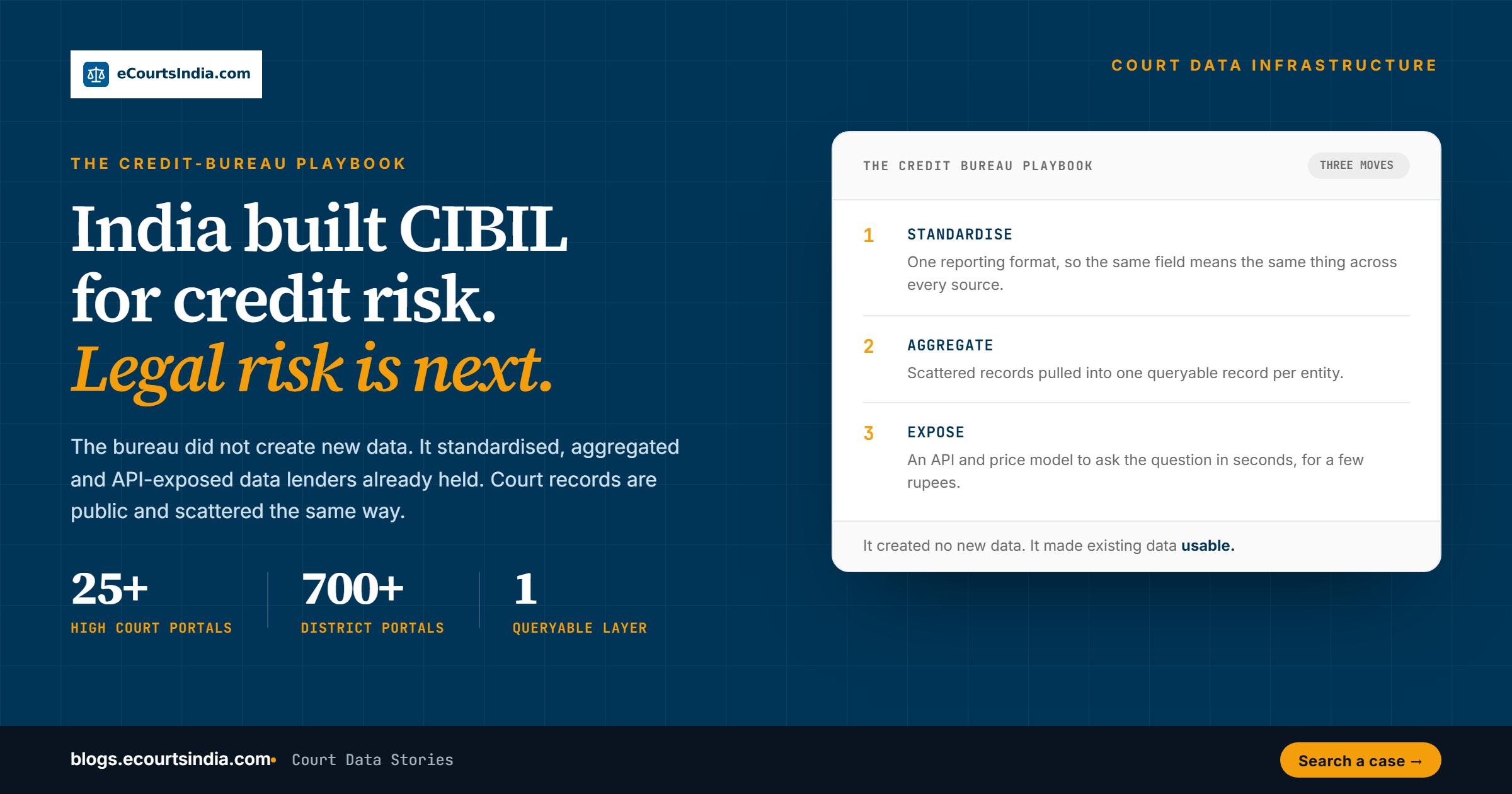
What the bureau did was three things. It standardised the reporting format so a field meant the same thing across every institution. It aggregated reports into one record per borrower. And it built the access model that let a lender check that record quickly and cheaply as a routine step in underwriting.
The information stayed where it was. Standardisation, aggregation and cheap access changed the shape of Indian lending, and today a bureau check is a standard step before a loan is sanctioned.
That business became valuable. TransUnion took a majority 55 percent stake in CIBIL in May 2014, when Standard Chartered and Sundaram Finance sold out. In March 2017, Bank of India sold its entire 5 percent stake to TransUnion for Rs 190.62 crore, which implies a value of roughly Rs 3,800 crore for the whole company, about 592 million dollars at the time. The product had nothing fancy in it. The value came from being the standard, trusted aggregator.
What a single court record contains
Start with one Indian court case. It has parties, sometimes a dozen on each side. It has advocates of record, a presiding judge, a court, district and state. It has a filing date and a stage history, the sections it was filed under and the relief sought. It has every order, adjournment, interim direction and final judgment. For a company case it names the directors sued, the bench that heard it, how long it took and whether it went on appeal.
Multiply that across 32 crore+ records, with 125 crore+ orders and judgments on eCourtsIndia. Add the cheque bounce corpus we examined in Cheque Bounce in India, the insolvency record in The NCLT Scorecard, and the property, family, writ and criminal dockets. Together they are the closest thing India has to a national dispute record for people and businesses.
Now compare a credit report. It shows whether someone missed a card payment or restructured a loan. It does not show a pending cheque bounce prosecution, a directorship in a company being wound up, or a partition suit brought by a former business partner. Court data covers exactly that gap.

Why no one could use it, until recently
The records were public. Three blockers kept them out of enterprise workflows.
Fragmentation. The Supreme Court, 25 High Courts, thousands of district and taluka court establishments and a string of tribunals each publish on their own portal with their own schema. “All cases naming this company” meant checking dozens of sites and reconciling dozens of spellings.
Captchas and rate limits. Government portals publish court data behind captchas. That is a sensible policy for one-case lookups. It is also why background-check vendors that tried to automate this ended up employing people to work through captchas by hand.
Unstructured output. Even when retrieved, records arrive as HTML and scanned PDFs in many languages. A lender’s risk engine cannot ingest a Hindi scan of a sessions court chargesheet. The last mile, OCR, entity resolution, normalisation and language handling, is most of the value. We told the engineering side of that story in From Scraping to Production.
What changed
Three shifts moved court data from theoretically available to usable.
The eCourts project digitised case records across the district tier, and Phase III, approved in September 2023 with an outlay of Rs 7,210 crore over four years, is extending that work. The portals are still uneven at the surface, but the records underneath are digital.
Modern AI made vernacular legal text tractable. Scanned Tamil or Marathi orders that once needed a translator can now be read and summarised at scale, which changes the economics of structuring the corpus.
API and MCP standards normalised how enterprise systems consume outside data. Lenders, insurers and verification firms already work in JSON and REST. What was missing was a court-data provider that spoke the same language. The eCourtsIndia API now offers 23 endpoints with Rs 200 in free credits, and an MCP server lets AI assistants query the same index.
LegalCheck: the CIBIL for litigation, now a product
Earlier versions of this post described a product class that did not yet exist. It does now. LegalCheck is eCourtsIndia’s legal background check: it screens a person or a company against Indian court and tribunal records, works out which records actually belong to that subject, and returns a banded report in which every finding links to the underlying court record.
The hard part of a court-record check in India is not searching. It is identity. A name search for a common name returns thousands of people. LegalCheck asks for the same details a verification form already carries, a name, a parent or spouse, a city and an age, and treats the match as an identity question first. Each record is placed in a band (confirmed, probable, possible or excluded), and the report says what it excluded and why, and what it could not check.
| Credit bureau report | LegalCheck report | |
|---|---|---|
| Source | Records reported by lenders | Public court and tribunal records on the eCourtsIndia index |
| What it tells you | Repayment behaviour on regulated credit | Disputes across courts: civil, criminal, commercial, family, insolvency, consumer and regulatory |
| How a match is made | Identifiers supplied by the lender | Name plus parent or spouse, city and age, resolved against the court record |
| Evidence | Account-level entries | Every finding carries a CNR and a link to the case record |
| Turnaround | Near instant | Most first reports in one to three minutes |
| Price | Set by the bureau | Rs 99 pay-as-you-go, Rs 33 with a subscription |
Individuals and small teams can run a check at legalcheck.ecourtsindia.com. Platforms can call the same engine through the LegalCheck partner API: submit a subject once, poll for the result, and read the report as often as needed. Only the submit call is charged; see the API pricing page and our LegalCheck API guide.
LegalCheck is the court layer of a background check. It is not FIR verification, not Aadhaar or PAN verification and not a police clearance certificate. For the police side, Crime Reports lets you search 12 lakh+ FIR PDFs from 13 states and union territories at Rs 1 per PDF, and our guide to checking FIR status online covers the official routes. For a step-by-step method on doing the court check yourself, see Background Check in India.

Who needs a litigation check
Six groups of buyers make up most of the demand. None of them is hypothetical. Each already pays for a slower, manual version of the same work.
| Buyer | What they check | Where to start |
|---|---|---|
| Banks and NBFCs | Borrower, promoter and guarantor litigation before sanction; new filings against existing obligors; assets under dispute in recovery | LegalCheck per applicant; API monitoring for the book. See the Bank Litigation Index |
| Insurers | Parallel claims, consumer commission history and motor accident claims at underwriting and claims | LegalCheck and case search by party |
| Background-verification firms | The court-record module of an employment or tenant check, nationally rather than one district at a time | LegalCheck partner API |
| Regtech and compliance teams | Ongoing matters before tribunals, anti-corruption courts, securities and tax forums for regulated entities | API with case tracking and alerts |
| Corporate legal teams | Their own docket across India, plus counterparties and vendors before contracting | Company litigation search and alerts |
| M&A and PE diligence teams | Every case involving a target, its directors and group companies | Due diligence engine on the API |
For ongoing monitoring rather than a one-time check, case tracking costs Rs 5 per case a month, with WhatsApp or email alerts at Rs 0.50 each when a tracked case gets a new order or hearing date. In-house teams that work in an AI assistant can run the same monitoring through MCP, as we showed in Litigation Portfolio Monitoring for General Counsel.
Regulation points the same way. Listed companies already disclose material litigation to stock exchanges, and lenders and insurers are expected to know their customers. A litigation check is fast becoming part of ordinary diligence rather than an extra.
How it differs from a credit bureau
The data is public, not contributed. A credit bureau aggregates reports that lenders file. A litigation check reads public court records that anyone can, in principle, look up. The legal basis differs even though the economics look alike.
The signal is broader. A credit report covers repayment on regulated credit. A court record covers disputes across life: commercial fraud, criminal allegations, family separation, regulatory action, property fights and contract enforcement.
The data is harder to structure. Credit data arrives in formats lenders are trained to file. Court data arrives as scanned PDFs in many languages, from portals with different schemas. The structuring work is the moat, and it is why the litigation equivalent took so long to appear. We set out that argument in The Data Moat in the Age of Commodity LLMs.
Fairness matters more. A pending criminal case is an allegation, not a finding. A good litigation check shows the record, its status and a link to the order, and leaves the judgment to a person who can ask the subject about it. That is why LegalCheck links every finding to its source instead of reducing a person to a single score.

What adopting early actually buys you
A lender or verifier that adds a court-record check today sees exposures its peers miss: the promoter with a sister company in insolvency, the guarantor facing a recovery suit, the candidate with an undisclosed dispute that matters for the role. Over a few years, that shows up as fewer surprises in the book.
There is also a simpler argument. The cost of a national check has fallen from the hundreds of rupees a manual, district-by-district search typically costs to Rs 99 or less. At that price, screening every applicant rather than only the largest ones is a reasonable default. We looked at how lenders and verification firms are already using court data in Court Data Is a FinTech Dataset.
What this means for eCourtsIndia
India built CIBIL for credit risk, and it changed lending. The same shape was overdue for legal risk. The data is public. The structuring is ours. LegalCheck and the API now let any lender, insurer, verifier or legal team ask the litigation question in minutes, for a price that makes it routine.
TL;DR
- CIBIL standardised, aggregated and opened up records lenders already held. It did not create new data.
- Court data had the same problem: public, but scattered across hundreds of portals and hard to structure. eCourtsIndia now indexes 32 crore+ records across every court tier and 18 tribunal types.
- LegalCheck is the CIBIL-for-litigation product: identity-first, banded, every finding linked to its court record, Rs 99 or Rs 33 on a subscription, with a partner API.
- Banks, insurers, verification firms, regtech, corporate legal and deal teams are the main buyers.
- A litigation record is broader than a credit record and needs more care: pending cases are allegations, and every finding should be checkable.
Sources
- Business Standard (PTI), “BoI sells entire 5% stake in TransUnion CIBIL for Rs 190.62 cr”, 23 March 2017
- Business Standard (PTI), “TransUnion hikes Cibil stake to 55%, StanC, Sundaram Fin exit”, 22 May 2014
- Credit Information Companies (Regulation) Act, 2005
- Press Information Bureau, Cabinet approval of eCourts Phase III (Rs 7,210 crore), September 2023
- eCourtsIndia, LegalCheck launch and LegalCheck API, September 2026
- eCourtsIndia index, corpus counts verified 23 September 2026
Read next: LegalCheck: India’s Identity-First Legal Background Check and The Data Moat in the Age of Commodity LLMs.
Frequently Asked Questions
What is a CIBIL for litigation?

It is a standard, aggregated check of India’s public court records that tells a lender, insurer or employer whether a person or company is involved in litigation, much as CIBIL does for credit. The records already exist; the value is in structuring them and matching them to the right person. eCourtsIndia offers this as LegalCheck.
What is LegalCheck?
LegalCheck is eCourtsIndia’s legal background check. You submit a person or company with details such as a parent or spouse, city and age, and it returns a banded report of court and tribunal records, each linked to the case. Most reports are ready in one to three minutes. Read the LegalCheck launch post.
How much does a litigation check cost in India?
A LegalCheck costs Rs 99 on pay-as-you-go or Rs 33 with a subscription, for a national check across the eCourtsIndia index. Case search on eCourtsIndia is free, case tracking is Rs 5 per case a month and alerts are Rs 0.50. The API pricing page lists every rate.
How much court data is there in India?
eCourtsIndia indexes 32 crore+ case records and 125 crore+ orders and judgments across the Supreme Court, all 25 High Courts, district and taluka courts in all 36 states and union territories, and 18 tribunal and commission types. You can search it free through eCourtsIndia case search.
Who uses litigation data in India?
Banks and NBFCs use it before lending and to monitor borrowers, insurers at underwriting and claims, background-verification firms for employee and tenant checks, regtech teams for regulated entities, corporate legal teams for counterparties, and deal teams for diligence. Developers can build these checks on the LegalCheck API.
Is court data harder to use than credit data?

Yes. Credit data comes in formats lenders are trained to file. Court data comes as scanned PDFs in many languages from portals with different schemas, so it needs OCR, entity resolution and identity matching. A pending criminal case is also an allegation, so findings must link to the record. See The Data Moat.