
Last updated: 28 September 2026
What happens when a judge is on leave?
When a judge is on leave, cases listed in that court are usually adjourned to a new date. You do not need to file anything because of the judge’s leave, but you do need to track the new date and attend on it. Urgent matters, such as bail or a stay, may need to be mentioned before a Link Judge, or before a Vacation Bench during court holidays.
eCourtsIndia is a private platform, not the Government’s eCourts portal (ecourts.gov.in).
A cause list is the daily list a court publishes of the cases it will take up that day, in order. The court’s own cause list is the official version; eCourtsIndia keeps a searchable copy refreshed daily from eCourts. If your court has no list for the day, do not assume it is closed: the list may be late, or eCourtsIndia may not have refreshed it yet. Our guide on how to read a court cause list explains each column.
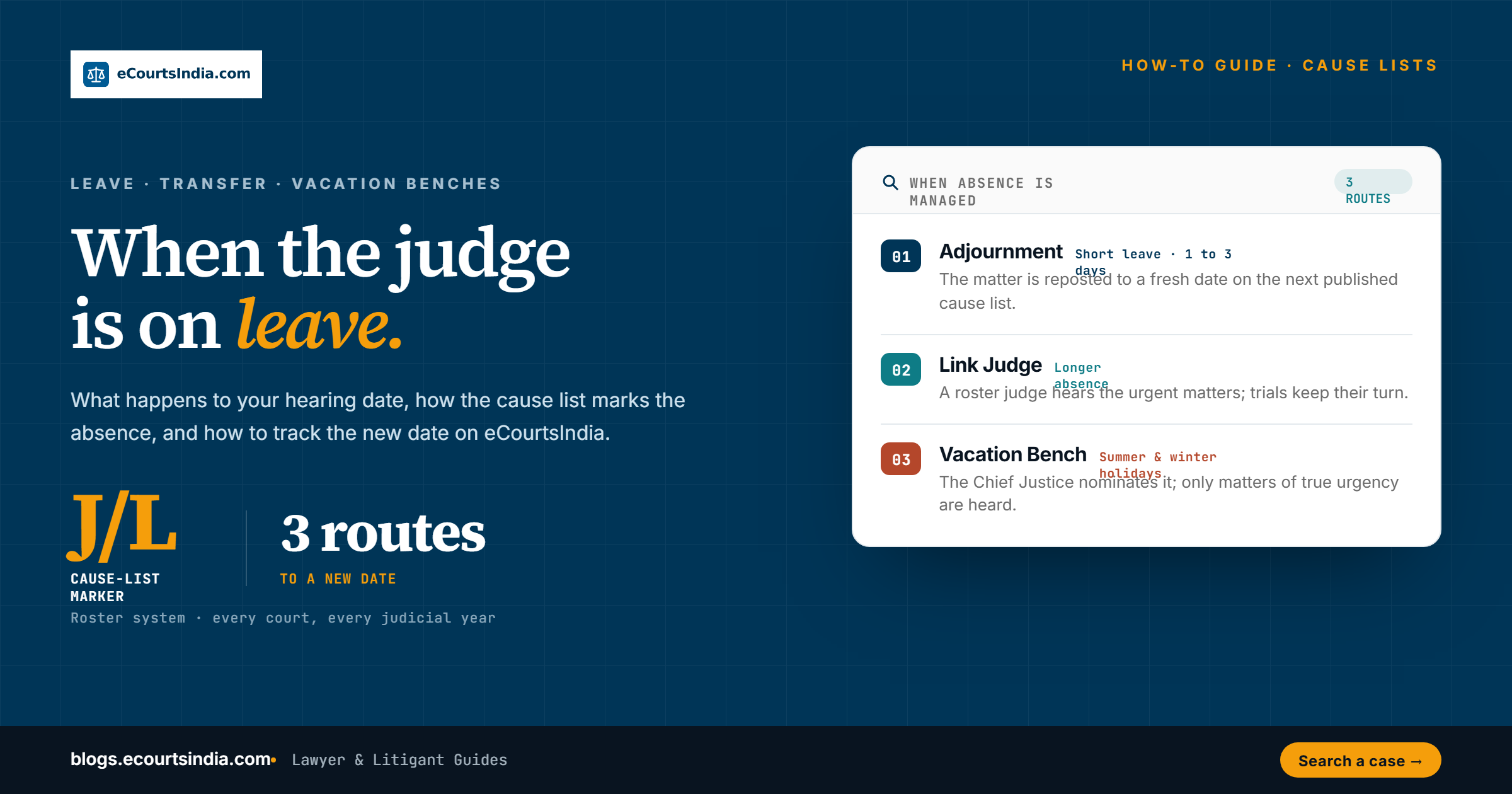
Indian courts run on a roster system. Each case is assigned to a specific court, often a numbered court room such as Court 1 or Court 12, and the judge presiding over that court hears it. Judges can be away on planned or casual leave, for training or official duty, because of illness, or on transfer. When that happens, the court’s work is handled in one of three ways: adjournment to a later date, urgent matters routed to another judge under the roster, or listing before a Vacation Bench during court holidays. This guide explains each, and shows how to check whether your court is sitting and what your next date is.

How is a judge’s absence handled?
1. Adjournment to a fresh date
For a short absence of a day or a few days, matters listed in that court are usually adjourned. The court staff assign a new date, and it shows up on a later cause list and on the case record. The party or advocate does not have to apply for anything, but should note the new date and attend on it. The case status often reads as adjourned, with the next hearing date updated; our case status dictionary explains what each status label means.
2. Urgent matters before a Link Judge
A Link Judge (sometimes called a link or in-charge officer) is a judge named to take up urgent work in a colleague’s court while that judge is away. In district courts, the District Judge usually issues these arrangements by administrative order, and they change as postings change. The Link Judge typically deals with urgent applications, such as bail, remand, interim injunctions and status quo, while trials and routine matters are adjourned until the regular judge returns. If you need urgent relief while your judge is away, your advocate can ask the court staff which judge is taking up that court’s urgent work that day.
In High Courts, the Chief Justice is the “master of the roster” and decides which bench hears which matters, as the Hon’ble Supreme Court reaffirmed in Shanti Bhushan v. Supreme Court of India (judgment dated 6 July 2018, read on Indian Kanoon).
3. Vacation Bench
Indian courts close for a summer break and a shorter winter break, and the length varies by court. During these periods, Vacation Benches sit to hear urgent matters; in High Courts, the Chief Justice nominates the vacation judges and the registry publishes the vacation roster and cause lists. See which matters a Vacation Bench hears below.
Note on terminology: the Hon’ble Supreme Court of India amended its rules in November 2024 (notified on 5 November 2024) to replace the word “vacation” with “partial court working days“, applied from 2025. In its 2026 calendar, the Supreme Court lists partial court working days from 1 June to 12 July 2026. Many High Courts and district courts still use “summer vacation” and “winter vacation”, and “Vacation Bench” remains the term litigants and advocates search for, so we use it here. To follow a Supreme Court matter, see our guide to Supreme Court case status. The bench types guide explains how single, division and vacation benches differ.
What happens to my next hearing date?
The next hearing date is normally fixed at the previous hearing. If the judge was away on the day your case was listed, the court assigns a fresh date from its available slots.
In civil cases, Order XVII Rule 1 of the Code of Civil Procedure, 1908 lets a court adjourn a hearing for reasons recorded in writing, and requires it to fix a day for the further hearing. The same rule says no adjournment shall be granted more than three times to a party during the hearing of a suit. An adjournment because the judge is on leave is not one that either party asked for. Ask your advocate how your court records it.
Deadlines work differently. Under Section 4 of the Limitation Act, 1963, if the time limit for filing a suit, appeal or application ends on a day when the court is closed, you may file on the day it re-opens. One judge’s leave does not by itself mean the court is closed, so check with your advocate before relying on this.
Courts update their records at different speeds, so the new date can take a few days to appear online. On eCourtsIndia it appears after the case is next refreshed from the court’s record. The revised date shows up in three places:
- The next published cause list for that court.
- The case page, which you can open by searching your CNR, case number or party name on eCourtsIndia search. The case status guide shows how.
- WhatsApp and email alerts, if you add the case to your eCourtsIndia dashboard and switch alerts on. The case alerts guide walks through the setup. As of September 2026, tracking costs ₹5 per case per month and each alert ₹0.50 per channel, paid from account credits. The free plan includes 50 credits a month (see current prices).
The government eCourts services also offer SMS updates for registered cases where available.
How do I check if my judge is sitting today?
On the official eCourts Services portal or app
Open the cause list for your state, district, court complex and court on the eCourts Services portal or the eCourts Services app. For a High Court or the Supreme Court, use the court’s own website, such as the Supreme Court cause lists.
On eCourtsIndia
- Go to ecourtsindia.com/causelist, choose your state, district and court establishment.
- Check whether your court number has a cause list for the day. If it has no list, do not assume the court is closed. The list may be late, or eCourtsIndia may not have refreshed it yet. Confirm on the official eCourts Services portal, or with your advocate or the court staff, before you decide not to attend.
- Search your case on eCourtsIndia search by your 16-character CNR (Case Number Record, the unique case identifier), case number or party name to see the latest listed date.
- If your case was listed but the judge is away, look for an adjournment or a fresh date on the case page.
- When in doubt, check with your advocate or the court staff.
You can also search cause lists by lawyer or party name over a range of dates.
If you check listings every evening, the eCourtsIndia Chrome extension shows upcoming hearings and cause-list listings for the cases you follow, and the Android and iOS apps do the same on your phone. For a full walk-through of the columns on a cause list, see how to read an Indian court cause list.
Worked example: a Surat district court
Take a litigant with a matter in the Surat District Court in Gujarat who wants to know, before travelling, whether the judge is sitting tomorrow (an illustrative example). The same steps work for any district court that publishes on the eCourts network:
- Open the Surat district cause list on eCourtsIndia (ecourtsindia.com/causelist/GJ/14), or on the official eCourts Services portal. For another district, start at ecourtsindia.com/causelist and pick your state and district.
- Choose the court establishment and the date, and look for your court number.
- If your court has a list and your case is on it, the court is expected to sit. If your matter shows an adjournment, it will not be heard that day. If the court has no list at all, confirm with the court or your advocate before you decide not to go.
- Check the case page for the next date once the court updates it, and attend on that date.
Many district courts also post leave notices and duty arrangements on their official websites, but the format and frequency differ from district to district. If you cannot find a notice, rely on the court’s own cause list and your case’s next date, and confirm with your advocate or the court staff. Our India courts and eCourts access directory lists where each court publishes its information. The same steps work for Delhi district court cause lists.
How do I read a duty roster or leave notice?
Where a court does publish a roster or leave notice, it usually carries some version of the following columns. Names and layout vary by court.
| Column | What it tells you |
|---|---|
| Court number or designation | Which court room or post the entry is about |
| Presiding officer | The judge’s name and designation |
| Status or period | On leave, on training, on other duty, and the dates |
| Link or in-charge officer | The judge taking up urgent work of that court meanwhile |
When are Indian courts on vacation?
Every High Court publishes its own calendar for itself and the district courts under it, so always check your court’s calendar. The common features are:
- Summer vacation: usually in May, June or July. High Courts often close for several weeks, district courts for less. Dates differ by court, so check your High Court’s calendar.
- Winter vacation: usually a shorter break in late December, varying by court.
- Festival breaks: the Supreme Court’s 2026 calendar also lists holidays for Holi (2 to 7 March), Dussehra (19 to 24 October), Diwali (9 to 14 November) and Christmas and New Year (21 December 2026 to 1 January 2027). High Courts set their own breaks, so check your court’s calendar.
- Gazetted holidays: national holidays such as Republic Day and Independence Day, plus major festivals.
- Local holidays: state-specific festivals and days notified by the state government or the High Court.
- Saturdays: practice varies. Some courts sit on certain Saturdays and not others, so check the calendar.
Which matters does a Vacation Bench hear?
Not every matter gets heard during vacation. Vacation Benches take up matters where waiting for the court to reopen would cause real harm. Typically that means:
- Bail applications, both regular and anticipatory, where liberty is at stake.
- Habeas corpus petitions against unlawful detention.
- Matters involving life, liberty or imminent dispossession.
- Interim orders to prevent irreversible harm, such as a demolition or an auction.
- Status quo or injunction applications in property and family disputes where delay would defeat the relief.
Each court sets its own procedure for getting a matter before the Vacation Bench, usually through a mentioning or urgency application to the registry. Listing rules differ by court. Your advocate files or mentions the matter as urgent, and the court decides whether it will be taken up during the vacation. Ordinary trials, final hearings and routine applications wait until the court reopens. For a matter in a High Court, our guide to High Court case status shows where to check its listing.
What can a lawyer do when the judge is away?
For a practising advocate, a judge’s absence is a scheduling problem more than a legal one. Keep a list of which of your matters sit in which courts, and check the next day’s lists every evening. When a court goes quiet for a week, you will see several of your dates shift at once, and you can plan around them rather than finding out in the corridor. Our guide to tracking all your pending cases in one place shows how to set that up. For how listings in one district move across several days, see our analysis of a week of Delhi cause lists.
Related reading
- How to Read an Indian Court Cause List
- India Courts & eCourts Access Directory
- Case Status Dictionary
- Bench Types in Indian Courts Explained
- How to Enable Case Alerts for Any Court Case in India

Frequently Asked Questions
How does a cause list show that a judge is on leave?

There is no single national format. Some courts publish no list for that courtroom on the day. Others print a note against the court, or list the matters and mark them adjourned. When leave is sudden, the list may already be out, so the matters are adjourned on the day. The dependable check is the next date on your case page or on the official eCourts Services portal. You can also open your court’s list on ecourtsindia.com/causelist.
What happens to my hearing date if the judge is on leave?
Your matter is usually adjourned to a new date. If it is urgent, such as a bail or status quo application, a Link Judge may take it up. You do not need to file anything because of the leave. The new date appears on a later cause list and on the case page, which you can open by CNR, case number or party name on eCourtsIndia search. Keep checking, and attend on the new date.
How do I check if a judge is sitting in Surat or any district court today?
Open the day’s cause list for your district, court complex and court number, on the official eCourts Services portal or on eCourtsIndia. If your matter is listed, the court is expected to sit. If the court has no list, do not assume it is closed. The list may be late or not yet refreshed. Confirm with your advocate or the court staff before you decide not to attend. For Surat, use the Surat district cause list; for any other district, start at ecourtsindia.com/causelist.
What is a Vacation Bench and which matters does it hear?
A Vacation Bench is a judge or set of judges who sit during a court’s summer or winter vacation to hear urgent matters. In High Courts, the Chief Justice nominates them. They usually take up bail, habeas corpus and applications to prevent irreversible harm, while trials wait until the court reopens. The Supreme Court now calls its summer period partial court working days (1 June to 12 July in 2026). Our bench types guide explains more.
Who decides the Link Judge when a judge is absent?

In district courts, the District Judge usually issues administrative orders naming link or in-charge judges, and these change as postings change. The Link Judge takes up urgent work of the absent judge’s court, such as bail and interim applications. In High Courts, the Chief Justice, as master of the roster, decides which bench hears which matters, including during vacations. You can see the cases listed before a judge on the public eCourtsIndia judge pages.
How can I get told automatically when my hearing date changes?
Add the case to your eCourtsIndia account and switch on WhatsApp and email alerts. You get a message when eCourtsIndia records a new date, order or status from the court’s records. As of September 2026, tracking costs ₹5 per case per month and each alert ₹0.50 per channel, paid from credits, and the free plan includes 50 credits a month (see current prices). Confirm key dates on the official record. The case alerts guide shows the setup.
Is eCourtsIndia the official eCourts website?
No. eCourtsIndia is a private legal-technology platform. It is not affiliated with, associated with, or endorsed by the Government of India, the Supreme Court of India or its e-Committee, or any court. Official case information and cause lists are published on ecourts.gov.in and on each court’s own website.
Sources
- Supreme Court of India: Calendar 2026 (partial court working days 1 June to 12 July 2026; holiday dates). Checked 28 September 2026.
- Supreme Court of India: Cause lists. Checked 28 September 2026.
- eCourts Services: district court case status and cause lists. Checked 28 September 2026.
- eCourts, e-Committee of the Supreme Court of India. Checked 28 September 2026.
- India Code: Code of Civil Procedure, 1908 and Limitation Act, 1963 (official text). Checked 28 September 2026.
- Indian Kanoon: Shanti Bhushan v. Supreme Court of India, judgment dated 6 July 2018 (master of the roster). Checked 28 September 2026.
- LiveLaw: ‘Vacation’ renamed as ‘partial court working days’, Supreme Court amends rules (7 November 2024). Checked 28 September 2026.
- IndiaCode by eCourtsIndia: CPC Order XVII Rule 1 (adjournments). Checked 28 September 2026.
- IndiaCode by eCourtsIndia: Limitation Act, 1963, Section 4 (court closed on the last day). Checked 28 September 2026.
- eCourtsIndia: Pricing (tracking, alerts and free credits, as of September 2026). Checked 28 September 2026.