
Last updated: 23 September 2026
What is a Revenue Board in India?
A Revenue Board in India is the apex quasi-judicial revenue court of a state that hears appeals and revisions against orders passed by Collectors, SDOs, and Tehsildars on land, tenancy, and mutation matters. The best known are the Rajasthan Board of Revenue at Ajmer and the Uttar Pradesh Board of Revenue at Lucknow.
A Revenue Board is a quasi-judicial body that hears appeals and revisions against the orders of revenue officers like Collectors, Sub-Divisional Officers (SDOs), and Tehsildars. Revenue Boards are the apex revenue courts within their respective states and have both administrative and judicial functions on land, revenue, and associated matters. Not every state still has one. Tamil Nadu and Kerala abolished theirs, and several states use a revenue tribunal or a Financial Commissioner instead, so the name on the door changes from state to state.

Revenue Boards operate under state-specific Land Revenue Acts and are independent of the regular civil court hierarchy. They are the final appellate body for revenue matters within the state. Their orders are then usually challenged in the High Court through a writ petition, which is where the dispute enters the court record you can search on eCourtsIndia.
Key takeaways
- The Rajasthan Board of Revenue sits at Ajmer. It came into existence in 1949 and now works under the Rajasthan Land Revenue Act, 1956.
- The UP Board of Revenue is headquartered at Lucknow and works under the UP Revenue Code, 2006.
- Board orders themselves sit on state revenue portals. The High Court writs that challenge them are searchable free on ecourtsindia.com/search.
- In the Rajasthan High Court, RJHC01 is the Principal Seat at Jodhpur and RJHC02 is the Jaipur Bench.
- Read the state code itself, section by section, on IndiaCode by eCourtsIndia.
Quick Answer
A Revenue Board in India is a state-level quasi-judicial authority that hears appeals and revisions on land and revenue matters. Major Revenue Boards include the Rajasthan Board of Revenue at Ajmer, the Uttar Pradesh Board of Revenue at Lucknow, and the Boards of Revenue in Madhya Pradesh (Gwalior), Chhattisgarh (Bilaspur), Bihar (Patna) and Odisha (Cuttack). For writs and revenue-linked matters before High Courts, use ecourtsindia.com/search with the words “Board of Revenue” and the relevant High Court code in the cc= parameter.
Rajasthan Board of Revenue, Ajmer
The Rajasthan Board of Revenue, headquartered at Ajmer, is one of the oldest revenue institutions in India. It was set up by an ordinance of the Rajpramukh in 1949, soon after the formation of United Rajasthan, when the revenue boards of the princely states were merged into it. It came into existence on 1 November 1949. Today it works under the Rajasthan Land Revenue Act, 1956, whose section 4 provides for a Board of Revenue for the State with a Chairman and other members. It hears appeals, revisions and references against revenue officer orders across Rajasthan.
Jurisdiction
- Second appeals from orders of Revenue Appellate Authorities
- Revision of lower revenue court orders
- Partition disputes under the Rajasthan Tenancy Act, 1955
- Mutation appeals
- Land record correction and entry challenges
- Land ceiling and assignment matters
- Revenue demand and assessment disputes
How to Check Rajasthan Revenue Writs and Appeals
The Rajasthan High Court has two seats, and each has its own court code on eCourtsIndia. RJHC01 is the Principal Seat at Jodhpur. RJHC02 is the Jaipur Bench. For writ petitions arising from Board of Revenue orders, search ecourtsindia.com/search?cc=RJHC01 (Jodhpur) or ecourtsindia.com/search?cc=RJHC02 (Jaipur). For direct Board of Revenue orders, visit the state revenue department portal.
Worked example: every Rajasthan High Court record that mentions the Board
Type "Board of Revenue" in quotes into eCourtsIndia search and add both Rajasthan court codes. On 23 September 2026 that search returned over 36,000 Rajasthan High Court records, split almost evenly between Jodhpur and Jaipur. Most of them are single-bench civil writs, which the Rajasthan High Court records under its own case type label (CWJC in the index), with writ appeals and civil miscellaneous applications behind them. That tells you two practical things. First, do not filter only on the generic WP_C code for Rajasthan, because most revenue writs there carry the court’s local label. Second, the phrase search runs through the full text of orders, so a writ that never names the Board in its title still turns up if the order discusses it.
Once you have the case, open its CNR page to read the orders, and switch on a WhatsApp or email alert so you hear about the next hearing date without checking by hand. If a writ you know about is missing, use Add a Missing Case to request it.
Uttar Pradesh Board of Revenue
The UP Board of Revenue is headquartered at Lucknow, as its official website (bor.up.nic.in) states. It is one of the busiest revenue courts in India and works under the Uttar Pradesh Revenue Code, 2006, which consolidated the state’s older land laws. The enactments it repealed are listed in its First Schedule, read with section 230.
Matters heard by the UP Board of Revenue
- Appeals under section 207 of the UP Revenue Code, 2006, where the Third Schedule names the Board as the appellate forum
- Calling for records and revision under section 210
- Review of its own orders under section 211 and transfer of cases under section 212
- Bhumidhari and tenancy rights disputes
- Mutation and record of rights appeals
- Boundary disputes and agricultural land cases
Writs against UP Board orders go to the Allahabad High Court. On eCourtsIndia the principal seat at Prayagraj is UPHC01 and the Lucknow Bench is UPHC02. Because the Board sits at Lucknow, many of its writs are filed at the Lucknow Bench, but the territorial rules of the High Court decide which seat hears a given matter.
Other State Revenue Boards and Equivalents
Every state has a revenue appellate structure. The nomenclature varies, but the function is similar. The table lists only bodies we could confirm from the state’s own website or statute. Where a governing law is linked, the link opens the Act on IndiaCode by eCourtsIndia.
| State | Apex Revenue Body | Governing Law |
|---|---|---|
| Rajasthan | Board of Revenue, Ajmer (set up 1949) | Rajasthan Land Revenue Act, 1956 |
| Uttar Pradesh | Board of Revenue, Lucknow | UP Revenue Code, 2006 |
| Bihar | Board of Revenue, Patna | Bihar tenancy and land-reform laws (Bihar Tenancy Act, Bihar Land Reforms Act, 1950) |
| Madhya Pradesh | Board of Revenue, Gwalior (circuit courts at divisional headquarters) | MP Land Revenue Code, 1959 |
| Chhattisgarh | Board of Revenue (Rajaswa Mandal), Bilaspur | Chhattisgarh Land Revenue Code, 1959 |
| Odisha | Board of Revenue, Cuttack | Odisha Board of Revenue Act, 1951 and the Orissa Land Reforms Act, 1960 |
| West Bengal | West Bengal Land Reforms and Tenancy Tribunal | WB Land Reforms and Tenancy Tribunal Act, 1997; WB Land Reforms Act, 1955 |
| Maharashtra | Maharashtra Revenue Tribunal | Maharashtra Land Revenue Code, 1966 |
| Gujarat | Gujarat Revenue Tribunal | Gujarat Land Revenue Code, 1879 |
| Karnataka | Karnataka Appellate Tribunal | Karnataka Land Revenue Act, 1964 |
| Tamil Nadu | No Board of Revenue since 1 December 1980 (Tamil Nadu Board of Revenue Abolition Act, 1980). Land matters moved to the Commissionerate of Land Administration and other departments. | State revenue laws administered by the Commissioner of Land Administration |
| Kerala | No Board of Revenue since 1 July 1997 (Kerala Board of Revenue Abolition Act, 1996). Replaced by the Commissionerate of Land Revenue. | Kerala Land Reforms Act, 1963 and other state revenue laws |
| Andhra Pradesh | Chief Commissioner of Land Administration | AP revenue laws |
| Punjab / Haryana | Financial Commissioner (Revenue) | Punjab Land Revenue Act, 1887 |
Browse every state’s legislation from the IndiaCode states index. Some state Acts are held only as a scanned gazette, and those pages say so. For anything you will file, read the scan.
Revenue Court Hierarchy in India
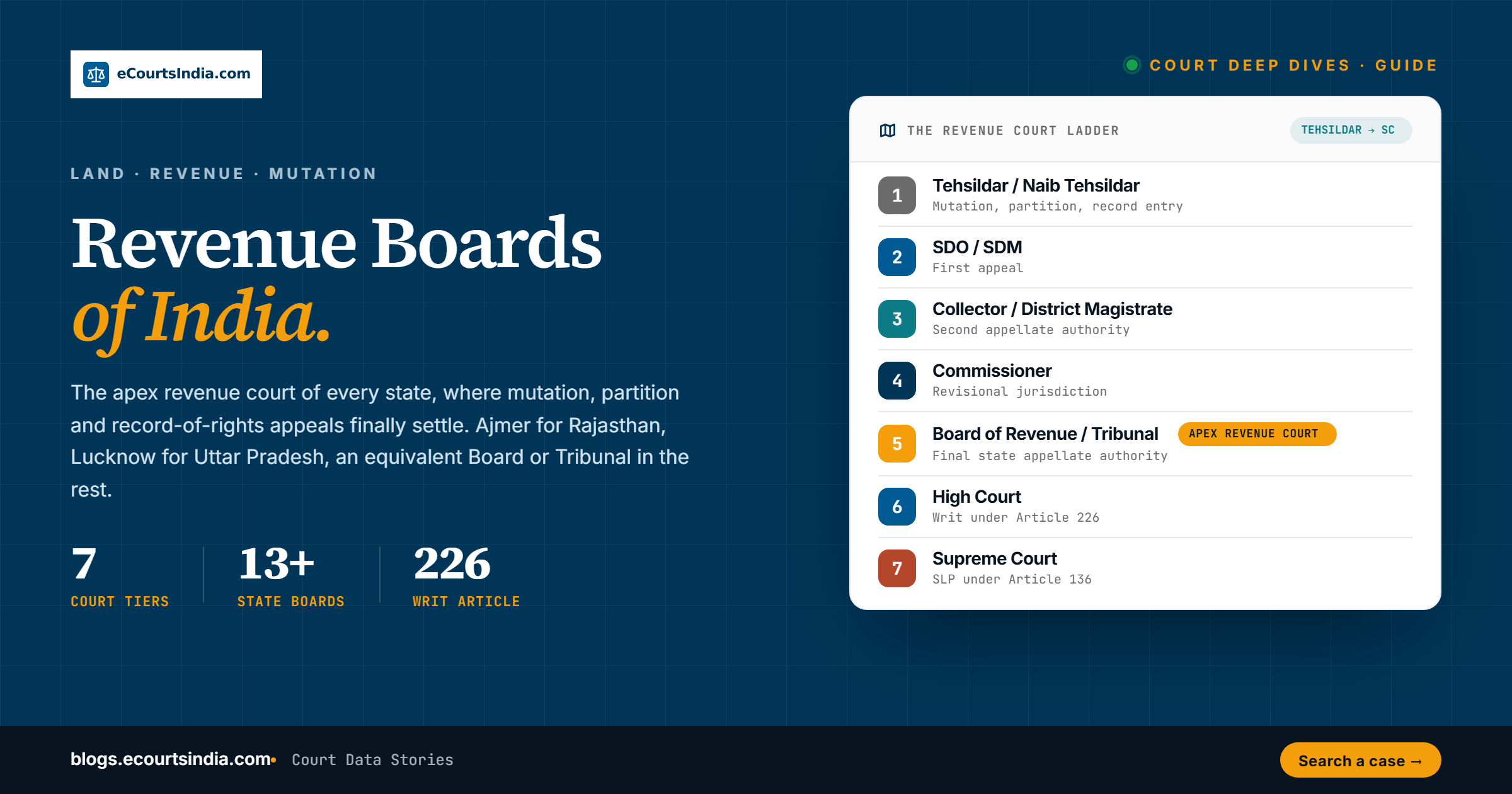
Revenue matters follow a state-specific hierarchy. For most states the flow is as follows.
- Tehsildar / Naib Tehsildar: Original mutation, partition, and record entry
- Sub-Divisional Officer (SDO) / SDM: First appeal or original jurisdiction in certain matters
- Collector / District Magistrate: Second appellate authority in many states
- Commissioner / Divisional Commissioner: Revisional jurisdiction
- Board of Revenue / Revenue Tribunal: Final state appellate authority
- High Court: Writ jurisdiction under Article 226
- Supreme Court: SLP under Article 136
The last two tiers are where eCourtsIndia helps. Every High Court and the Supreme Court are in the index, and our guide to checking High Court case status in all 25 High Courts walks through the codes for each one.
RDO Proceedings: What Are They?
RDO stands for Revenue Divisional Officer, a designation used in many southern states including Tamil Nadu, Andhra Pradesh, Telangana, Kerala, and Karnataka. The RDO is equivalent to an SDM or SDO in other states and handles revenue matters at the sub-district level.
Common RDO proceedings include:
- Patta transfer and mutation
- Land measurement and boundary verification
- Revenue recovery proceedings
- Enquiry into encroachment
- Certificate cases for legal heirship, community, nativity, and income
- Appeals from Tehsildar orders
RDO orders themselves are not indexed on the eCourts portal. However, subsequent writ petitions arising out of RDO proceedings are searchable. Search ecourtsindia.com/search for the village, survey number or party name and narrow by the relevant High Court using the cc= parameter. The Case Type Encyclopedia explains the writ and appeal codes you will see in the results.
How to File a Revenue Appeal
The procedure varies by state but the typical steps are as follows.
- Obtain the original order: Get a certified copy of the order you want to challenge.
- Check limitation: Each revenue statute fixes its own appeal period, and it differs by state and by the kind of order. Read the appeal section of your state’s code before you file.
- Prepare memorandum of appeal: Include grounds, facts, and relief sought. Most state acts prescribe a specific form.
- Pay court fee: Varies by state and value of the subject matter.
- File with correct forum: Ensure you file at the appellate authority specified in the state act.
- Serve notice: On respondents and implead any state revenue officer involved.
- Attend hearings: The appellate authority will hear both sides, examine records, and may call for remarks from lower authorities.
- Obtain decision: The order of the appellate authority is binding and can be further appealed or revised.
Revenue Board vs Civil Court: Which Has Jurisdiction?
This is one of the most litigated issues in India. Most state revenue acts bar the jurisdiction of civil courts on matters expressly provided for under the revenue code. The principle is captured in Section 9 of the CPC, which says that civil courts have jurisdiction except where expressly or impliedly barred.
The Supreme Court in several decisions has held that where a right is created and remedy provided by a special statute (like a Land Revenue Act), the civil court jurisdiction is impliedly barred. Revenue matters are generally within the exclusive jurisdiction of revenue courts.
However, questions of title, declaration of ownership, and specific performance of contracts concerning land typically fall within civil court jurisdiction, while mutation, partition, and record entries are within revenue court domain. If you are checking land before a purchase or a loan, run both searches: the High Court writs from the revenue side, and civil suits in the district court. Our due-diligence guide for finding all cases against a company shows how to do that by party name.
Related reading
- India Courts & eCourts Access Directory
- Case Status Dictionary: All 71 Codes
- Case Type Encyclopedia
- IndiaCode by eCourtsIndia: every Act, every section

Frequently Asked Questions
Where is the Rajasthan Board of Revenue located and what does it do?

The Rajasthan Board of Revenue sits at Ajmer and is the apex revenue court for the whole state. It was set up in 1949 and now works under the Rajasthan Land Revenue Act, 1956. It hears appeals, revisions and references against revenue officer orders. For writs against its orders, search the Rajasthan High Court (RJHC01 Jodhpur, RJHC02 Jaipur) on eCourtsIndia.
Can I check Revenue Board case status online?
Board of Revenue orders are usually hosted on each state’s own revenue department portal, not the national eCourts portal. Writ petitions arising from Revenue Board orders before High Courts are, however, indexed and searchable. Search the words Board of Revenue with the relevant High Court code on eCourtsIndia search to locate them, then set a case alert.
What is the time limit to appeal a revenue officer order?
It depends on the state and the type of order. Each Land Revenue Act or Revenue Code sets its own appeal period, so read the appeal section of your state’s code before filing. You can open most of them section by section on IndiaCode by eCourtsIndia, and track any resulting High Court matter on eCourtsIndia.
Can I file a writ petition against a Revenue Board order?
Yes. A writ petition under Article 226 of the Constitution lies to the High Court against a Revenue Board order on grounds such as jurisdictional error, breach of natural justice or perversity. For Rajasthan, search the Principal Seat at Jodhpur with cc=RJHC01 or the Jaipur Bench with cc=RJHC02, adding the words Board of Revenue.
What is the difference between a revenue court and a civil court?

Revenue courts have specialised jurisdiction over land, revenue assessment, tenancy, mutation, and partition under state Land Revenue Acts. Civil courts handle all civil disputes except where expressly or impliedly barred, so revenue jurisdiction usually ousts the civil court on the same matter. For the status codes you will meet while tracking these cases, see our Case Status Dictionary.