Last updated: 23 September 2026. Title and claims corrected to match the actual sample (80 rows over two working days), percentages and the case-type tally rechecked, and links added to free cause lists and alerts.
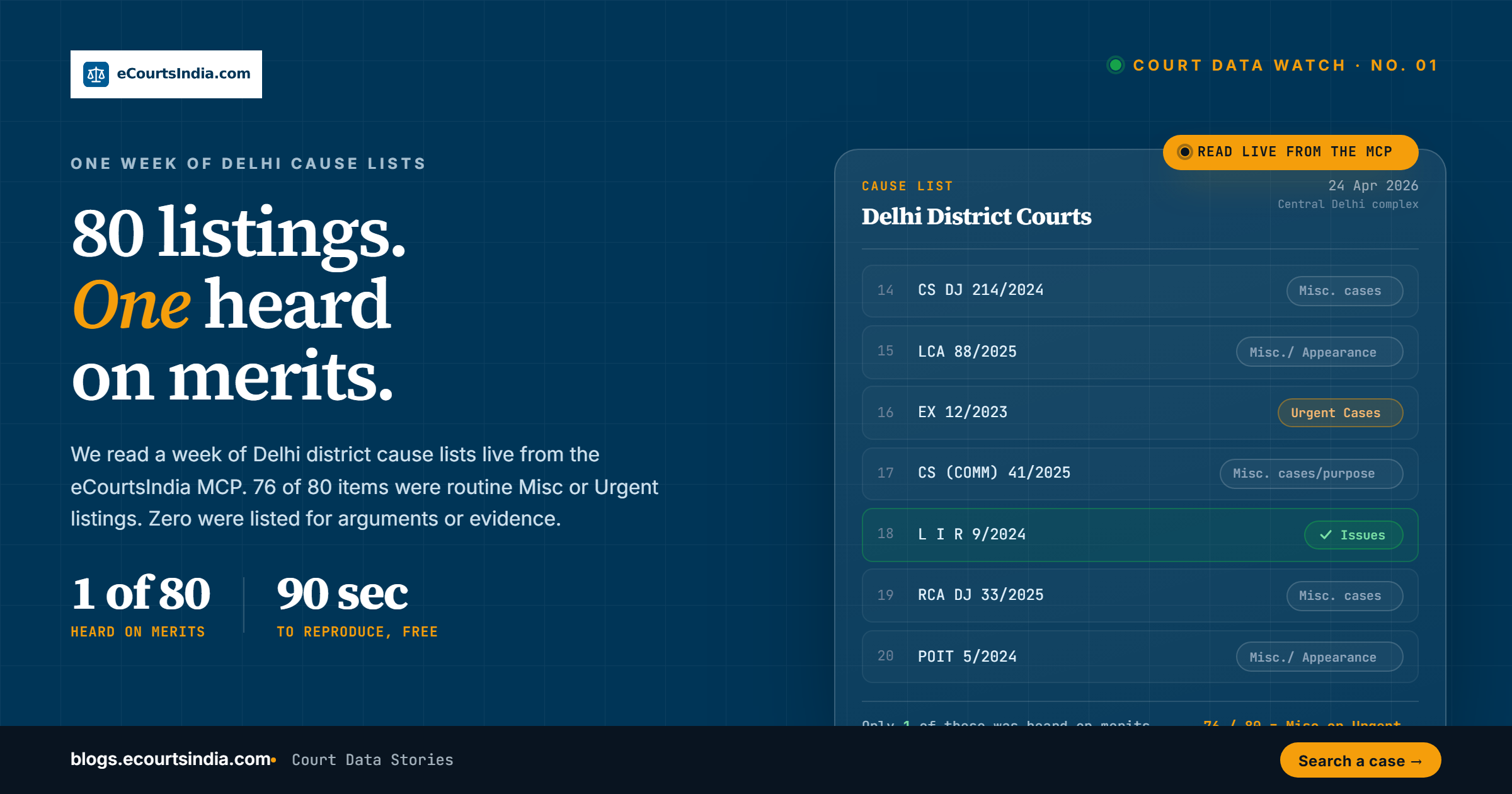
We read 80 Delhi district court cause-list items from two working days, 24 and 27 April 2026, live from the eCourtsIndia MCP. 60 of the 80 carried a status label. 59 of those were miscellaneous, appearance or urgent listings, and exactly one was a substantive stage (Issues). The other 20 rows had no status. Of every item where the court said why it was listed, about one in sixty was a hearing on merits.
An advocate walks into the court corridor at 10.15 am. She finds her matter on the cause list, item 14. She waits. Her turn comes at 12.30 pm. The hearing lasts forty seconds. The court takes the next date. She walks out. That is the Indian district court day for a very large share of matters, and there has been little open, row-level data showing how large that share is. We pulled two days of Delhi district court cause lists through the eCourtsIndia MCP to take a first look. The sample is small. The pattern in it is striking.
This is a first reading, not a census. It uses row-level data read fresh from the MCP rather than aggregates or old screenshots, and anyone can rerun it on a larger sample. eCourtsIndia now holds 7 crore+ cause-list entries, so the same method scales well beyond 80 rows.

Key takeaways
- Sample: 80 rows from the civil cause lists of 24 and 27 April 2026, all from the Central Delhi court complex.
- 59 of 60 labelled rows were miscellaneous, appearance or urgent listings. One was a substantive stage. None was listed for arguments or evidence.
- 20 rows (all on 24 April) had an empty status field, which is itself a data-quality finding.
- Labour matters dominated the case-type tally because the default sort returned labour court benches first. A multi-district pull would change the mix.
- You can browse Delhi cause lists free on ecourtsindia.com/causelist and rerun the analysis with the API or MCP.
The question
Indian courts publish tens of thousands of cause-list items every working day. What almost no one publishes is the breakdown. Of all those items, how many are substantive hearings on merits? How many are routine listings where the lawyer shows up, the court notes appearance, and the matter is adjourned?
That distinction matters. The Supreme Court’s 25 September 2025 directions on Section 138 of the Negotiable Instruments Act ordered every district and sessions judge in Delhi, Mumbai and Calcutta to maintain a public dashboard reflecting, among other things, the average number of adjournments per case. Policy makers, journalists and the litigants paying for it all deserve an honest count. We went looking for one.
The method
We used two MCP tools. The first checked which dates had data. The second pulled the rows.
get_available_causelist_dates(state="DL")
search_causelist(state="DL", date="2026-04-24", limit=50)
search_causelist(state="DL", date="2026-04-27", limit=30)
The first call returned 12 dates with active data spanning 21 April to 2 May 2026. The second and third returned the actual rows for two working days, Friday 24 April and Monday 27 April. We then tallied the status field for every row where it was populated. The status field is the court’s own label for why the matter was listed that day. Values we saw in the sample: Misc. cases, Misc. cases/purpose, Misc./ Appearance, Urgent Cases, Issues. No rows in the sample were tagged Arguments, Final Arguments, Evidence or Judgment.
If you only want to read a cause list rather than analyse one, you do not need the MCP. Delhi’s district cause lists are free to browse on eCourtsIndia, and our guide to searching Delhi district court cases and cause lists walks through all seven court complexes and eleven districts.
The finding
Out of 80 items sampled across two days in Delhi district courts, 60 carried a status label. 59 of the 60 labelled rows sat inside the miscellaneous or urgent buckets, and one row carried the substantive tag Issues. Zero rows in the sample were listed for arguments or evidence.

| Status | 24 Apr 2026 | 27 Apr 2026 | Combined | Share of 80 |
|---|---|---|---|---|
| Misc. cases / purpose | 11 | 12 | 23 | 28.8% |
| Misc. cases | 10 | 9 | 19 | 23.8% |
| Misc. / Appearance | 7 | 4 | 11 | 13.8% |
| Urgent Cases | 2 | 4 | 6 | 7.5% |
| Issues (substantive) | 0 | 1 | 1 | 1.3% |
| Status field empty | 20 | 0 | 20 | 25.0% |
| Sample total | 50 | 30 | 80 | 100% |
If you exclude the rows with a blank status field, the concentration is even sharper. Of the 60 rows that carry a label, 59 sit inside the miscellaneous or urgent buckets. One row out of sixty was tagged for a substantive stage. That is 1.7 percent.
What “Misc” actually means
It is tempting to dismiss “Miscellaneous” as a vague label and move on. It is not vague. In Indian district court practice, an item listed for Misc. cases/purpose or Misc./ Appearance is the court recording that the matter is before it, that the parties or their counsel are present or absent, and that some small procedural step is to be taken. Filing an affidavit. Marking service of summons. Recording a statement under Order X CPC. Fixing the next date. These are necessary steps. They are not, however, the trial itself. They are not the moment where the court applies its mind to the question the litigant raised.
We have written about what every status label means in our Case Status Dictionary, about reading a list line by line in How to Read an Indian Court Cause List, and about the quirks of morning listings when a judge is on leave. The short version is that a working-day listing in a district court is usually procedural. Arguments, evidence recording, cross-examination and final orders take up a much smaller share of listing slots than the public would assume.
The case types tell a story too
We also tallied case type codes. One correction to the earlier version of this post: the case-type counts we recorded add up to 50 rows, not all 80, so read the table below as a partial breakdown of the sample. We use our Case Type Encyclopedia to decode the codes.
| Code | Case type | Count |
|---|---|---|
| LCA | Labour Court Application | 7 |
| CS DJ | Civil Suit, District Judge | 7 |
| L I R | Labour Industrial Reference | 7 |
| EX / Execution (Comm.) | Execution | 6 |
| Misc DJ | Miscellaneous, District Judge | 5 |
| CS (COMM) | Commercial Suit | 5 |
| RCA DJ | Regular Civil Appeal | 4 |
| POIT | Industrial Tribunal matter | 3 |
| M Ex | Miscellaneous Execution | 2 |
| MACT | Motor Accident Claims Tribunal | 1 |
| Other singletons | Various | 3 |
| Total recorded | 50 |
The over-representation of labour matters (LCA, L I R and POIT together make 17 of the 50 recorded rows) is not Delhi as a whole. It is what happens when the sample is weighted toward the labour court benches sitting at the Central Delhi court complex on those days. A bigger, multi-district pull would rebalance the mix.
Why this matters
Three reasons.
One. The NLSIU’s 2021 “Justice Delayed” district-wise empirical study said its researchers had to work with whatever data was publicly available or could be acquired. In 2026 the data is available, live and queryable. If you are an empirical legal studies student looking for a dissertation question, you now have the raw material to examine how much of a working day a district court spends on substantive hearings versus procedural listings. There is a paper in it.
Two. The Supreme Court has moved first on Section 138 NI Act cases. Its September 2025 directions in Sanjabij Tari v. Kishore S. Borcar (2025 INSC 1158) noted pendency of 6,50,283 such cases in Delhi district courts alone, 1,17,190 in Mumbai and 2,65,985 in Calcutta. The Ministry of Law told the Lok Sabha in a written reply in December 2024 that 43,05,932 cheque bounce cases were pending nationwide; we unpack that backlog in Cheque Bounce in India. The Court ordered each district and sessions judge in those three cities to publish a dashboard showing, among other things, the average number of adjournments per case. If most cause-list slots are procedural rather than substantive, that dashboard will look very different from what casual readers expect. A running tally of adjournments cannot be produced without this kind of data.
Three. Every litigant in India intuitively knows this. Every practising advocate knows it. What they have not had is a number. This post is a first pass at the number. Not final, not definitive, not a census. A first pass that you can reproduce in a few minutes through the eCourtsIndia API and MCP (you need a free account and an API key; new accounts get Rs 200 of free API credits).
Six follow-up questions, and the MCP prompts to answer them
Each of these is a credible dissertation or op-ed.
- Does the Misc share shift across a full month? Prompt the MCP: “Pull cause lists for Delhi district courts for every date from 1 to 30 April 2026 at limit 100 each. Compute the share of Misc-variant statuses per day.”
- Which courtrooms have the highest Misc share? Same data, grouped by judge name. Outliers will tell you something about listing discipline.
- Does Monday look different from Friday? Fridays are widely believed to be adjournment days. The data can confirm or refute that.
- How does Delhi compare to Mumbai, Bengaluru and Kolkata? Run the same pull for state=MH, KA and WB districts.
- How many Section 138 NI Act items sit inside the Misc bucket? Pull the cause-list rows and scan them for Section 138 or NI Act references.
- Which advocates appear in the urgent slot most often? A careful piece of reputational journalism, handled with the caution described below.
For the mechanics of automating a daily cause-list pull, see The 5 AM Cause List Problem, and How to Fix It With One MCP Call.

Caveats
Our sample is 80 rows across two working days in one court complex. It is indicative, not representative. The empty status field on 20 of the 50 rows for 24 April (40 percent of that day, a quarter of the whole sample) is itself data. It reflects that the underlying portal does not always populate the field. The MCP returns what the portal exposes. If you want to replicate this with a larger sample, raise the limit parameter up to 100 and paginate with offset, then filter by district across Delhi’s eleven districts.
We have also deliberately not named any individual advocate or judge in a way that draws conclusions about them. The point of this post is the system-level pattern, not the individual.
What this means for eCourtsIndia
We built the MCP so that serious questions about Indian court data can be asked and answered in minutes, and this was one of the first public answers. If you are a law student, journalist or empirical researcher and you run a larger version of this analysis, write to us through ecourtsindia.com; we would like to read it.
If you are an advocate or litigant rather than a researcher, the practical takeaway is simpler. Most listings are procedural, so the cost of a wasted morning falls on whoever did not know the matter was only listed for appearance. Check tomorrow’s list on the free cause-list page or the eCourtsIndia Chrome extension, and switch on WhatsApp or email alerts for the cases you track.
Of 80 Delhi district court cause-list items read live from the eCourtsIndia MCP on 24 and 27 April 2026, 60 carried a status label, and 59 of those were miscellaneous, appearance or urgent listings. One single item carried a substantive stage tag.
Methodology notes
MCP calls executed 24 April 2026 IST. Sample: Delhi state, 50 rows for 2026-04-24 (civil list) and 30 rows for 2026-04-27 (civil list). Civil list only; the criminal list is not in this sample. All rows came from the Central Delhi court complex (complex codes 1260008 and 1260009-1) because that is what the default sort returned. Case-type codes were recorded for 50 of the 80 rows. For a wider view, filter by district code across Delhi’s eleven districts.
Sources cited
- Supreme Court directions, Sanjabij Tari v. Kishore S. Borcar (2025 INSC 1158), dated 25 September 2025.
- Ministry of Law and Justice, written reply in the Lok Sabha, December 2024.
- NLSIU, “Justice Delayed: A District-Wise Empirical Study on Indian Judiciary,” 2021.
- eCourtsIndia MCP, tools
get_available_causelist_datesandsearch_causelist, April 2026.
Further reading: MCP 101 for Legal Teams, How to Search Delhi District Court Cases, Case Status Dictionary.
Frequently Asked Questions
What did the eCourtsIndia analysis of Delhi cause lists find?

Out of 80 cause-list items sampled across 24 and 27 April 2026 in Delhi district courts, 60 carried a status label. 59 of those were miscellaneous, appearance or urgent listings and only one carried a substantive Issues tag. No rows were listed for arguments or evidence. Browse the same lists yourself on eCourtsIndia cause lists.
What does Misc mean on an Indian court cause list?
A miscellaneous listing means the court is recording that the matter is before it, noting whether parties or counsel appear, and taking a small procedural step such as filing an affidavit, marking service or fixing the next date. It is not the trial itself. Our Case Status Dictionary explains each label.
How many Section 138 cheque bounce cases are pending in India?
The Ministry of Law told the Lok Sabha in a written reply in December 2024 that 43,05,932 cheque bounce cases were pending nationwide. The Supreme Court’s September 2025 directions noted 6,50,283 such cases in Delhi district courts, 1,17,190 in Mumbai and 2,65,985 in Calcutta. Look up individual matters on eCourtsIndia search.
How can I pull Delhi cause list data myself?
Use two eCourtsIndia MCP tools. First get_available_causelist_dates to see which dates have data, then search_causelist with the state and date to return the rows. You need a free eCourtsIndia account and an API key; new accounts get Rs 200 of free API credits. See the eCourtsIndia API and MCP for setup.
Where can I check Delhi district court cause lists for free?

Delhi district cause lists are free to browse on eCourtsIndia, and the Chrome extension shows tomorrow’s listings. Our guide to searching Delhi district court cases covers all seven court complexes and eleven districts, including how to find your item number before you leave for court.
How big was the sample, and is it representative?
The sample was 80 civil cause-list rows from two working days, 24 and 27 April 2026, all from the Central Delhi court complex. It is indicative, not representative. Twenty rows had no status, and labour benches were over-represented. A larger pull across Delhi’s eleven districts would give a sturdier number. Learn the tools in MCP 101 for Legal Teams.