
The only directory you need to navigate every court in India
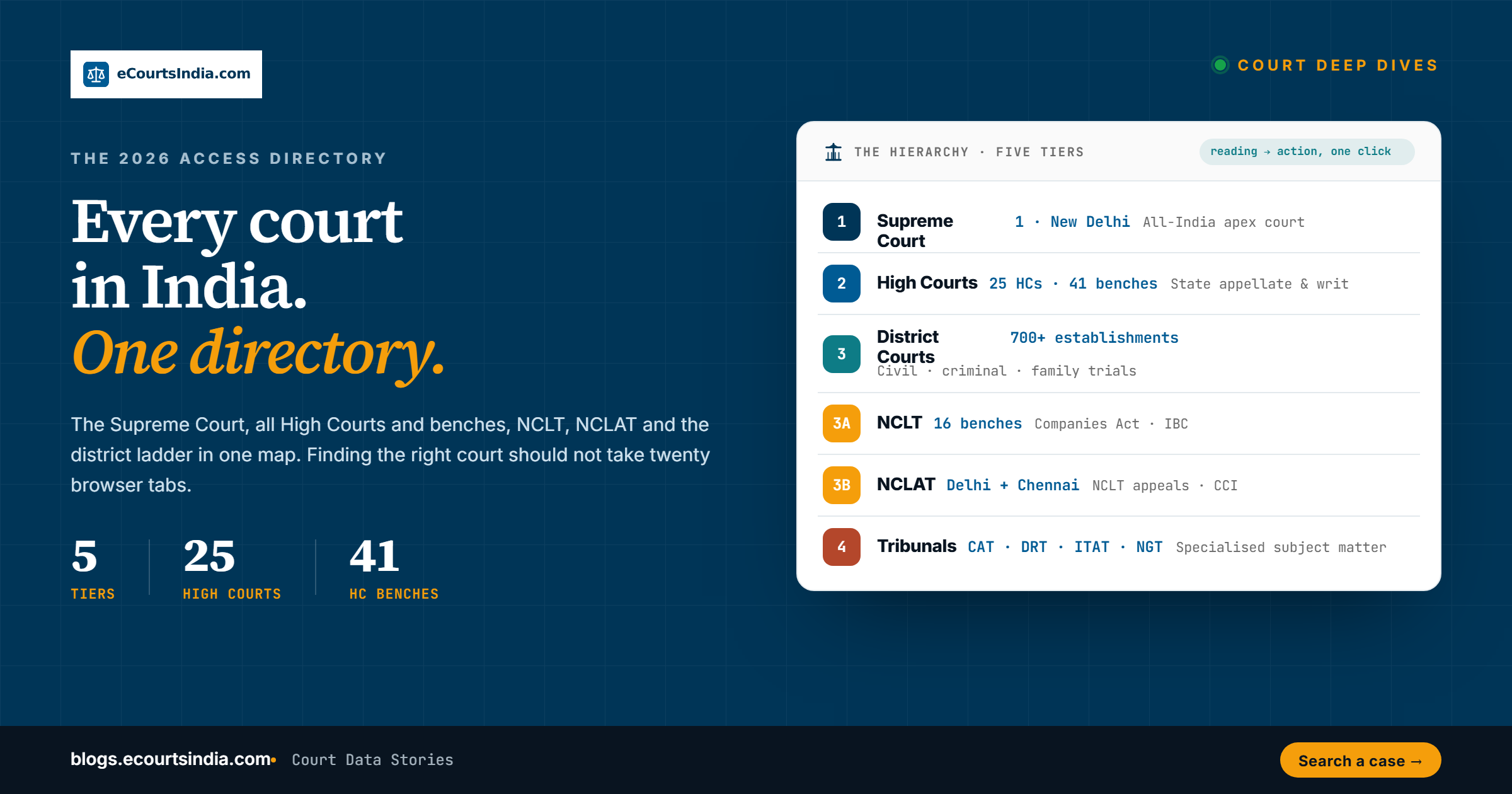
India’s judicial system runs on five tiers: one Supreme Court, 25 High Courts across 41 benches, district courts across India’s 800+ districts, plus NCLT, NCLAT, and specialised tribunals. This directory maps every one of them with direct links to live cause lists, case status, and CNR lookups on eCourtsIndia.
India has one Supreme Court, 25 High Courts with 41 principal and bench locations, district courts in every one of India’s 800+ districts across 38 states and Union Territories, 16 National Company Law Tribunal benches, the NCLAT with its Principal Bench at New Delhi and a bench at Chennai, and dozens of specialised tribunals. Finding the right court, the right cause list, or the right CNR for your case should not require twenty browser tabs. This directory consolidates every court in the Indian judicial system in one place, with direct links to live data on eCourtsIndia.com.

Use the table of contents below to jump to your court, or search by state, city, or case type. Every section links directly into the live search, cause list, or CNR lookup on eCourtsIndia.com so you can move from reading to action in one click.
Table of Contents
- 1. India Court Hierarchy at a Glance
- 2. Supreme Court of India
- 3. High Courts (41 Benches)
- 4. District Courts by State
- 5. NCLT (16 Benches)
- 6. NCLAT (Delhi and Chennai)
- 7. Other Specialised Tribunals
- 8. How to Find Cause Lists, CNR, and Case Status
- 9. Frequently Asked Questions
1. India Court Hierarchy at a Glance
The Indian judicial system is organised in five tiers. At the apex sits the Supreme Court of India. Below it are the 25 High Courts with their 41 principal and circuit benches. Under each High Court sit the state district courts, which handle trials and first-instance civil and criminal matters. Parallel to this mainstream hierarchy are specialised tribunals like NCLT, NCLAT, CAT, DRT, CESTAT, ITAT, and consumer forums that handle specific subject matter.
| Tier | Court | Count | Primary Jurisdiction | Appeals To |
|---|---|---|---|---|
| 1 | Supreme Court of India | 1 | All-India apex court | None (final) |
| 2 | High Courts | 25 HCs, 41 benches | State-level appellate and writ | Supreme Court |
| 3 | District Courts | Across 800+ districts | Civil, criminal, family trials | High Court |
| 3A | NCLT | 16 benches | Companies Act, IBC | NCLAT |
| 3B | NCLAT | Delhi (Principal) and Chennai | NCLT appeals, CCI | Supreme Court |
| 4 | Tribunals | Varies | Specialised subject matter | HC or SC |
Knowing where your case belongs in this hierarchy is the first step. A service dispute with the central government goes to CAT, not a district court. A company winding-up petition goes to NCLT, not the civil court. A constitutional writ goes to the High Court under Article 226, or the Supreme Court under Article 32.
2. Supreme Court of India
The Supreme Court of India is the final court of appeal under Article 124 of the Constitution. It sits in New Delhi and, as of 2026, is composed of the Chief Justice of India and up to 37 other Justices (a sanctioned strength of 38, raised from 34 by the Supreme Court (Number of Judges) Amendment, 2026). It has original jurisdiction in disputes between the Union and States, appellate jurisdiction in civil, criminal, and constitutional matters, and advisory jurisdiction under Article 143.
- Court code: SCIN01
- Location: Tilak Marg, New Delhi
- Bench types: Single Bench (rare), Division Bench (2-3 judges), Larger Bench, Constitution Bench (5+ judges)
- Common case types: SLP_C (Special Leave Petition Civil), SLP_CRL (Criminal), CA (Civil Appeal), TP_C / TP_CRL (Transfer Petition), RP_C / RP_CRL (Review Petition), CURP (Curative Petition)
- Cause list: ecourtsindia.com/causelist/SC
- Case search: All Supreme Court cases
3. High Courts (41 Benches)
India has 25 High Courts that together operate from 41 principal and bench locations. Some states like Maharashtra, Madhya Pradesh, Uttar Pradesh, Karnataka, Rajasthan, J&K, and West Bengal have multiple benches. Use the directory below to locate your High Court.
Northern Region
- Delhi High Court (DLHC01), New Delhi. Cause list | Search cases
- Punjab and Haryana High Court (PHHC01), Chandigarh, the common High Court for both Punjab and Haryana. Punjab cause list | Haryana cause list
- Himachal Pradesh High Court (HPHC01), Shimla, with benches at Mandi (HCMA01) and Dharamshala (HCMD01). Cause list
- Uttarakhand High Court, Nainital. Cause list
- J&K High Court with benches at Srinagar (JKHC01) and Jammu (JKHC02). Cause list
Western Region
- Bombay High Court (HCBM01 Principal, Mumbai), the High Court for Maharashtra and Goa, with benches at Nagpur (HCBM03), Aurangabad (HCBM02), and Goa (HCBM04). Cause list
- Gujarat High Court (GJHC24), Ahmedabad, with a Rajkot Bench. Cause list
Southern Region
- Andhra Pradesh High Court (APHC01), Amaravati. Cause list
- Telangana High Court, Hyderabad. Cause list
- Karnataka High Court (KAHC01, Bengaluru) with Hubli (KAHC02) and Kalaburagi (KAHC03) benches. Cause list
- Kerala High Court (KLHC01), Kochi. Cause list
- Madras High Court (Tamil Nadu). Cause list
Eastern Region
- Calcutta High Court (WBCHCA), the oldest High Court in India, with a permanent circuit bench at Port Blair (Andaman and Nicobar) and a circuit bench at Jalpaiguri (WBCHCJ). Cause list
- Odisha High Court (ODHC01), Cuttack. Cause list
- Bihar High Court (BRHC01), Patna. Cause list
- Jharkhand High Court (JHHC01), Ranchi. Cause list
- Manipur High Court (MNHC01), Imphal.
- Sikkim High Court (SKHC01), Gangtok.
- Gauhati High Court (GAHC), Guwahati, with benches at Kohima (Nagaland), Aizawl (Mizoram), and Itanagar (Arunachal Pradesh). Cause list
- Tripura High Court (TRHC), Agartala. Cause list
- Meghalaya High Court (MLHC01), Shillong. Cause list
Central Region
- Madhya Pradesh High Court (MPHC01, Jabalpur) with Indore (MPHC02) and Gwalior (MPHC03) benches. Cause list
- Chhattisgarh High Court (CGHC01), Bilaspur. Cause list
- Rajasthan High Court (RJHC01, Jaipur) with Jodhpur Bench (RJHC02). Cause list
- Uttar Pradesh High Court (UPHC01, Lucknow) with Allahabad Bench (UPHC02). Cause list
4. District Courts by State
District courts handle the overwhelming majority of civil and criminal trials in India. Every district in India has at least one court complex, and most have several. Court types at the district level include the Principal District Judge, Additional District Judge, Civil Judge Senior Division, Civil Judge Junior Division, Chief Judicial Magistrate (CJM), Chief Metropolitan Magistrate (CMM in metros), Judicial Magistrate First Class (JMFC), Family Court, Motor Accident Claims Tribunal (MACT), and Fast Track Courts.
To find a district court cause list or search cases by district, use the state landing page below and then drill into your specific district. Paths use the pattern /causelist/{state_code} for the state hub, and /causelist/{state_code}/{numeric_district_code} for a specific district.
| State / UT | Code | Region | Cause List Link |
|---|---|---|---|
| Andhra Pradesh | AP | Southern | causelist/AP |
| Arunachal Pradesh | AR | Eastern | causelist/AR |
| Assam | AS | Eastern | causelist/AS |
| Bihar | BR | Eastern | causelist/BR |
| Chhattisgarh | CG | Central | causelist/CG |
| Goa | GA | Western | causelist/GA |
| Gujarat | GJ | Western | causelist/GJ |
| Haryana | HR | Northern | causelist/HR |
| Himachal Pradesh | HP | Northern | causelist/HP |
| Jammu and Kashmir | JK | Northern | causelist/JK |
| Jharkhand | JH | Eastern | causelist/JH |
| Karnataka | KA | Southern | causelist/KA |
| Kerala | KL | Southern | causelist/KL |
| Madhya Pradesh | MP | Central | causelist/MP |
| Maharashtra | MH | Western | causelist/MH |
| Manipur | MN | Eastern | causelist/MN |
| Meghalaya | ML | Eastern | causelist/MG |
| Mizoram | MZ | Eastern | causelist/MZ |
| Nagaland | NL | Eastern | causelist/NL |
| Odisha | OD | Eastern | causelist/OD |
| Punjab | PB | Northern | causelist/PB |
| Rajasthan | RJ | Western | causelist/RJ |
| Sikkim | SK | Eastern | causelist/SK |
| Tamil Nadu | TN | Southern | causelist/TN |
| Telangana | TS | Southern | causelist/TS |
| Tripura | TR | Eastern | causelist/TR |
| Uttar Pradesh | UP | Northern | causelist/UP |
| Uttarakhand | UK | Northern | causelist/UK |
| West Bengal | WB | Eastern | causelist/WB |
| Delhi (UT) | DL | Northern | causelist/DL |
| Chandigarh (UT) | CH | Northern | causelist/CH |
| Puducherry (UT) | PY | Southern | causelist/PY |
| Andaman and Nicobar | AN | Eastern | causelist/AN |
| Lakshadweep (UT) | LW | Southern | causelist/LW |
| Dadra & Nagar Haveli and Daman & Diu (UT) | DD | Western | causelist/DD |
| Ladakh (UT) | LD | Northern | causelist/LD |
Popular city-level court searches
The following district court complexes draw the heaviest search traffic on eCourtsIndia.com. Each link takes you into the live cause list or case status page for that complex. District codes are numeric identifiers used inside the eCourts system.
- District Court Faridabad (Haryana, district 5): causelist/HR/5
- District Court Gurugram (Haryana, district 6): causelist/HR/6
- District Court Gautam Buddha Nagar / Noida (UP, district 20): causelist/UP/20
- District Court Pune (Maharashtra, district 25): causelist/MH/25
- District Court Bengaluru Urban (Karnataka, district 20): causelist/KA/20
- District Court Chennai (Tamil Nadu, district 13): causelist/TN/13
- District Court Lucknow (UP, district 24): causelist/UP/24
- District Court Jaipur Metro (Rajasthan, district 4): causelist/RJ/4
- District Court Surat (Gujarat, district 14): causelist/GJ/14
- District Court Indore (Madhya Pradesh, district 47): causelist/MP/47
- District Court Hyderabad (Telangana, district 2): causelist/TS/2
5. National Company Law Tribunal (NCLT): 16 Benches
The National Company Law Tribunal was constituted in June 2016 under the Companies Act, 2013. It handles all corporate matters including winding-up, amalgamation, arrangement, oppression and mismanagement, and insolvency proceedings under the Insolvency and Bankruptcy Code, 2016. The IBC prescribes a 180-day statutory timeline for Corporate Insolvency Resolution, extendable to 330 days. eCourtsIndia indexes every operational NCLT bench.
Critical note: NCLT court codes require a trailing zero for the eCourts search API. Use NCLTMB0, not NCLTMB.
| Bench | Code | City | Jurisdiction |
|---|---|---|---|
| Mumbai | NCLTMB0 | Mumbai | Maharashtra, Gujarat, Goa |
| New Delhi | NCLTDL0 | New Delhi | Delhi, Haryana, Punjab, HP |
| Chennai | NCLTCH0 | Chennai | Tamil Nadu, Puducherry, A&N |
| Kolkata | NCLTKL0 | Kolkata | West Bengal, Odisha, Jharkhand |
| Ahmedabad | NCLTAH0 | Ahmedabad | Gujarat (partial) |
| Hyderabad | NCLTHD0 | Hyderabad | Telangana, Andhra Pradesh |
| Bengaluru | NCLTBG0 | Bengaluru | Karnataka |
| Jaipur | NCLTJP0 | Jaipur | Rajasthan |
| Allahabad | NCLTAR0 | Allahabad | Uttar Pradesh |
| Indore | NCLTIN0 | Indore | Madhya Pradesh |
| Chandigarh | NCLTCG0 | Chandigarh | Chandigarh, HP |
| Cuttack | NCLTCT0 | Cuttack | Odisha (partial) |
| Guwahati | NCLTGW0 | Guwahati | All Northeast states |
| Kochi | NCLTKC0 | Kochi | Kerala |
| Amaravati | NCLTAM0 | Amaravati | Andhra Pradesh |
| New Delhi (Principal Bench) | NCLTPB0 | New Delhi | Principal Bench, all-India administrative |
Common NCLT case types: COP (Company Petition), IP (Insolvency Petition), IA_IBC (Interlocutory Application under IBC). To search an NCLT bench, use the cc= parameter with the bench code, for example ecourtsindia.com/search?cc=NCLTMB0 for Mumbai. You can pass multiple codes by comma-separating them in the same cc parameter.
These bench and case-type codes are a point-in-time snapshot. The authoritative, always-current list of court codes and case types (including newer tribunals such as GSTAT as they roll out) lives at the API enums endpoint. See ecourtsindia.com/api/docs.
6. National Company Law Appellate Tribunal (NCLAT)
The NCLAT is the appellate forum over NCLT decisions and also hears appeals against the Competition Commission of India. It sits as a Principal Bench at New Delhi and a bench at Chennai. The Principal Bench at New Delhi hears appeals other than those falling within the jurisdiction of the Chennai Bench, while the Chennai Bench hears appeals arising from NCLT benches in the southern states. Typical disposal time is 6 to 12 months, with IBC matters often expedited to 3 to 6 months.
Common NCLAT case types include CA_IBC (Corporate Appeal under IBC), CA_CA (Corporate Appeal under Companies Act), and TA_IBC (Transfer Appeal under IBC). To pull up the NCLAT cause list or cases, use the cc= parameter with the bench code, for example ecourtsindia.com/search?cc=NCLAD00 for the Principal Bench. Multiple bench codes can be comma-separated in a single cc value.
7. Other Specialised Tribunals
Beyond NCLT and NCLAT, India’s judicial system includes many specialised tribunals that handle subject-specific matters. Here is how they map to the system, and to what you can search on eCourtsIndia today.
Searchable on eCourtsIndia right now
- DRT (Debts Recovery Tribunal): bank and financial-institution debt recovery for claims of Rs. 20 lakh and above. Multiple benches across India.
- DRAT (Debts Recovery Appellate Tribunal): appeals from DRT.
- ITAT (Income Tax Appellate Tribunal): direct-tax appeals, with benches in major cities.
- CESTAT (Customs, Excise and Service Tax Appellate Tribunal): indirect-tax appeals, with regional benches.
- GSTAT (Goods and Services Tax Appellate Tribunal): GST appeals. Bench court-codes and case types are now being seeded into the search pickers, with full case indexing rolling out across state benches.
- SAT (Securities Appellate Tribunal): appeals against SEBI and market-regulator orders, Mumbai.
- TDSAT (Telecom Disputes Settlement and Appellate Tribunal): telecom, broadcasting and IT disputes, New Delhi.
- APTEL (Appellate Tribunal for Electricity): power-sector disputes, New Delhi.
- Consumer Commissions (e-Jagriti): consumer disputes across District, State, and National (NCDRC) tiers.
Part of the system (indexing in progress or research-only)
- CAT (Central Administrative Tribunal): central-government service matters, multiple benches.
- NGT (National Green Tribunal): environmental matters, Principal Bench at Delhi with regional benches. Coverage is actively being added and expanded.
- AFT (Armed Forces Tribunal): defence service matters, multiple benches.
- Family Courts: matrimonial, custody, maintenance, and guardianship.
- Labour Courts / Industrial Tribunals: industrial disputes under the ID Act, 1947.
- RERA Authorities: real-estate disputes under RERA, 2016, at the state level.
- Revenue Boards: Rajasthan Board of Revenue (Ajmer), UP Board of Revenue, and state equivalents.
- Lok Adalats: people’s courts for amicable settlement, at National, State, and Taluka tiers.
8. How to Find Cause Lists, CNR, and Case Status
Four common search paths cover almost every lookup on eCourtsIndia.com.
A. Find a case by CNR Number
Every case in an Indian court has a 16 character Case Number Record (CNR). If you know the CNR, go directly to the case page. Format: ecourtsindia.com/cnr/{CNR}. A CNR encodes state, district, court establishment, year, and serial number. Read our CNR Decoded guide for the full breakdown. High Court and District Court case pages now also display richer structured fields (such as e-filing number and date, filing and litigant type, case-type conversion, structured parties, and process, interim-application, transfer and hearing-history records) as our coverage continues to expand.
B. Find a cause list by court and date
Cause lists are the daily agenda of a court. Access them at ecourtsindia.com/causelist/{STATE} for the state hub, /causelist/{STATE}/HC for the High Court of that state, and /causelist/{STATE}/{district_code} for a specific district complex. Dates are typically the current day or next working day. Weekends and gazetted holidays are skipped.
C. Search cases by party name, advocate, or CNR
Use the general search at ecourtsindia.com/search. You can filter by court (cc=), case type (ct=), case status (cs=), bench type (bt=), filing year (fy=), decision year (dy=), petitioner (pet=), respondent (res=), advocate (adv=), judge (judge=), and free text (q=). Multi-value filters accept comma-separated codes in a single parameter. See our Search Filter Guide for every parameter with live examples.
D. Find a lawyer
Search by name, bar council number, or city at ecourtsindia.com/lawyer. Each lawyer profile shows cases filed, courts practised in, and practice areas.
Keep this directory bookmarked
India’s court system evolves. New tribunal benches are constituted, bench codes change, and new states or UTs can redefine court geography. This directory is updated quarterly to reflect the latest composition. Bookmark it, share it, and use it as your starting point for any court lookup.
For programmatic access to the same taxonomy for AI agents, LLM grounding, or automated lookups, see our llms-courts.txt machine-readable court directory. It contains the same data in a flat, parseable format optimised for Large Language Model ingestion.

Frequently Asked Questions
How many High Courts are there in India?

India has 25 High Courts operating from 41 principal and bench locations. Some states share a court, such as the Punjab and Haryana High Court at Chandigarh, while others run several benches, like Bombay with its Mumbai principal seat and benches at Nagpur, Aurangabad, and Goa. You can open any High Court cause list, for example the Delhi High Court list, on eCourtsIndia.
What is the difference between NCLT and NCLAT?
NCLT is the tribunal of first instance for corporate and insolvency matters and runs 16 benches across India. NCLAT is the appellate tribunal that hears appeals from NCLT and from the Competition Commission of India, sitting as a Principal Bench at New Delhi and a bench at Chennai. Search either forum at eCourtsIndia.
How do I check a district court cause list like Faridabad or Gurugram?
District court cause lists follow the pattern causelist plus state code plus district number. Faridabad sits at causelist/HR/5 and Gurugram at causelist/HR/6. Each list shows the matters set for the current working day, organised judge-wise and court-wise.
How do I find a case using a CNR number?
Every Indian court case carries a unique 16 character Case Number Record. If you have it, open the case directly at ecourtsindia.com/cnr followed by the CNR, which encodes state, district, court establishment, and year. Our CNR Decoded guide explains every segment, or start a wider case search.
How do I find a lawyer or search cases by party name?

Use the lawyer directory at eCourtsIndia lawyer search to look up an advocate by name, bar number, or city, along with their case history and practice areas. To search cases by party, advocate, or judge, use the filters at eCourtsIndia search.