Madras High Court case status
The Madras High Court hears cases from Tamil Nadu and Puducherry at its principal seat in Chennai and its bench at Madurai. In our index it is the busiest High Court by filings in recent years. Here is how to find a case, and what the numbers say.
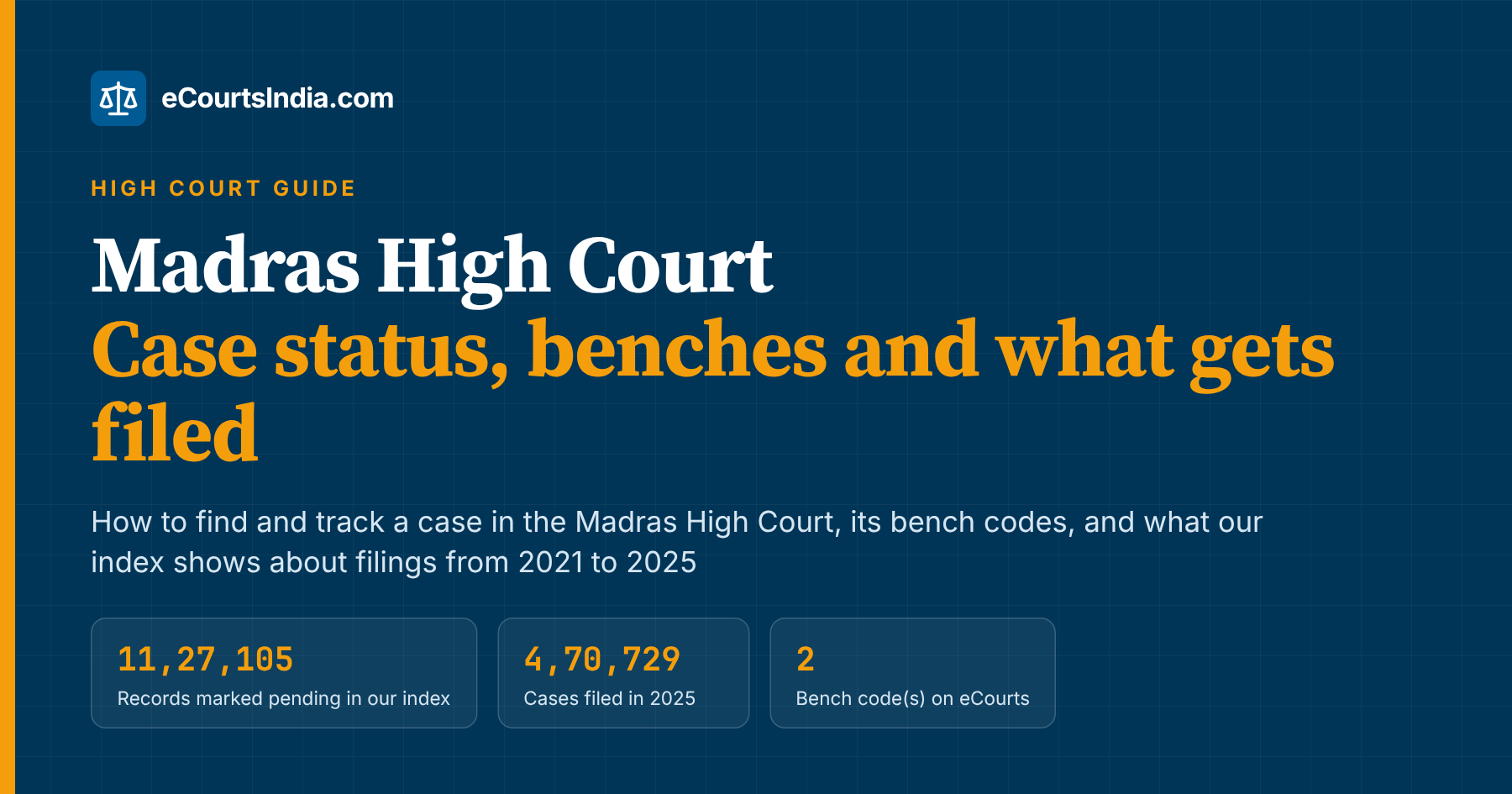
Chennai cases use the code HCMA01 and Madurai cases HCMD01. Filings in our index rose from 2,81,499 in 2021 to 4,70,729 in 2025.
Counts read from the eCourtsIndia index on 15 November 2026.
Last updated: 15 November 2026
Key takeaways
- Two seats: Chennai (HCMA01) and the Madurai bench (HCMD01). The CNR prefix tells you which.
- Volume: 18,76,391 cases filed from 2021 to 2025 in our index, 11,69,317 at Chennai and 7,07,074 at Madurai.
- Growth: 2025 filings were about 67% higher than 2021.
- Applications outnumber main cases: civil miscellaneous applications (6,51,632) are the largest single code, ahead of writ petitions (3,58,321).
- Pending records: 11,27,105 records are marked pending across both seats in our index.
Where does the Madras High Court sit?
| Seat | Court code and CNR prefix | Pending records | Filed 2021 to 2025 |
|---|---|---|---|
| Chennai (principal seat) | HCMA01 | 7,80,273 | 11,69,317 |
| Madurai bench | HCMD01 | 3,46,832 | 7,07,074 |
The Madurai bench hears matters from the southern districts of Tamil Nadu. The rest of the state and Puducherry go to Chennai. If a search by name brings up two seats, check the CNR prefix and the case’s lower court details to pick the right one.
What is filed in the Madras High Court?

Applications, writs and criminal petitions. The court registers many interim and miscellaneous applications as their own numbered matters, which is why civil miscellaneous applications (6,51,632) outnumber writ petitions (3,58,321) in our index. When you track a writ, expect several connected application numbers alongside it, each with its own CNR. Criminal miscellaneous petitions (2,95,342) and criminal miscellaneous applications (2,05,339) carry most criminal work, including bail and quash petitions. Civil revisions (46,719), appeals and applications under the CA code (44,335), writ appeals (38,175) and contempt petitions (33,645) follow.
How fast are filings growing?
| Filing year | Cases in our index |
|---|---|
| 2021 | 2,81,499 |
| 2022 | 3,52,092 |
| 2023 | 3,81,663 |
| 2024 | 3,90,408 |
| 2025 | 4,70,729 |
Every year from 2021 to 2025 was higher than the one before, and 2025 alone added more than 4.7 lakh cases. Part of that rise is applications filed within existing matters, so a higher count does not always mean more disputes. Still, the steady climb is a useful signal for lawyers and litigants planning around listing delays. For cross-court comparisons see our disposal time index.
Is the Madras High Court keeping up with new filings?
Nearly. From 2021 to 2025 our index records 16,42,366 cases decided by the Madras High Court against 18,76,391 filed, about 88 decisions for every 100 new cases, so the pending list grew a little over the period.
| Year | Cases filed | Cases decided | Decided per 100 filed |
|---|---|---|---|
| 2021 | 2,81,499 | 2,42,219 | 86 |
| 2022 | 3,52,092 | 3,18,577 | 90 |
| 2023 | 3,81,663 | 3,35,083 | 88 |
| 2024 | 3,90,408 | 3,54,469 | 91 |
| 2025 | 4,70,729 | 3,92,018 | 83 |
The strongest year by this measure was 2024, with 91 decisions per 100 filings; the weakest was 2025, at 83.
This is a rough measure, not an official clearance rate. Decisions in any year include cases filed long before, and the most recent year can be undercounted until our refresh of every record from the court catches up.

How long does a case take in the Madras High Court?
69% of the cases the Madras High Court decided between 2021 and 2025 were decided within a year of filing. About 81% were decided within three years, and 11% took more than five.
| Time from filing to decision | Cases decided 2021 to 2025 | Share |
|---|---|---|
| Within 1 year | 11,31,593 | 69% |
| 1 to 3 years | 1,98,287 | 12% |
| 3 to 5 years | 1,24,214 | 7.6% |
| Over 5 years | 1,88,272 | 11% |
| Total | 16,42,366 | 100% |
Fast disposals are not all wins. The within-a-year group includes bail orders, petitions dismissed or allowed at the first hearing, matters withdrawn and cases sent back to a lower authority. Full appeals that need the record from the trial court, and writ matters where the government asks for time to file replies, are the ones that tend to stretch into years.
What this means in practice: if your matter in the Madras High Court has been pending for more than three years, it is in the slower group, roughly 19% of recent decisions. Check the last hearing date on the case page, and if nothing has happened for months, ask your advocate whether an application for early hearing or a mention is worth filing. Our next hearing date guide explains what to do when a date passes without an update.
How old are the cases pending in the Madras High Court?
79% of the 11,27,143 records marked pending in our index were filed in 2020 or later. 88,901 were filed before 2010.
| Filed in | Pending records | Share of pending |
|---|---|---|
| Before 2010 | 88,901 | 7.9% |
| 2010 to 2014 | 19,939 | 1.8% |
| 2015 to 2019 | 1,30,867 | 12% |
| 2020 to 2024 | 4,34,427 | 39% |
| 2025 or later | 4,53,009 | 40% |
The older end of the list deserves a word. A case filed before 2010 that still shows as pending may genuinely be waiting, may be tagged with a connected matter that is still running, or may have been decided without the court’s online record being updated. If you are tracking one of these 88,901 cases, open it on eCourtsIndia and use Refresh to pull the latest status from the court, then compare the last order date with what your advocate tells you.
Which case types make up the Madras High Court’s pending list?
Civil miscellaneous application matters lead the pending list, with 5,00,496 records or 44% of everything pending. The table explains what each common code means.
| Case type | What it is | Pending | Share |
|---|---|---|---|
| Civil miscellaneous application (CMAppl) | applications filed within a main case, such as for a stay or condonation of delay | 5,00,496 | 44% |
| Writ petition (civil) (WP_C) | a petition under Article 226 against a government body or authority, often on service, land or licensing matters | 1,33,028 | 12% |
| Criminal miscellaneous application (CRL_MA) | criminal applications such as bail, quashing or suspension of sentence | 90,488 | 8.0% |
| Criminal miscellaneous (CR_MISC) | criminal petitions such as bail, quashing under the BNSS or old CrPC, and other applications | 66,407 | 5.9% |
| Type not recognised (UNKNOWN) | a case type our index could not map to a standard label | 65,918 | 5.8% |
| Second appeal (SA) | a further appeal on a substantial question of law after the first appeal | 36,524 | 3.2% |
| Civil application or appeal (CA) | civil applications or appeals, the use varies by court | 35,924 | 3.2% |
| Writ appeal (WA) | an appeal to a Division Bench against a single judge’s writ order | 31,306 | 2.8% |
Comparing this with what is filed tells you which matters stay longest. In the Madras High Court, criminal miscellaneous matters are 16% of recent filings but only 5.9% of the pending list. A type that is a bigger share of the pending list than of new filings is one that takes longer to close; one that is a big share of filings but a small share of pending tends to be decided quickly.
If a label here does not match the one on your court papers, that is expected: we normalise every High Court’s labels to common codes so you can compare courts. Our case type encyclopedia maps local labels to these codes.
About 5.8% of pending records carry a case type we could not map. Search those by CNR, party name or number rather than by type.
Will a single judge or a Division Bench hear the case?
Mostly a single judge: 73% of pending records in the Madras High Court are marked for a single bench and 17% for a Division Bench of two judges. The rest have no bench type recorded yet.
Single judges hear the bulk of the work: writs, bail, revisions and many appeals. Division Benches take intra-court appeals (writ appeals or letters patent appeals), PILs, and the heavier criminal appeals. The precise split is set by the roster that the Chief Justice issues, and rosters are revised regularly.
Why it matters to you: the bench type tells you which cause list to watch. Division Bench lists and single bench lists are published separately, and a matter can move from one to the other when an appeal is filed. The bench type is shown on the case page on eCourtsIndia.
Can I read the orders in a pending case?
Not yet for most cases from the Madras High Court: only 14% of pending records in our index have an order attached. Orders for this court are largely still to be added to our index. Until they are, use the case page for status and dates, and get order copies from the court’s own website or its copying section.
- Read free where available: when an order is in our index, open the case on eCourtsIndia and click View Orders. Each order has its own page with the text and an AI summary of what was decided.
- Get a copy you can file: for filing in court or before an authority you need a certified copy; our certified copy guide explains how to apply.
- Get the next one automatically: switch on case alerts and new dates are sent to you by WhatsApp or email.
- Decode the status: terms like “admitted”, “rule nisi” or “disposed” are explained in our case status dictionary.
How should I use these numbers?
- If you are a litigant: compare your case’s age with the tables above. A case younger than the typical disposal time is not “stuck”; one much older is worth a conversation with your advocate.
- If you are an advocate: the pending mix by case type shows where listings are tight in the Madras High Court. Track every matter on one dashboard and let alerts tell you about new dates.
- If you run checks for a business: a pending writ or appeal is a status, not a finding. Read the latest order before you draw any conclusion about a party.
- If you are a researcher or journalist: these are counts of records in our index, refreshed from the courts in batches. Cite them with the date, and use the National Judicial Data Grid for official pendency.
Tips for searching Madras High Court cases
- Find the main case first: if you only have an application number, open it and look for the connected main case, then track both.
- Tamil names: spellings vary widely in transliteration. Try initials plus surname, and the father’s name.
- Government parties: departments appear as “The State of Tamil Nadu, rep. by its Secretary” and similar; search the private party instead. Our government litigation index shows how often the state is a party.
- Advocates: track every matter you appear in from one lawyer dashboard.
How to search any High Court case on eCourtsIndia
- By CNR: paste the 16-character CNR from any order or notice into ecourtsindia.com/search. A High Court CNR starts with the court code shown in the bench table above. Our CNR guide explains each part.
- By party name: search the petitioner’s or respondent’s name and filter by court. Government departments appear under many spellings, so try the department name and the officer’s designation.
- By case number: you need the exact case type label the court uses, the number and the year. If a label returns nothing, search without it and read the case type facet.
- By advocate: search the advocate’s name with the court filter to see their listed matters.
- Track it: add the case to your dashboard and switch on alerts so a new date or order reaches you.
A downloaded order is a copy for reading and sharing. For filing or producing it before an authority, apply for a certified copy; our certified copy guide explains how. For all 25 High Courts in one place, see our High Court case status hub.
Frequently asked questions
How do I check Madras High Court case status online?
Search the CNR on ecourtsindia.com/search. Without a CNR, search a party name and filter to the Madras High Court at Chennai (HCMA01) or the Madurai bench (HCMD01).
What is the code for the Madurai bench?
HCMD01. The Chennai principal seat is HCMA01. The CNR begins with this code.
Why does my case have several numbers?
The Madras High Court registers many applications filed in a case as separate numbered matters. Track the main case and its connected applications together.
How many cases are filed in the Madras High Court each year?
Our index shows 4,70,729 cases filed in 2025 across both seats, up from 2,81,499 in 2021. Counts include applications.
Is the pending count official?
No. It counts records in our index whose last-read status is pending. Refer to the court and the National Judicial Data Grid for official figures.
How long does a case take in the Madras High Court?
In our index, 69% of cases decided from 2021 to 2025 were decided within a year of filing and 11% took more than five years.
How many cases does the Madras High Court decide each year?
Between 2,42,219 and 3,92,018 a year from 2021 to 2025 in our index, against 2,81,499 to 4,70,729 filed.
How old are the pending cases in the Madras High Court?
79% of pending records in our index were filed in 2020 or later; 88,901 date from before 2010.
Important: This guide is general information about using public court records. It is not legal advice; for advice on your own case, speak to an advocate or your nearest legal services authority. Case data on eCourtsIndia is a copy of public court records as last read from the court and is not a certified copy. For anything you will rely on in court, get a certified copy from the court itself. A name match is not identity, a pending case is not guilt, and a disposed case is a status, not an outcome. Figures were read on the date shown at the top and change every day. eCourtsIndia is a private legal-technology platform by Billion Insights Ventures Pvt. Ltd. and is not affiliated with any court, the e-Committee of the Supreme Court or the Government of India. Found an error? Write to support@ecourtsindia.com.


