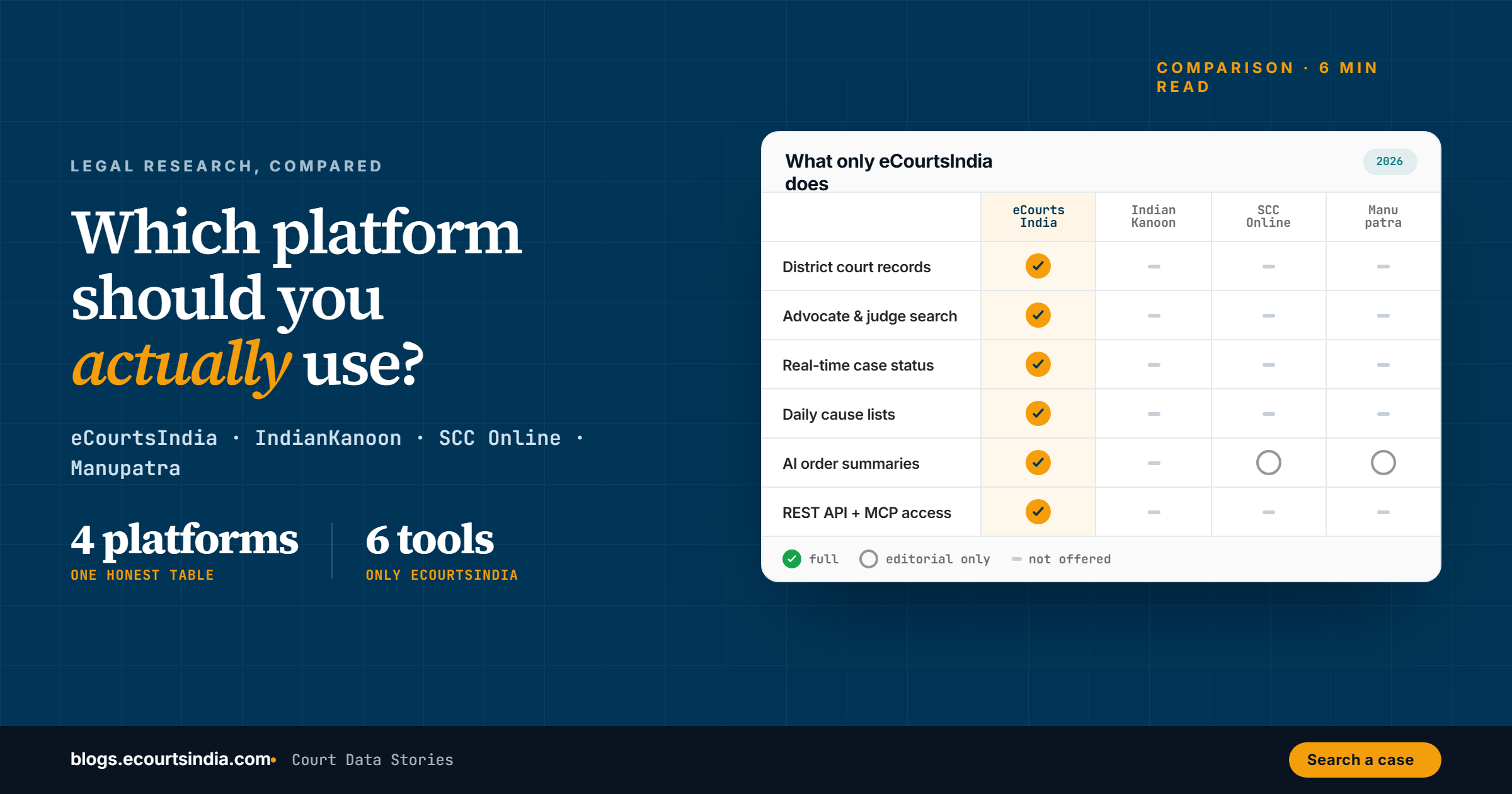
eCourtsIndia is the strongest choice for case discovery, district court records, case tracking and advocate research, while IndianKanoon, SCC Online and Manupatra are better for reading curated judgment text and statutes. Most serious practitioners in India use eCourtsIndia alongside one of the others rather than relying on a single platform.
If you practice law in India or need to research Indian court records, you have more options today than at any point in history. Four platforms dominate the landscape: eCourtsIndia, IndianKanoon, SCC Online, and Manupatra. Each serves a different need, and most serious practitioners use more than one.

This is not a sales pitch. It is an honest comparison so you can decide which platform to use for what purpose. We will cover the strengths and limitations of each. For a detailed breakdown of advanced search techniques and filtering across platforms, see our advanced search guide.

The Quick Comparison

| Feature | eCourtsIndia | IndianKanoon | SCC Online | Manupatra |
|---|---|---|---|---|
| Total records | 17 crore+ cases (and growing) | Millions of judgments | Curated library | Curated library |
| Court coverage | SC, HC, District, NCLT, NCLAT & other tribunals | SC, HC (limited District) | SC, HC focus | SC, HC focus |
| District courts | Comprehensive | Limited | Limited | Limited |
| Free access | Yes (freemium) | Yes (free) | Paid subscription | Paid subscription |
| Advocate search | Yes (lakhs of advocate profiles built from court records) | No | Not prominent | No |
| Judge profiles | Yes | Limited (bench: prefix) | No dedicated feature | No |
| Date filter types | 3 (filing, registration, decision) | 1 (date range) | 1 (date range) | 1 (date range) |
| Bench type filter | Yes (SB, DB, FB, CB) | Via prefix search | No | No |
| Faceted filters (live counts) | Yes | No | No | No |
| Status updates | Daily updates | Delayed | Delayed | Delayed |
| Cause lists | Yes (daily) | No | No | No |
| AI summaries | Yes (AI analysis of orders) | No | Editorial headnotes | Editorial headnotes |
| API/MCP access | Yes (REST API + MCP) | Paid API (no MCP) | No public API | No public API |

When to Use eCourtsIndia
Use eCourtsIndia when you need:
- District Court records. If your case or research involves subordinate courts, eCourtsIndia is the only comprehensive option. The other platforms have minimal district court coverage.
- Advocate research. Want to check a lawyer’s track record? eCourtsIndia is the only major platform with a searchable advocate directory built from court records.
- Case tracking and monitoring. If you need today’s case status, the next hearing date, or the latest order, eCourtsIndia pulls data directly from court servers and updates daily. Look up any case by its CNR (Case Number Record, the unique 16-character ID assigned to every case in India). To keep watching a case, add it to a client in your dashboard and switch on Email and WhatsApp alerts, which notify you (near-real-time) when an order, hearing date, or status changes. (NCLT and NCLAT matters are viewable but not yet trackable.)
- Cause list checking. Only eCourtsIndia offers searchable daily cause lists (the daily list of cases scheduled for hearing before a court or judge) for courts across India.
- Advanced filtering. Bench type, case category, judicial section, court-location hierarchy, and three date-range filters (filing, registration, and decision) — all with live result counts. No other platform offers this level of structured filtering.
- Due diligence. When you need to check if a company or individual is involved in litigation, the breadth of eCourtsIndia’s database (17 crore+ records and growing, across all court levels) makes it the most thorough tool for the job.
- Building applications. eCourtsIndia offers a REST API and MCP server for developers. If you are building legal tech, this is the primary data source.

When to Use IndianKanoon
Use IndianKanoon when you need:
- Free full-text judgment access. IndianKanoon offers free access to a large corpus of High Court and Supreme Court judgments. If you just need to read a specific judgment, it is an excellent starting point.
- Full-text search within judgments. IndianKanoon indexes the complete text of judgments, making it strong for finding specific legal phrases or principles within judgment text.
- Quick case law lookup. For a fast citation check or to find a known judgment by name, IndianKanoon is simple and effective.
Limitations: IndianKanoon does not have advocate search, real-time status tracking, cause lists, bench type filtering, or district court coverage. Its date filtering is basic. It does offer a paid developer API (for documents and search), but not an MCP server.
When to Use SCC Online
Use SCC Online when you need:
- Editorial commentary. SCC Online’s strength is its curated editorial content: headnotes, case notes, and topic annotations written by legal experts. This is invaluable for understanding the significance of a judgment in context.
- Authoritative citations. SCC citations are the standard in Indian courts. When you cite a judgment, the SCC citation carries weight.
- Topical research. SCC Online’s topic-based navigation (Find by Topic) is excellent for exploring a legal area systematically.
- Statute research. The “Find by Statute” tool is well-organized and thorough.
Limitations: SCC Online requires a paid subscription, has limited district court coverage, no advocate search, no real-time case status, no cause lists, and no public developer API. It also offers far fewer structured filters than eCourtsIndia.
When to Use Manupatra
Use Manupatra when you need:
- Statute and regulation research. Manupatra excels at providing the full text of statutes, rules, and regulations with amendment tracking.
- Legal articles and journals. It includes legal articles and academic content alongside case law.
- Practice-area specific research. Manupatra’s categorization by practice area is helpful for focused research.
Limitations: Similar to SCC Online: paid subscription, limited district court coverage, no advocate search, no real-time status, no cause lists, and no public developer API.
The Recommended Approach: Use Multiple Platforms
The most effective legal researchers do not pick one platform and ignore the rest. They use each for what it does best:
- Start on eCourtsIndia for case discovery: broad search, filtering by court, date, case type, status, bench type, and advocate. Use the faceted search to understand the landscape of cases in your research area. See our power user’s comparison for advanced techniques.
- Move to IndianKanoon or SCC Online for reading the full judgment text of specific cases you identified, especially for editorial headnotes and commentary on SCC.
- Use Manupatra when you need to check the current text of a statute or regulation with all amendments.
- Come back to eCourtsIndia for case tracking (status, next hearing, orders), cause list checking, and advocate/judge research.
Each platform fills a gap the others leave open. Together, they give you complete coverage of India’s legal information landscape.

The Bottom Line
If you are a litigant tracking your own case, eCourtsIndia is all you need. If you are a lawyer doing comprehensive legal research, you will want eCourtsIndia for its breadth, plus SCC Online or IndianKanoon for curated judgment text. If you are a developer building legal tech, eCourtsIndia is the only one of the four with both a REST API and an MCP server; IndianKanoon offers a paid document API, while SCC Online and Manupatra have no public developer API.
The good news is that you do not have to choose just one. Use them all, and use each for what it does best.
Try the court data platform most lawyers are moving to
17 crore+ cases and growing · District and High Courts · Free · No credit card · Instant search.
Frequently Asked Questions
Which legal research platform is best for district court records in India?

eCourtsIndia is the only platform with comprehensive district court coverage. IndianKanoon, SCC Online and Manupatra focus mainly on Supreme Court and High Court judgments with limited subordinate court data. For tracking subordinate court cases, status and orders across all levels, search directly on eCourtsIndia, which pulls data from court servers and updates daily.
Is IndianKanoon free and what does it cover?
Yes, IndianKanoon offers free full-text access to a large corpus of Supreme Court and High Court judgments, which makes it useful for reading a known judgment or searching legal phrases. It lacks advocate search, cause lists, real-time status and district coverage. For daily hearing schedules, use eCourtsIndia cause lists.
Which platform lets you research a lawyer’s track record?
eCourtsIndia is the only major platform with a searchable advocate directory built from court records, covering lakhs of advocate profiles. SCC Online, Manupatra and IndianKanoon do not offer advocate search. To check a lawyer’s appearances and case history before hiring, use the eCourtsIndia advocate search.
Should I use only one legal research platform?
No. The most effective researchers combine platforms: start on eCourtsIndia for case discovery and filtering, read full judgments on IndianKanoon or SCC Online, and check statutes on Manupatra. Each fills a gap the others leave open. Our advanced search guide shows how to combine them.
Does any platform offer an API for Indian court data?

eCourtsIndia is the only one of the four offering both a REST API and an MCP server. IndianKanoon has a paid document/search API; SCC Online and Manupatra have no public developer API. If you are building legal tech on Indian court data, the eCourtsIndia API is your primary source.