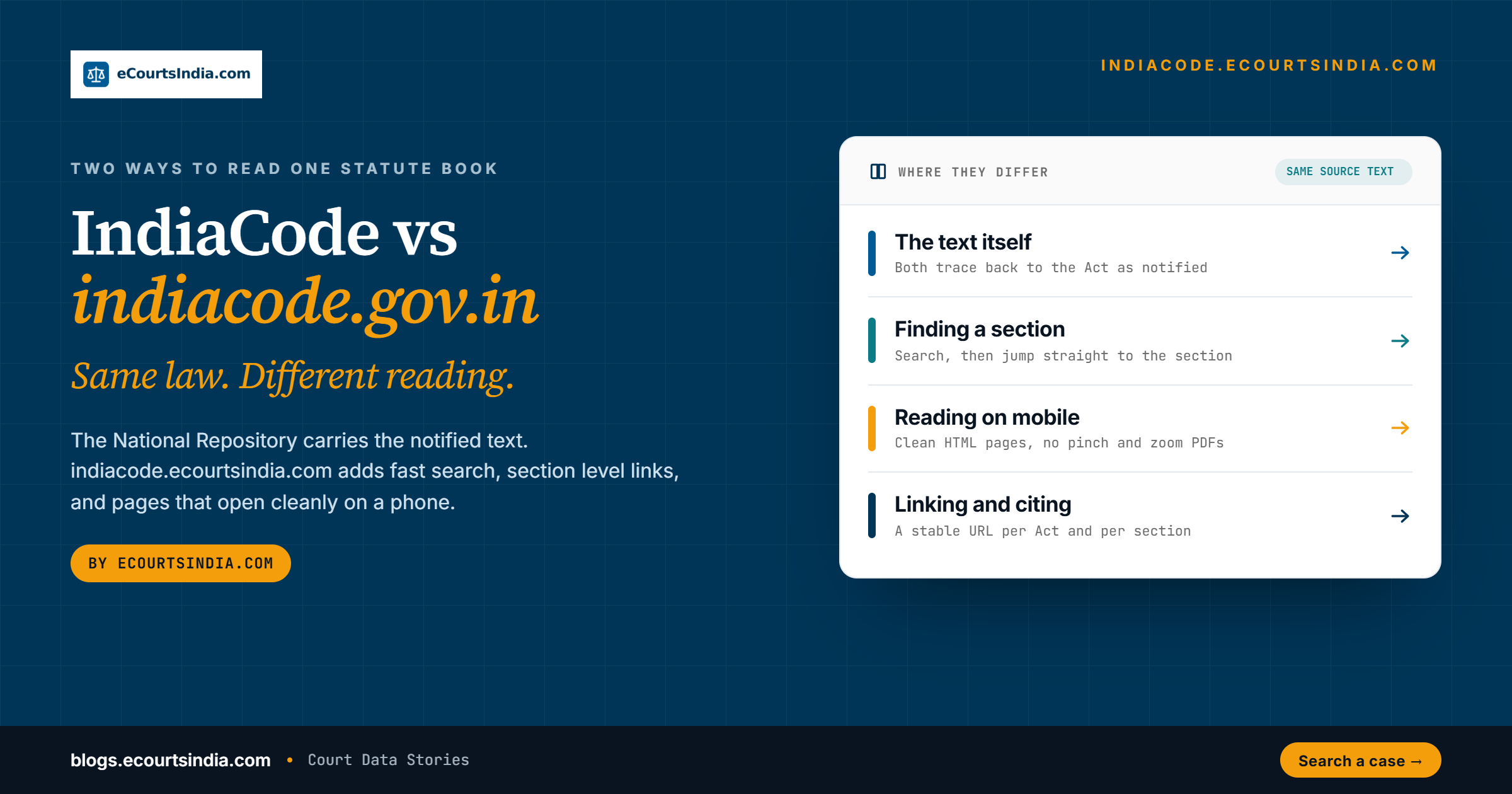
indiacode.gov.in is the official India Code portal of the Legislative Department. IndiaCode at indiacode.ecourtsindia.com is eCourtsIndia’s section-by-section edition of that corpus, with judgments, old-to-new converters and a public JSON API on top. They share a name and they share a source. They are not the same site. The Gazette of India is still the text that wins if anything disagrees. This page is the honest comparison after the government’s 13 August 2026 relaunch: what is official, what is citable in a draft, and which URL you should paste.
Key takeaways
- On 13 August 2026 the Ministry of Law and Justice relaunched indiacode.gov.in with AI-assisted, semantic and speech search, Eighth Schedule multilingual access, e-Gazette links and QR-enabled documents. That portal remains the official digital repository of Central, State and Union Territory legislation.
- IndiaCode by eCourtsIndia harvests that repository through India Code’s public API, does not edit the words, and republishes them with original commentary under section 52(1)(q)(ii) of the Copyright Act, 1957. The live site holds 836 Central Acts, 1,410 State Acts and 77,072 sections (corpus dated 28 August 2026).
- Use the government portal when you need the official repository, Hindi or other scheduled-language access, a Gazette/PDF scan, or a handle that a ministry already cites. Use IndiaCode when you need a permanent section URL, the judgments that construed the section, an IPC/CrPC/IEA converter, or JSON/Markdown.
- Neither site is a substitute for the Gazette. If a provision on either page differs from the Gazette, the Gazette is right. Corrections on our side: hi@ecourtsindia.com.

Two sites, one source
IndiaCode’s about page says this in one sentence: the corpus is harvested from India Code, the Government of India’s official repository, through its public API. The harvest is a reviewed step on a machine eCourtsIndia controls. The published site then makes no external calls. Statutory text is normalised for markup and not rewritten.
That is why the names collide. “India Code” is the official product. “IndiaCode” is the eCourtsIndia reading layer. We kept the name because that is what people type when they want a bare Act. The domains are different on purpose: indiacode.gov.in versus indiacode.ecourtsindia.com.
Side-by-side
| What you need | India Code · indiacode.gov.in | IndiaCode · indiacode.ecourtsindia.com |
|---|---|---|
| Who publishes it | Legislative Department, Ministry of Law and Justice, with NIC | eCourtsIndia, from the official corpus plus original matter |
| Is it official? | Yes. It is the government’s digital repository. | No. It is a structured edition of that repository. The Gazette still governs. |
| Permanent section URL | Document and handle based. Fine for retrieving a file, awkward to paste into a pleading. | /bns/section/103/, /ni-act/section/138/, /constitution-of-india/article/21/. Stable slugs. Nothing moves. |
| Judgments on the section | Not the product. You leave the portal to find case law. | 2,667 reported judgments attached where the order itself applied the provision. Example: NI Act 138 carries MSR Leathers (CNR SCIN010047712001) through to the order on eCourtsIndia. |
| Old law / new law | Legislative history and amendment information on the revamped portal. | Four converters with both texts on one page: IPC to BNS, CrPC to BNSS, Evidence Act to BSA, Income-tax 1961 to 2025. Repealed pages are not redirected. |
| Developer API | A public harvest API exists; it is not a documented, CORS-open, OpenAPI product for builders. | No key, no registration, CORS *. /api/, OpenAPI 3.1, Markdown, Akoma Ntoso XML, CSV at /data/. |
| Hindi and other languages | Revamp of 13 August 2026: AI-assisted access in all 22 Eighth Schedule languages, plus speech search. | English. IndiaCode does not machine-translate operative text. Hindi, when it comes, will be the official Hindi text under the Authoritative Texts (Central Laws) Act, 1973. |
| Gazette / source PDFs | e-Gazette integration, document viewer, QR-enabled access, scanned State Acts. | Instruments link to the source PDF on India Code. 8,351 State Acts that the source holds only as a scan are indexed and linked to the government handle — no text is published for them here, because the extraction is not reliable enough to state as the law. |
| CPC First Schedule | Orders and Rules as flat lists. | Tied back together. Order 7 Rule 11 is a page, not a scroll. |
| Paywall / login | Government portal. | None. No ads over the text. |
/api/v1/meta, corpus dated 28 August 2026, checked 30 August 2026. Government relaunch: 13 August 2026, Kartavya Bhavan 2.What is official, and what you can cite
The Gazette of India is the authoritative text of an enactment. India Code is the official digital repository of that legislation. IndiaCode is a reading copy of the same words, plus commentary, classification, cross-references and case law that the government portal does not put on the same page.

For a pleading or a charge-sheet, the professional habit is still: quote the section, name the Act and year, and if you paste a URL, paste one that will still open next year. That is the job of indiacode.ecourtsindia.com/{act}/section/{number}/. It is a citation aid, not a replacement for “as published in the Gazette”.
Do not treat a text-similarity mapping as an official correspondence. The IPC → BNS table is measured, not gazetted. IPC 302 is BNS 103 at 90 per cent on the words; the comparison page says so. The income-tax converter is different: that correspondence is the Department’s own.
What the 13 August 2026 relaunch changed — and what it did not
The revamped India Code portal is a real upgrade: AI and speech search, amendment history, Act-to-subordinate-legislation links, e-Gazette, QR, and a path to 22 scheduled languages. If you need the law in Hindi, Tamil or any other Eighth Schedule language, that is the government product, not ours.
What the relaunch did not add is a section-level case citator, a stable slug per provision, or a documented JSON/Markdown API that a browser can call. Those remain the IndiaCode layer, and they are why the two sites should sit next to each other in a bookmarks bar rather than competing.
A practical split for drafting
- Find the provision on IndiaCode. Example: murder in force is BNS 103, not BNS 302. Cheque bounce is still NI Act 138.
- Read the neighbouring sections, the BNSS First Schedule classification, and the reported judgments on that page.
- If you are converting an old number, open the side-by-side page — /ipc-to-bns/302/ — and read both texts. Our IPC → BNS and CrPC → BNSS hubs list the rows a trial court actually types.
- If the matter turns on a Gazette notification, a Hindi text, or a State Act that IndiaCode marks “listed, no text”, go to indiacode.gov.in and use the source document.
- Quote the Gazette if there is any mismatch. Tell us at hi@ecourtsindia.com if our page is wrong.
What IndiaCode will not do
It will not redirect a repealed section to its successor. A murder committed on 30 June 2024 is still an IPC 302 case. It will not invent a mapping it cannot source. It will not fill a gap with a paraphrase where the source published no section-level text. Those 8,351 listed State Acts are findable; they are not restated as law.
The search/API companion to this page is How to find any Indian Act or section. The product overview remains the 24 August launch article.
Read next
- IndiaCode launch: every Act, every section, with the judgments that read them
- IndiaCode search, JSON API and Markdown
- IPC to BNS mapping (2026)
- Official India Code portal · IndiaCode · Sources and method
Frequently Asked Questions
Is IndiaCode (indiacode.ecourtsindia.com) the same as India Code (indiacode.gov.in)?
No. India Code at indiacode.gov.in is the official Legislative Department repository. IndiaCode at indiacode.ecourtsindia.com is eCourtsIndia’s section-by-section edition of that corpus, with judgments, converters and an open API. The statutory words are harvested from the government source and not rewritten. The Gazette of India remains authoritative if anything disagrees.
Which site should I cite in a pleading or client note?
Cite the Act, year and section in the usual way. If you paste a URL, IndiaCode’s permanent section addresses — for example indiacode.ecourtsindia.com/bns/section/103/ — are built to be shared. They are a citation aid. They do not replace “as published in the Gazette of India”.
Where do I read Indian Acts in Hindi?
On the official portal. The 13 August 2026 relaunch of indiacode.gov.in announced AI-assisted multilingual access in all 22 Eighth Schedule languages. IndiaCode publishes English and does not machine-translate operative statutory text.
Does the government India Code portal have a JSON API?
IndiaCode harvests through India Code’s public API, so a government interface exists. What builders actually call is documented on indiacode.ecourtsindia.com/api: no key, open CORS, OpenAPI 3.1, Markdown and CSV. That contract is eCourtsIndia’s, not a Legislative Department developer product.
Where should I look up Gazette notifications and scanned State Acts?
Start from the instrument or listed-Act page on IndiaCode, which links to the source document on India Code, or go straight to indiacode.gov.in and the e-Gazette. IndiaCode indexes 8,351 State Acts that the source holds only as a scan and publishes no section text for them — the scan is the authority.
If the two sites disagree, which text is right?
The Gazette. Then the official India Code repository. Then tell eCourtsIndia at hi@ecourtsindia.com with the URL. IndiaCode’s about page states this rule in those words.