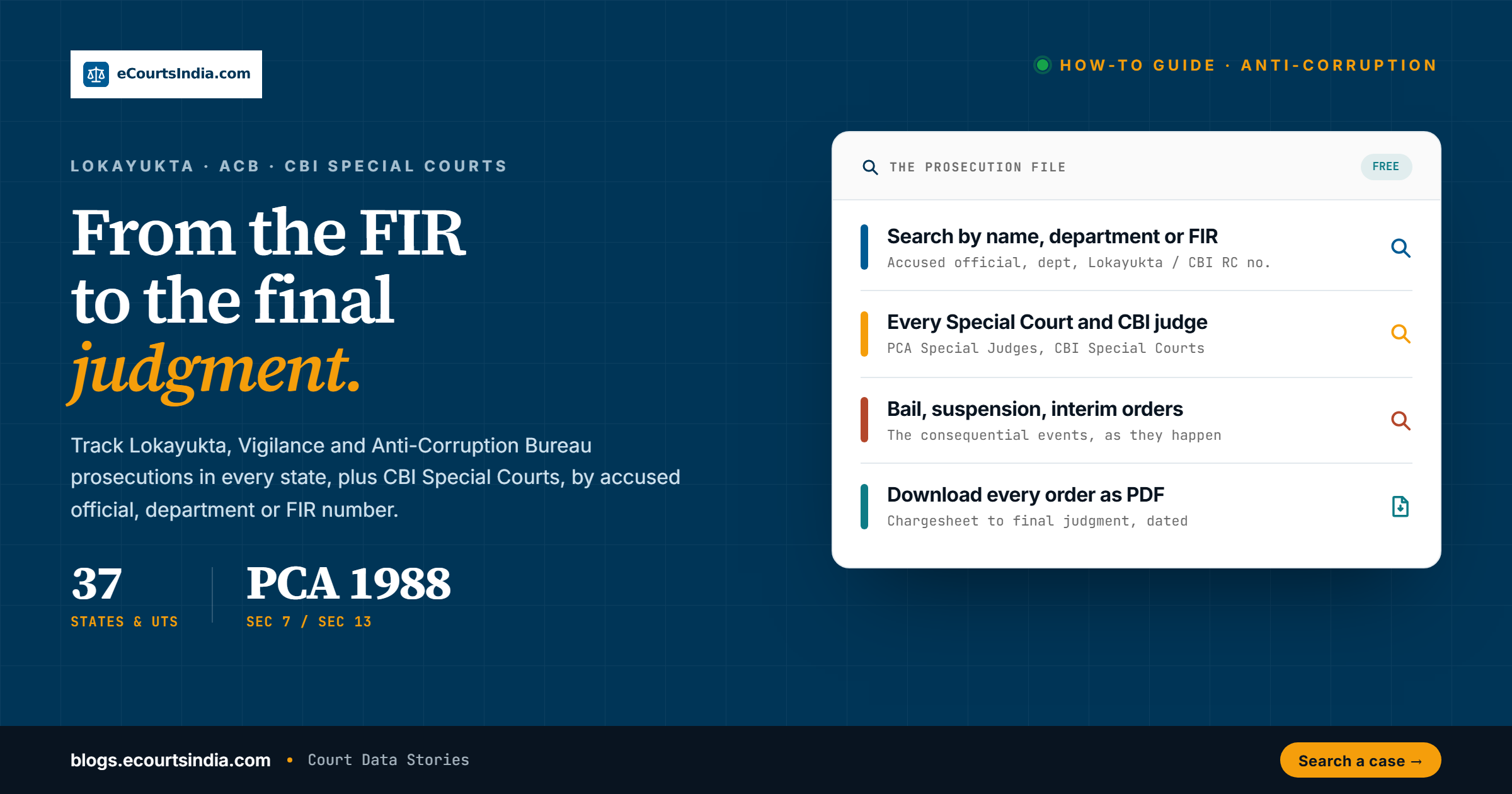
You can track every Lokayukta, Vigilance, and Anti-Corruption Bureau court case in India, across every state, at every stage, on eCourtsIndia.com/litigant/karnataka-lokayukta and the companion state-wise pages. Search by the accused official’s name, the department, or the FIR number, and see the full prosecution timeline: chargesheet filing, framing of charges, bail orders, witness examination, and judgement. For journalists covering graft, RTI activists, and citizens following a high-profile case, it turns an otherwise opaque system into a daily-tracker.

TL;DR
- State Lokayukta and ACB cases are searchable by accused name or FIR on eCourtsIndia.
- Covers Lokayukta and equivalent bodies across all states, plus CBI / ACB special courts.
- Every order in a Prevention of Corruption Act case is downloadable as a PDF.
- Dedicated pages exist for major states (Karnataka, Maharashtra, Telangana, Kerala, and more) indexing the regional Vigilance courts.
- Useful for investigative reporters, RTI activists, lawyers in graft cases, and researchers tracking political accountability.
All States
Lokayukta & ACB data covered
Special Courts
PCA and CBI Special Judges
Free
Orders, judgements, daily tracking
What Are Lokayukta and ACB Courts?
Every Indian state has an institutional mechanism to investigate and prosecute public servants for corruption. In most states, this body is the Lokayukta, a statutory ombudsman established under state-level Lokayukta Acts, modelled loosely on the Lokpal and Lokayuktas Act, 2013. In other states, the investigating arm is an Anti-Corruption Bureau (ACB) that reports to the Home Department or the Chief Minister’s office. In either case, once the investigation produces a chargesheet, the case is filed in a Special Court designated under the Prevention of Corruption Act, 1988 (now read with the 2018 Amendment). These Special Courts sit inside the district judiciary structure, Special Judges (PCA) and CBI Special Judges, and their cases are indexed on eCourtsIndia alongside all other court records.
How to Search a Lokayukta Case on eCourtsIndia
The fastest approach is to search the accused official’s name in the litigant search at ecourtsindia.com/litigant. Enter the name, pick the state and district, and look for cases filed in Special Courts or cases invoking the Prevention of Corruption Act in the Acts & Sections field. You can also search by FIR number (the Lokayukta or ACB FIR number) using the FIR search tab, with the Lokayukta police station selected. If you are new to FIR-to-court tracking, our check FIR status online guide walks through the lookup flow. For states with dedicated eCourtsIndia landing pages (like Karnataka Lokayukta), the page pre-fills the relevant jurisdiction to simplify the query.
What a Corruption Case Timeline Looks Like
A Prevention of Corruption Act prosecution moves through a predictable sequence, and the case page on eCourtsIndia shows each step. First, the Lokayukta or ACB lodges an FIR under the relevant sections, typically Section 7 (public servant taking bribe) or Section 13 (criminal misconduct) of the PCA, 1988. After investigation, they file a chargesheet; the Special Judge takes cognizance and summons the accused. Charges are framed, and then the prosecution leads evidence witness by witness, each hearing logged as an order. The defence cross-examines, leads its own evidence, and argues. Finally, the Special Judge pronounces judgment. Each of these stages generates an order on eCourtsIndia, and the full chain is visible on the case page with dates and downloadable PDFs.

Bail, Suspension, and Interim Orders
In corruption cases, interim orders are often the most consequential events: an order granting bail, an order suspending the accused from service, or an order directing the accused not to leave the jurisdiction. These interim orders appear in the case’s order history on eCourtsIndia and are downloadable. When the accused files a bail application in the Special Court or the High Court, that application generates its own case (case type BA), which you can find by searching the accused’s name in the relevant court. High Courts across India, searchable via eCourtsIndia’s 25 High Court case status index, frequently hear appeals and revisions arising from Special Court orders, making the High Court record equally important for tracking.
CBI Cases and the Federal Layer
Central Bureau of Investigation (CBI) cases are prosecuted before CBI Special Courts that sit in various districts. These courts are part of the district judiciary and their cases appear on eCourtsIndia like any other district-level case. To find a CBI case, search by the accused’s name and filter for CBI Special Court in the court/establishment field, or search the CBI RC (Registration Case) number through the FIR/police station search. High-profile CBI cases involving Members of Parliament, state ministers, or senior bureaucrats often produce bail orders and charge-framing orders that are of public interest, and every one of those orders is downloadable from the case page.
State-Wise Coverage and Dedicated Pages
eCourtsIndia offers dedicated landing pages for Lokayukta and anti-corruption case tracking in major states, pre-filtering the search jurisdiction so you don’t have to navigate the full search interface manually. Karnataka’s Lokayukta page is the reference example; similar pages exist for Maharashtra (ACB), Telangana (ACB), Kerala (Vigilance and Anti-Corruption Bureau), Andhra Pradesh (ACB), Tamil Nadu (Directorate of Vigilance and Anti-Corruption), and Rajasthan (ACB). Each page surfaces cases in Special Courts (PCA) and CBI Special Courts within that state. Since eCourtsIndia covers all 36 state and UT jurisdictions across 29,000+ courts and tribunals, even states without dedicated landing pages are still searchable through the main search interface.
For Journalists and RTI Activists
One of the primary audiences for Lokayukta tracking is investigative journalism. When a public servant is accused of corruption, the story arc depends on court events: was the chargesheet filed, was the case dropped at the “no charges” stage, did the accused get bail, how many witnesses have testified, and when is the next hearing? eCourtsIndia makes this information available to anyone: no court visit required, no registry fee, no dependency on a lawyer’s contacts. RTI activists who file complaints and then want to track whether the Lokayukta actually prosecuted the complaint through to trial can follow the same trail. To monitor a specific case, add it to a client in your eCourtsIndia dashboard and turn on Email and WhatsApp alerts. You then get a notification (near-real-time, on a few-minutes polling cycle) whenever there’s a new order, a fresh hearing date, or a status change, so you don’t have to remember to check back manually. Alerts are opt-in and run on credits.
Tracking the Disposal and Final Judgment
Corruption cases are notoriously slow; many run for a decade or more. When a case is finally disposed (status DISPOSED on eCourtsIndia, one of dozens of case statuses tracked), the disposition type tells you the outcome: convicted and sentenced, acquitted, discharged, compromised, or abated (typically because the accused died during trial). The final judgment is the last order in the chronological list and is downloadable as a PDF. For disposed cases, you can use eCourtsIndia’s AI-powered case summaries to get a quick read on what the court decided, saving you from reading a 200-page judgment in full. AI summaries run on credits; every account gets free monthly credits, with more on the Pro plan.

Limitations and Complementary Sources
eCourtsIndia covers the court side of corruption prosecution, the case from chargesheet to verdict. It does not cover the investigation phase that precedes court filing (that sits with the Lokayukta, ACB, or CBI internally), and it does not cover disciplinary proceedings within the department (those are administrative, not judicial). For the investigation side, the state Lokayukta’s annual report (which most states publish) is the reference; for the administrative side, RTI applications to the department can surface suspension orders and departmental inquiry reports. Where eCourtsIndia is decisive is the court record because that’s the record that determines acquittal or conviction, bail or custody, career end or continuation.
Track a Lokayukta or ACB case
Free search by accused name, FIR number, or department. Follow the prosecution from chargesheet to verdict.
Related Reading
- How to Check FIR Status Online in India, from FIR to court record, step by step.
- The Complete Guide to eCourtsIndia’s Search Engine, using every filter available.
- How to Track All Your Cases on eCourtsIndia, organise cases under clients and get Email and WhatsApp alerts.
Frequently Asked Questions
How do I track a Lokayukta or ACB court case in India?

Search the accused official’s name, department, or FIR number in the litigant search on eCourtsIndia litigant search. Pick the state and district, then look for cases filed in Special Courts under the Prevention of Corruption Act. State pages such as Karnataka Lokayukta pre-fill the jurisdiction so the query is faster.
What is the difference between a Lokayukta and an Anti-Corruption Bureau?
A Lokayukta is a statutory ombudsman set up under a state Lokayukta Act, while an Anti-Corruption Bureau is an investigating arm reporting to the Home Department or Chief Minister. Both file chargesheets in Special Courts under the Prevention of Corruption Act, 1988. You can follow either kind of prosecution on eCourtsIndia.
Can I download corruption case orders and judgments for free?
Yes. Every order in a Prevention of Corruption Act case, from bail orders to the final judgment, is downloadable as a PDF on eCourtsIndia. For disposed cases, the AI-powered case summaries give a quick read of the outcome (on a credit basis, with free monthly credits), so you avoid reading a long judgment in full.
How do I find a CBI corruption case?
Search the accused’s name and filter for CBI Special Court in the court field, or search the CBI RC (Registration Case) number through the FIR and police station search. CBI Special Courts sit within the district judiciary, so their cases appear on eCourtsIndia like any other district case, with every order downloadable.
Which states have dedicated Lokayukta tracking pages?
Karnataka, Maharashtra, Telangana, Kerala, Andhra Pradesh, Tamil Nadu, and Rajasthan have dedicated pages that pre-filter the jurisdiction. Even states without a landing page stay searchable across 29,000+ courts and tribunals. The Karnataka page is the reference example at eCourtsIndia Karnataka Lokayukta.
How can I get alerts for a corruption case hearing?

Add the case to a client in your eCourtsIndia dashboard and turn on Email and WhatsApp alerts. You then get a notification (near-real-time) when there is a new order, hearing date, or status change, so you do not have to check back manually. Alerts are opt-in and run on credits. This helps journalists and RTI activists follow long-running graft trials. Our case tracking guide shows how to set it up.