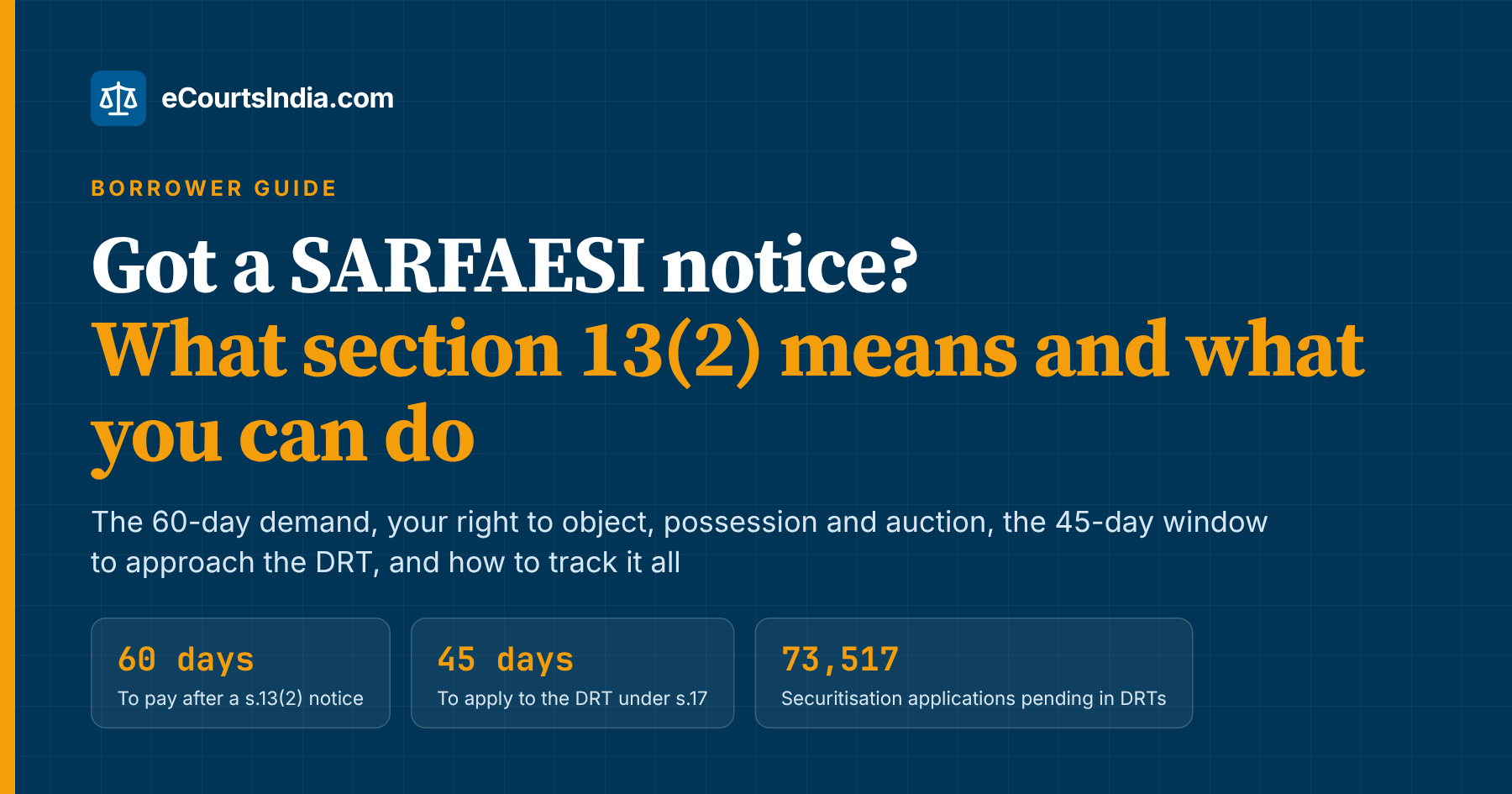
Got a SARFAESI notice? What section 13(2) means for you
A SARFAESI notice lets a bank enforce its security, often your home or business premises, without first going to court. The clock starts the day the notice is dated. Knowing the timelines, and your rights at each step, is the difference between options and none.
You have 60 days to pay after a section 13(2) notice. If the bank then takes a measure such as possession, you have 45 days to challenge it before the Debts Recovery Tribunal.
SARFAESI Act, 2002 text read on 15 November 2026. DRT counts from the eCourtsIndia index on the same day. This is general information, not legal advice.
Last updated: 15 November 2026
Key takeaways
- The notice: after your account is classified as a non-performing asset, the bank can demand full payment within 60 days (section 13(2)). The notice must state the amount and the assets it intends to enforce against (section 13(3)).
- Object in writing: if you reply with an objection, the bank must consider it and, if it rejects it, tell you why within 15 days (section 13(3A)).
- Do not sell: after the notice you cannot transfer the secured assets, other than in the ordinary course of business, without the bank’s written consent (section 13(13)).
- Challenge: apply to the DRT within 45 days of a measure under section 13(4) (section 17). Appeal from the DRT goes to the DRAT within 30 days, with a deposit (section 18).
- Scale: 73,517 securitisation applications are pending in Debts Recovery Tribunals, led by Maharashtra, West Bengal and Uttar Pradesh.
What is a section 13(2) notice?
It is the bank’s formal demand to repay the whole secured debt within 60 days, the first step before it can act against your security.
Section 13 of the SARFAESI Act, 2002 lets a secured creditor enforce its security interest without the intervention of a court or tribunal. Under section 13(2), when a borrower defaults and the account is classified as a non-performing asset, the creditor may require the borrower by written notice to discharge the full liability within 60 days. Section 13(3) requires the notice to give details of the amount payable and the secured assets the creditor intends to enforce against.
The Act does not apply everywhere. Section 31 excludes, among other things, a security interest for a financial asset not exceeding one lakh rupees, a security interest in agricultural land, and any case where the amount due is less than 20 per cent of the principal and interest. If your loan falls in one of these, raise it in your reply and with your advocate.
What happens step by step after the notice?

| Step | What the law says | What you can do |
|---|---|---|
| Demand notice, s.13(2) | Pay the full secured debt within 60 days | Check the amount, the assets listed and whether the loan is excluded by s.31 |
| Objection, s.13(3A) | If you object, the bank must consider it and give reasons for rejecting it within 15 days | Reply in writing, keep proof of delivery |
| No transfer, s.13(13) | You cannot sell or lease the listed assets outside ordinary business without written consent | Talk to the bank before any sale |
| Measures, s.13(4) | The bank may take possession, take over management, appoint a manager, or collect from your debtors | Note the date of each measure; your 45 days run from it |
| Magistrate help, s.14 | The bank may ask the Chief Metropolitan Magistrate or District Magistrate to take possession, normally within 30 days of its application | The magistrate’s order is a separate proceeding; search for it too |
| Redemption, s.13(8) | If you tender all dues with costs before the auction notice is published, the bank cannot sell | Move before the auction notice, not after |
A detail many borrowers miss: the bank’s reply rejecting your objection is not itself something you can take to the DRT. Both section 13(3A) and the explanation to section 17(1) say so. Your right to apply arises when the bank actually takes a measure under section 13(4).
How do I challenge the bank’s action at the DRT?
By filing a securitisation application within 45 days of the measure you want to challenge.
Section 17 lets any person aggrieved by a section 13(4) measure, including the borrower, apply to the Debts Recovery Tribunal within 45 days from the date the measure was taken. The application goes to the DRT where the cause of action arose, where the secured asset is located, or where the bank branch keeps the account. If the DRT finds the measure was not in line with the Act and its rules, it can declare it invalid and restore possession or management. If it upholds the measure, the bank may proceed.
Appeals from the DRT’s order go to the Debts Recovery Appellate Tribunal within 30 days of receiving the order (section 18). A borrower’s appeal is entertained only after depositing 50 per cent of the debt as claimed by the bank or determined by the DRT, whichever is less. The appellate tribunal may reduce this to not less than 25 per cent for recorded reasons.
How many SARFAESI challenges are pending?
73,517 securitisation applications are pending in DRTs in our index.
| State | Pending securitisation applications |
|---|---|
| Maharashtra | 11,356 |
| West Bengal | 10,028 |
| Uttar Pradesh | 9,333 |
| Tamil Nadu | 8,410 |
| Kerala | 7,066 |
| Madhya Pradesh | 6,560 |
| Gujarat | 4,144 |
| Delhi | 2,951 |
SARFAESI fights do not stay in the DRT. Searching our index for pending cases that mention SARFAESI returns 8,817 matters, and 5,587 of them are writ petitions in High Courts, with Kerala accounting for more than half of all such mentions. Writs are usually not the first remedy when a DRT application is available, so take advice before going that route.
How long will the DRT take on my application?
The Act says 60 days, extendable to four months; the records say most applications take longer. Section 17(5) asks the DRT to dispose of a securitisation application within 60 days. It can extend that for reasons recorded in writing, but total pendency is not meant to exceed four months; after that, either side can ask the Appellate Tribunal under section 17(6) to direct quick disposal.
| Filed in | Securitisation applications still pending | Share |
|---|---|---|
| 2025 or 2026 | 34,350 | 46.7% |
| 2022 to 2024 | 26,968 | 36.7% |
| 2019 to 2021 | 7,963 | 10.8% |
| 2018 or earlier | 4,236 | 5.8% |
| All pending | 73,517 | 100% |
For a borrower, two practical points follow. First, do not plan around a quick final decision; plan around the interim stage. Whether the tribunal stays possession or the auction while the application is heard often matters more in the first months than the final outcome. Second, if your application has gone past four months without a decision, ask your advocate whether a section 17(6) application to the Appellate Tribunal makes sense in your case.
Your key dates at a glance
| Clock | Starts | Length | Provision |
|---|---|---|---|
| Pay the demand | Date of the section 13(2) notice | 60 days | Section 13(2) |
| Challenge a measure at the DRT | Date the section 13(4) measure was taken | 45 days | Section 17(1) |
| DRT to decide | Date of the application | 60 days, total not to exceed four months | Section 17(5) |
| Appeal to the DRAT | Receipt of the DRT’s order | 30 days | Section 18 |
For the wider picture of DRT caseloads, including the banks’ own recovery applications, see our DRT and SARFAESI data for 2026. If someone contacts you claiming to be from a court or the police and demanding payment over a SARFAESI matter, check the case yourself first; our guide to verifying a court summons shows how.
How do I track my SARFAESI case online?
- DRT application: once filed, search the CNR or your name on ecourtsindia.com/search and filter to tribunals. Our DRT and DRAT case status guide covers the details.
- Bank’s recovery case: banks also file original applications for recovery in the DRT. Search your name and the bank’s name together to find them.
- Magistrate’s possession proceeding: section 14 applications are heard by the CMM or DM. Search the district court records for your name or the property.
- High Court: search the High Court for any writ by the same names; see our High Court guide.
- Stay alert: add every related case to one dashboard with alerts. In SARFAESI matters, missing one date can mean losing a stay.
Practical tips if you have just received the notice
- Write down the date on the notice and the date you received it. Count 60 days.
- Check the outstanding amount against your own statements. Errors are worth raising in writing.
- Reply with any objection, and keep proof of delivery.
- Talk to the bank about restructuring or a one-time settlement early; options shrink once an auction notice is published.
- Do not sell or lease the listed property without written consent.
- If you are a guarantor, you may be named too. Our borrower and guarantor guide explains how lenders look at court records.
Frequently asked questions
How many days do I get after a SARFAESI section 13(2) notice?
Sixty days from the date of the notice to discharge the full liability, under section 13(2) of the SARFAESI Act, 2002. After that the bank may take measures under section 13(4).
What is the time limit to approach the DRT against SARFAESI action?
Forty-five days from the date the measure under section 13(4), such as taking possession, was taken, under section 17(1).
Can I stop the auction by paying the dues?
Under section 13(8), if all dues with costs and charges are tendered before the date of publication of the auction notice, the bank cannot transfer the secured assets.
Does SARFAESI apply to small loans or farm land?
Section 31 excludes a security interest for a financial asset not exceeding one lakh rupees, a security interest in agricultural land, and cases where the amount due is less than 20 per cent of principal and interest, among others.
How much must I deposit to appeal to the DRAT?
Fifty per cent of the debt as claimed by the bank or as determined by the DRT, whichever is less, which the appellate tribunal may reduce to not less than 25 per cent, under section 18.
How long does the DRT take to decide a SARFAESI application?
Section 17(5) asks for 60 days, extendable, with total pendency not to exceed four months. In our index about 95% of the 73,517 pending applications were filed more than four months ago.
What can I do if the DRT has not decided within four months?
Under section 17(6), any party can apply to the Appellate Tribunal for a direction to the DRT to dispose of the application quickly. Ask your advocate whether it suits your case.
Is my securitisation application on eCourtsIndia?
DRT records are in our index. Search your name or the CNR on ecourtsindia.com/search and filter to tribunals, then add the case to your dashboard for alerts.
Important: This guide is general information about using public court records. It is not legal advice; for advice on your own case, speak to an advocate or your nearest legal services authority. Case data on eCourtsIndia is a copy of public court records as last read from the court and is not a certified copy. For anything you will rely on in court, get a certified copy from the court itself. A name match is not identity, a pending case is not guilt, and a disposed case is a status, not an outcome. Figures were read on the date shown at the top and change every day. eCourtsIndia is a private legal-technology platform by Billion Insights Ventures Pvt. Ltd. and is not affiliated with any court, the e-Committee of the Supreme Court or the Government of India. Found an error? Write to support@ecourtsindia.com.


