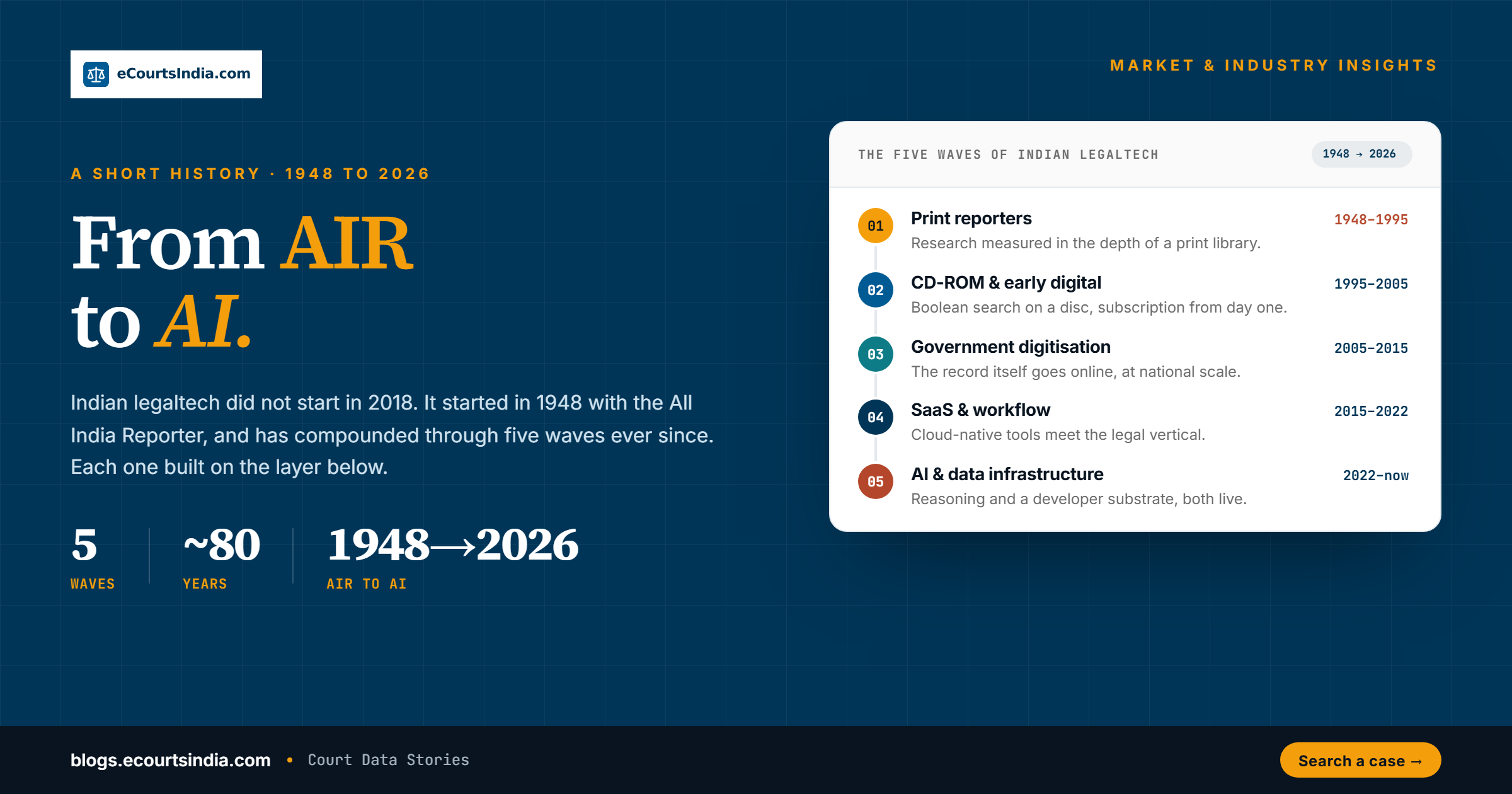

Indian legaltech did not begin with SaaS in 2018 or even Indian Kanoon in 2008. Its roots run back to the All India Reporter, founded in 1914, and the field has evolved through five distinct waves, each layer building on the one below toward today’s court-data infrastructure.
Last updated: 23 September 2026
Every now and then, someone writes that Indian legaltech “just started.” That framing is wrong, and misses the most important point about this market. Indian legaltech did not start in 2018 with contract management SaaS. It did not start in 2008 with Indian Kanoon. It did not start in 2000 with Manupatra. The modern legal-information story begins with the All India Reporter, founded in 1914, and the field has been continuously evolving ever since. Each wave built on the last. Understanding the history makes it much easier to predict where the next wave goes.

This post traces the five eras of Indian legaltech, names the pioneers of each, and connects the thread to the infrastructure wave that is just beginning. If you are an investor trying to locate where the market is, the answer depends heavily on which wave you think you are looking at.
Era 1: Print reporters, 1914 to 1995
The All India Reporter (AIR) has been publishing since 1914, when V.V. Chitaley started it in Nagpur, well before Indian legaltech was a category. This is where the modern legal-information story begins. By Independence in 1947, it was the dominant legal research product in the country. Supreme Court Cases (SCC), launched in 1969 by Eastern Book Company, became the second pillar. For most of post-Independence India, a law firm’s research capability was measured in the depth of its print library.
This era matters because it set the norms of Indian legal research: citation-first, judge-aware, and edited with care by generations of reporters. When digital products arrived, they inherited this editorial tradition, and the premium research products in India still reflect it.
Era 2: CD-ROM and early digital, 1995 to 2005
The first digital wave was not the internet. It was the CD-ROM. Manupatra, founded in 2000, and SCC Online, from EBC, led the transition of Indian legal research into structured databases with boolean search. Delhi High Court and a handful of progressive district courts started experimenting with digital cause lists. Law firms that could afford the licenses gained a real productivity edge over firms that stayed paper-only.
Internet penetration was limited, so most of these products were sold as client-installable CD-ROM collections with annual update subscriptions. The business model was subscription from day one, which is why Indian legal research has always been subscription-led, not transactional.
Era 3: Government digitisation, 2005 to 2015
This is the era the tech-focused audience sometimes skips, and it is arguably the most important. Starting with the Supreme Court and High Courts in the early 2000s and expanding through the eCourts Mission Mode Project from 2007, the Indian government built the first nation-scale digital infrastructure for courts. By the end of Phase II in 2023, 18,735 district and subordinate courts had been computerised and ran on the Case Information System, the National Judicial Data Grid was publishing daily pendency numbers, and public portals like ecourts.gov.in gave citizens search access to their own cases.
In parallel, 2008 saw the launch of Indian Kanoon by Sushant Sinha, which aggregated freely available case law into a single searchable index. Indian Kanoon is one of the most quietly consequential Indian internet products of the last two decades. It made case law searchable by the public and seeded a generation of legaltech founders with the idea that freely accessible legal data was viable at scale. We wrote more about this in our deep dive on eCourts, and for a plain-English primer on how the system works today, see What Is the eCourts System in India?
Era 4: SaaS and workflow, 2015 to 2022
The fourth wave was the SaaS wave. Cloud-native tools started targeting the Indian legal workflow. A partial timeline.
| Year | Launch / milestone |
|---|---|
| 2015 | Early contract lifecycle, e-signature and compliance software experiments begin to target Indian legal teams |
| 2016 | Leegality founded, focused on digital signatures and e-stamping |
| 2017 | SpotDraft and LegitQuest founded, in contract management and AI-assisted research respectively |
| 2020 | COVID lockdown accelerates virtual hearings and e-filing adoption across Indian courts |
| 2022 | Generative AI enters the conversation, and Indian legaltech starts planning AI-first roadmaps |
| 2023 | SpotDraft raises a USD 26 million Series A led by Premji Invest (March); Thomson Reuters completes its USD 650 million purchase of Casetext in the US |
This is the era most commonly referred to when people say “Indian legaltech.” It was characterised by horizontal SaaS patterns applied to a vertical market: CLM, matter management, research platforms such as CaseMine and NearLaw, digital signatures, compliance tracking. For the full roster of companies and what each one does, see our directory of Indian legaltech companies.
Era 5: AI and data infrastructure, 2022 to present
The current wave has two threads, and they are both live. The first is the AI thread, where generative models are being applied to research, drafting, due diligence, and client communication. The second is the data infrastructure thread, where the underlying court data is becoming developer-accessible through APIs and MCPs. Both threads depend on the same foundation: dataset-grade court data at national scale.
eCourtsIndia.com, which launched publicly in April 2025, sits inside this fifth wave as a dedicated data infrastructure layer (we told that story in From Zero to National Coverage in 12 Months). Clio’s acquisition of vLex sits inside this wave globally. Harvey, Hebbia, and domain AI copilots sit inside it for the US. Casetext was inside it until Thomson Reuters acquired it in 2023 for $650 million. The wave is not speculative, it is already moving.
The last twelve months made that plain. A few markers:
- November 2025. Clio completed its USD 1 billion acquisition of vLex and raised a USD 500 million Series G at a USD 5 billion valuation, the largest deal the category has seen. We read it for Indian lessons in Reading the Clio-vLex Deal.
- January to February 2026. Haveli Investments agreed to take a majority stake in Sirion, the contract lifecycle company with deep Indian roots, and closed the deal in February.
- 2026 at eCourtsIndia. The AI Clerk brought case tracking, client mapping and WhatsApp and email alerts into one workflow; IndiaCode put 10,084 Acts next to the judgments that read them; LegalCheck launched an identity-first legal background check; and the eCourts MCP opened cases, cause lists and statutes to AI agents.
The thread that ties it all together
Every Indian legaltech wave has been built on the assumption that more of the Indian legal system becomes structured, searchable, and accessible over time. AIR structured the reporter. CD-ROMs structured the database. eCourts structured the record. Indian Kanoon structured the access. SaaS structured the workflow. AI is structuring the reasoning. Each layer builds on the one below.
The natural next step, and the one we are building, is to structure the data itself as a developer primitive. Court data as API. Court data as MCP. Court data as input to AI agents. Not as a product people use, but as a substrate everything else depends on.

What this means for eCourtsIndia
We treat the long arc of Indian legaltech as context, not competition. AIR, SCC, Manupatra, Indian Kanoon, LegitQuest, CaseMine, SpotDraft, and dozens of other products have each earned their place. Our job is to make the underlying data available so that every new product built in the sixth wave starts with a better foundation than the products built in the fifth.
If you are a founder or investor trying to locate where this market is, remember that Indian legaltech is not new. It is long, layered, and compounding. The next wave is not going to replace the previous waves. It will run on top of them.
See what dataset-grade Indian court data looks like at eCourtsIndia.com. Coverage spans 32 crore+ case records across the Supreme Court, all 25 High Courts, district and taluka courts in all 36 states and union territories, and 18 tribunal and commission types, plus 125 crore+ orders and judgments and a directory of 34 lakh+ advocates, available via a modern REST API and the eCourts MCP.
Related reading
- Mapping India’s Court Data Stack
- Reading the Clio-vLex Deal
- Inside eCourts: How India Digitised the Courts
Sources
- All India Reporter (AIR) historical records, aironline.in
- Supreme Court Cases, Eastern Book Company, scconline.com
- Manupatra, manupatra.com
- Indian Kanoon, indiankanoon.org
- Department of Justice eCourts project documentation
- Public company disclosures and founder interviews for SpotDraft, LegitQuest, CaseMine, Leegality and others
- SpotDraft, SpotDraft Raises $26 Million in Series A Funding, Business Wire, 2 March 2023
- Clio press release on completing the vLex acquisition, 10 November 2025; Sirion press release on the Haveli majority investment, 2026
Frequently Asked Questions
When did Indian legaltech actually start?

Indian legaltech traces back to the All India Reporter, which has been publishing since 1914, not to SaaS in 2018 or Indian Kanoon in 2008. The modern legal-information story begins there. The market has since moved through five waves, from print reporters to today’s court-data infrastructure. You can explore live court records at eCourtsIndia.
What are the five eras of Indian legaltech?
The five eras are print reporters (1914 to 1995), CD-ROM and early digital (1995 to 2005), government digitisation (2005 to 2015), SaaS and workflow (2015 to 2022), and AI and data infrastructure (2022 to present). Each wave built on the last, and none replaced the one before it. See how the newest layer works through the eCourtsIndia API.
What was the eCourts project’s role in this history?
The eCourts Mission Mode Project, under way since 2007, built India’s first nation-scale digital court infrastructure. By the end of Phase II in 2023, 18,735 district and subordinate courts had been computerised, and the National Judicial Data Grid was publishing daily pendency numbers. Phase III, worth ₹7,210 crore, is now digitising legacy records. Read our deep dive on eCourts.
How does eCourtsIndia.com fit into the current wave?
eCourtsIndia.com launched publicly in April 2025 as a dedicated data infrastructure layer inside the fifth wave. It indexes 32 crore+ case records and makes them developer-accessible through a REST API and an MCP server, and adds workflow through the AI Clerk and statutes through IndiaCode. Browse coverage and search records at eCourtsIndia.
Why does the history of Indian legaltech matter for founders and investors?

Understanding the five waves makes it easier to predict where the market goes next. Indian legaltech is long, layered, and compounding, and the next wave runs on top of the previous ones rather than replacing them. To research advocate and case records first-hand, try the lawyer search.
When did SpotDraft raise its Series A?
SpotDraft, founded in 2017, announced a USD 26 million Series A on 2 March 2023. The round was led by Premji Invest with Prosus Ventures, 021 Capital, Arkam Ventures and others. It remains one of the best-funded independent Indian legaltech companies. For where SpotDraft sits among Indian legaltech companies today, see our legaltech directory.