Saying no to a friend is awkward. Chasing a friend in court for five years is worse.
Before you lend money to a friend, a relative or a colleague, look at whether others have had to take them to court for unpaid money.
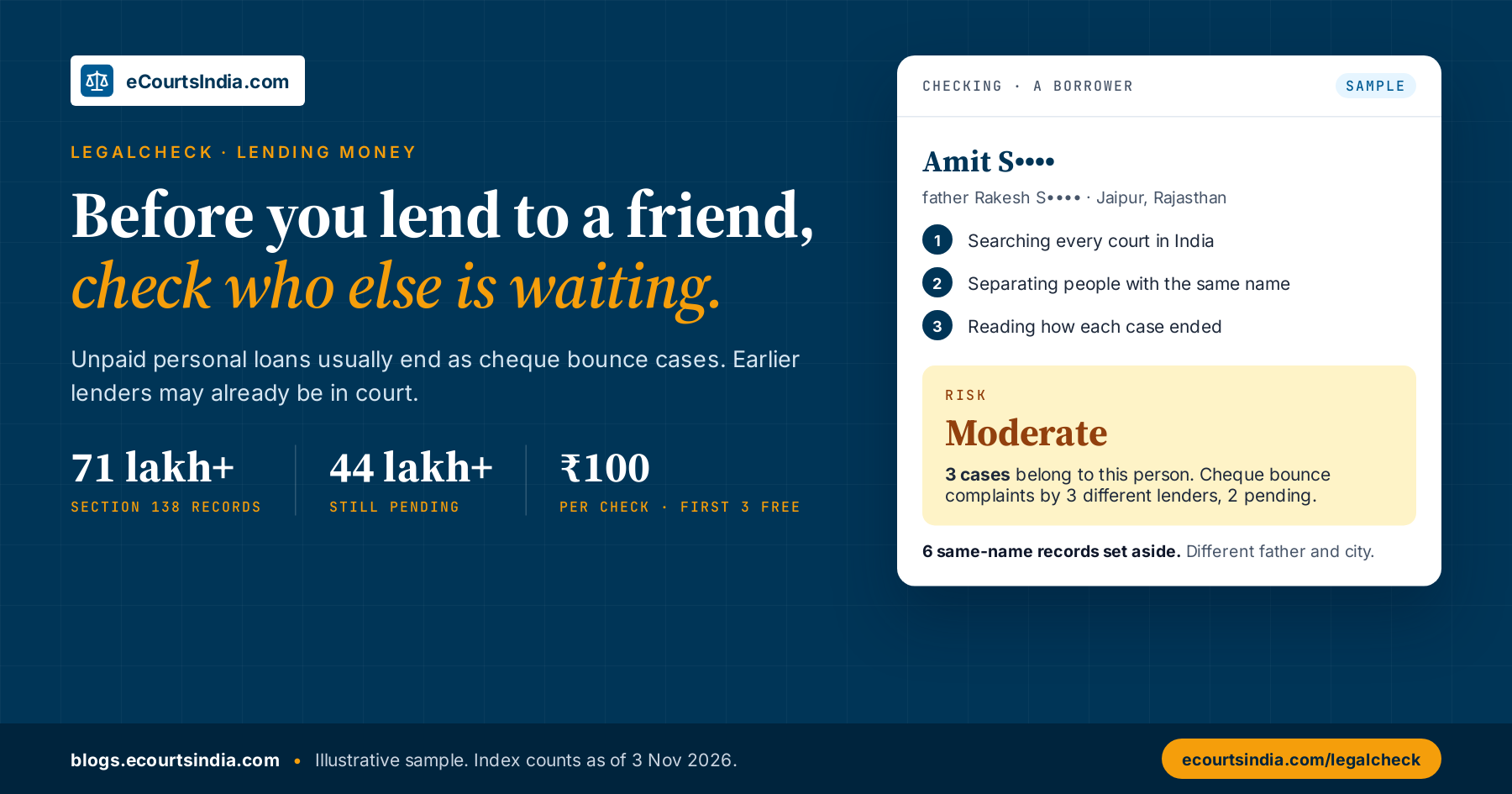
A pre-lending court check searches public court records for cases linked to the borrower, especially cheque bounce complaints under Section 138 of the Negotiable Instruments Act, money recovery suits and bank recovery cases, and links each finding to the case. LegalCheck searches 35 crore+ case records using the borrower’s name, a parent or spouse’s name and city. The borrower is never contacted.
Your first 3 checks are free. It takes less time than the conversation you are about to have.
Last updated: 3 November 2026
Key takeaways
- Unpaid personal loans usually end as cheque bounce cases. On 3 November 2026 the eCourtsIndia index held more than 71 lakh records tagged under Section 138, over 44 lakh of them pending, and new filings are still rising.
- A borrower with several Section 138 complaints already has a pattern. It takes minutes to see it, and years to recover from missing it.
- Lend through the bank, and write it down. A bank transfer, a signed acknowledgement and a cheque give you the strongest position if things go wrong.
- The clock matters. A recovery suit for money lent generally has to be filed within three years, and a cheque bounce notice within 30 days of the bank’s return memo.
- Standing guarantor is lending too. In Indian law a guarantor’s liability is generally as wide as the borrower’s.
Most money lent between friends in India is lent on trust, in cash or by UPI, with no paperwork. Most of it comes back. When it does not, the lender finds out the hard way that they did not know as much about the borrower as they thought.
The good news is that the most useful thing to know is already public. If someone has borrowed and not repaid before, there is a fair chance an earlier lender has filed a cheque bounce complaint or a recovery suit. This guide shows how to look, what the law says about getting your money back, and how to lend in a way that protects the friendship and the money.
Why check a friend’s court record before lending?
Because the person most likely to default on you is someone who has defaulted on others, and that history is often in court. Section 138 of the Negotiable Instruments Act makes it an offence to issue a cheque that bounces for a legally enforceable debt, punishable with up to two years’ imprisonment, a fine of up to twice the cheque amount, or both. Lenders use it because it is faster than a civil suit and puts real pressure on the borrower.
The result is one of the largest categories of litigation in the country. On 3 November 2026, the eCourtsIndia index held 71,74,299 records tagged under Section 138, of which 44,65,942 were pending. Filings tagged under it rose from about 7.8 lakh in 2024 to about 9.4 lakh in 2025, and passed 9 lakh again in the first ten months of 2026. The government told the Lok Sabha in December 2024 that 43,05,932 cheque bounce cases were pending, as SCC Online has summarised. Our analysis of the cheque bounce litigation crisis explains why these cases take so long.

What happens when a friend does not repay? Real cases
When a personal loan goes bad, it often turns into several cases at once, because each bounced cheque can be a separate complaint. These examples come from court reporting.
Rs 27 lakh from one family, several cheques, more than two years in jail
A businessman borrowed Rs 27 lakh from members of one family and repaid with several cheques, which bounced. A magistrate in Andheri convicted him in 2019 in each case. In an order of 24 December 2025, the Bombay High Court directed that his sentences run concurrently and he was released after more than 26 months in jail, the Free Press Journal reported. The lenders had spent the better part of a decade in court.
A cash loan, an unanswered notice, and a conviction restored
On 25 September 2025, in Sanjabij Tari v. Kishore S. Borcar (2025 INSC 1158), the Supreme Court restored the conviction of a borrower who had taken a cash loan, issued a cheque that bounced and did not reply to the lender’s legal notice. The Court held that once a borrower admits signing the cheque, the law presumes it was given for a debt, and simply questioning the lender’s financial capacity does not displace that presumption, as reported.
And the other side: a lender who could not show the money
Not every lender wins. In October 2026, the Karnataka High Court set aside a cheque bounce conviction in a case about a Rs 10 lakh hand loan to a family friend, because the lender could not show he had the funds to lend, Law Trend reported. The lesson is simple: lend through the bank, from money you can show was yours.
A friend who has been taken to court by three earlier lenders is not necessarily a bad person. But you deserve to know that before you become the fourth.
How do you check a friend or relative for cheque bounce cases?
Search their name across courts, separate them from namesakes, and read the role and outcome of anything that comes up.
- Get the details right. Full name as on official documents, father’s or spouse’s name, and the city or district where they live and work.
- Run a LegalCheck. LegalCheck searches courts across India, matches on family name, city and age, and sets aside records that belong to someone else with the same name, explaining why.
- Or search free yourself. The eCourtsIndia litigant search covers every court tier. For a common name you will get many strangers, so compare the father’s name and place before relying on anything. Our step-by-step guide to checking cheque bounce cases by name walks through it.
- Read the role. In a Section 138 case, the complainant is the person who was owed money and the accused is the person whose cheque bounced. Being a complainant in several cases is a very different picture.
- Read the outcome. Many cheque bounce cases end in a settlement once the money is paid. A string of recent, pending complaints is the signal that matters.
If you do lend, how do you protect yourself?
Make the loan easy to prove: through the bank, in writing, with a cheque you understand.
- Use a bank transfer, not cash. Income tax law has long barred accepting a loan of Rs 20,000 or more otherwise than by account payee cheque, draft or electronic transfer: Section 269SS of the Income-tax Act, 1961, explained on the Income Tax Department’s site, which counts earlier unpaid loans from the same person too. The Income-tax Act, 2025 replaced the 1961 Act from 1 April 2026, so check how the limit now applies. In Sanjabij Tari, the Supreme Court held that a cash loan above the limit can still be recovered under Section 138 and that the consequence is a tax penalty, but a bank trail removes the argument altogether.
- Write it down. A short signed acknowledgement of the loan, the amount, the date and when it will be repaid. A promissory note is common for personal loans; stamp duty rules vary by state, so check locally.
- Understand the cheque you take. In Sripati Singh v. State of Jharkhand (28 October 2021), the Supreme Court held that a “security” cheque is not worthless paper: if the loan falls due and is not repaid, the lender can present it, and if it bounces Section 138 applies, LiveLaw reported.
- Do not let deadlines pass. Under Section 138 you must send a written demand notice within 30 days of the bank’s return memo; the borrower then has 15 days to pay, and the complaint must be filed within one month after that, as the text of Section 138 and Section 142 set out. RBI has limited cheque validity to three months since April 2012.
- Know the civil route. Under the Limitation Act, 1963, a suit for money lent is generally to be filed within three years of the loan, even when it is payable on demand. Where there is a promissory note or a written contract for a fixed sum, a summary suit under Order XXXVII of the Civil Procedure Code lets the court decree the amount quickly unless the borrower gets leave to defend. Take a lawyer’s advice on which route fits your facts.
Should you stand guarantor for a friend’s loan?
Only if you are prepared to repay the whole loan yourself. Under Section 128 of the Indian Contract Act, “the liability of the surety is coextensive with that of the principal debtor” unless the contract says otherwise, as courts have repeatedly applied, for example in Punjab National Bank v. IVth ADJ. In practice, a bank can pursue the guarantor without first exhausting its remedies against the borrower. Recovery suits and Debts Recovery Tribunal cases often name guarantors alongside borrowers; our guide to DRT case search shows how to look them up.
So the check that matters before you sign as guarantor is the same one: has this person been sued for unpaid money before?
What a pre-lending court check does not mean
- It is not a credit score. It shows cases that reached a court, not loans repaid late, credit card dues or informal debts.
- A clean report is not a promise. People with no court history can still fail to repay.
- A case is not guilt. A pending complaint is an allegation, and many end in settlement.
- Namesakes are common. Read our same-name study before treating any record as your friend’s.
The same logic applies to other money decisions: checking a business partner before you invest together, and checking a landlord before you pay a large deposit.
Two minutes now, or years in a magistrate court later
Your first 3 completed LegalChecks on the website are free. After that, each check costs Rs 100 plus a small AI usage charge, shown before you submit and charged only when the report is ready (as of November 2026). A check takes 1 to 3 minutes and every finding links to the court record, so you can read it yourself.
You need a free eCourtsIndia account to run a check. The borrower is never contacted. Running checks at volume? Business plans are ₹99 per check, or ₹33 with a subscription.
Sources and method
- Court record counts: eCourtsIndia index via the eCourts MCP, read 3 November 2026. Records tagged “Negotiable Instruments Act | Section 138”: 71,74,299 (44,65,942 pending). Filings by year: 2024, 7,84,862; 2025, 9,43,662; 2026 to date, 9,07,146. Counts change daily and depend on how cases are tagged.
- Negotiable Instruments Act, 1881, Sections 138 and 142 (text via Indian Kanoon); RBI circular of 4 November 2011 on cheque validity; Income Tax Department page on Section 269SS; Limitation Act, 1963, Articles 19, 21 and 35; Indian Contract Act, 1872, Section 128.
- Sanjabij Tari v. Kishore S. Borcar, 2025 INSC 1158 (IndiaLaw, 26 September 2025); Sripati Singh v. State of Jharkhand, 28 October 2021 (LiveLaw); Free Press Journal, 25 January 2026 (Bombay High Court); Law Trend, 23 October 2026 (Karnataka High Court); SCC Online, 13 October 2026 (Lok Sabha pendency figure). Read 3 November 2026.
- LegalCheck web price and inputs from ecourtsindia.com/legalcheck, read 3 November 2026; case count (35.3 crore cases) from the eCourtsIndia homepage, read 3 November 2026.
Frequently asked questions
How can I check if a friend has cheque bounce cases before lending?
Search their name on a national court record search such as the eCourtsIndia litigant search, or run a LegalCheck with their name, a parent or spouse’s name and city. LegalCheck sets aside records belonging to people with the same name and links each finding to the case, so you can see whether they were the complainant or the accused.
Can I file a cheque bounce case for money lent to a friend?
Yes, if the friend gave you a cheque for a legally enforceable debt and it was dishonoured. You must send a written demand notice within 30 days of the bank’s return memo, give 15 days to pay, and file the complaint within one month after that. Take a lawyer’s advice before filing.
Is a cash loan above Rs 20,000 recoverable through Section 138?
In Sanjabij Tari v. Kishore S. Borcar (September 2025), the Supreme Court held that a cash loan above the Rs 20,000 limit under the income tax law is still enforceable under Section 138, and that the consequence of breaching the limit is a tax penalty. A bank transfer is still the safer way to lend, because it proves the loan.
What is the time limit to recover money lent to a friend in India?
Under the Limitation Act, 1963, a suit for money lent is generally to be filed within three years from when the loan is made, including loans payable on demand. A promissory note payable on demand has three years from its date. Cheque bounce complaints have much shorter deadlines measured in days.
Can a security cheque given for a loan be presented if the friend does not repay?
Yes. In Sripati Singh v. State of Jharkhand (2021), the Supreme Court held that if the loan falls due and is not repaid, the lender can present a security cheque, and if it bounces Section 138 applies.
Am I liable if I stood guarantor for a relative’s loan?
Usually yes, for the full amount. Under Section 128 of the Indian Contract Act, a guarantor’s liability is coextensive with the borrower’s unless the contract limits it, and a lender can pursue the guarantor directly. Read the guarantee carefully before signing.
Will my friend know I checked their court record?
No. LegalCheck reads public court records and nobody is contacted. Keep the result private and use it only for your own decision.
How much does a LegalCheck cost?
Your first 3 completed LegalChecks on the eCourtsIndia website are free. After that each check costs Rs 100 plus a small AI usage charge, shown before you submit and charged only when the report is ready (as of November 2026).
Important: LegalCheck is a court-record matching report based on public records and probabilistic identity matching. It is not an identity certificate, FIR search, police clearance certificate or legal advice. A match is not proof of wrongdoing. Verify identity, read the case and give the person an opportunity to explain before acting. Use reports only for a lawful purpose and keep them confidential. News reports cited here describe allegations unless a court has ruled; the people named are presumed innocent until proven guilty. eCourtsIndia is a private legal-technology platform and is not affiliated with any court or the Government of India. This article is general information and is not legal or financial advice.
Lend with your eyes open. It is kinder to the friendship too.