Punjab district court case status
Punjab’s district courts have a more balanced mix than most states in our index: complaint cases lead, but bail, criminal miscellaneous petitions, civil suits and civil appeals all carry real weight. Here is how to search them.
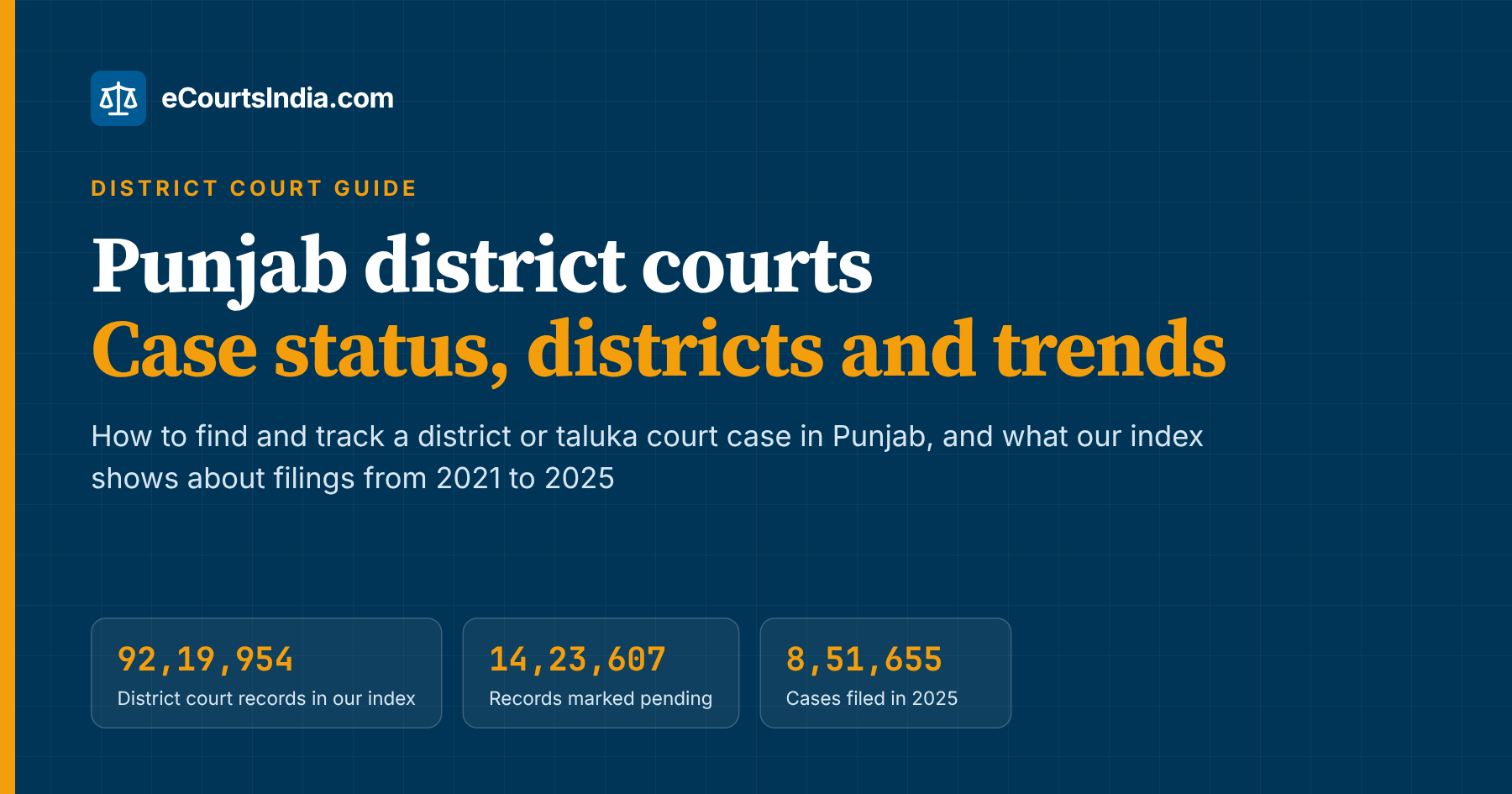
92,19,954 records across 23 districts; 14,23,607 marked pending.
Counts read from the eCourtsIndia index on 15 November 2026.
Last updated: 15 November 2026
Key takeaways
- Scale: 92,19,954 records; 15.4% marked pending.
- Ludhiana: 16,75,668 records, 18% of the state.
- Bail: 5,68,601 bail applications since 2021, 14.6% of filings.
- Civil appeals: 2,45,187 filings under the CA code, a large civil appellate load at district level.
- Peak year: 8,67,894 filings in 2023.
How big is Punjab’s district court system?
Close to a crore records. Our index has 92,19,954 Punjab district court records: 77,96,347 marked disposed and 14,23,607 pending. The pending share, 15.4%, is lower than in neighbouring Haryana (19%). These are index record counts, not official pendency.
Which districts are busiest?

Ludhiana, then Jalandhar and Amritsar. Ludhiana (16,75,668) leads, followed by Jalandhar (10,48,623) and Amritsar (7,93,457). Patiala, Bathinda, Hoshiarpur, SAS Nagar (Mohali) and Gurdaspur each hold between 3.5 and 6.6 lakh records.
What kinds of cases are filed?
| Case type (normalised code) | Filed 2021 to 2025 | Share |
|---|---|---|
| Criminal complaint case (CC) | 9,10,803 | 23.4% |
| Bail application (BA) | 5,68,601 | 14.6% |
| Criminal miscellaneous (CR_MISC) | 4,54,307 | 11.7% |
| Civil suit (CS) | 3,59,780 | 9.3% |
| Civil misc. application (CMAppl) | 3,13,946 | 8.1% |
| Civil appeal / application (CA) | 2,45,187 | 6.3% |
Complaint cases are under a quarter of filings, a lower share than in most large states. Civil work, counting suits, civil applications and appeals, adds up to about 24%. If you are tracking a bail matter that moves up, our guide to checking the next hearing date helps you follow it.
How many cases are filed each year?
| Filing year | Cases in our index |
|---|---|
| 2021 | 6,21,370 |
| 2022 | 7,76,767 |
| 2023 | 8,67,894 |
| 2024 | 7,66,933 |
| 2025 | 8,51,655 |
Filings peaked in 2023, dipped in 2024 and recovered in 2025 to about 37% above 2021.
Are Punjab district courts keeping up with new filings?
Nearly. From 2021 to 2025 our index records 37,50,067 district and taluka court cases decided in Punjab against 38,84,619 filed, about 97 decisions for every 100 new cases, so the pending list grew a little.
| Year | Cases filed | Cases decided | Decided per 100 filed |
|---|---|---|---|
| 2021 | 6,21,370 | 5,44,569 | 88 |
| 2022 | 7,76,767 | 7,91,015 | 102 |
| 2023 | 8,67,894 | 9,16,097 | 106 |
| 2024 | 7,66,933 | 7,81,502 | 102 |
| 2025 | 8,51,655 | 7,16,884 | 84 |
The strongest year by this measure was 2023, with 106 decisions per 100 filings; the weakest was 2025, at 84. In 2022, 2023 and 2024 the courts decided more cases than were filed.
Read this as a rough guide, not an official clearance rate. A case decided in 2024 may have been filed in 2012, so the decided column mixes old and new work, and the latest year can be understated until every record has been re-read from the courts.

How long does a district court case take in Punjab?
66% of the district and taluka court cases decided in Punjab between 2021 and 2025 were decided within a year of filing. 29% took one to five years, and 4.8% took more than five.
| Time from filing to decision | Cases decided 2021 to 2025 | Share |
|---|---|---|
| Within 1 year | 24,86,492 | 66% |
| 1 to 5 years | 10,82,694 | 29% |
| Over 5 years | 1,80,881 | 4.8% |
| Total | 37,50,067 | 100% |
A large share of quick disposals at district level are petty offence cases, compounded or settled matters, bail and other applications, and cases closed at Lok Adalats. Contested civil suits, sessions trials and cheque bounce complaints where the accused does not appear are the ones that tend to run for years.
If your case in Punjab has been pending for well over a year, check the last few dates on the case page. Repeated adjournments for the same reason, such as summons not served or a witness absent, are worth raising with your advocate. Our next hearing date guide explains what to do when a date passes without an update.
How old are pending district court cases in Punjab?
97% of the 14,23,671 district court records marked pending in our index were filed in 2020 or later. 404 were filed before 2010.
| Filed in | Pending records | Share of pending |
|---|---|---|
| Before 2010 | 404 | under 0.1% |
| 2010 to 2014 | 3,062 | 0.2% |
| 2015 to 2019 | 38,456 | 2.7% |
| 2020 to 2024 | 4,71,747 | 33% |
| 2025 or later | 9,09,930 | 64% |
Most of the pending list in our index is recent: 64% of pending records were filed in 2025 or later. Treat the age profile as indicative: it describes records in our index, and older pending matters may not all be present in it yet.
What kinds of cases are pending in Punjab district courts?
Criminal complaint case records are the largest mapped group on the pending list, with 3,04,106 or 21% of everything pending. A further 2.7% carry a case type we have not mapped yet.
| Case type | What it usually covers | Pending | Share of pending |
|---|---|---|---|
| Criminal complaint case (CC) | criminal cases before a magistrate, including complaint cases such as cheque bounce under Section 138 of the Negotiable Instruments Act | 3,04,106 | 21% |
| CA (local label) | cases registered under this label; its use varies from court to court, so read the case title | 2,59,088 | 18% |
| Civil suit (CS) | ordinary civil suits for money, property or declarations | 2,52,279 | 18% |
| Civil miscellaneous application (CMAppl) | applications filed inside a civil case, for example for an injunction or to restore a dismissed suit | 1,31,995 | 9.3% |
| Criminal miscellaneous (CR_MISC) | criminal applications such as bail or release of property | 1,02,960 | 7.2% |
| NDPS case (NDPS) | cases under the Narcotic Drugs and Psychotropic Substances Act | 60,908 | 4.3% |
| Execution application (EA) | applications to enforce a decree or award | 45,310 | 3.2% |
| Miscellaneous appeal or application (MA) | miscellaneous appeals or applications; the exact use varies by district | 41,866 | 2.9% |
District courts in different states use different labels for the same kind of case, so a type you see on your summons may not match the code here. Our case type encyclopedia maps local labels to these codes.
Can I read the orders in a pending district court case?
Usually yes: 97% of pending district court records from Punjab in our index already have at least one order attached. Interim orders at district level are short, often a line recording the next date and the reason, but they show you what happened at each hearing.
- Read the order sheet: open the case on eCourtsIndia and click View Orders. Each order has its own page with the text and an AI summary.
- Get a copy you can file: courts and authorities need a certified copy; our certified copy guide explains how to apply.
- Hear about the next date first: switch on case alerts and new dates and orders come to you by WhatsApp or email.
- Understand the status: terms like “appearance”, “evidence” or “arguments” are explained in our case status dictionary.
What can I do if my district court case is moving slowly?
- Read the last few orders. The reason for each adjournment is usually recorded. If summons have not been served, ask your advocate about fresh steps for service.
- Ask about settlement. Many civil, family, motor accident and cheque bounce cases can be referred to mediation or a Lok Adalat. Our Lok Adalat guide explains how referral works and how to check the outcome.
- Keep your documents ready. A hearing lost because a document or witness was not ready adds months. Check what stage the case is at (appearance, framing of issues or charge, evidence, arguments) and prepare for that stage.
- Know where an appeal goes. Appeals and revisions from district courts in Punjab go to the district judge or to the Punjab and Haryana High Court, depending on the order and the law involved.
How should I use these numbers?
- Litigants: compare your case’s age with the duration table. A case younger than most is not stuck; one far older is worth a conversation with your advocate.
- Advocates: track every district court matter on one dashboard and let alerts tell you about new dates, so a listing never slips past.
- Verification and compliance teams: a pending district court case is a fact about the case, not a finding about a person. Read the latest order before acting on it.
- Researchers and reporters: quote these as eCourtsIndia index counts with the read date. For official pendency, refer to the National Judicial Data Grid. Our all-states district court guide lets you compare Punjab with other states.
Tips for Punjab searches
- Mohali and Nawanshahr: these appear as SAS Nagar and SBS Nagar on eCourts.
- Newer districts: Malerkotla is listed separately from Sangrur; older cases may sit with Sangrur.
- Punjabi names: try with and without “Singh” or “Kaur”, and add the father’s name to narrow results.
- Appeals: see our Punjab and Haryana High Court guide.
How to search any district court case on eCourtsIndia
- By CNR: paste the 16-character CNR from a summons, notice or order into ecourtsindia.com/search. The first two letters are the state and the next two the district, so you can tell at a glance where the case sits. Our CNR guide breaks it down.
- By party name: search the name, then filter by state and district. Add the filing year if the name is common. Spellings vary between documents, so try a shorter form if the full name returns nothing.
- By case number: you need the case type the court uses, the number and the year. If a case type returns nothing, search without it and read the case type filter in the results.
- By hearing date: district and taluka cause lists show what is listed in each courtroom on a given day. Our guide on how to read a cause list explains the columns.
- Track it: add the case to your dashboard and switch on alerts so a new date or order reaches you without checking every day.
If your next date has passed and the record has not moved, see our guide to finding the next hearing date. For a copy you can file or produce before an authority, use the certified copy guide. Appeals and writs go to the High Court; our High Court hub covers all 25. For other states, see the district court guides for every state and UT.
Frequently asked questions
How do I check Punjab district court case status online?
Search the CNR on ecourtsindia.com/search, or search a party name and filter by Punjab and the district.
Where are Mohali court cases on eCourts?
Under SAS Nagar district.
Which district court in Punjab has the most cases?
Ludhiana, with 16,75,668 records in our index, followed by Jalandhar and Amritsar.
How many cases were filed in Punjab district courts in 2025?
Our index shows 8,51,655 cases filed in 2025.
Is the pending count official?
No. It counts records in our index whose last-read status is pending. Refer to the court and the National Judicial Data Grid for official figures.
How long does a district court case take in Punjab?
In our index, 66% of district and taluka court cases decided in Punjab from 2021 to 2025 were decided within a year of filing and 4.8% took more than five years.
How many cases do Punjab district courts decide each year?
Between 5,44,569 and 9,16,097 a year from 2021 to 2025 in our index, against 6,21,370 to 8,67,894 filed.
How old are pending district court cases in Punjab?
97% of pending district court records in our index were filed in 2020 or later; 404 date from before 2010.
Important: This guide is general information about using public court records. It is not legal advice; for advice on your own case, speak to an advocate or your nearest legal services authority. Case data on eCourtsIndia is a copy of public court records as last read from the court and is not a certified copy. For anything you will rely on in court, get a certified copy from the court itself. A name match is not identity, a pending case is not guilt, and a disposed case is a status, not an outcome. Figures were read on the date shown at the top and change every day. eCourtsIndia is a private legal-technology platform by Billion Insights Ventures Pvt. Ltd. and is not affiliated with any court, the e-Committee of the Supreme Court or the Government of India. Found an error? Write to support@ecourtsindia.com.


