A rent agreement tells you what a tenant promises. A court record tells you what they have done before.
Tenant verification in India usually means a police form. A court record check adds the part the form cannot show: earlier landlords who had to go to court.
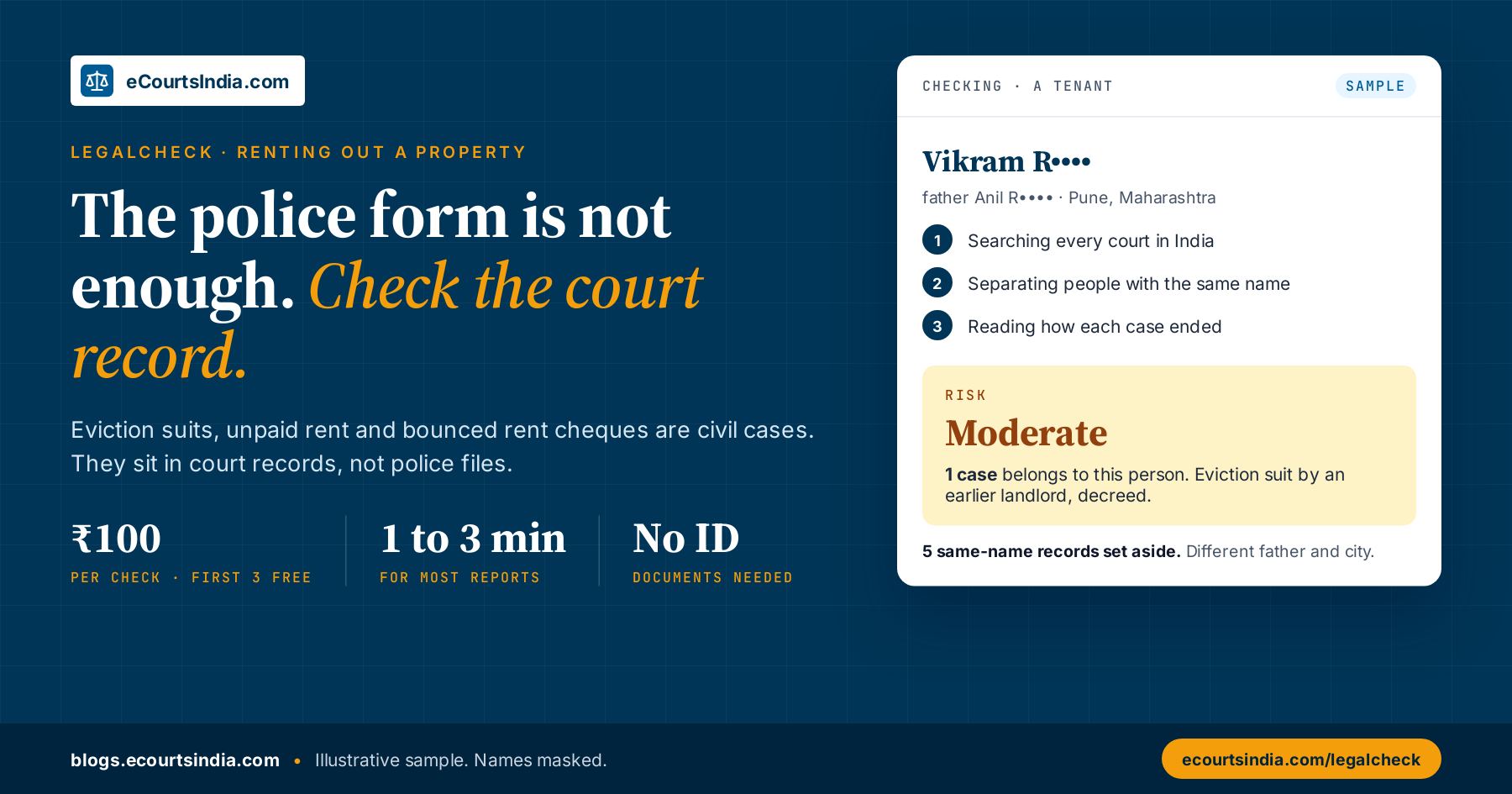
A tenant court record check searches public court and tribunal records for cases linked to the person or company you are about to rent to, such as eviction and rent suits filed by earlier landlords, cheque bounce complaints, money recovery suits and criminal cases, and links each finding to the case. LegalCheck searches 35 crore+ case records using the tenant’s name, a parent or spouse’s name and their city. No ID documents are needed, and the tenant is never contacted.
Your first 3 checks are free. Tell the tenant you run a court check for every let; good tenants rarely mind.
Last updated: 3 November 2026
Key takeaways
- Police verification is local and time-bound. Most cities require it through orders under Section 163 of the BNSS, and landlords who skip it can be prosecuted under Section 223 of the BNS. But it mainly reads police records in that area.
- The costly tenant problems are civil, not criminal. Unpaid rent, refusal to vacate and bounced rent cheques end up in rent courts and magistrate courts, which a police form does not read.
- Those cases are on record. On 3 November 2026 the eCourtsIndia index held 79,002 records tagged under state Rent Control Acts, 52,504 of them pending, and more than 71 lakh tagged under the cheque bounce law.
- Run both checks: a court record check before you sign, and police verification before the tenant moves in.
- Be fair. Confirm it is the same person, read the role and the outcome, and let the tenant explain before you decide.
Most landlords in India pick a tenant the same way: a broker’s word, a quick look at an ID card, a salary slip and a feeling. Then the agreement is signed for 11 months, the keys change hands, and the landlord hopes for the best.
Usually it works out. When it does not, it tends to go wrong slowly and expensively. The rent comes late, then not at all. A post-dated cheque bounces. The tenant stops answering the phone but does not leave. By the time the landlord thinks of checking the tenant’s past, a lawyer is already involved.
This guide covers what police verification actually does, what it misses, what court records can add, and how to run a fair tenant check in about ten minutes of your own time.
Is tenant police verification mandatory in India?
There is no single national law. In most large cities it is mandatory through local orders, and ignoring them is an offence. City police commissioners and district magistrates issue orders under Section 163 of the Bharatiya Nagarik Suraksha Sanhita (which replaced Section 144 CrPC) that require landlords to report tenant details. Breaking such an order is punishable under Section 223 of the Bharatiya Nyaya Sanhita (formerly Section 188 IPC) with simple imprisonment of up to six months, a fine of up to Rs 2,500, or both, rising to one year and Rs 5,000 where the breach endangers human life, health or safety.
These orders are real and police do act on them:
- Pune, August 2026: police took action against 113 landlords and PG operators under Section 223 of the BNS for not following tenant information orders, Punekar News reported. Landlords there can file details online through the Pune Police citizen portal.
- Mumbai, November 2024: after investigators found that the men accused in the Baba Siddique shooting had rented a house in Kurla, Tilak Nagar police registered about ten FIRs against landlords who had not verified their tenants, the Free Press Journal reported.
- North Goa, November 2025: the District Magistrate ordered owners to verify tenants with ID and submit the verification form to the local police station before tenants move in, according to the official order.
- Jammu, November 2025: the District Magistrate gave landlords seven days to report tenants on a form signed by both owner and tenant, PTI reported.
Check the order in your own city. These orders usually run for a fixed period, often 60 days, and are then re-issued, so the exact rules, forms and deadlines change. Delhi Police lists tenant registration among its online citizen services, and Mumbai and Pune police take tenant details through their citizen portals. When in doubt, ask the local police station.
What does police verification not tell you about a tenant?
Police verification mainly checks police records in one area. It does not read the civil courts where landlord disputes are decided, and it gives you an outcome, not the underlying cases. That leaves real gaps for a landlord.

| Court record check (LegalCheck) | Police verification | |
|---|---|---|
| What it reads | Public cases in courts and tribunals across India | Police records and local enquiry, as per the city order |
| Eviction or unpaid-rent suits by earlier landlords | Yes, if the case reached a court and can be matched | No, these are civil cases |
| Bounced rent cheques (Section 138) | Yes, if matched | No, a complaint is filed in a magistrate court, not as an FIR |
| A criminal case in another state | Yes, if it reached court and can be matched | Often not |
| An FIR still under investigation | No | Often yes, in that police area |
| Gives you the actual case | Yes, with a link to the court record | Usually a status, not the records |
| Typical time | 1 to 3 minutes for most reports | Days to weeks |
| Cost | First 3 checks free, then Rs 100 plus a small AI usage charge | Usually free or nominal |
Our explainer on court checks vs police verification vs FIR search goes deeper into what each record covers.
What can go wrong with a tenant? Three recent cases
Most tenants pay and leave on time. The cases that hurt landlords are the ones that drag on for years, and they usually leave a trail. These examples come from published reports; where a matter is still in court, the facts are allegations.
Worli, 2025: a flat rented for Rs 24,000, re-let for Rs 15 lakh
In November 2025, Tardeo police in Mumbai booked a tenant and two others. The tenant had rented the flat for Rs 24,000 a month and then allegedly forged a “heavy deposit” agreement and re-let the same flat to a third person for Rs 15 lakh, the Free Press Journal reported. The owner found out only when the new occupant turned up.
Noida, 2024: an eviction order and no rent
In January 2024, a flat owner in a Noida society told reporters that his tenant had ignored a 30-day notice served in January 2022, that the ADM court at Surajpur had ordered her on 23 May 2023 to vacate within 30 days, and that she had paid no rent since June 2023, India TV reported. The owner was living on rent elsewhere. These are his allegations, and the dispute was reported as continuing.
Kochi, 2025: five years without rent, settled by the Supreme Court
On 21 November 2025, in P.U. Sidique v. Zakariya, the Supreme Court restored the eviction of a tenant of two shops in Kochi who had not paid rent for more than five years and against whom a civil decree of over Rs 26 lakh had been passed, giving him until 31 December 2025 to vacate, as reported by CourtBook. It took that owner years and three tiers of courts to get the shops back.
The problem tenant is rare. But when one appears, there is often an earlier landlord who has already been to court. A two-minute search lets you meet that landlord’s case file before you meet the problem.
How common are rent and eviction cases in Indian courts?
Common enough that a landlord should assume they exist and look. On 3 November 2026, the eCourtsIndia index held 79,002 case records tagged under state Rent Control Acts, of which 52,504 were pending. Maharashtra alone accounted for 44,360, which fits the way Mumbai’s rent disputes are concentrated: the Court of Small Causes in Mumbai has exclusive jurisdiction under the Maharashtra Rent Control Act, 1999.
That tag undercounts. Many eviction and arrears cases are filed as ordinary civil suits and are not tagged under a Rent Act at all. And many tenants pay rent by post-dated cheque: the same index held more than 71 lakh records tagged under Section 138 of the Negotiable Instruments Act, the cheque bounce law, with over 44 lakh pending. Our deep dive on India’s cheque bounce litigation explains why those cases run for years.
What should you look for in a tenant’s court record?
Look for the cases that predict how the tenancy will end: disputes with earlier landlords, unpaid money, and serious criminal cases. A single old or minor case is a reason to ask, not automatically a reason to refuse.
| What may surface | Where it is usually filed | What it may tell you |
|---|---|---|
| Eviction or arrears suit by an earlier landlord | Rent Controller, Small Causes Court or civil court, depending on the state | How the last tenancy ended. Read who won and why |
| Cheque bounce complaints (Section 138) | Magistrate courts | A pattern of paying with cheques that bounce |
| Money recovery or summary suits | Civil and commercial courts | Unpaid dues to others |
| Criminal cases (cheating, forgery, theft, assault) | Criminal courts | Allegations worth understanding before someone lives in your property |
| For a company tenant: insolvency or bank recovery | NCLT, DRT | Whether the company can keep paying rent |
If the tenant is a company taking an office, shop or staff accommodation, check the legal entity and its directors, not just the brand. Our guide to checking a company before you sign shows how, and the case status dictionary explains what statuses like disposed, dismissed and withdrawn really mean.
How do you verify a tenant, step by step?
Collect details with consent, run a court check, do police verification as your city requires, then document everything.
- Collect the details, with consent. Full name as on an ID document, father’s or spouse’s name, year of birth, permanent address and current city. For a company, the registered name, CIN and the names of its directors. Tell the tenant you run a court check and police verification for every let.
- Run a court record check. Search the name free on the eCourtsIndia litigant search, or run a LegalCheck with the parent or spouse name and city. LegalCheck matches on family name, city and age and sets aside records that belong to someone with the same name, with the reason shown.
- Read anything that comes up. Who filed the case, what it was about, and how it ended. A tenant who sued a landlord to get a deposit back is in a very different position from one who was evicted twice.
- Complete police verification through your city police portal or local station, before the tenant moves in. Keep the acknowledgement.
- Sign a proper agreement. In Maharashtra, leave and licence agreements are registered through the state’s IGR system; elsewhere, follow local stamp duty and registration rules. Take the deposit and rent through the bank, not in cash.
- Keep the file. The report, the police acknowledgement, the agreement and payment records. If something goes wrong, your lawyer will want all four.
How do you keep a tenant check fair?
Use the check to protect your property, not to filter people out for who they are. A court record can show you a pattern. It cannot tell you someone’s character, and it should never become a reason to refuse a tenant because of a namesake, a dispute they won, or a case where they were the victim.

- Confirm identity. Common names match lakhs of records, as our same-name study found. Compare the father’s name, age and city before treating anything as the tenant’s.
- Check the role. Was the tenant the petitioner or the respondent? Filing a case is not the same as being sued.
- Check the outcome and the age. A ten-year-old dispute that ended in a settlement says little about next year’s rent.
- Ask before you decide. A clear explanation with papers is often the end of it.
- Keep it private. Use the report for your decision only. Personal data should be used for a lawful purpose, and court records are no exception.
What a tenant court check does not mean
- It is not police verification and does not replace it where your city requires it.
- A clean report is not a guarantee. It means no matching case was found in the courts searched with the details you gave. Some disputes never reach court.
- A case is not guilt. Pending cases are allegations, and many end in settlement or acquittal.
- It is not legal advice. For an eviction or a serious dispute, speak to a lawyer who practises in rent matters in your state.
If you are on the other side of the deal, read our companion guide on checking a landlord and a flat before you pay the deposit. The same check also works before you hire a driver, maid or caregiver.
Meet the last landlord’s case file before you meet the problem
Your first 3 completed LegalChecks on the website are free. After that, each check costs Rs 100 plus a small AI usage charge, shown before you submit and charged only when the report is ready (as of November 2026). A tenant check takes 1 to 3 minutes, and every finding links to the court record.
You need a free eCourtsIndia account to run a check. Property managers and co-living operators can use the LegalCheck API. Running checks at volume? Business plans are ₹99 per check, or ₹33 with a subscription.
Sources and method
- Court record counts: eCourtsIndia index via the eCourts MCP, read 3 November 2026. Records tagged under state Rent Control Acts: 79,002 (52,504 pending; Maharashtra 44,360). Records tagged “Negotiable Instruments Act | Section 138”: 71,74,299 (44,65,942 pending). Tags undercount, because many cases are filed without an Act tag.
- Bharatiya Nyaya Sanhita, 2023, Section 223 (text via AdvocateKhoj bare act); Section 163 BNSS orders cited from the North Goa District Magistrate order (November 2025) and Tribune/PTI on Jammu (2 November 2025).
- Punekar News, 8 August 2026 (Pune); Free Press Journal, 4 November 2024 (Tilak Nagar) and 16 November 2025 (Worli); India TV / PTI, 29 March 2025 (Mumbai portal order); India TV, 26 January 2024 (Noida); CourtBook on P.U. Sidique v. Zakariya, Supreme Court, 21 November 2025. All read 3 November 2026. Arrests and complaints describe allegations.
- Court of Small Causes, Mumbai, official site, on its jurisdiction under the Maharashtra Rent Control Act, 1999.
- LegalCheck web price and inputs from ecourtsindia.com/legalcheck, read 3 November 2026; case count (35.3 crore cases) from the eCourtsIndia homepage, read 3 November 2026.
Frequently asked questions
Is tenant police verification mandatory in India?
There is no single national law, but most large cities make it mandatory through police or district magistrate orders under Section 163 of the BNSS. A landlord who ignores such an order can be prosecuted under Section 223 of the BNS, with up to six months’ simple imprisonment, a fine of up to Rs 2,500, or both. Orders are time-bound and re-issued, so check the current one in your city.
What is the penalty for a landlord who does not verify a tenant?
Breaking a Section 163 BNSS order is an offence under Section 223 of the BNS: simple imprisonment up to six months, a fine up to Rs 2,500, or both, and up to one year and Rs 5,000 where the breach endangers life, health or safety. Pune police acted against 113 landlords in August 2026, and Mumbai police registered about ten FIRs in Tilak Nagar in November 2024.
Does police verification show a tenant’s civil or cheque bounce cases?
Usually not. Police verification reads police records and local enquiry. Eviction suits, unpaid-rent cases and money recovery are civil cases, and cheque bounce complaints are filed directly in magistrate courts. A court record check searches those courts across India and links each finding to the case.
How can I check if a tenant has court cases?
Search the tenant’s name free on the eCourtsIndia litigant search, or run a LegalCheck with their name, a parent or spouse’s name and city. LegalCheck sets aside records that belong to people with the same name and shows a risk level with each case explained in plain words. No ID documents are needed and the tenant is not contacted.
Will the tenant know I ran a court record check?
No. LegalCheck reads public court records and nobody is contacted. It is still good practice to tell the tenant you run a court check and police verification for every let, and to use the result only for your decision.
What should I do if the check shows an eviction case against the tenant?
First confirm it is the same person by comparing the father’s name, age and city. Then read who filed the case, what it was about and how it ended, and ask the tenant to explain. One settled dispute may mean little; repeated eviction or arrears cases are a stronger signal.
Where do eviction cases go in India?
It depends on the state and the type of premises. Many states have a Rent Controller under their Rent Control Act; in Mumbai the Court of Small Causes has exclusive jurisdiction under the Maharashtra Rent Control Act, 1999; and premises outside rent control go to civil courts. A lawyer in your city can tell you the right forum.
How much does a tenant court check cost?
Your first 3 completed LegalChecks on the eCourtsIndia website are free. After that each check costs Rs 100 plus a small AI usage charge, shown before you submit and charged only when the report is ready (as of November 2026). Searching a name yourself on the litigant search is free.
Important: LegalCheck is a court-record matching report based on public records and probabilistic identity matching. It is not an identity certificate, FIR search, police clearance certificate or legal advice. A match is not proof of wrongdoing. Verify identity, read the case and give the person an opportunity to explain before acting. Use reports only for a lawful purpose and keep them confidential. News reports cited here describe allegations unless a court has ruled; the people named are presumed innocent until proven guilty. eCourtsIndia is a private legal-technology platform and is not affiliated with any court or the Government of India.
Check first. Then hand over the keys.