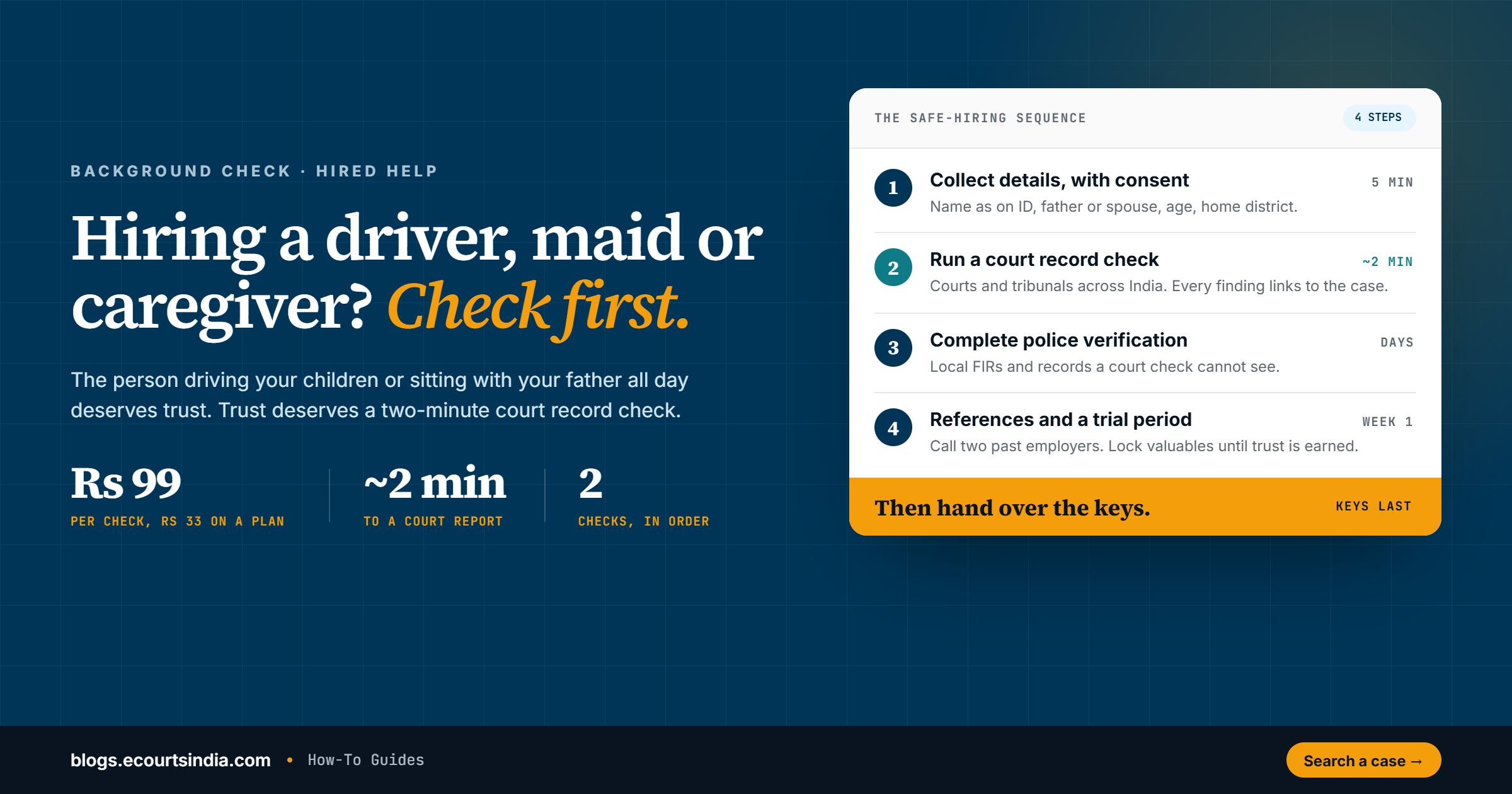
The person driving your children, cooking in your kitchen or sitting with your father all day deserves trust. Trust deserves a two-minute check.
Before you hand over the car keys or the house keys, look at what India’s courts already record about the person you are about to hire.
A court record check on a driver, maid, nanny or caregiver searches public court and tribunal records for cases linked to that person, such as theft, cheating, assault or drunk driving, and links each finding to the case. LegalCheck searches 32 crore+ records in about two minutes for ₹99.
Tell the candidate you run a court check for every hire. Honest candidates rarely mind.
Last updated: 5 October 2026
Key takeaways
- In several widely reported crimes by hired help, the person already had a past case or arrest that a basic check could have flagged.
- Cab aggregators must already verify drivers. India’s 2025 aggregator guidelines require police verification before onboarding and bar drivers with certain recent convictions. Most households check nothing.
- Run two checks, not one: a court record check first (minutes), then police verification (days). They see different records.
- For drivers, look for traffic and drunk-driving cases too. On 5 October 2026 the eCourtsIndia index held more than 5 lakh records tagged under the Motor Vehicles Act’s drunk-driving section.
- Be fair. Confirm identity, check the role and outcome, and let the person explain before you decide.
“Doing this direct LegalCheck on the driver we were about to hire for the team cab probably saved a life.”
Mamta, HR
Mamta works in HR. Her team was about to hire a driver for the team cab, and they ran a LegalCheck on him before the offer went out. Her one-line verdict is above. We are not publishing the details, because they belong to her team and to the driver. But that sentence is the reason this guide exists.
Families make the same decision every day with far less process than a company. A neighbour’s maid knows someone. The agency says the caregiver is “verified”. The driver has a licence and a nice manner. And then the person is alone with your children, your parents or your locker.
What do the news reports keep telling us about hired help?
The same thing, again and again: the warning sign was often already on record, and nobody looked. The cases below are drawn from published news reports; where a case is still in court, the accused is presumed innocent.
Delhi, 2014: the cab ride that changed the rules
In December 2014, a woman was raped by an Uber driver in Delhi, and the Delhi government banned Uber days later. The driver, Shiv Kumar Yadav, was convicted and sentenced to life imprisonment in November 2015, as Al Jazeera reported. Investigators found he had faced an earlier rape charge in 2011, for which he had spent months in custody before being acquitted. When the leaked Uber Files were reported in 2022, The Quint noted that the company’s own internal emails said the police character certificate it relied on had not caught those earlier allegations.
An acquittal is an acquittal, and it should not be held against anyone forever. But an earlier case of that nature is something an employer has the right to know about, read and ask about before giving a stranger a car and a passenger.
Mumbai, 2018: one domestic worker, more than 30 theft cases
In September 2018, Khar police in Mumbai arrested a 37-year-old domestic worker accused of stealing ₹4 lakh in gold from her employer. According to the Hindustan Times report, police said she had more than 32 theft cases across Mumbai, Navi Mumbai and Thane and a previous conviction, and that she would join a new house promising to submit her verification papers “in a few days”. The senior inspector’s advice was simple: verify domestic staff on day one.
Bengaluru, 2022: the caretaker hired a week earlier
In September 2022, a caretaker hired through a home-care agency to look after an 87-year-old retired DIG (Prisons) in Bengaluru was arrested a week later, accused of stealing valuables worth about ₹15 lakh. Deccan Herald reported it was her second brush with the law: she had earlier been arrested in Shivamogga for stealing jewellery from a house where she worked.
Hyderabad, 2026: 565 servant-theft cases in two years
In July 2026, Hyderabad’s police commissioner said 565 servant-theft cases had been registered in the city over two years, with senior citizens, IT professionals and students living alone among the main targets. As Telangana Today reported, police urged residents to make verification mandatory before hiring and to check previous employment.
Nationally, The Federal, citing NCRB’s 2024 data, reported 32,602 crimes against senior citizens in 2024, a 16.9% rise over the year before. Many elderly people in Indian cities now live with a paid caregiver as their closest daily contact.
The pattern is not that hired help is dangerous. Most drivers, maids and caregivers are honest people doing hard work. The pattern is that the rare bad hire usually had a history, and the family never looked.
What do the rules already require, and why does it matter at home?
Companies that put drivers in front of the public are already required to check them. Households are not, which is exactly why they need to do it themselves.
The Motor Vehicles Aggregator Guidelines 2025 require cab aggregators to have each driver’s character and antecedents verified by the police at least seven days before onboarding, and bar drivers convicted in the previous three years of drunk driving or of cognizable offences including fraud, sexual offences, theft and violence, as MediaNama’s explainer sets out. In 2019, Noida police filed an FIR against a ride-hailing company over lapses in driver verification, Inc42 reported.
In Delhi, domestic-help placement agencies need police verification to obtain a licence from the Labour Department, according to a 2023 PTI report.
A private family hiring a driver through a WhatsApp forward has none of those safeguards. The family is the employer, the HR team and the compliance desk, all at once.
Court record check or police verification: which do you need?
Both, in that order. A court record check is fast and searches the whole country. Police verification is slower, local and sees records that never reached court.
| Court record check (LegalCheck) | Police verification | |
|---|---|---|
| What it reads | Public cases in courts and tribunals across India | Local police records and enquiry, as per state process |
| Typical time | About 2 minutes | Days to weeks, depending on the state |
| Sees an FIR not yet in court? | No | Often yes, within that police jurisdiction |
| Sees a case in another state? | Yes, if it reached court and can be matched | Often not, unless it shows up in the systems the police search |
| Gives you the actual case? | Yes, every finding links to the case and orders | Usually a verification outcome, not the underlying records |
| Cost | ₹99 per report | Usually free or nominal; process varies by state |
Our explainer on court checks vs police verification vs FIR search vs PCC goes deeper, and if you need to look up a specific FIR, see how to check FIR status online.
What can a court check reveal about a driver, maid or caregiver?
It can reveal criminal and civil cases that reached a court and match the person, including the kinds of cases that matter most for each role.
| Role | Cases worth looking for | Why |
|---|---|---|
| Driver (family or staff cab) | Drunk driving under the Motor Vehicles Act, rash or negligent driving, accident cases, theft, assault, sexual offences | They control a vehicle with your family or staff inside |
| Domestic help, cook, cleaner | Theft, theft by a servant, house-breaking, cheating | Daily access to the home, keys and valuables |
| Nanny, babysitter | Any offence involving children, assault, theft | Unsupervised time with children |
| Caregiver for elderly parents | Theft, cheating, forgery, assault | Access to a vulnerable person, jewellery, cards and documents |
| Security guard, watchman | Theft, house-breaking, assault, cheating | Access to the building and knowledge of routines |
| Office staff and accountants | Cheating, criminal breach of trust, cheque-bounce, forgery | Access to money and company systems |

Drivers deserve special mention. On 5 October 2026, the eCourtsIndia index held more than 5.4 lakh case records tagged under Section 185 of the Motor Vehicles Act, the drunk-driving provision, and more than 1.4 lakh of those were still pending. A licence tells you someone passed a test once. It does not tell you what happened after.
How do you run a safe-hiring check, step by step?
Collect the right details with consent, run a court check, do police verification, then take references and start with a trial period. It takes about ten minutes of your time, spread over a few days.
- Collect details, with consent. Full name as on an ID document, father’s or husband’s name, age, permanent address and current address. Tell the candidate you will run a court record check and police verification. Write it down and get their signature or a WhatsApp “okay”.
- Run a LegalCheck. Enter the name, the parent or spouse name, age and the home district. Add the city they last worked in. You get a report in about two minutes, with each finding linked to the case.
- Complete police verification. Most state police forces run tenant and servant verification through their citizen portals or the local station. This catches recent FIRs and local records a court check cannot see.
- Call two previous employers. Ask why the person left. Agencies often give you a name, not a reference.
- Start with a trial period and keep valuables, cards and documents locked away until trust is earned. That protects a good employee from suspicion too.
We are a company. How should HR use this?
Make the court check a standard, documented step for every role with access to people, vehicles, money or homes, and run it before the offer, not after an incident.
- Drivers and transport vendors. If you run staff cabs, check every driver your transport vendor sends, not just the vendor company. One check on one driver is what Mamta’s team needed.
- Facility staff, security and housekeeping. These roles are often outsourced and turn over quickly. A two-minute check scales where field verification does not.
- Finance and cash-handling roles. Cheating, criminal breach of trust and cheque-bounce cases are worth knowing about.
- Volume hiring. Teams that hire in bulk can run the same check through the LegalCheck API and plug it into their onboarding system.
For a wider view of how a court record check fits into employee verification, read what a court record check in India covers.
Something came up in the report. What is the fair thing to do?
Confirm it is the same person, read the role and the outcome, and give the candidate a chance to explain before you decide.
- Is it really them? Common names like Ramesh Kumar or Sunita Devi each match well over a lakh court records, as our same-name study found. Compare the father’s name, age and district. A possible match is not a match.
- What was their role? Many people appear in court as complainants or victims. A driver who filed a case after his own accident is not an accused.
- What happened? Open the case. Disposed does not mean convicted. The case status dictionary explains the terms.
- How relevant is it to the job? A ten-year-old minor dispute is not the same as a recent theft case for a role inside your home.
- Ask the person. A clear explanation, with papers, is often the end of it. A lie about something you can see on the record is a better reason to say no than the case itself.
Do not punish people for being poor or unlucky. Domestic workers and drivers are more likely to be caught up in petty disputes, and are often the first to be blamed when something goes missing. A court check should protect your family without turning one old case into a life sentence.
What a court check for hiring does not mean
- It is not police verification and does not replace it. Recent FIRs and local records may only appear there.
- A clean report is not a guarantee. It means no matching case was found within the coverage and the details you gave. People with no record can still do harm, and people with an old record can be excellent employees.
- It is not proof of guilt. Pending cases are allegations, and many end in acquittal.
- It is not a reason to skip common sense: references, a trial period and keeping valuables secure still matter.
Two minutes now, peace of mind for years
One LegalCheck costs ₹99, or ₹33 with an active subscription. Most reports are ready in one to three minutes, and every finding links to the court record.
Already signed in? It opens in your eCourtsIndia dashboard. New? Create a free account first.
Sources and method
- Live count from the eCourtsIndia index via the eCourts MCP, read 5 October 2026: records tagged “Motor Vehicles Act | Section 185”, 5,40,433 records, 1,40,379 pending.
- Al Jazeera, 8 December 2014 and 3 November 2015; The Quint, 11 July 2022 (Uber Files). Read 5 October 2026.
- Hindustan Times (Mumbai) via PressReader, 5 September 2018; Deccan Herald, 27 September 2022; Telangana Today, 26 July 2026; The Federal, 19 May 2026 (reporting NCRB 2024 data). Read 5 October 2026. Arrests describe allegations.
- MediaNama, 5 July 2025, on the Motor Vehicles Aggregator Guidelines 2025; Inc42, 19 February 2019; Business Standard / PTI, 29 July 2023. Read 5 October 2026.
- Testimonial shared with eCourtsIndia by the user named, September 2026.
- LegalCheck price from ecourtsindia.com/api/pricing, read 5 October 2026.
Frequently asked questions
How do I do a background check on a driver or maid in India?
Collect the person’s full name, father’s or spouse’s name, age and home district with their consent. Run a court record check such as LegalCheck, which searches court records across India in about two minutes. Then complete police verification through your state police or local station, and call previous employers.
Is police verification enough for domestic help?
It is important but it is not the whole picture. Police verification is local and can take days, and it may not show a case that reached court in another state. A court record check covers courts across India and links you to each case. For anyone working inside your home, run both.
Can a court check show drunk-driving cases for a driver?
Yes, if the case reached a court and can be matched to the driver. Drunk driving is prosecuted under Section 185 of the Motor Vehicles Act, and the eCourtsIndia index holds lakhs of such records. Matching depends on the details you provide, so add the father’s name, age and district.
Do I need the candidate’s consent to run a court check?
Court records are public, but asking for consent is fair and good practice, and it is the easiest way to get accurate details for matching. Tell the candidate you check every hire. Honest candidates rarely object, and the conversation itself is useful.
What if the report shows a case with the same name?
Do not assume it is the candidate. LegalCheck separates confirmed, probable and possible matches and shows records it excluded. Compare the father’s name, age and district, then ask the candidate. Our guide on same-name false matches explains why this happens.
Should I reject someone who has an old case?
Not automatically. Check whether they were the accused or the complainant, how the case ended and how relevant it is to the job. A ten-year-old minor dispute is very different from a recent theft case for a role inside your home. Give the person a chance to explain.
Can companies run these checks in bulk?
Yes. HR and facility teams can run checks one by one from the dashboard or in volume through the LegalCheck API, which returns the same report as structured data for onboarding systems.
How much does a LegalCheck cost?
₹99 per report on pay as you go, or ₹33 with an active subscription. Opening a finished report again is free. See the background check guide for other situations where a check helps.
Important: LegalCheck is a court-record matching report based on public records and probabilistic identity matching. It is not an identity certificate, FIR search, police clearance certificate or legal advice. A match is not proof of wrongdoing. Verify identity, read the case and give the person an opportunity to explain before acting. Use reports only for a lawful purpose and keep them confidential. News reports cited here describe allegations unless a court has ruled; the people named are presumed innocent until proven guilty. eCourtsIndia is a private legal-technology platform and is not affiliated with any court or the Government of India.
Your family’s safety should not depend on a referral and a good feeling. Check first, then hand over the keys.