The person showing you the flat may not own it. The flat may already belong to a bank.
Before you hand over a deposit worth months of rent, spend a few minutes checking who you are paying and what you are renting.
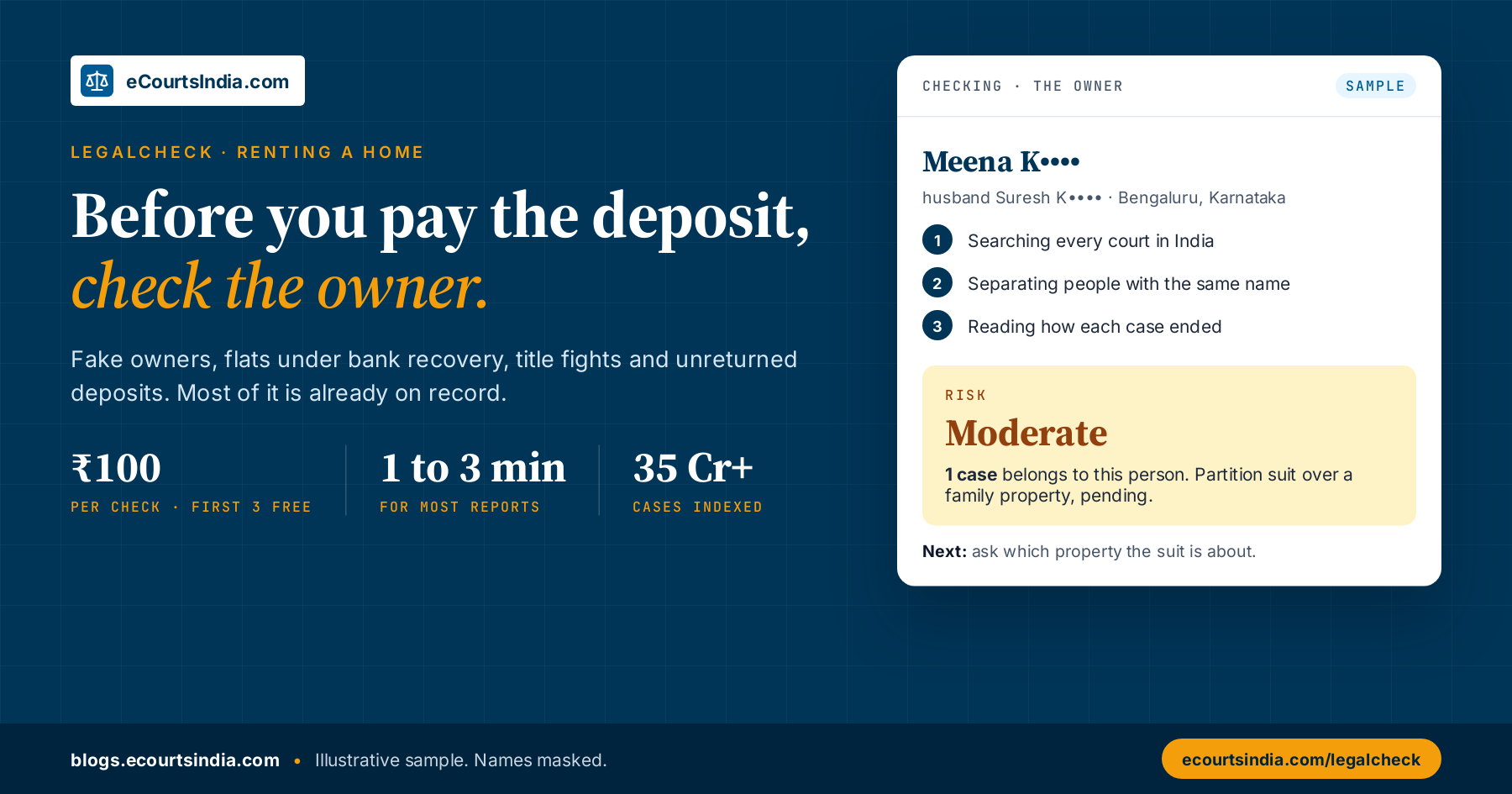
A landlord court check searches public court and tribunal records for cases linked to the owner, and to the property where you can identify it, such as title and partition suits, bank recovery and SARFAESI proceedings, cheating complaints and disputes with earlier tenants. LegalCheck searches 35 crore+ case records using the owner’s name, a parent or spouse’s name and their city, and links every finding to the case.
Your first 3 checks are free. The landlord is never contacted.
Last updated: 3 November 2026
Key takeaways
- Rental scams are organised. In 2025 Delhi Police arrested two people accused of posing as owners of other people’s flats and collecting over Rs 3 crore in deposits from about 100 tenants.
- Heavy-deposit offers carry the biggest risk. When the deposit is Rs 10 lakh or more, one check on the owner and the property is cheap insurance.
- A bank can take the flat. The Supreme Court held in 2025 that a tenancy created after the property was mortgaged does not bind the lender when it enforces its security under SARFAESI.
- Check three things: that the person is the real owner, that the property is not mortgaged or in dispute, and that the owner has no pattern of disputes with tenants.
- Pay through the bank and register the agreement so you have proof if the deposit is not returned.
In most Indian cities, a tenant pays more upfront than a landlord risks. Bengaluru landlords commonly ask for six to nine months of rent as a deposit, sometimes 12, Business Today reported in April 2025. In Mumbai, “heavy deposit” deals ask for lakhs in exchange for low or zero rent.
Yet tenants rarely check anything beyond the flat itself. The landlord checks the tenant’s ID and salary slip. The tenant checks the water pressure. This guide flips that around and shows what a tenant can check, in public records, before the money moves.
What can go wrong when you rent without checking the landlord?
Three things: the person is not the owner, the owner cannot give you what you paid for, or the owner will not return your deposit. All three have happened at scale. The cases below are drawn from news reports and describe allegations unless a court has ruled.
Delhi, 2025: fake owners, real deposits, about 100 victims
In March 2025, Delhi Police’s Economic Offences Wing arrested two people accused of posing as owners of flats that belonged to others. Using fake lease agreements, they allegedly collected more than Rs 3 crore in deposits from about 100 tenants, paid rent to the real owners at first to keep things quiet, then stopped, the Millennium Post reported. The tenants were left facing the real owners.
Mira Road, 2024: “heavy deposit, zero rent”
In April 2024, police at Kashimira near Mumbai registered four FIRs against fake agents who allegedly ran a heavy-deposit, zero-rent scheme, taking deposits of Rs 10 to 12 lakh and collecting Rs 47.01 lakh from four complainants. One person was arrested, and police advised home seekers to confirm the actual owner with the housing society, the Free Press Journal reported.
Bengaluru, 2020: property managers posing as owners
In November 2020, 39 tenants in Bengaluru said they were owed between Rs 8 lakh and Rs 36.6 lakh each after a property management couple allegedly took lease deposits while posing as owners. An FIR was registered for cheating and criminal breach of trust, and some tenants faced eviction when the real owners demanded rent, The News Minute reported.
Every one of these tenants checked the flat. None of them could easily check the person. That is the gap a five-minute records check closes.
What happens to a tenant if the bank takes the flat?
If the flat was mortgaged before your tenancy began, you may have very little protection when the lender enforces its security. On 15 July 2025, in PNB Housing Finance v. Manoj Saha, the Supreme Court held that a tenant cannot resist eviction under the SARFAESI Act without proving the tenancy began before the mortgage, and that leases created after the mortgage do not bind the secured creditor. Relying on an earlier ruling, it noted that oral or unregistered tenancies last no more than a year from the lender’s Section 13(2) notice, LiveLaw reported.
These proceedings leave a record. On 3 November 2026, the eCourtsIndia index held 88,773 records tagged under the SARFAESI Act, 27,980 of them pending, almost all in district courts, where lenders apply to take physical possession. Bank recovery suits also go to Debts Recovery Tribunals; our guide to DRT and DRAT case search shows how to look them up.
Rule of thumb: the bigger the deposit, the more it matters whether the flat is mortgaged. A tenant who pays Rs 15 lakh on a heavy-deposit deal is, in effect, lending money against the flat, without the security a bank would insist on.
How do you check the landlord and the flat before paying?
Check the owner’s identity against official land records, look for mortgages and court cases, and confirm with the society. None of this needs the landlord’s permission, and most of it is free.

- Match the person to the property record. Ask for the sale deed or property card and compare the owner’s name with official land records. In Maharashtra, Mahabhulekh gives 7/12, 8A and property card extracts online; most states have a similar land records portal. These online extracts are for information, not legal use, but they are enough to spot a mismatch.
- Look for a mortgage. Ask whether there is a home loan on the flat. The Central Registry (CERSAI) records security interests created by lenders, and your state’s registration department can issue an encumbrance certificate for the property.
- Search the owner’s name in court records. Run a LegalCheck with the owner’s name, a parent or spouse’s name and city, or search free on the eCourtsIndia litigant search. Look for partition and title suits, bank recovery, SARFAESI, cheating complaints and earlier eviction disputes.
- Search the property itself. Use the building name, survey number or address in eCourtsIndia’s keyword search, which looks across case details and the text of uploaded orders. This can surface a suit about the flat even when the owner’s name is spelt differently.
- Confirm with the society or neighbours. Ask the society office who the registered owner is. Police in the Mira Road case gave exactly this advice.
- Pay through the bank and register the agreement. Never pay a deposit in cash. Make sure the agreement is in the owner’s name, is stamped and, where your state requires it, registered. Keep receipts.
What should you look for in the owner’s court record?
| What may surface | What it may mean for you | What to ask |
|---|---|---|
| Partition or title suit naming the owner | Someone else may claim the property | Which property is involved, and is there a stay? |
| Bank recovery, DRT or SARFAESI matter | The flat or the owner’s assets may be under recovery | Is this flat mortgaged? Is the loan current? |
| Earlier tenants’ suits for deposit refund | A pattern of not returning deposits | How were they resolved? |
| Repeated eviction suits by the owner | Could be lawful, or a habit of conflict with tenants | Read who won and why |
| Cheating or criminal breach of trust complaints | Allegations about money taken from others | Check the status and outcome before paying anything |
A case is not a verdict. Owners sue defaulting tenants for good reasons, and many partition suits are family matters that never touch the flat you are renting. The case status dictionary explains how to read where a case stands.
How much deposit can a landlord ask for in India?
It depends on your state’s law, and in practice on the city. The Model Tenancy Act, which the Union Cabinet approved on 2 June 2021 for states to adopt, according to PIB, caps the security deposit at two months’ rent for residential premises and six months for non-residential premises, as Business Today has summarised. It applies only where a state has adopted it. In July 2022 the government told the Rajya Sabha that Andhra Pradesh, Tamil Nadu, Uttar Pradesh and Assam had revised their tenancy laws on the model’s lines, Housing.com reported. Check what your state’s current law says before you negotiate.
Whatever the amount, the deposit is your money held by someone else. That is why it is worth knowing who that someone is.
What a landlord check does not mean
- It is not a title search. For a long lease or a large heavy-deposit deal, have a lawyer read the title documents.
- A clean court record is not a clean title. Disputes that never reached court, unregistered agreements and some family arrangements will not appear.
- A case is not wrongdoing. Many owners appear in court as the party who was wronged.
- Names repeat. Compare the father’s name, age and city before treating any record as the owner’s. Our same-name study shows why.
Landlords run the same check on tenants; see tenant verification and what the police form misses. And if a friend is asking you for money towards a deposit, read what to check before lending to a friend.
Check who holds your deposit before you hand it over
Your first 3 completed LegalChecks on the website are free. After that, each check costs Rs 100 plus a small AI usage charge, shown before you submit and charged only when the report is ready (as of November 2026). A landlord check takes 1 to 3 minutes, needs no ID documents, and every finding links to the court record.
You need a free eCourtsIndia account to run a check. The landlord is never contacted. Running checks at volume? Business plans are ₹99 per check, or ₹33 with a subscription.
Sources and method
- Court record counts: eCourtsIndia index via the eCourts MCP, read 3 November 2026. Records tagged under the SARFAESI Act: 88,773 (27,980 pending). Tags undercount, because many cases are filed without an Act tag.
- Millennium Post, 21 March 2025 (Delhi EOW); Free Press Journal, 23 April 2024 (Mira Road); The News Minute, 10 November 2020 (Bengaluru). Read 3 November 2026. Arrests and FIRs describe allegations.
- LiveLaw, 18 July 2025, on PNB Housing Finance v. Manoj Saha, Supreme Court, 15 July 2025.
- PIB, 2 June 2021 (Model Tenancy Act); Business Today, 15 April 2025 and 26 October 2025 (deposits); Housing.com on the Rajya Sabha reply of July 2022.
- Maharashtra Mahabhulekh and CERSAI official portals, read 3 November 2026.
- LegalCheck web price and inputs from ecourtsindia.com/legalcheck, read 3 November 2026; case count (35.3 crore cases) from the eCourtsIndia homepage, read 3 November 2026.
Frequently asked questions
How do I check if the landlord is the real owner of the flat?
Ask for the sale deed or property card and compare the owner’s name with your state’s land records portal, such as Mahabhulekh in Maharashtra. Confirm the owner with the housing society office, and make sure the rent agreement names the same person. Pay only to a bank account in that person’s name.
How do I check if a property has a court case?
Search the owner’s name on a national court record search such as the eCourtsIndia litigant search, and search the building name, survey number or address in keyword search. A LegalCheck on the owner matches the name against a parent’s name and city and links each finding to the case.
How do I check if a flat is mortgaged or under bank auction?
Ask the owner directly, check for a security interest on the CERSAI registry, and ask your state’s registration department for an encumbrance certificate. A court check on the owner can also show SARFAESI and Debts Recovery Tribunal matters where lenders are already trying to recover.
What happens to a tenant if the bank seizes the property?
If the tenancy began after the property was mortgaged, the tenant usually cannot stop the lender from taking possession. In July 2025 the Supreme Court held that such leases do not bind the secured creditor, and that oral or unregistered tenancies last at most a year from the lender’s Section 13(2) notice. Take legal advice quickly if you receive a notice.
Is a heavy-deposit or zero-rent flat safe?
It carries more risk, because you are effectively lending a large sum against the flat without a bank’s protections. Police in the Mira Road case advised confirming the actual owner with the society. Check ownership, mortgages and court cases, pay by bank transfer, and have a lawyer review a large agreement.
How much security deposit is legal in India?
It depends on your state’s law. The Model Tenancy Act, approved by the Union Cabinet in June 2021, caps residential deposits at two months’ rent, but it applies only where a state has adopted it. In many cities deposits are set by local custom, such as six to nine months in Bengaluru.
Will the landlord know I checked their court record?
No. LegalCheck reads public court records and nobody is contacted. Use the result only for your own decision and keep it private.
How much does a landlord court check cost?
Your first 3 completed LegalChecks on the eCourtsIndia website are free. After that each check costs Rs 100 plus a small AI usage charge, shown before you submit and charged only when the report is ready (as of November 2026). Searching a name yourself on the litigant search is free.
Important: LegalCheck is a court-record matching report based on public records and probabilistic identity matching. It is not an identity certificate, FIR search, police clearance certificate or legal advice. A match is not proof of wrongdoing. Verify identity, read the case and give the person an opportunity to explain before acting. Use reports only for a lawful purpose and keep them confidential. News reports cited here describe allegations unless a court has ruled; the people named are presumed innocent until proven guilty. eCourtsIndia is a private legal-technology platform and is not affiliated with any court or the Government of India.
Check the person. Check the property. Then pay.