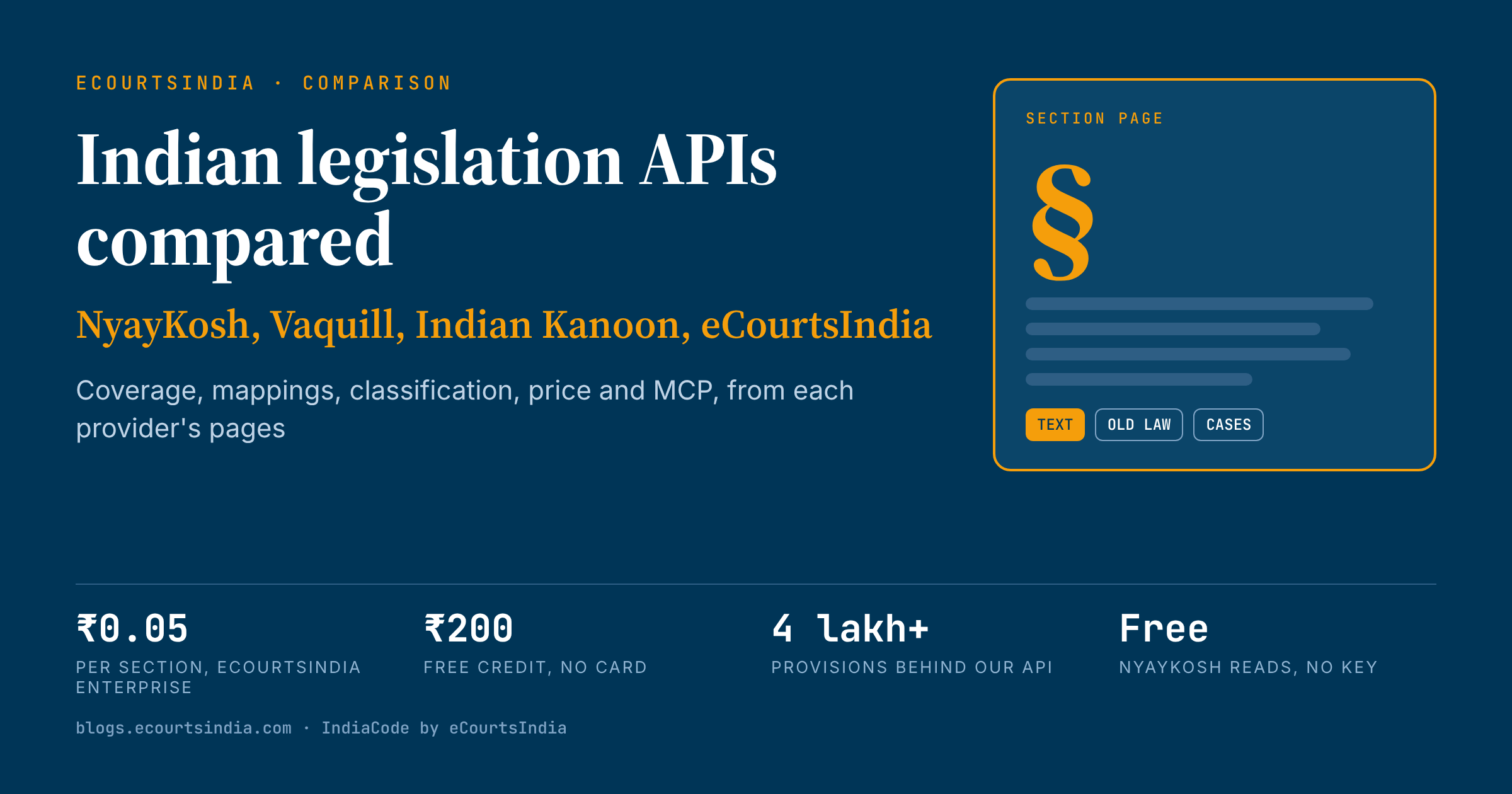
Indian legislation APIs compared: NyayKosh, Vaquill, Indian Kanoon and eCourtsIndia
No single Indian legislation API does everything. NeGD’s NyayKosh is free and open but covers a handful of digital laws. Vaquill and eCourtsIndia serve Central and State Acts section by section on paid credits, with old to new code mappings. Indian Kanoon’s API is built around judgments, with Central Acts and rules searchable too.
An Indian legislation API is a web service that returns the text of Indian Acts, sections, rules or notifications as structured data, usually JSON or XML, so software can read the law without scraping PDFs.
No card needed. eCourtsIndia is a non Govt. initiative; the Gazette is the authoritative text.
Last updated: 3 November 2026
Key takeaways
- NyayKosh (NeGD, Law as Code) publishes a few Acts and Rules as open JSON and Akoma Ntoso XML with no key for reads. Its project page names the DPDP Act 2023, Online Gaming Rules 2026, the Aadhaar Act 2016 and the IT Act 2000.
- Vaquill serves Central and State Acts from India Code on credits, with an IPC to BNS and CrPC to BNSS mapping transcribed from the BPR&D tables and an MCP server.
- Indian Kanoon’s API is priced per request (₹0.02 to ₹0.50) and centres on judgments; its docs mention a “laws (Central Act and Rules)” filter.
- eCourtsIndia’s Acts and Sections API (ours) returns a section with its offence classification and old and new equivalents in one call, at ₹0.05 to ₹0.15 per section, and links statutes to 35 crore+ case records.
- The government’s India Code did not mention an API in its August 2026 relaunch release, so building on it means scraping, with its own costs.
Disclosure. Billion Insights Ventures Pvt. Ltd. makes the eCourtsIndia Acts and Sections API and IndiaCode by eCourtsIndia, one of the options compared here. Every statement about another API comes from that provider’s own page or documentation, with its address and the date we read it, 3 November 2026. Where a page is silent we write “not stated”. We make no claims about anyone else’s accuracy or quality, and each option gets a fair “choose it when” line.
Which Indian legislation API should you use?
Pick by coverage first, then by the extra fields your product needs. If you only need the DPDP Act and Aadhaar Act as open data, an open government feed is the obvious start. If you need any Central or State section on demand, you need a full-corpus API. If your product sits on criminal law or court cases, mappings, classification and case links matter more than raw text.
- Best free, open, government-published data for a few digital laws: NyayKosh.
- Best for Central and State Act text with amendment history records and an MCP: Vaquill.
- Best if your product is mainly judgments, with Acts alongside: Indian Kanoon API.
- Best for sections with offence classification, IPC to BNS, CrPC to BNSS and Evidence Act to BSA equivalents, and links to court cases: eCourtsIndia Acts and Sections (ours).
- Best when you need full control, offline use or a single Act: building your own from India Code and the Gazette.
This post sits next to our comparison of court data APIs in India, which covers the case side. For readers rather than developers, the sibling guide on the best websites for bare acts online compares the reading sites.
What should you compare in an Indian legislation API?
Compare eight things: coverage, State Acts, old and new code mapping, offence classification, links to case law, authentication, price and MCP support. Text alone is the easy part. The hard parts are State Acts (many exist only as gazette scans), the 2024 criminal-code renumbering, and joining a section to the cases that cite it.
| API | Coverage (as published) | State Acts | Old/new code mapping | Offence classification | Case-law link |
|---|---|---|---|---|---|
| NyayKosh (NeGD) | DPDP Act, Online Gaming Rules, Aadhaar Act, IT Act; “217+ provisions mapped” | Not stated (four laws named) | Not stated | Penalties mapped as data | Not stated |
| Vaquill Indian Acts | 64,179 acts, 745,970 sections (measured 6 Sep 2026) | Yes | IPC to BNS, CrPC to BNSS from BPR&D tables | Not mentioned | Not stated for sections |
| Indian Kanoon API | Judgments and legal documents; “laws (Central Act and Rules)” filter | Not stated for the API | Not stated | Not stated | Judgments are the core |
| Scraping India Code | Whatever you build | Yes, at source | You build it | You build it | You build it |
| eCourtsIndia Acts and Sections | 4 lakh+ provisions incl. rules and notifications | Yes, 9,000+ State Acts | IPC, CrPC, Evidence Act with relation labels | Yes, one row per offence | Yes, case provisions and search by section |
| API | Auth | Price (as published) | Free start | Formats | MCP |
|---|---|---|---|---|---|
| NyayKosh (NeGD) | “No key for read” | Not stated | Open reads | JSON, Akoma Ntoso XML, PDF | Not stated |
| Vaquill Indian Acts | Bearer vq_key_ | Credits per route; credit price not shown on pages read | Free credits for personal, student and academic use, on request | JSON | Yes, 8 India tools |
| Indian Kanoon API | Authorization: Token | ₹0.02 to ₹0.50 per request | ₹500 on sign-up | JSON or XML responses; HTML documents | Not stated |
| Scraping India Code | None | Your engineering time | Free data | HTML and PDF | No |
| eCourtsIndia Acts and Sections | Bearer eci_live_ | ₹0.05 (Enterprise) or ₹0.15 (PAYG) per section | ₹200 on sign-up, no card | JSON; free pages as Markdown and Akoma Ntoso | Yes, mcp.ecourtsindia.com |

NyayKosh: the government’s open Law as Code feed
NyayKosh, also called Law as Code, is a National e-Governance Division project that “publishes Indian laws as open, structured, machine-consumable data”. NeGD’s project page says each Act and Rule is parsed into sections and clauses, encoded in LegalDocML and mapped to obligations and penalties. It says “Coverage spans the DPDP Act 2023, Online Gaming Rules 2026, the Aadhaar Act 2016, and the IT Act 2000”, with “217+ provisions mapped and growing”, and that every statute is available as a citizen-friendly read, a PDF, LegalDocML/Akoma Ntoso XML and versioned REST APIs, with “no registration required” (NeGD project page, read 3 November 2026).
The portal at lawascode.negd.in showed “4 Acts indexed” on the day we read it, naming the Promotion and Regulation of Online Gaming Act, 2025, the Digital Personal Data Protection Act, 2023 and the Aadhaar Act, 2016. It shows example endpoints such as GET /v1/laws/dpdp-2023 and GET /v1/laws/dpdp-2023/penalties, describes the PDF as an “Authoritative, gazette-faithful copy for citation”, and labels reads “No key for read” (lawascode.negd.in, read 3 November 2026). The API docs page says “no sign-up, no key” and did not list a base URL, rate limits or a licence when we read it (API docs page, read 3 November 2026).
Choose it when: you are building for data protection, Aadhaar or online gaming compliance and want open, government-published structured data, including penalty schedules, with no account.
Vaquill: Central and State Acts on credits, with an MCP
Vaquill serves Indian Acts section by section over a credit-metered REST API and an MCP server. Its India page says it serves “64,179 acts and 745,970 distinct sections, built from India Code”, “over 18 REST routes and inside Claude over MCP”, with the MCP “publishing 8 tools”, Bearer-token access and “no sales call”. It lists credit costs per route: coverage and filters free, list 1 credit, search 2, a section 2, a section’s body 3, an Act’s text 3 and amendments 5 (vaquill.ai/in, read 3 November 2026).
Its coverage page goes into detail. It splits the corpus into 19,965 central and 32,268 state acts by category, says counts were measured on 2026-09-06, that “India Code is re-swept on a weekly cadence”, that “No commercial database is a source”, and that Vaquill does not apply amendments to the text it serves; structured amendment records exist for 1,061 acts (India coverage, read 3 November 2026). The section body endpoint returns the text “as published” with provenance links back to the source (section body docs, read 3 November 2026).
For the criminal codes, GET /api/v1/in/acts/corresponding-provisions/{act_code} costs 1 credit and returns IPC to BNS or CrPC to BNSS lists; IEA and BSA return 404 until that mapping is available (mapping docs, read 3 November 2026). The coverage page says it holds 534 IPC to BNS and 518 CrPC to BNSS pairs “transcribed from the correspondence tables the Bureau of Police Research and Development publishes”. Vaquill’s homepage lists Pro and Business plans with 20,000 and 200,000 credits a month and free credits for personal, student and academic work on request, but we did not find a rupee or dollar price per credit in the page text we read (vaquill.ai, read 3 November 2026).
Choose it when: you want Central and State Act text with provenance and amendment history records, a BPR&D-based mapping, and an MCP, and a credit plan suits your volume.
Indian Kanoon API: judgments first, laws alongside
The Indian Kanoon API exposes the same search and documents as the indiankanoon.org website, priced per request, and it is built around court judgments. Its homepage describes “raw court data” plus an “enriched HTML file with proper layout and metadata”, with search “with all supported filters and operators” and text fragments for a query (api.indiankanoon.org, read 3 November 2026). The documentation lists five endpoints (search, doc, origdoc, docfragment and docmeta), uses an Authorization: Token header, and says the doctypes filter can take the aggregator “laws (Central Act and Rules)” (API documentation, read 3 November 2026). It does not describe a section-level endpoint for Acts, State Acts through the API, or old and new code mapping.
Pricing is published in rupees per request: search ₹0.50, original document ₹0.50, document ₹0.20, document fragment ₹0.05 and document metainfo ₹0.02. New sign-ups get ₹500 “to develop and test your API integration”, non-commercial users can receive ₹10,000 a month after use-case verification, and billing is prepaid (API pricing, read 3 November 2026). On the website, the browse page carries Union Acts, the Constitution and one Act collection per State (browse laws, read 3 November 2026).
Choose it when: your product is mainly judgment search and you want Central Acts and rules in the same index, at published per-request prices.
Scraping India Code: free data, paid in engineering
India Code is the government’s repository of Central and State Acts and their subordinate legislation, and it is free to read, but we found no documented API for it. Its About page describes “a database of all Central enactments which are in force and their subordinate legislations” plus State and UT laws (India Code About, read 3 November 2026). The PIB release on its 13 August 2026 relaunch lists AI-assisted and semantic search, linkage to subordinate legislation and e-Gazette integration, and does not mention an API (PIB release, read 3 November 2026). On 3 November 2026 the homepage’s robots rules blocked our automated reader, which is worth checking before you plan a crawler.
What you take on if you scrape: splitting Acts into sections, OCR for State Acts that exist only as scans, keeping up with amendments, and building your own mappings and classification tables. Our sibling post on buying a statute API versus scraping India Code works through that cost model.
Choose it when: you need one or a few Acts, must run fully offline, or need licensing terms no vendor offers, and you have the engineering time.
eCourtsIndia Acts and Sections API: statutes joined to court data
Our Acts and Sections API returns any section of a Central or State Act, the Constitution, the CPC First Schedule or a rule or notification as JSON, with its offence classification and old and new code equivalents in the same response. It is part of the eCourtsIndia API, so the same key also reaches 35 crore+ case records, and it serves the same corpus readers see on IndiaCode, described in our IndiaCode pillar guide.
There are seven endpoints, all on https://webapi.ecourtsindia.com with a Bearer eci_live_ token: Get a Section, a Batch of 1 to 50 sections, Section Equivalents, Resolve an Act Name, Search, Corpus Status (free) and Case Provisions, which returns the sections parsed from a case record, with their text and classification (API docs, read 3 November 2026). Every Acts call costs ₹0.05 at the Enterprise rate or ₹0.15 on Pay As You Go; not-found answers are free; new accounts get ₹200 of credit with no card (API pricing, read 3 November 2026). The docs set rate limits of 100 requests a minute, 3,000 an hour, 50,000 a day and 10 concurrent. The same tools are on the remote MCP server at mcp.ecourtsindia.com.
The limits we want you to know. Our old to new mappings are a text comparison with relation labels, not an official table. Links from cases to sections come from citations parsed out of each case record, and not every record carries them, so treat “every case under BNS 318” as a search, not a complete join. And the old free IndiaCode JSON API, described in our August post on the IndiaCode search and JSON API, is withdrawn: it now returns HTTP 410 and points to ecourtsindia.com/api. The free Markdown and Akoma Ntoso page formats remain.
Choose it when: your product needs criminal-law classification, IPC to BNS style equivalents, State Acts, or a join from statute to court cases. Our pillar on the Indian statute API documents every endpoint.
Worked example: three questions, answered live
We put three typical developer questions to our own statute tools on 3 November 2026, through the eCourtsIndia MCP, which calls the same API underneath.
1. Turn a messy Act name into a key. resolve_act("Karnataka Rent Act") returned a single match, key ka/2001/34, “THE KARNATAKA RENT ACT, 1999”, with its IndiaCode URL. The equivalent API call is GET /api/partner/acts/resolve?name=Karnataka%20Rent%20Act, charged only because it returned one match; an ambiguous name returns candidates and is free.
2. Find the law by words, not numbers. search_statute("dishonour of cheque", limit 5) reported 44 matching provisions as of 3 November 2026. The top three were Negotiable Instruments Act sections 138 (dishonour of cheque for insufficiency of funds), 146 (bank’s slip as prima facie evidence) and 140 (defence not allowed in a 138 prosecution), followed by two GST circulars. Hits carry keys and headings, not text.
3. Get the classification and the old number in one go. lookup_offence("318") returned BNS 318’s three offence rows and its equivalents, IPC 415 (near-identical), 418 and 420 (close). The documented request for the mapping alone is:
curl -X GET "https://webapi.ecourtsindia.com/api/partner/acts/2023/45/sections/318/equivalents" \
  -H "Authorization: Bearer eci_live_your_token_here"
And a mapping that does not exist is free: map_provision for IPC 124A returned no recorded counterpart, with a note that BNS 152 is a differently worded offence. That “no” is as useful to a product as a “yes”. The sibling guide on IPC to BNS converters tests five more mappings like it.
What do 10,000 section reads cost on each API?
On published prices, 10,000 section reads cost ₹500 to ₹1,500 on eCourtsIndia; Indian Kanoon and Vaquill price a different unit, and NyayKosh states no price. This is arithmetic on each provider’s published rate, before GST, not a quote.
| API | Unit priced | Published rate | 10,000 units |
|---|---|---|---|
| eCourtsIndia, Enterprise rate | One section returned | ₹0.05 | ₹500 |
| eCourtsIndia, Pay As You Go | One section returned | ₹0.15 | ₹1,500 |
| Indian Kanoon | One document request (a whole document) | ₹0.20 | ₹2,000 |
| Indian Kanoon | One document fragment | ₹0.05 | ₹500 |
| Vaquill | One section body | 3 credits | 30,000 credits (credit price not shown) |
| NyayKosh | One read | Not stated (no key) | Not stated |
Units matter more than rates. An Indian Kanoon “document” is a whole judgment or Act; a Vaquill credit buys different things on different routes; and our price is per distinct section returned, so a batch of 50 that finds 48 sections charges 48.
Which legislation API fits which product?
Match the API to the job your product does most often.
| Product | Good first choice | Why |
|---|---|---|
| DPDP or Aadhaar compliance tool | NyayKosh | Open, government-published, penalties as data |
| Legal chatbot citing any Central or State section | eCourtsIndia or Vaquill | Full corpus, section-level, MCP |
| Criminal-law or bail product | eCourtsIndia | Classification rows and BNS/BNSS equivalents |
| Judgment search with statutes alongside | Indian Kanoon API | Judgments are its core index |
| Litigation portfolio enriched with statutes | eCourtsIndia | Case Provisions joins cases to sections |
| Offline app for one Act | Build from India Code and the Gazette | No per-call cost, full control |

If you are wiring a statute tool into Claude, ChatGPT or Cursor, our guide to Indian public data over MCP covers the setup.
What this comparison does not tell you
- It does not test anyone’s accuracy. We describe what each provider publishes. Run your own test set before you choose.
- Counts belong to their owners. Vaquill’s figures are its own, measured on 6 September 2026; NeGD’s are its own.
- “Not stated” is not “not available”. A feature may exist that the page we read does not mention.
- No API returns an authenticated copy. The Gazette is the authoritative text of any Indian law, and India Code is the government’s repository.
Sources and method
- NeGD NyayKosh project page, negd.gov.in; portal lawascode.negd.in and API docs; read 3 November 2026.
- Vaquill India page, homepage, India coverage, mapping and section body docs: vaquill.ai/in, vaquill.ai, coverage, mapping, section body; read 3 November 2026.
- Indian Kanoon API homepage, documentation and pricing: api.indiankanoon.org, documentation, pricing; browse laws indiankanoon.org/browselaws; read 3 November 2026.
- India Code About page and PIB release of 13 August 2026: About, PIB; read 3 November 2026.
- eCourtsIndia API docs and pricing: ecourtsindia.com/api/docs, ecourtsindia.com/api/pricing; read 3 November 2026.
- Live examples: resolve_act, search_statute, lookup_offence and map_provision via the eCourtsIndia MCP, 3 November 2026.
Frequently asked questions
Is there a free Indian legislation API?
Yes, for a few laws. NeGD’s NyayKosh (Law as Code) publishes the DPDP Act, Aadhaar Act, online gaming law and IT Act material as open JSON and Akoma Ntoso XML, and says reads need no key. For full Central and State coverage, the APIs we found charge per call, though most give free credit to start. See lawascode.negd.in.
Does India Code have an API?
India Code, the government’s repository, did not mention an API in the PIB release on its 13 August 2026 relaunch, and we found no documented API. Developers either scrape it, which means section splitting, OCR and upkeep, or use a statute API built from it. Our post on statute API versus scraping India Code compares the two.
Which API gives IPC to BNS mappings?
Two publish one. Vaquill’s corresponding provisions endpoint returns IPC to BNS and CrPC to BNSS lists transcribed from the BPR&D tables. eCourtsIndia’s Section Equivalents endpoint covers IPC, CrPC and the Evidence Act with relation labels, and a missing mapping is free. Read the eCourtsIndia API docs for the request shape.
Does the Indian Kanoon API return Acts?
Its documentation says the doctypes filter can take “laws (Central Act and Rules)”, so Central Acts and rules are in the searchable index. The docs list search, document, original document, fragment and metainfo endpoints, and do not describe a section-level endpoint for Acts. Prices run from ₹0.02 to ₹0.50 per request, per its pricing page.
How much does a statute API cost in India?
On published rates, eCourtsIndia charges ₹0.05 per section at the Enterprise rate or ₹0.15 on Pay As You Go, so 10,000 sections cost ₹500 to ₹1,500 before GST. Indian Kanoon charges ₹0.20 per document request. Vaquill prices in credits and NyayKosh states no price. See eCourtsIndia API pricing.
Which legislation APIs work with Claude or ChatGPT over MCP?
Vaquill says its India MCP publishes 8 tools. eCourtsIndia runs a remote MCP server at mcp.ecourtsindia.com with statute tools such as lookup_provision, map_provision and lookup_offence alongside its court data tools. NeGD’s and Indian Kanoon’s pages did not mention MCP. Our guide to connecting the eCourtsIndia MCP to Claude shows the setup.
Is the old IndiaCode JSON API still available?
No. The free IndiaCode JSON API at indiacode.ecourtsindia.com/api/v1 has been withdrawn and returns HTTP 410 with a pointer to the eCourtsIndia API. The free Markdown and Akoma Ntoso versions of each IndiaCode page, and llms.txt, remain. Section data as JSON now comes from the Acts and Sections API.
Important: This comparison describes each API from its provider’s own pages, read on 3 November 2026, and reports live calls to eCourtsIndia’s own statute tools on the same date. It does not test or rate any provider’s accuracy. Prices are as published and exclude taxes; check each provider before you buy. No API returns an authenticated copy of a law; the authoritative text is the Official Gazette, and India Code is the government’s repository. eCourtsIndia is a non Govt. initiative of Billion Insights Ventures Pvt. Ltd., Noida, and is not affiliated with any court or the Government of India. This is not legal advice.
Read any Indian section as JSON
Text, offence classification and old and new code equivalents in one call, joined to 35 crore+ court records. ₹200 free credit, no card.
Prefer an AI assistant? The same tools are on the eCourtsIndia MCP.