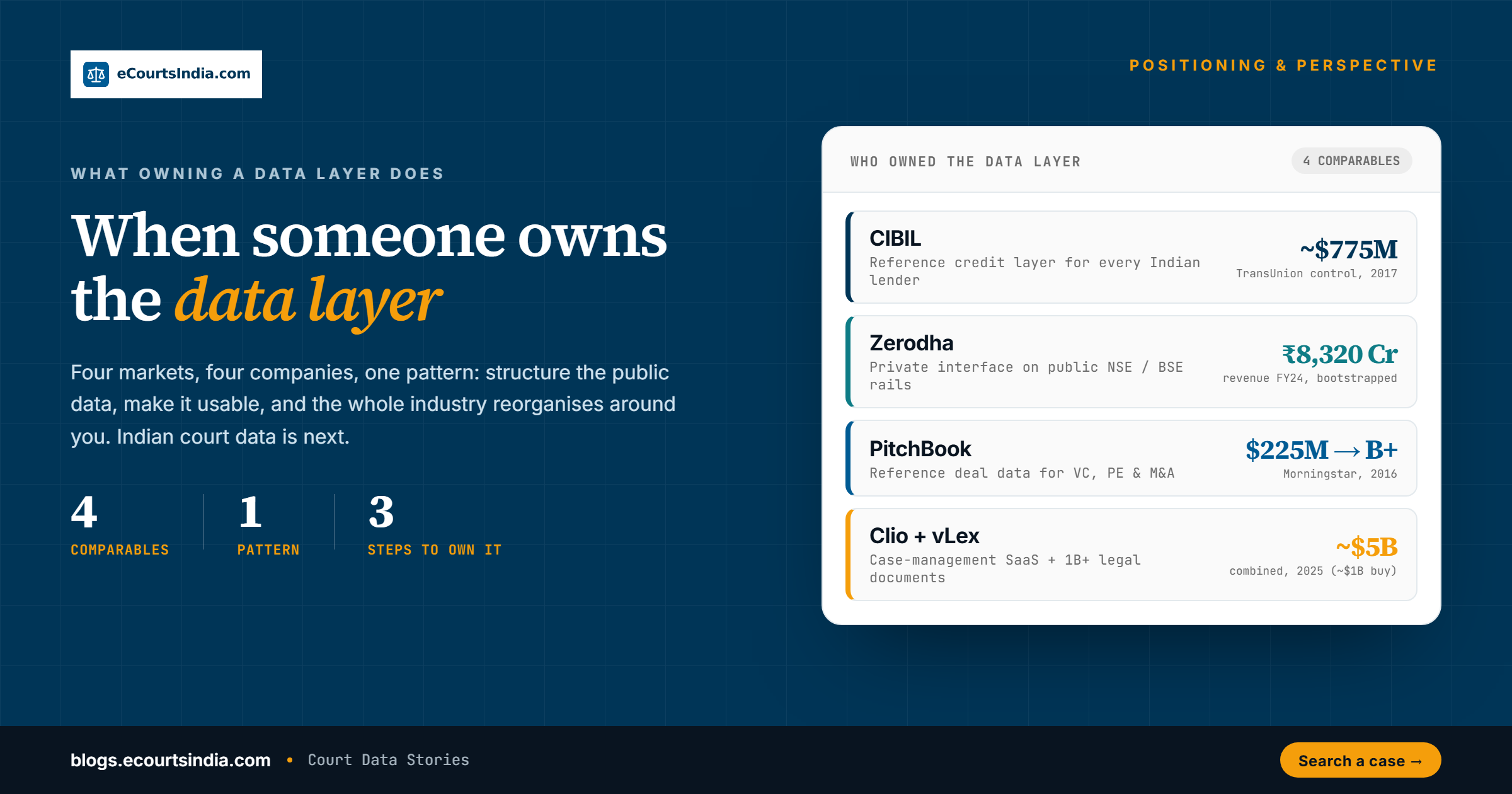
When one company owns an industry’s primary data layer, the whole sector reorganises around it. CIBIL, Zerodha, PitchBook, Clio-vLex and Bloomberg each took data that was scattered, public or semi-public, turned it into a structured reference that professionals trust, and captured outsized value as a result. Indian court data is the same kind of opening. This post lines up the five comparables, shows the pattern they share, is honest about where each analogy breaks, and explains what it means for how court data gets built in India.
Last updated: 23 September 2026
Key takeaways
- The pattern is consistent: take data that already exists, invest for years to make it clean and structured, then make it trivially easy for professionals and their tools to use.
- CIBIL shows the end state of a mandatory reference check. Bank of India’s 2017 sale of a 5% stake implied a value of about USD 592 million for TransUnion CIBIL.
- Zerodha shows what a better private interface on public rails can earn: Rs 8,847 crore of revenue and Rs 4,237 crore of profit in FY25.
- PitchBook, Clio-vLex and Bloomberg show that data plus a daily workflow is worth far more than either half.
- For Indian court data, LegalCheck plays the CIBIL-shaped role and eCourtsIndia search plays the Zerodha-shaped one, on a base of 32 crore+ case records.

Five comparables at a glance
Every few decades a category produces one company that becomes the reference data layer for its industry. Credit bureaus in lending. PitchBook in private markets. Clio-vLex in global legal work. Bloomberg in financial markets. Zerodha is a slightly different case, a distribution play on top of public market infrastructure, but it teaches the same lesson from the interface side.
| Company | Core data or role | Primary customers | Outcome (sourced) |
|---|---|---|---|
| TransUnion CIBIL (India, credit bureau) | Credit histories of Indian borrowers | Every Indian lender | TransUnion took majority control (55%) in May 2014. Bank of India’s 5% sale in March 2017 for Rs 190.62 crore implied a value of about USD 592 million. |
| Zerodha (India, retail broking) | Not a data owner. Private interface on NSE and BSE | Indian retail investors | Rs 8,847 crore revenue and Rs 4,237 crore profit in FY25, bootstrapped. |
| PitchBook (US, private markets) | Deal, fund and private company data | VCs, PE funds, investment banks | Morningstar took full ownership in 2016 in a deal that valued it at about USD 225 million. |
| Clio + vLex (global legal) | Lawyer workflow plus a corpus of more than a billion legal documents | Law firms worldwide | Clio bought vLex for about USD 1 billion in 2025 and raised a USD 500 million Series G at a USD 5 billion valuation, with about USD 400 million ARR. |
| Bloomberg (global finance) | Market data, filings and news in one normalised graph, plus the Terminal | Traders, analysts, banks, media | A Terminal seat reportedly costs about USD 30,000 a year. Bloomberg does not publish its price. |
The pattern beneath the five

Each of these companies did the same three things in some order. First, they took data that already existed in the public or semi-public domain and was technically available to anyone. Second, they invested for long enough to turn that raw availability into clean, reliable, structured data. Third, they made that structured data easy to reach for the professionals who needed it, and later for the applications those professionals used. The result was the same every time. The industry stopped going to the source and started going to them.
None of the five won on a single feature. They won on completeness, reliability and habit. That is worth keeping in mind for Indian law, where the temptation is to build one clever tool on a thin slice of Supreme Court and High Court judgments. We define the full stack in the operating system for Indian law.
CIBIL: the mandatory reference layer
TransUnion CIBIL is the cleanest example of the end state. Credit information always existed, spread across banks and NBFCs. CIBIL aggregated it, structured it, scored it and plugged it into every lender’s underwriting workflow. Once Reserve Bank of India rules made credit bureau checks a routine part of retail lending, CIBIL stopped being a product and became infrastructure.
The ownership history tracks that shift. TransUnion held a minority stake for years, then raised it from 27.5% to 55% in May 2014 by buying shares from six banks and finance companies. More buyouts followed. In March 2017 Bank of India sold its entire 5% stake, 12,50,000 shares, to TransUnion International at Rs 1,525 a share, or Rs 190.62 crore in total. That price implied a value of roughly Rs 3,800 crore, or about USD 592 million, for the whole bureau. That was nearly a decade ago, and the reference role has only become more entrenched since.
For Indian law, the CIBIL analogue is litigation history as a reference check. Lending, M&A, PE and VC diligence, hiring, vendor onboarding, tenant screening and compliance all need a reliable litigation signal sooner or later. That product now exists. LegalCheck is an identity-first legal background check built on the eCourtsIndia corpus, with a partner API at Rs 99 per check pay-as-you-go or Rs 33 on a subscription. The LegalCheck launch post explains how a report is built, and why India needs a CIBIL for litigation makes the wider case.
Zerodha: the private interface on public rails
Zerodha is interesting because it is not a data layer company in the CIBIL sense. NSE and BSE are the market infrastructure. Zerodha built the interface retail investors came to prefer, at a price that broke the legacy brokerage model. It has never raised outside capital. Even in FY25, a tougher year for brokers amid regulatory changes and lower trading activity, it reported revenue from operations of Rs 8,847 crore and a profit of Rs 4,237 crore.
The point is not that Zerodha owns stock market data. It is that when public rails meet a private interface that is far better, with honest pricing, people move, and the interface becomes a large and durable business. The same structure exists in Indian law. The eCourts services, the National Judicial Data Grid and the individual court portals play the role of NSE and BSE. They are good at what they were built for. A private interface that unifies them is a different job, which is why case search on eCourtsIndia is free and the paid layers sit on top. The Zerodha playbook for Indian legaltech goes deeper.
PitchBook: reference data for a fragmented private market
PitchBook started by solving a problem every VC had. Funding rounds, cap tables, exits and comparables were scattered across press releases, filings and deal sheets, and nobody had stitched them into a searchable reference. PitchBook did. Morningstar, already an early shareholder with about 20%, took full ownership in 2016 in a deal that valued PitchBook at roughly USD 225 million. It has since grown into a major contributor to Morningstar’s revenue. The appreciation came from the data layer compounding for a decade.
Indian court data looks a lot like pre-PitchBook venture data. It exists in public sources, but until recently nobody had structured it into a single reference reliable enough for professional decisions. Today eCourtsIndia holds 32 crore+ case records and 125 crore+ orders and judgments from the Supreme Court, all 25 High Courts, district and taluka courts in all 36 states and union territories, and 18 tribunal and commission types, linked to 34 lakh+ advocate names and 82,000+ judges.
Clio and vLex: data plus workflow wins the category

The Clio-vLex deal is the most recent and most legal-specific comparable. Clio brought a large base of law firms using its case-management software. vLex brought more than a billion legal documents across jurisdictions. Clio completed the roughly USD 1 billion acquisition in 2025 and, alongside it, closed a USD 500 million Series G at a USD 5 billion valuation, with about USD 400 million in annual recurring revenue at the time. We read the deal in detail in what a USD 1 billion legal research acquisition tells us.
The thesis is exactly the one this post is about. A data corpus plus a daily workflow tool is worth more than either half, because the data informs the workflow and the workflow tells you what data to collect next. In India the workflow half is the AI Clerk, which tracks cases, reads orders and sends WhatsApp or email alerts, on plans that start free and run from Rs 250 + GST a month.
Bloomberg: the platform, the terminal and the network

The Bloomberg Terminal is the analogy people grasp fastest when they hear about a court data platform. It is useful, with caveats. At its core Bloomberg is three things: a data platform that ingests market data, filings, news and contributions into one normalised structure; a workflow layer, the Terminal, where traders and analysts query and act on that data; and a distribution network that reaches almost every serious market participant. A seat reportedly costs about USD 30,000 a year. The moat is not one feature. It is that everyone in the market uses it, so everyone else has to.
Where the analogy fits Indian courts
- Fragmented sources. Courts sit across 36 states and union territories, with formats that vary by court. A single normalised layer has real value.
- A professional user base. Litigators, in-house counsel, credit officers, compliance heads, deal teams and researchers need different views of the same data.
- Time sensitivity. A next-hearing update that arrives in an hour is a different product from one that arrives in a week.
Where the analogy breaks
| Dimension | Bloomberg in finance | Court data in India |
|---|---|---|
| Source of data | Exchanges, private contributions and proprietary feeds | Public government systems (eCourts, NJDG, court portals) |
| Willingness to pay | About USD 30,000 per seat per year | Much lower per person. Search is free and paid plans start small; enterprises pay per check or per API call |
| Network effects | Strong, including Bloomberg chat | Limited. The data is public and there is no chat |
| Regulation | Securities regulators such as the SEC, FCA and SEBI | Bar Council rules, data protection and court rules |
The biggest difference is that much of Bloomberg’s data is proprietary. Court data is a public good. So the moat is not ownership of the data. It is scale, completeness, freshness, developer experience and distribution. That is also why a Bloomberg-style per-seat price would be wrong for Indian lawyers. The price has to start at zero and grow with the work.
What a court data platform should actually do
Following the Bloomberg pattern but adapted to India, a real court data platform needs five things:
- Normalised coverage. Every court, every state, one schema. Not a list of “supported courts”.
- Entity resolution. Parties, advocates and judges linked across cases, jurisdictions and court tiers.
- Freshness. Daily updates, with WhatsApp and email alerts when a tracked case changes.
- Several interfaces. A web app and mobile apps for people, a Chrome extension for lawyers already in the browser, a REST API with 23 endpoints for services, and an MCP server for AI agents.
- Enterprise reliability. Uptime, security, audit trails and clear terms.
If any of these is missing, you have a scraper, not a platform. The test for a lawyer is simple: can you answer in under thirty seconds what used to take a clerk an afternoon? What is the status of this case, who is on the bench, what has this judge done in similar matters, when is the next listing, and who is on the other side. We map the underlying layers in India’s court data stack.
What this implies for Indian legaltech
The Indian legal data market sits where all five comparables meet. It has CIBIL’s mandatory-reference dynamic, because litigation risk is becoming a standard diligence check. It has Zerodha’s public-rails-plus-private-interface structure, because court data is public and the upstream portals are run by the state. It has PitchBook’s fragmentation problem, because court data is spread across dozens of official sites with no common schema. It has the Clio-vLex dynamic, because a data layer is worth far more when lawyers use a workflow product on it every day. And it has Bloomberg’s professional user base, minus the proprietary data.
Any one of those analogies would point to a large outcome. A market that contains all five at once is unusual, and investors have noticed. We track the money in Indian legaltech VC funding. The question is not whether a reference data layer gets built for Indian law. It is who builds it with the fewest holes and the most responsible relationship with the public rails underneath.
What this means for eCourtsIndia

We treat the five comparables as a blueprint, not a promise. A reference data layer for Indian courts, which is the CIBIL shape and is now sold as LegalCheck. A private interface that complements the public upstream, which is the Zerodha shape and is free case search, cause lists and directories. PitchBook-quality structure across 32 crore+ records. A daily workflow tied to the data, which is the Clio shape and is the AI Clerk. And a platform with several interfaces, the useful part of the Bloomberg idea, delivered through the web, apps, the API and the eCourtsIndia MCP server. The outcomes in the table above show what the ceiling looks like when that work is done well.
Explore the platform: eCourtsIndia.com, the API documentation and pricing.
Related reading
- The Operating System for Indian Law: A Category Definition
- LegalCheck API: India’s Court-Record BGV API
- Reading the Clio-vLex Deal
- The Zerodha Playbook for Indian Legaltech
- Court Data Is a FinTech Dataset
Sources
- TransUnion newsroom and SEC Form 8-K, May 2014: TransUnion raises its CIBIL holding from 27.5% to 55%. Business Standard, 22 May 2014.
- Business Standard (PTI), 23 March 2017: Bank of India sells its entire 5% stake in TransUnion CIBIL for Rs 190.62 crore (Rs 1,525 a share). Implied value of about USD 592 million as reported at the time.
- Zerodha FY25 financial statements as reported by Entrackr and Indian Startup News (revenue from operations Rs 8,847 crore, profit Rs 4,237 crore).
- Morningstar acquisition of PitchBook, 2016 investor communications (deal valued at about USD 225 million).
- Clio press release, November 2025: completion of the USD 1 billion vLex acquisition and USD 500 million Series G at a USD 5 billion valuation.
- Industry reporting on Bloomberg Terminal subscription prices, 2026 (Bloomberg does not publish list prices).
- eCourtsIndia index counts, verified 23 September 2026.

Frequently Asked Questions
What does it mean to own the data layer of an industry?
It means gathering data that already exists in public or semi-public sources, structuring it into a clean and reliable reference, and making it easy for professionals and their tools to use. Once an industry relies on that layer instead of the raw source, the owner becomes infrastructure. You can see the idea applied to Indian court records in free eCourtsIndia case search.
How is CIBIL a model for Indian legaltech?
CIBIL gathered scattered credit histories, scored them and became a routine check in retail lending. When Bank of India sold its 5% stake in 2017, the price implied a value of about USD 592 million. Litigation history can play the same reference role in lending, hiring and onboarding, which is what LegalCheck does with Indian court records.
What is the Zerodha parallel for Indian court data?
Zerodha does not own market data. It built a much better private interface on top of the public NSE and BSE rails and earned Rs 8,847 crore of revenue in FY25. Indian court portals such as the eCourts services and NJDG are the public rails, and a unified interface over them is a separate job. Read our Zerodha playbook for Indian legaltech.
Is eCourtsIndia a Bloomberg Terminal for Indian court data?
It follows the useful part of the pattern: one normalised data platform, a daily workflow and several ways to reach it, including the web, mobile apps, an API and an MCP server. It is not priced like a terminal. Search, cause lists and directories are free, and paid plans start small. See the pricing page for AI Clerk plans and per-use charges.
Why is Indian court data compared to pre-PitchBook private market data?
Before PitchBook, venture deal data sat scattered across press releases and filings with no searchable reference. Indian court data was similar: public, but spread across dozens of official sites with no common schema. Structuring it into one reliable reference is the work that creates value. eCourtsIndia now indexes 32 crore+ case records you can search at ecourtsindia.com/search.
How can I research a lawyer or judge using structured court data?
Structured court data lets you see an advocate’s case history or a judge’s past matters in one place instead of checking separate portals. That helps with diligence, hiring and case strategy. Try the lawyer directory, which covers 34 lakh+ advocate names from court records, or browse public judge pages at ecourtsindia.com/judge.