Last updated: 23 September 2026
Before you pay an advance or hand over original documents, spend a few minutes checking the lawyer you are about to engage. It is the cheapest insurance you will ever buy. State Bar Councils do remove names from their rolls, and people who appear in court and collect fees without a valid enrolment are more common than most litigants expect. The good news is that the signals that matter most are all checkable online, for free, in about ten minutes.

Those signals are a valid Bar Council enrolment, a real and recent appearance history in the court where your matter is pending, and a record that fits your kind of case. This guide shows you how to check each one on eCourtsIndia, how to use the two lawyer directories on the site, what to read into the record and, just as importantly, what the record cannot tell you. If you are still building a shortlist, start with our guide on how to find a lawyer in India, then come back here to check your candidates.
Key takeaways
- Check three things before you sign a vakalatnama: enrolment, recent activity in your court, and fit with your case type.
- The lawyer directory (/lawyer) is built from court records and indexes 34 lakh+ advocate names. It shows what a name has appeared in, but it does not verify enrolment.
- The verified advocate directory (/advocate) lists profiles that advocates write themselves and that are verified against Bar Cards. It is free, and nobody is rated or ranked.
- Search, cause lists and both directories are free on ecourtsindia.com. No login is needed to search.
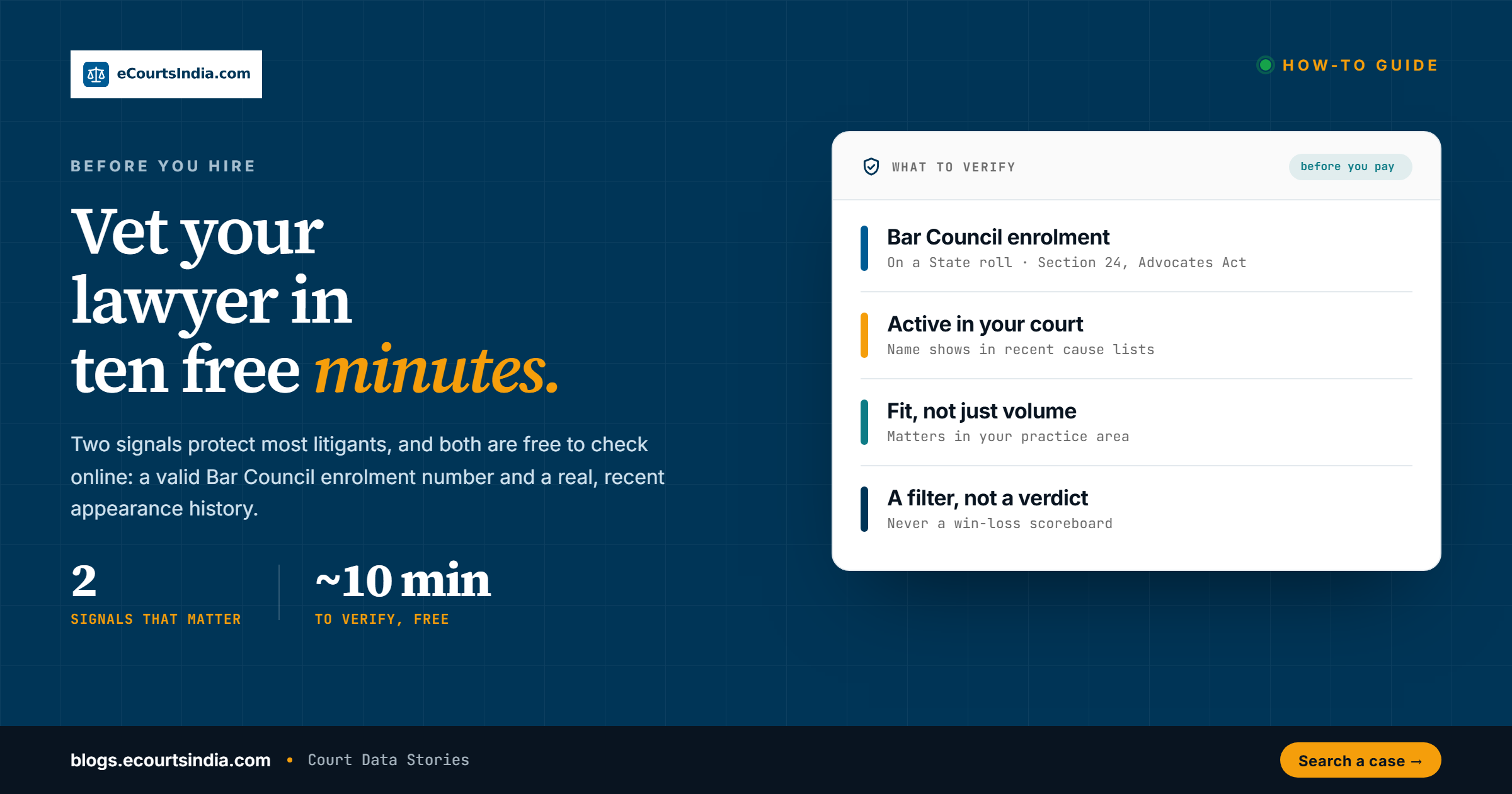
- Treat the record as a filter for who is genuine, active and a fit, never as a win-loss scoreboard.
Why checking the record beats relying on a referral alone
Checking a lawyer’s record means confirming their enrolment and looking at the public court record for the matters they have actually appeared in. Word of mouth is how most Indians choose a lawyer, and it often works, until it does not. A referral tells you that one person had a reasonable experience once. It does not tell you whether the lawyer is currently enrolled, whether they practise in the court that will hear your case, or whether they handle your kind of matter at all.
Indian advocates are not obliged to publish a track record. A lawyer handing you a card at the court gate could have hundreds of matters behind them, or be a first-year junior who has never argued a main matter. The public court record fills those gaps with facts rather than impressions, and it turns a hopeful introduction into an informed decision.
Step one: verify the Bar Council enrolment
Every practising advocate in India must be enrolled with a State Bar Council under Section 24 of the Advocates Act, 1961. Ask for the enrolment number. It usually follows the pattern of a state code, then a running number, then the year of enrolment. For example, D/2134/2012 would mean an advocate enrolled with the Bar Council of Delhi in 2012. The prefix tells you the state council at a glance.
| Prefix (illustrative) | State Bar Council |
|---|---|
| D | Delhi |
| M or MAH | Maharashtra and Goa |
| U, UP or UPBC | Uttar Pradesh |
| KAR | Karnataka |
| TN | Tamil Nadu and Puducherry |
| WB | West Bengal |
| G | Gujarat |
| KER | Kerala |
| P | Punjab and Haryana |
Do not reject a valid number just because the prefix is written slightly differently from what you expected. What matters is that the number resolves to a real entry on a state roll, which you can confirm with the State Bar Council concerned.
There is now a faster first check. If the advocate has a profile on the verified advocate directory, it shows a Verified mark with their State Bar Council and Bar ID, because profiles there are self-declared and then checked against the advocate’s Bar Card. A missing profile proves nothing on its own, since listing is voluntary. A verified one is a good sign that the enrolment is real.
A valid enrolment confirms that the person is on a state roll. It does not, by itself, tell you that they actively practise before the court you need. For that, you move to the court record.
Two directories on eCourtsIndia, and when to use each
eCourtsIndia has two lawyer directories that answer different questions. Readers mix them up all the time, so here is the difference in one table.
| Lawyer directory | Verified advocate directory | |
|---|---|---|
| Address | ecourtsindia.com/lawyer | ecourtsindia.com/advocate |
| Built from | Advocate names as they appear on court records | Profiles the advocate writes, checked against their Bar Card |
| Size | 34 lakh+ names | Over 3,800 verified advocates, growing |
| Best for | Seeing where a name has appeared, in which courts and case types | Confirming enrolment and contacting the advocate directly |
| Verifies enrolment? | No | Yes, against the Bar Card |
| Ratings or paid ranking? | No | No. “We don’t rate, rank, or charge advocates for listing.” |
Using the lawyer directory (/lawyer)
Open ecourtsindia.com/lawyer and type the advocate’s name. Partial names work, so “Sharma” returns every Sharma on the record. You can also browse by state to narrow the list. Open a profile and you see the matters where that name appears as counsel, with the courts, case types and case status of each, and every matter links through to its full case page.

Remember what this directory is. It is assembled from the names typed into court records, so one advocate can appear under several spellings, and two different people with the same name can be merged. That is why it can hold more entries than there are enrolled advocates. Use it to see appearances, not to prove identity.
Using the verified advocate directory (/advocate)
Open ecourtsindia.com/advocate and filter by State Bar Council, Area of Practice and Practising At. Each profile shows the advocate’s bar council and Bar ID, their own description of their practice, their office, the case types and courts they work in, any matters they have linked from the court record, and a Contact button that sends your message to them on WhatsApp or email. Advocates build these profiles for free, and we explain how in our guide for advocates.
Step two: confirm active practice in the right court
Open eCourtsIndia case search and use the Advocate field to look up the name. You can combine it with a court, a case type or a filing year, which is the quickest way to see recent work in the forum that matters to you. The eCourtsIndia Search Guide explains how to combine these fields so your results are clean rather than noisy.
Then check recent cause lists for the court where your matter will be heard. A cause list is the day’s schedule of cases, and the advocate’s name appears next to each listed matter. An advocate who turns up again and again in the relevant court, in the recent past, is demonstrably a current practitioner there. If you have not read a cause list before, our guide to reading one takes five minutes.
Be exact about the court. Benches of the same High Court are separate courts on the record, so the Nagpur bench and the principal seat of the Bombay High Court show up as different entries. If the advocate’s listings in your bench are in single digits or zero, they are not a regular practitioner there, even if their firm’s name is on the boards in that city.

Step three: read the case history for fit, not just volume
Once you can see the record, read it for fit. You are looking for matters in your practice area, in your forum, with reasonable recency. A lot of cheque bounce matters is reassuring if your case is a cheque bounce and far less relevant if you need a writ petition. If a case status looks unfamiliar, our Case Status Dictionary explains what terms like pending, disposed and allowed actually mean, so you do not misread the history.
Four quick checks do most of the work:
- Domain match. An insolvency matter before the NCLT needs someone with a run of NCLT listings, not a long list of traffic challans.
- Court match. Look for your exact court and bench, as above.
- Currency. Look for listings in the last few weeks. A record that has been quiet for six months is a question to ask.
- Volume sanity. An enormous number of active matters is not automatically a good sign. It can mean heavy reliance on juniors for appearances. Ask who will actually argue your case.
A worked example: finding NCLT experience
Say someone recommends a lawyer for an insolvency matter before the Mumbai bench of the NCLT. On the search page, pick the NCLT as the court, narrow to the Mumbai bench, and add the advocate’s name in the Advocate field. If the results show a steady run of company and insolvency petitions over the last year, the recommendation holds up. If they show nothing, ask why. You can run the same search without a name to see which advocates appear again and again on that bench, which is a good way to build a shortlist. Our NCLT and NCLAT guide covers the benches in detail.
Green signals and red flags
Putting it together, here is what to welcome and what to question.

| Green signals | Red flags |
|---|---|
| Valid enrolment number that resolves on the state roll | Refuses to share an enrolment number or Bar Card |
| Verified profile on ecourtsindia.com/advocate | Claims to be listed or “top ranked” somewhere that does not exist |
| Name appears in recent cause lists of your court | No visible appearances in your court in the last six months |
| Case history in your practice area | Promise of a guaranteed result or order |
| Clear written fee note, paid by UPI or bank | Claims of special access to a judge or registry |
| Honest about timelines and likely outcomes | Large cash advance with no written note, or wants original property or bank papers upfront |
What the record cannot tell you
A word of caution so you read the data fairly. The court record shows appearances, orders and dispositions. It does not label a case as won or lost, and that is by design. A matter shown as dismissed may have been withdrawn on strategy. A matter shown as allowed may have come with a costs order that hurt. Outcomes turn on the facts of each case, not only on the lawyer, so a string of favourable orders is not a guarantee for yours.
Public data also cannot tell you about communication, fee transparency, how quickly someone answers a WhatsApp message, or whether they will take a hard matter. Those come from meeting the lawyer, speaking to past clients and trusting your own judgement in the first meeting. The record narrows a shortlist from fifty names to five. You still have to meet the five.

A ten-minute checklist before you sign
- Ask for the enrolment number and Bar Card. Check whether the advocate has a verified profile on ecourtsindia.com/advocate.
- Search the name on ecourtsindia.com/lawyer and in the Advocate field of case search, filtered to your court.
- Scan the last few weeks of cause lists for your court.
- Check the case-type mix against your matter.
- Open two recent orders and read them. You will learn a lot about the kind of work involved.
- Ask for two references from matters disposed of in the last two years.
This takes less than half an hour and replaces a decision most people make on gut feel. It also sets expectations. If a lawyer mostly handles commercial matters and you want them for a family court dispute, you at least know they are stretching into a new area and can talk about it honestly.
Checking a person or company, not a lawyer
Sometimes the question is not “is my lawyer genuine?” but “does this person or business have cases against them?”. For that, use the litigant search, which our Litigant Search Guide explains, or read our background check guide. For a formal, identity-first report on a candidate, tenant or vendor, LegalCheck matches court records to the person rather than to a name, as we describe in the LegalCheck launch post.
Once you have hired, you can track the matter yourself. Add the case to your dashboard and switch on WhatsApp or email alerts, so you hear about a new order or date within minutes of the record changing. Tracking costs Rs 5 per case per month, and every account gets 50 free credits a month. Details are on the pricing page.

Frequently asked questions
How do I check if a lawyer is genuine in India?
Ask for the Bar Council enrolment number and Bar Card, and check whether the advocate has a Verified profile on ecourtsindia.com/advocate, where profiles are verified against Bar Cards. Then search their name in eCourtsIndia case search and scan recent cause lists for your court. A genuine, active lawyer shows real, recent appearances in the court that will hear your matter.
Can I see a lawyer’s past cases online?
Yes. The lawyer directory and the Advocate field in eCourtsIndia case search show the matters where a name appears as counsel, drawn from public records of district courts, High Courts, the Supreme Court and tribunals. Each matter links to its full case page with status and orders. Searching is free and needs no login.
What is the difference between the lawyer directory and the verified advocate directory?
The lawyer directory at ecourtsindia.com/lawyer is built automatically from advocate names in court records and covers 34 lakh+ names, but it does not check enrolment. The verified advocate directory lists profiles that advocates write themselves and that are verified against Bar Cards, with a contact button. Use the first for appearances and the second for identity.
What does it mean if a lawyer has no recent appearances?
It can mean they no longer practise actively in that forum, that they work mainly in a court your search did not cover, or that their name is spelt differently on the record. Try spelling variants and ask them directly. For a matter in a specific court, an advocate with no recent presence there is a weaker fit. See our search guide for tips.
Should I judge a lawyer by their win rate?
No. Court records show appearances, orders and dispositions, not wins and losses, and outcomes depend on the facts of each case. A dismissed matter may have been withdrawn on strategy. Use the court record to confirm a lawyer is genuine, active and a fit for your case type, and rely on the consultation and references to judge quality.
Is it fair to research a lawyer before hiring them?
Completely. Court records are public, and checking enrolment and appearances is ordinary due diligence. A reputable advocate will expect an informed client and will share an enrolment number without hesitation. Many now list a free verified profile themselves, as our guide for advocates explains, precisely so that clients can check them.
In short
- Verify enrolment first: ask for the number and Bar Card, and look for a verified profile on /advocate.
- Use /lawyer and the Advocate field in case search to see real appearances in your court.
- Read the case history for fit with your case type and court, not just for volume.
- Treat the record as a filter for who is genuine and active, never as a win-loss scoreboard.

Sources
- Advocates Act, 1961, Section 24 on enrolment with a State Bar Council.
- eCourtsIndia case search, cause lists, lawyer directory (ecourtsindia.com/lawyer) and verified advocate directory (ecourtsindia.com/advocate), checked 23 September 2026.
- Bar Council of India Certificate and Place of Practice (Verification) Rules, 2015, on verification of practising advocates.
Read next: How to Find a Lawyer in India: Bar Council, Court, and City Search and Your Advocate Profile on eCourtsIndia Is Free.