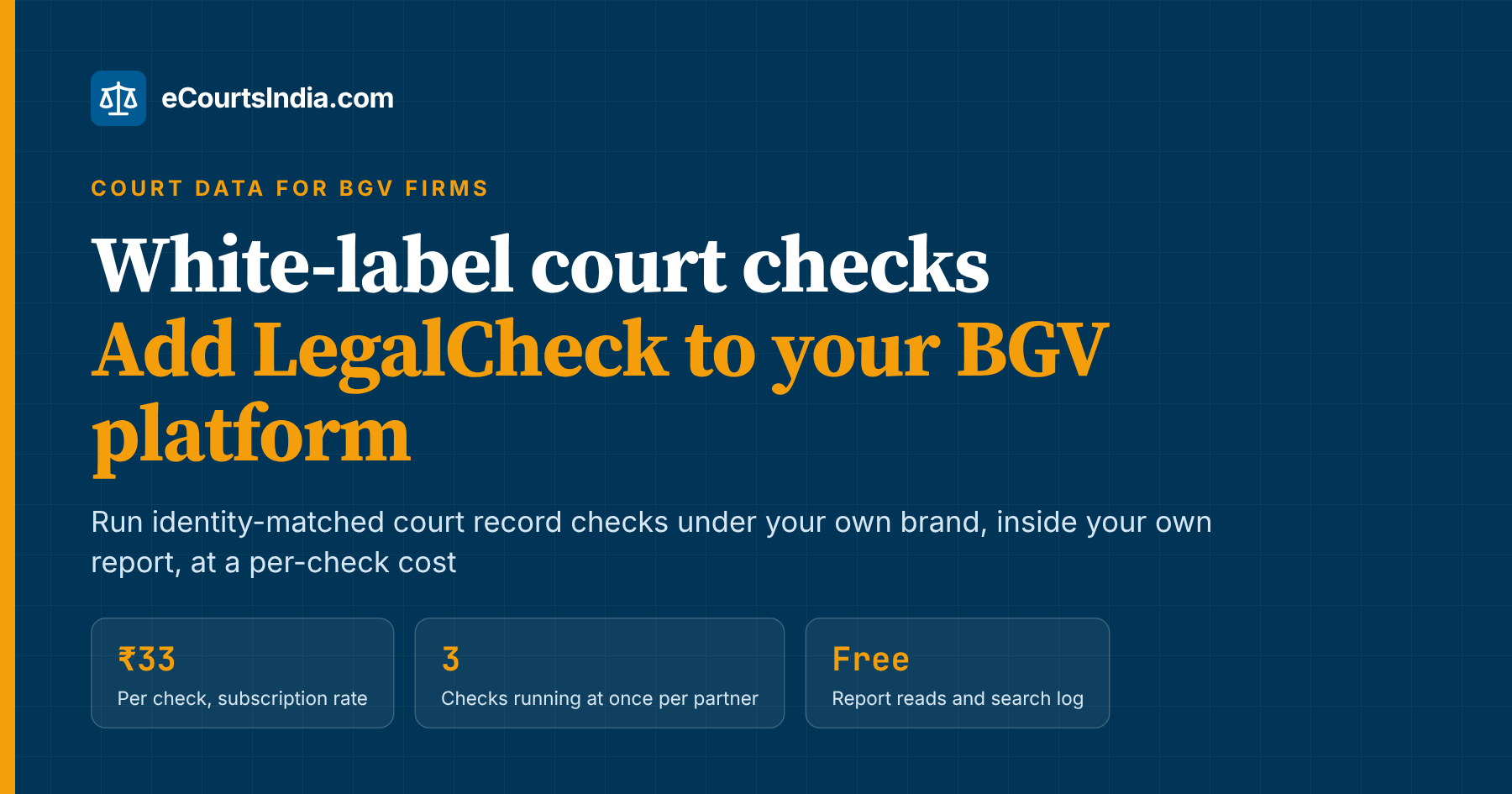
White-label court checks for BGV firms
Every background verification report sold in India has a court record section. Many BGV firms still fill it by hand or through local counsel, which is slow and hard to audit. The LegalCheck API lets a BGV firm run an identity-matched court check from its own platform and present the result in its own report, under its own brand.
Collect the identity fields with consent, submit a check with an idempotency key, read the report when it completes, and map the identity bands into your own clear, review or flag outcome.
API details and prices read from ecourtsindia.com on 15 November 2026.
Last updated: 15 November 2026
Key takeaways
- Cost per check: ₹33 with an active subscription, ₹99 on Pay As You Go, charged once when the job is accepted. Reading the report, the log and the list is free.
- Asynchronous: submit, then poll. A check commonly takes several minutes.
- Concurrency: at most three checks queued or running per partner. Put a queue in front of the API.
- Identity bands: confirmed, probable, possible and excluded. Only confirmed matters drive the headline risk.
- Your brand, our evidence: the report carries the cases, the scoring evidence and a search log you can keep for audit.
Why are BGV firms moving court checks to an API?
Because manual checks are slow, vary by checker, and leave little evidence of what was searched.
A manual court check means someone searching portals court by court, or a lawyer visiting the court and certifying that no case was found in a few courts near an address. It takes days, covers only the courts someone thought to check, and produces a certificate rather than a record of the search. An API check screens the full corpus of district courts, High Courts, the Supreme Court and tribunals, scores each record against the identity you supplied and keeps a step-by-step log of what it searched and why it ruled records out. Our comparison of court checks, police verification and FIR searches explains where each fits.
What does the integration look like?

- Intake. Collect the candidate’s full name, father’s name, date of birth, current and past addresses and any aliases, with consent recorded in your form. Father’s name is the single most useful field, because Indian cause titles carry it.
- Submit. Send the subject to the LegalCheck submit endpoint with your own
client_ref_noand anIdempotency-Key. A retry with the same key and body returns the original job without a second charge. - Queue. Keep no more than three checks queued or running at once. Hold the rest in your own queue and release one as each finishes.
- Read. Poll the status until it is completed, then read the report as JSON. Filter by band or minimum score as you need. Reads are free.
- Report. Map the result into your template and keep the JSON and the search log with the case file.
The full field-by-field reference is in our LegalCheck API guide.
How should identity bands appear in your report?
| LegalCheck band | Meaning | Suggested report outcome |
|---|---|---|
| Confirmed | Tied to the subject by evidence beyond the name | Report the matter, its current status and outcome; send to a reviewer if adverse |
| Probable / possible | Records that share the name but are not resolved to the subject | Do not report as the candidate’s case. Route to a reviewer, who may ask the candidate |
| Excluded | Ruled out | Do not report |
| Unresolved risk band | Records exist under the name but none could be attributed | Not a clean result. Mark as needing review, never as clear |
The most common mistake in court checks is reporting a namesake’s case as the candidate’s. Our post on same name, wrong person shows how often that happens with common Indian names.
How many checks can I run a day?
Plan on the concurrency limit, not on the daily request limit. With three checks running at once and each taking several minutes, a single partner account completes a few hundred checks a day if the queue is kept full around the clock. If your volume is higher, talk to us about your plan before you go live, and spread submissions across the day rather than in one morning batch.
What are the unit economics?
| Item | Per check |
|---|---|
| LegalCheck with an active subscription | ₹33 |
| LegalCheck on Pay As You Go | ₹99 |
| Report, log and list reads | Free |
| Reviewer time for probable or possible matches | Your cost; falls as you collect better identity fields |
For comparison, our court check cost index sets out what Indian employers typically pay for court checks today. If you are choosing a provider, the 25-question RFP checklist lists what to ask about coverage, matching and audit.
What does the criminal caseload look like behind a check?
Large, old and mostly without order text. A court check is a search against this caseload, so it helps to know its shape. On 15 November 2026 our index held 3,32,18,317 pending criminal case records in district courts under case type CC, the code most magistrate courts use for complaints and police cases.
| Filed in | Pending CC records | Share |
|---|---|---|
| 2025 or 2026 | 1,30,07,867 | 39.2% |
| 2020 to 2024 | 1,28,73,672 | 38.8% |
| 2015 to 2019 | 45,57,861 | 13.7% |
| 2010 to 2014 | 15,63,669 | 4.7% |
| Before 2010 | 12,15,248 | 3.7% |
| All pending CC records | 3,32,18,317 | 100% |
Two numbers matter for a BGV firm. About 22% of these pending matters were filed before 2020, so a candidate’s case from years ago can still be live; a check that only looks at recent filings will miss it. And only 40,85,171 of them, about 12%, carry any order text. Most hits will be a case record with parties, court, dates and the sections charged, not a readable order. Your report template should present that clearly rather than imply that an order was read.
Which laws do these cases cite?
| Act | Pending CC records citing it | What it usually means in a report |
|---|---|---|
| Indian Penal Code, 1860 | 46,60,801 | Offences before 1 July 2024; read the sections |
| Negotiable Instruments Act, 1881 | 19,79,189 | Mostly cheque dishonour complaints; financial, not violent |
| Bharatiya Nyaya Sanhita, 2023 | 13,49,107 | Offences on or after 1 July 2024 |
| Motor Vehicles Act, 1988 | 11,52,535 | Traffic offences; relevance depends on the role |
| Payment and Settlement Systems Act, 2007 | 5,65,912 | Electronic payment mandate dishonour complaints |
| Arms Act, 1959 | 2,98,701 | Weapons offences |
| Dowry Prohibition Act, 1961 | 1,91,772 | Matrimonial complaints |
The table is a useful reminder that “criminal case” covers very different things. A cheque dishonour complaint and a weapons charge both sit under CC. A good report names the Act and section, says whether the matter is pending or decided, and leaves the judgment about relevance to the client’s written policy, not to the word “criminal”.
A report layout that holds up to challenge
- Subject and inputs: the identity fields searched and the date of the search.
- Coverage: the courts and court levels searched, from the search log.
- Confirmed matters: CNR, court, case type, Act and section, filing date, status and, if decided, the outcome from the order.
- Unresolved name matches: a count only, marked for review, never listed as the candidate’s cases.
- Outcome: clear, review or flag, with the reason in one line.
- Limits: a short statement that this is a search of public court records, not a police clearance.
Clients who run hiring on an applicant tracking system can trigger the check from the offer stage; our ATS and HRMS integration guide shows the flow. For consent, retention and correction, see our note on court data and the DPDP Act.
What will your clients ask about compliance?
- Consent and purpose: record the candidate’s consent and the purpose of the check. Pass the purpose in the submit call so it is recorded on the report.
- Retention: keep the report for as long as your contract and the law require, then delete it.
- Adverse action: a confirmed pending case is not a conviction. Clients should follow a written policy and give the candidate a chance to explain before acting. Our note on undisclosed cases and the DPDP Act covers the employer side.
- Not a certificate: the report is evidence of a search of public records, not an identity certificate or a police clearance.
Sources and method
- LegalCheck endpoints, bands, concurrency and idempotency from ecourtsindia.com/api/docs; prices from /api/pricing, read 15 November 2026.
- Report outcomes in the band table are a suggested practice for BGV reports.
Frequently asked questions
Can a BGV firm white-label the LegalCheck court check?
Yes. The API returns the result as JSON with evidence and a search log, which a BGV firm can map into its own report and brand. Talk to us about partner terms.
How much does a court check cost through the API?
₹33 per check with an active subscription and ₹99 on Pay As You Go, charged once when the job is accepted. Reading the report and log is free.
How long does a LegalCheck take?
Commonly several minutes. It is asynchronous: submit, poll the status and read the report when it is completed.
How many checks can run at once?
At most three checks queued or running per partner. Put your own queue in front of the API and release a new check as each one finishes.
Should a possible match go in the report?
Not as the candidate’s case. Probable and possible matches share the name but are not tied to the candidate; route them to a reviewer instead.
How many criminal cases are pending in Indian district courts?
Our index held 3,32,18,317 pending district court records with case type CC on 15 November 2026. About 22% were filed before 2020.
Will a court check always include the order?
No. Only about 12% of pending CC records in our index carry order text. Most hits are case records with parties, court, dates and sections, so say so in the report.
Is a cheque bounce case a criminal record?
It is a criminal complaint under the Negotiable Instruments Act, and 19,79,189 pending CC records cite that Act. Report it with its Act and status and let the client’s policy decide relevance.
Important: This guide is published by Billion Insights Ventures Pvt. Ltd., the company behind eCourtsIndia. It is not legal advice. Court data shown here is a copy of public court records as read on the date stated at the top of this page and is not a certified copy. A name match is not identity, a pending case is not guilt, and a disposed case is a status, not an outcome. Prices, limits, counts and examples were checked on that date and can change. eCourtsIndia is a private legal-technology platform and is not affiliated with any court, the e-Committee of the Supreme Court or the Government of India. Found an error? Write to support@ecourtsindia.com.


