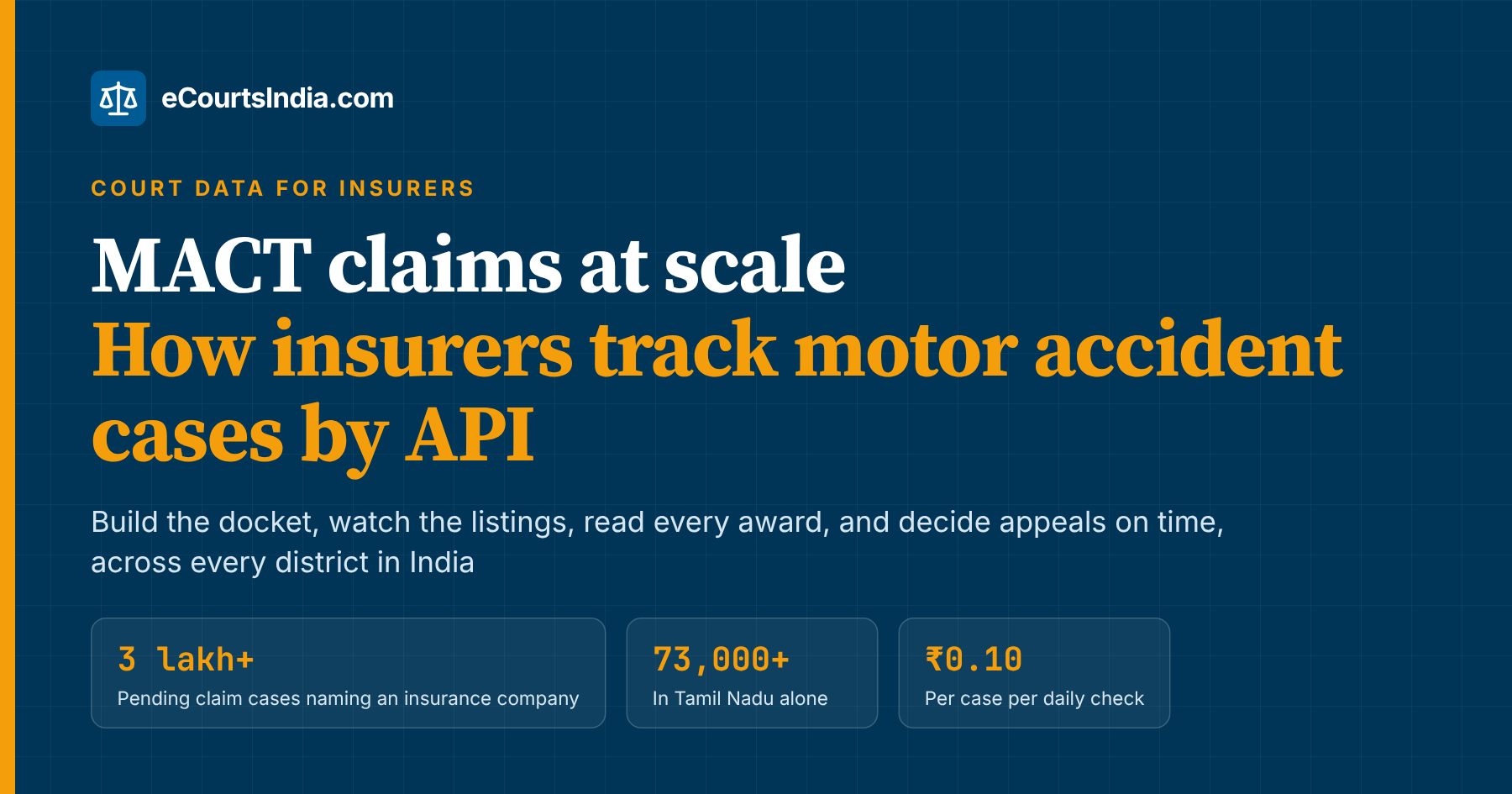
MACT claims at scale: how insurers track motor accident cases by API
General insurers are named as respondents in more than 3 lakh pending motor accident claims in India’s district courts. Each claim runs in a Motor Accident Claims Tribunal in some district, on its own schedule, with its own panel advocate. Missing a listing or the window to appeal an award costs real money. Court data APIs let a claims team see the whole docket in one place.
Search by insurer name and claim case types to build the docket, check listings daily by CNR, read every new award with Order + AI, and route appeal decisions before time runs out.
Counts from a live search on 15 November 2026. Rounded down and dated.
Last updated: 15 November 2026
Key takeaways
- Scale: 3,07,627 pending district court claim cases (case types MACA and MCOC) had a respondent whose name includes “Insurance Company” on 15 November 2026. That is a floor, not a ceiling.
- Where: Tamil Nadu leads with 73,000+, then Madhya Pradesh, Kerala, Karnataka and Maharashtra.
- Recent: most pending claims were filed from 2023 onwards.
- Four jobs: build the docket, watch listings, read awards, decide appeals.
- Cost: about ₹0.10 per claim per daily listing check and ₹2.50 per award read at the Enterprise base rate.
How many motor accident claims name an insurer?
At least 3 lakh pending cases in district courts, on one conservative search.
On 15 November 2026 we searched district courts for pending cases of the two claim case types our data uses for these matters, MACA (Motor Accident Claims) and MCOC (Motor Vehicle Compensation Case), where a respondent’s name contains both “Insurance” and “Company”. Sorting by filing date gave an exact count: 3,07,627. Names typed as “Insurance Co. Ltd.” or with the insurer’s brand only are not all caught, so the true number is higher.

The filing-year breakdown shows how recent the pile is: about 35,000 of these pending cases were filed in 2023, 58,000 in 2024, 87,000 in 2025 and 80,000 in 2026 up to mid-November. Older claims are fewer because many have been decided, settled or sent to Lok Adalat. A different query, a full-text search for “Motor Accident” with an insurer as respondent, finds more than 1.8 lakh records; the two searches overlap but catch different spellings, which is why claims teams should build their docket from several queries and de-duplicate by CNR.
Job 1: how do you build the docket?
Search by the insurer’s names and the claim case types, state by state, and keep every CNR.
- List every way your company is named in cause titles: full legal name, short name, old names before a merger, “Divisional Manager” and “Branch Manager” forms.
- Run Case Search for each name with
caseTypes=MACA,MCOC,courtLevels=DCand the states you write business in. Use the facets to see the split by state and year before you page through. - Check the case type facet of a broad search too: some courts register claims under other codes.
- De-duplicate by CNR and match each case to your claim number using the policy, vehicle and accident details in the case.
Add High Court appeals separately: an award appealed by either side moves to the High Court, where the case type and court code differ.
Job 2: how do you watch listings?
Check every pending CNR against upcoming cause lists each day, and refresh the ones whose dates have passed.
The CNR cause-list batch check takes up to 100 CNRs and tells you which are listed, where and for what, across the 8,000+ district and taluka courts we hold lists for. Send each listing to the panel advocate the evening before. For claims whose next date has passed with no listing, queue a case refresh to pick up the adjourned date.
Job 3: how do you read awards quickly?
When a claim moves to disposed, read the award with Order + AI and route it.
The Court Order Summary API returns a summary of the award, the outcome and the directions, alongside the full text. A claims handler can see at once the compensation awarded, the interest, the liability finding and any direction on recovery from the owner. Always read the full award before acting: an AI summary is a triage tool, not a substitute for the document.
Job 4: how do you decide appeals on time?
Start the clock from the award date in the record, not from when the panel advocate reported it.
The decision date on the case record and the date on the order give you the start of the limitation period for an appeal. A daily check that flags every newly disposed claim, with its award summary, gives the legal team the most time to decide whether to appeal, settle or pay. Pair it with your own rules: award above a threshold, liability disputed, contributory negligence ignored, or an issue the insurer is pressing as a matter of policy.
What do the statute’s deadlines mean for a claims team?
Two clocks matter, and both are short. We read both provisions in the statute text on 15 November 2026.
| Provision | What it says | What the claims team should do |
|---|---|---|
| Section 166(3), Motor Vehicles Act | A claim must be made within six months of the accident; the Tribunal may admit it within a further twelve months for sufficient cause | Flag claims filed outside six months and check whether the delay was condoned |
| Section 173(1) | An appeal against an award lies to the High Court within ninety days of the award; the party required to pay must deposit ₹25,000 or half the amount awarded, whichever is less | Start the 90-day clock from the award date in the record and budget the deposit |
| Section 173(2) | No appeal lies if the amount in dispute in the appeal is less than one lakh rupees | Filter out awards where the disputed amount is below ₹1 lakh before referring for appeal |
How many claims are decided each year?
Between 1.5 and 2 lakh in a typical year. Our index holds 33,42,083 district court claim cases under the MACA label, of which 27,17,562 are disposed and 6,24,521 pending. Counting the disposed ones by year of decision shows a steady flow of awards, with a sharp dip in 2020.

For an insurer, the useful figure is the flow, not the stock. At 1.5 to 2 lakh MACA decisions a year, the country produces roughly 3,000 to 4,000 claim awards a week, and a large insurer is a respondent in a good number of them. That is the volume the award-reading step in Job 3 has to handle, and the reason to read every new order by machine and route only the adverse ones to people.
How long did claims decided in 2025 take?
| Time from filing to award | MACA cases decided in 2025 | Share |
|---|---|---|
| Up to two years | 87,395 | 57% |
| Two to five years | About 43,000 | About 28% |
| More than five years | 23,726 | 15% |
| All decided in 2025 | 1,54,292 | 100% |
Under section 171 of the Act, a Tribunal can award interest from a date as early as the date of the claim, so a long-running claim can cost more by the time it is decided. A docket that shows each pending claim’s age lets the claims team spot the old ones and look at settlement before the award, for example at a Lok Adalat; our National Lok Adalat guide explains how those sittings work. To keep the docket current without re-reading every claim, use the weekly routine in our portfolio monitoring guide.
What does a claims docket cost?
| Item | Volume (illustration) | Enterprise | PAYG |
|---|---|---|---|
| Daily listing check | 10,000 pending claims × 22 working days | ₹22,000 | ₹66,000 |
| Refresh of stale claims | 1,000 a day × 22 days | ₹1,100 | ₹3,300 |
| Award reads | 500 new awards a month | ₹1,250 | ₹3,750 |
| Docket rebuild searches | 200 searches a month | ₹40 | ₹120 |
For annual plans and custom volume pricing, write to hi@ecourtsindia.com. The court data API for business hub covers the other industries.
What should insurers be careful about?
- Claimants are private individuals. Use their data for handling the claim, keep access to the claims team and do not reuse it for marketing or profiling.
- A name match is not your claim. Confirm each case against policy and accident details before you act on it.
- Coverage gaps. Cause lists cover district and taluka courts, not High Courts. Read High Court appeal dates from the case record.
Sources and method
- Live search through the eCourts MCP on 15 November 2026: case types MACA and MCOC, district courts, status pending, respondents “Insurance Company”, sorted by filing date, with state and filing-year facets.
- Case type labels from the live enums. Prices from ecourtsindia.com/api/pricing, read 15 November 2026.
Frequently asked questions
How many motor accident claim cases involve insurance companies?
A search on 15 November 2026 found 3,07,627 pending district court claim cases with a respondent named as an insurance company. Spelling variants are not all caught, so the real number is higher.
Which states have the most pending motor accident claims against insurers?
Tamil Nadu leads with more than 73,000, followed by Madhya Pradesh, Kerala, Karnataka and Maharashtra, on the 15 November 2026 search.
How can an insurer track MACT cases automatically?
Build the docket with Case Search by insurer name and claim case types, check listings daily with the CNR cause-list batch, refresh stale cases and read new awards with Order + AI.
Can the API read a MACT award?
Yes. Order + AI returns a summary, outcome and directions with the full text. Use it to triage awards and read the full award before acting.
Does it cover High Court appeals against awards?
Case records and orders, yes. Cause lists, no: the cause-list data covers district and taluka courts, so read High Court dates from the case record.
What is the time limit to appeal a MACT award?
Ninety days from the award, to the High Court, under section 173(1) of the Motor Vehicles Act. The paying party must deposit ₹25,000 or half the award, whichever is less, and no appeal lies if the amount in dispute is under ₹1 lakh.
How many motor accident claims are decided each year?
Between about 1.5 and 2 lakh MACA cases a year in district courts in our index, with 1,54,292 decided in 2025 and a dip to 94,997 in 2020.
How long does a motor accident claim take?
Of MACA cases decided in 2025, 57% were decided within two years of filing and 15% took more than five years, in our index.
Important: This guide is published by Billion Insights Ventures Pvt. Ltd., the company behind eCourtsIndia. It is not legal advice. Court data shown here is a copy of public court records as read on the date stated at the top of this page and is not a certified copy. A name match is not identity, a pending case is not guilt, and a disposed case is a status, not an outcome. Prices, limits, counts and examples were checked on that date and can change. eCourtsIndia is a private legal-technology platform and is not affiliated with any court, the e-Committee of the Supreme Court or the Government of India. Found an error? Write to support@ecourtsindia.com.


