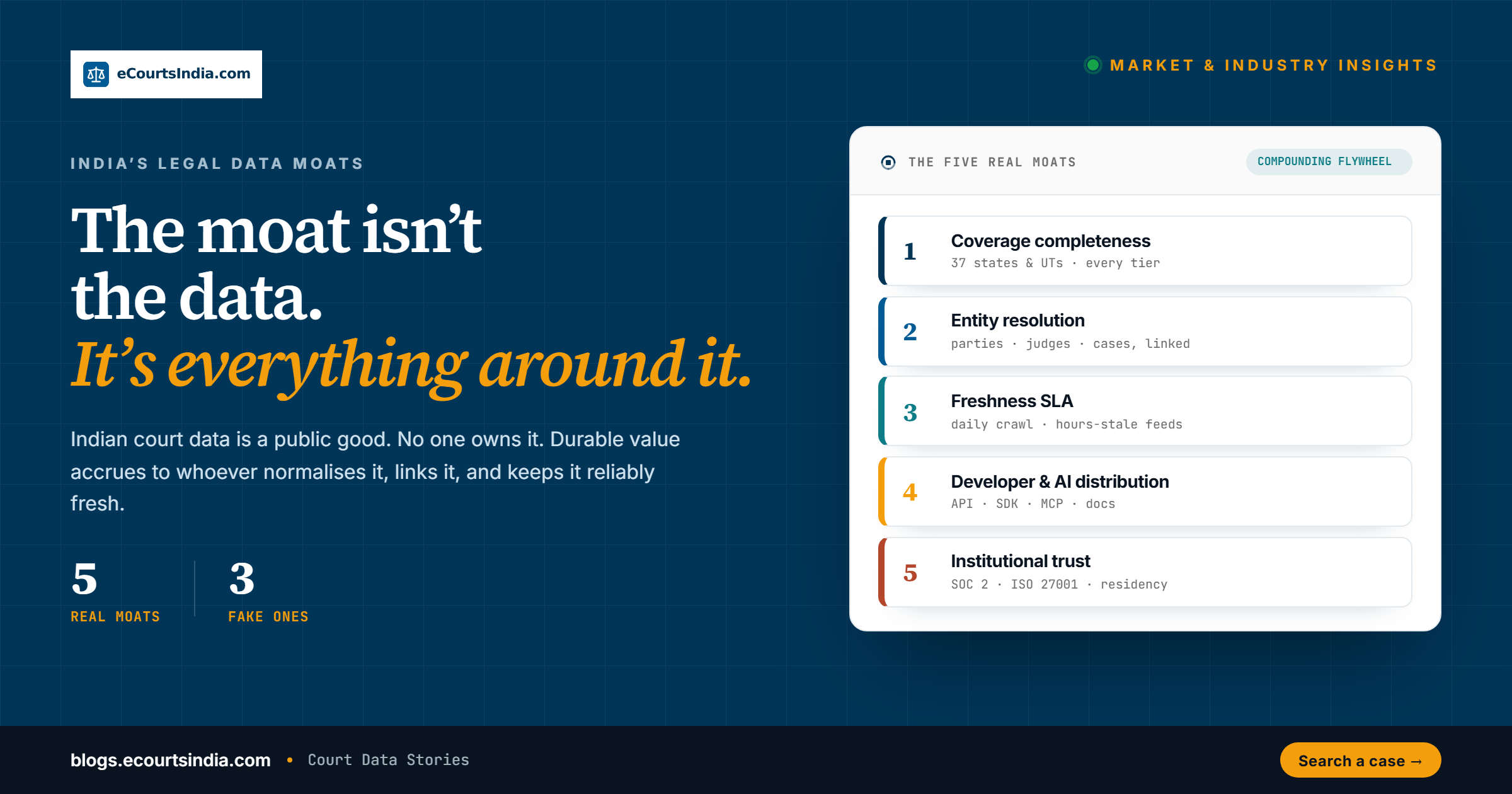
India’s durable legal data moats come from coverage completeness, entity resolution at scale, freshness SLAs, developer and AI distribution, and trust with institutional buyers, not from owning the public court data itself. The raw eCourts data is free for anyone to crawl, so lasting value accrues to whoever normalises, links and keeps it reliably fresh.
In every large data market, the question that separates winners from visitors is the same: where is the moat, and who is allowed to have it. In Indian legaltech, this question is unusually sharp. The underlying data is a public good, produced by the eCourts system and the Supreme Court eCommittee. No one owns it. And yet, durable businesses will get built on top of it. The question is what the moats look like, and how to tell a real one from a cosmetic one.

This is the closing post of a long series on Indian legaltech from a VC, founder, and operator lens. It pulls together the threads from every earlier post into a single framework for thinking about moats. If you read only one post in this series, start with the layer-stack post. If you read two, pair it with this one.

The five real moats
- Coverage completeness. Most aggregators cover some states, some courts, some tiers. True national coverage across all 36 states and union territories, including taluka courts and specialised tribunals, is rare and expensive to maintain. Once achieved, it is a hard moat.
- Entity resolution at scale. Clean, de-duplicated linking of parties, judges, and cases across millions of records. Requires graph-level data work, ongoing investment, and patience.
- Freshness SLA. Daily crawl, hours-stale feeds, near-real-time change detection, and dependable update delivery (for example, email and messaging alerts the moment a tracked case moves). Enterprise customers care about this more than any other dimension once they reach production usage.
- Developer and AI distribution. API quality, SDK ergonomics, MCP support, documentation, and the network of products built on top. This is a compounding moat because every integration makes the next one easier.
- Trust with institutional buyers. SOC 2, ISO 27001, data residency, audit trails, and an enterprise security posture. Not a glamorous moat, but it is often the deciding factor on a procurement committee.
The three fake moats
Moats that sound impressive in a deck but do not hold up to pressure.
- Proprietary access to public data. If the data is public, it is public. Claiming exclusivity on court data, which is by definition publicly accessible, is not a real moat.
- Celebrity lawyer endorsement. Useful for initial credibility, but does not translate into enterprise procurement wins or developer adoption.
- Pretty UI. UI is necessary but not sufficient. A beautiful interface without the underlying data reliability is a liability the first time a lawyer misses a hearing.
How the moats compound
The five real moats are not independent. They reinforce each other.
- Coverage completeness drives entity resolution quality, because more records help the resolution algorithm.
- Entity resolution drives freshness value, because stale data on a well-linked entity is more useful than fresh data on a fragmented record.
- Freshness drives developer adoption, because builders trust sources that stay current.
- Developer adoption drives enterprise trust, because procurement committees look for “who else is building on this.”
- Enterprise trust funds further coverage investment, closing the loop.
This is the positive flywheel that a data infrastructure company tries to build. It is the same flywheel that Bloomberg built in finance, that Stripe built in payments, that Mapbox built in geospatial, that Plaid built in banking data. The exact shape differs. The underlying pattern is the same.
Where the moats are not
Being equally honest about where durable moats are not likely to emerge in Indian legaltech.
- Foundation models. Anyone can swap models. Not a moat for legaltech builders.
- Surface-level prompt engineering. Early differentiator, commoditised fast.
- Single-jurisdiction apps. A great Delhi High Court tool is an app, not a platform.
- Regulatory advantage via exclusive government tender. Government tenders change hands every cycle. Not a durable moat.
A rubric for founders and investors
When evaluating an Indian legaltech company, five questions separate signal from noise.
- What is your actual coverage footprint? Not “supported,” actual. How many of the 36 states and union territories. How many district courts. Which tribunals.
- What is your freshness SLA? In hours, not in prose. How do you handle state-specific feed lags.
- How do you resolve entities? Show me two records for the same party and tell me how you linked them.
- Who builds on you? Show me the API reference. Show me the SDKs. Show me the MCP. Show me five customers integrated in production.
- Are you SOC 2 and ISO 27001 compliant? If not, what is the timeline, and what is your plan for data residency.
These questions cut through marketing. Any infrastructure company worth its price will answer them specifically. Any one that dodges is telling you something.

What this means for eCourtsIndia
We have tried to build on each of the five real moats from day one. National coverage across 36 states and union territories. Entity resolution across 17 crore+ (178 million+) case records and growing, plus millions of advocate profiles. Daily freshness. Developer-grade REST API and MCP. Enterprise compliance posture. None of these is finished. All of them are in motion, and they reinforce each other.
The next decade of Indian legaltech will reward operators who build in the unglamorous places. Crawl stability. Schema discipline. Freshness SLAs. Developer docs. Enterprise security. That is where durable value accrues. The applications and agents that win in 2030 will run on top of infrastructure that someone decided to build in 2025.
If you are investing in, building with, or researching Indian legaltech, start with eCourtsIndia.com. The REST API and MCP are designed to be the data primitive you can trust.
Related reading
- Mapping India’s Court Data Stack
- The Bloomberg Terminal Analogy
- The AI Agent Layer for Indian Law
- Public Data, Private Experience: A Manifesto
Sources
- Academic and industry writing on data infrastructure moats (Bloomberg, Stripe, Plaid comparables)
- eCourts Services Portal, ecourts.gov.in
- eCourtsIndia.com coverage and product architecture, April 2026
What a Data Moat Actually Means
A data moat is the gap between what a platform can do because of its data and what a new entrant can do on day one. In consumer products, the moat is built by user generated content. On Google Maps it is the local reviews. On LinkedIn it is the career history. In legal data, the moat is built by accumulated, normalised, cross linked records of cases, judges, counsel and orders spanning years. A platform that has five years of this depth can answer questions no fresh entrant can answer no matter how well funded.
The Indian legal data moat has two unusual properties. First, the raw data is public. Anyone can technically crawl the eCourts ecosystem. Second, the normalisation cost is huge because the schema is inconsistent and the formats change without notice. So the moat is not about access. It is about the years of engineering, QA and customer feedback that go into making the data reliably usable. That kind of moat is not visible in a pitch deck but it shows up the first time a lawyer tries an alternative product and realises that half the searches return nothing useful.
The Four Layers of a Defensible Moat
A defensible legal data moat has four layers. The crawl layer keeps pace with the sixty plus portals across India. The normalisation layer resolves case types, party names, judge names and court hierarchies into a consistent schema. The enrichment layer adds summaries, entity tags and citation graphs to raw orders. The application layer exposes all of this through workflows that a lawyer actually uses daily. A competitor needs to match all four layers to win. Matching one or two leaves the user with a product that looks good in a demo and fails in real work.
Of these layers, normalisation is the quiet giant. When the Punjab and Haryana High Court publishes a case type as CM(M) and the Bombay High Court uses MA, the raw data looks different but the concept is the same. Making the user see one concept regardless of court takes thousands of engineering hours and continuous maintenance. That is the real work and it compounds. For context on how these layers stack up across the Indian legal tech landscape, see our analysis of mapping the India court data stack.
Why Copy Pasted Data Is Not a Moat
Some new entrants think they can avoid the hard work by licensing data from an intermediary. This strategy fails for three reasons. One, the intermediary usually offers only a slice of coverage and the moment the user asks for a court outside that slice, the product breaks. Two, the intermediary’s schema does not exactly match the product’s needs, so a fragile transformation layer has to be built. Three, the intermediary can change pricing at will, which destroys unit economics overnight. Real moats are built on owned infrastructure, not on data leases.
The Zerodha lesson discussed in our Zerodha playbook piece applies here too. The companies that win the long game in Indian financial services built their own infrastructure for order routing, clearing and risk. The companies that rented infrastructure from the big broker backends struggled when their costs rose. Indian legaltech will look similar. The winners will own the crawl, the normalisation and the enrichment, and the rest will be application features on top.
Partner Relationships as a Soft Moat
Beyond pure data, there is a soft moat built through partnerships. Integration with bar councils. Formal relationships with tribunals. Data licenses to fintech and BGV players. Research collaborations with academics. Each of these adds a piece of coverage that is hard to replicate and each also pulls the platform closer to the institutions that produce the data. Over time, these partner relationships feed back into better product because the platform learns what the institutions care about and adjusts accordingly.
This kind of moat cannot be built in a year. It requires real operational patience. But once built, it is extraordinarily resistant to being copied because it is not written down anywhere. It exists in the working relationships between product teams, content teams and institutional counterparts. When a large legaltech exit eventually happens in India, the acquirer will buy these relationships as much as the code base.
Protecting the Moat as the Ecosystem Matures
As the eCourts ecosystem itself matures, some of the moat becomes public utility. Faster order uploads from courts, cleaner data exports, standardised APIs all reduce the engineering gap. The serious platform response is to move up the stack. More analytics. Better summaries. Workflow integrations with calendars, DMS and billing systems. The ones who keep investing in value above the commoditised layer will hold on to their customer base. The ones who rest on the crawl advantage alone will find themselves overtaken as the underlying data itself becomes easier for everyone to access.
Frequently Asked Questions
What is a legal data moat?

A legal data moat is the gap between what a platform can do because of its accumulated data and what a fresh entrant can manage on day one. In Indian legal data it is built from years of normalised, cross linked records of cases, judges and counsel. You can see that depth in action on eCourtsIndia search.
What are the five real moats in Indian legaltech?
The five real moats are coverage completeness across all states and tribunals, entity resolution at scale, a strong freshness SLA, developer and AI distribution, and trust with institutional buyers. They reinforce each other in a flywheel rather than standing alone. Explore how broad coverage looks across judges and benches on eCourtsIndia judge research.
Why is proprietary access to public court data not a real moat?
If court data is public, exclusivity over it is not a real moat. Anyone can technically crawl the eCourts ecosystem. The durable advantage is the engineering, QA and customer feedback that make the data reliably usable, not access itself. Try a live case lookup on eCourtsIndia to see normalised public records in practice.
Why is data normalisation so important?
Normalisation resolves inconsistent case types, party names, judge names and court hierarchies into one consistent schema, so a user sees a single concept whatever the court calls it. It takes thousands of engineering hours and constant maintenance. We unpack the layered data stack in our piece on mapping the India court data stack.
How does eCourtsIndia build its moat?

eCourtsIndia builds on all five real moats: national coverage across 36 states and union territories, entity resolution over crores of case records and lakhs of advocate profiles, daily freshness, and a developer grade API and MCP. Builders can start with the eCourtsIndia API to integrate court data in production.