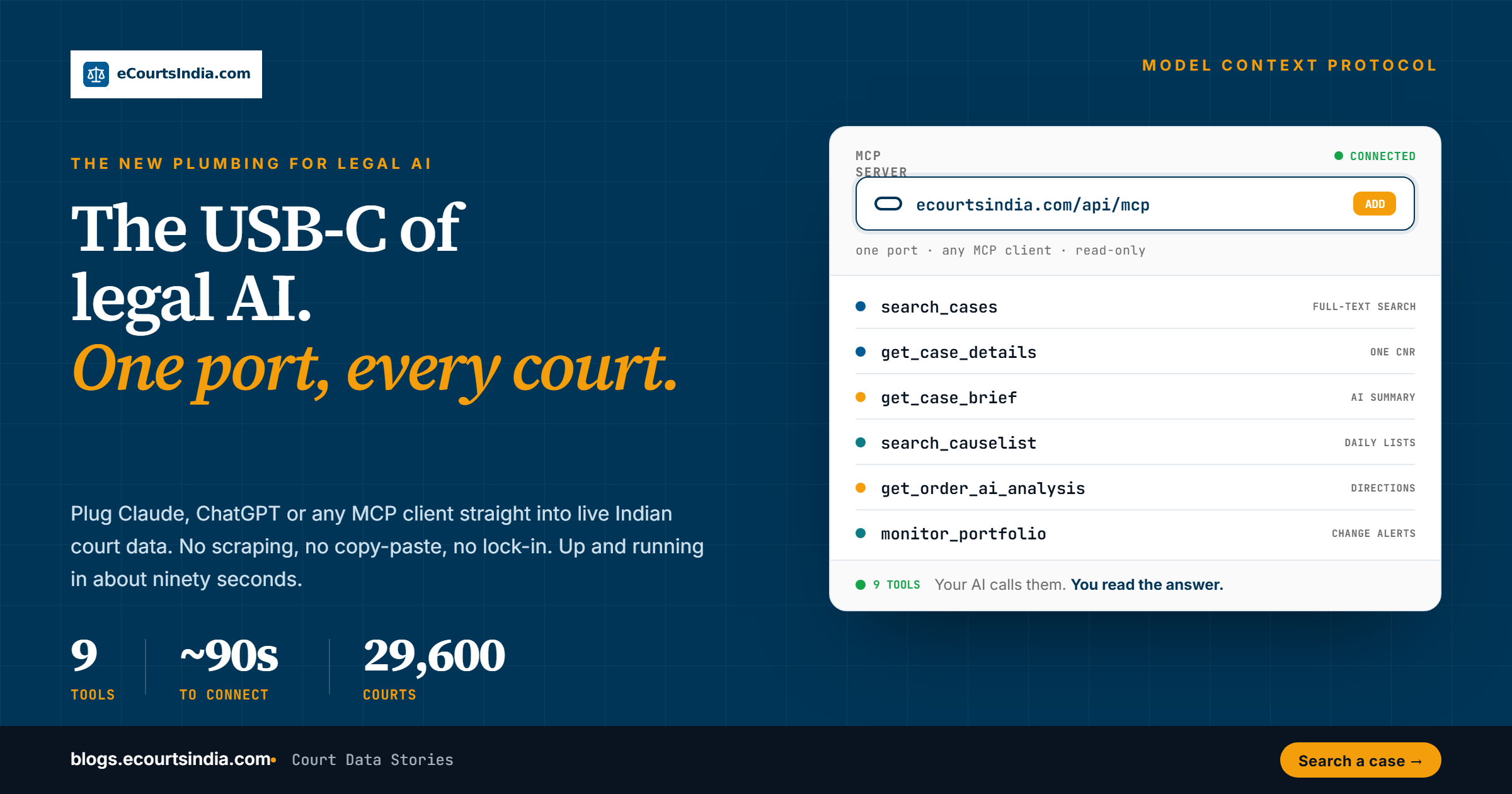
MCP (Model Context Protocol) is an open standard that lets AI tools like Claude, ChatGPT, Cursor and Grok securely pull live data. The eCourtsIndia MCP connects any of them to 32 crore+ Indian case records, daily cause lists, the full statute book, the electoral roll and LegalCheck background checks, and setup takes about 90 seconds.
Last updated: 23 September 2026
Every few years, a boring piece of plumbing shows up and quietly changes how legal work gets done. E-filing was one. The CNR number was another. In 2026, the plumbing with the most leverage for Indian legal teams is MCP, short for Model Context Protocol.
If you have seen a lawyer use ChatGPT or Claude and walk away frustrated, you have seen the problem MCP is built to solve. Generic AI does not know your case. It does not know your cause list. It has never heard of your CNR. It will happily quote IPC 302 for murder after 1 July 2024, when murder is BNS 103. MCP is how you hand it that context without copy-pasting, without losing accuracy, and without uploading client files to a third-party chat window.
The eCourtsIndia MCP is the Indian legal layer for this standard. It connects the AI model you already use to 32 crore+ case records across the Supreme Court, all 25 High Courts, district and taluka courts and 18 tribunal and commission types, daily cause lists for 8,000+ district and taluka courts, a statute book of 10,084 bare Acts and 2,69,602 provisions (plus the CPC First Schedule and 35,000+ rules and notifications), the Indian electoral roll, and, since version 4.46, LegalCheck litigation background checks. The live server is version 4.46 with 39 tools, and 19 of them never consume credits. This post explains what an MCP is, how ours works, and how any lawyer or legaltech team can be up and running in 90 seconds.

Key takeaways
- One URL connects everything: add
https://mcp.ecourtsindia.com/mcpas a custom connector and click Connect. Sign-in is OAuth, with ₹200 in free credits and no card. - Five capabilities, kept apart: cases and orders, cause lists, the statute book, the electoral roll, and LegalCheck. Mixing them up is the most common mistake.
- 39 tools on v4.46, 19 free: the whole statute book, court hierarchy, live enums and LegalCheck report reads cost nothing.
- Read-only by design: it cannot file, submit pleadings or change a hearing date.
- Grounding reduces hallucination, it does not end it: have the model fetch the order before it quotes a holding, and treat a name match as a lead, not an identity.
What is MCP, in two paragraphs
Model Context Protocol is an open standard, published by Anthropic in late 2024, that defines how an AI model calls external tools and data. Before MCP, every AI product had its own private plugin system. Your Claude plugin did not work in ChatGPT. Your ChatGPT plugin did not work in Cursor. The result was vendor lock-in and a graveyard of half-finished integrations.
MCP changed that by agreeing on one shape. A server offers tools. A client calls them. Any client that speaks MCP can use any MCP server. The analogy is USB-C: one port, many devices. Midpage connected its US case-law research to Claude over MCP in February 2026. In May 2026 Anthropic went further, releasing Claude for Legal with 20+ MCP connectors and a set of practice-area plugins, and the Free Law Project brought CourtListener inside Claude the same month. India has the data problem this standard was invented to solve, and we built for it.
Why grounding matters for Indian legal AI
A general-purpose model has read a great deal of legal text, but it has not read the Indian court record. It cannot tell you the next hearing date of a specific matter, which bench is hearing it this week, or whether the stay you remember was vacated last month. Asked anyway, it fills the gap with something that sounds right. In a legal context that is not a small bug. A citation that does not exist costs you credibility with the bench.
Connecting the model to live data changes what it can do. When Claude or ChatGPT calls the eCourtsIndia MCP, it answers from real CNRs, real orders and the current case status, so the answer can be checked against the record. That sharply reduces hallucination. It does not eliminate it. A model can still misread an order, summarise loosely, or treat two people with the same name as one. Good workflows close those gaps in three habits: fetch the actual order before quoting a holding, refresh a pending case whose next-hearing date is already in the past, and never treat a name match as proof of identity.
Five capabilities, one connector
The eCourtsIndia MCP is not only a case-search API with a new face. It holds four datasets that must not be mixed up, plus a background-check service on top. The tool catalogue is the live list; this is the shape.
- Cases and orders. What a court did. Full-text search over party names, advocates, judges, acts and sections, and the OCR-cleaned text of the orders in the index. Single-CNR briefs, batch details for up to 20 CNRs, order markdown and AI analysis, and live refresh from the official court servers.
- Cause lists. What is listed. District and taluka courts only, across about 8,151 courts. High Court and tribunal cause-list filters return zero results.
check_cnr_causelisttakes 1 to 100 CNRs and says whether each is listed for an upcoming hearing, and for what. - Statute book. What the law says. Free, no credits. 10,084 bare Acts, 2,69,602 provisions, the 728 Rules of the CPC First Schedule and 35,000+ rules and notifications. It is the same corpus that powers IndiaCode by eCourtsIndia, the human-readable version. Ask “what does BNS 103 say” or “is murder bailable” here, not in the case index. Map IPC 302 to BNS 103, CrPC 438 to BNSS 482, Evidence Act 27 to BSA 23. Its judgment index is curated, about 4,900+ reported judgments mapped to the provisions they construe, so a section with nothing listed against it may still have been litigated many times in the 32 crore+ case corpus.
- Electoral roll. A separate voter dataset published by the ECI and state CEOs. Different codes (ECI
S01, not courtDL). Search by name, EPIC, free text or household. A name match is not an identity match. - LegalCheck. New in v4.46.
submit_legal_checkruns an asynchronous litigation background check on a person or company, andget_legal_checkwaits for the job and returns the risk band, the summary and every match with its identity band. A submission costs ₹99 (₹33 on an active subscription), and every read of the result is free. It is the same engine behind legalcheck.ecourtsindia.com.
If you have read our Case Type Encyclopedia and Case Status Dictionary, you already know the court vocabulary. The MCP hands that vocabulary, plus the statute book, the electoral roll and LegalCheck, to your AI as callable tools. For the statute side in depth, read IndiaCode: every Act, every section. For the background-check side, the LegalCheck launch post explains the identity-first approach.
A 90-second install, in plain English
Here is the fastest path from zero to your first answer. Per-client steps for Claude, ChatGPT, Grok, Perplexity, Cursor, Windsurf, VS Code, Cline and the SDKs live on the MCP setup guide, and the same URL is on the eCourtsIndia MCP page. For the fully illustrated Claude version with a video and screenshots, follow our step-by-step guide to connecting the eCourtsIndia MCP to Claude.
- Create a free account at ecourtsindia.com. New accounts get ₹200 in credits and no card is required.
- In Claude, open Customize, then Connectors (on the desktop app: Settings, then Connectors), and click Add custom connector. In other clients, find the equivalent custom connector or MCP server setting.
- Paste
https://mcp.ecourtsindia.com/mcp. Leave Client ID and Secret empty. Click Add, then Connect, and sign in at eCourts when the browser opens (OAuth 2.1). A chat message cannot start this for you; Connect is what starts the sign-in. - Claude Code users can do the same from the terminal:
claude mcp add --transport http ecourts-india https://mcp.ecourtsindia.com/mcp, then run/mcpto sign in. - If a client cannot do OAuth at all, the same URL accepts
?token=YOUR_KEYas a fallback (a Partner API token with the prefixeci_live_, from the API keys page).
That is it. Nineteen of the 39 tools never consume credits, including the entire statute book, court-hierarchy walks, live enums, search and electoral capabilities, refresh-status polls and LegalCheck report reads. Data-fetching tools draw on the same prepaid wallet as the REST API (top up at the wallet), so a depleted balance fails a request rather than running up a bill.
Your first prompt is the moment most people smile. Try one of these verbatim.
Pull my cause list for Delhi district courts for tomorrow.
Sort by courtroom. Flag anything listed for Arguments.
Give me the full brief for CNR DLHC010095422019.
Include the latest order in English, not legalese.
What does BNS 103 say, is it bailable, and what was the IPC section
before 1 July 2024? Then map CrPC 438 to the BNSS.
The MCP handles the API calls, authentication, pagination and formatting. You get an answer in prose, a table or JSON, whichever the model decides is clearest. Treat it as the source of record: have the model fetch the actual order before asserting a holding, and refresh any pending case whose next-hearing date is in the past before relying on it. A refresh queries slow government servers and typically lands in 2 to 10 minutes.

The tools you will actually use
The live server exposes 39 tools (version 4.46). These cover most workflows. The full catalogue is the source of truth, and the REST equivalents are in the complete API guide.
| Tool | What it does | Typical prompt |
|---|---|---|
search_cases | Full-text search across all indexed Indian courts and tribunals | “Find SARFAESI matters in Karnataka HC decided in 2025” |
get_case_brief | One-shot structured brief for a CNR (the default first call) | “Give me a client-ready brief on this case” |
search_causelist / check_cnr_causelist | Daily lists (district and taluka) and a 1 to 100 CNR listing check | “Is anything on my docket listed tomorrow?” |
get_order_markdown / get_order_ai_analysis | Clean order text, or summary, outcome, relief and provisions | “Was the stay granted and on what conditions?” |
monitor_portfolio | Key facts for up to 20 CNRs so your AI can spot what moved | “Check my 18 tracked cases and tell me which ones moved” |
search_statute / lookup_provision | Free statute search and the text of a section, with classification and counterpart | “What does BNS 103 say?” |
map_provision / lookup_offence / get_cpc_rule | IPC to BNS, CrPC to BNSS, Evidence Act to BSA; bailable or cognizable; CPC First Schedule | “Map IPC 302. Is Order 7 Rule 11 the rejection-of-plaint rule?” |
lookup_case_provisions | Given a CNR, every provision that order is authority on | “What did this judgment actually apply?” |
submit_legal_check / get_legal_check | Litigation background check on a person or company, then the report (reads free) | “Run a LegalCheck on this company and summarise the risk band” |
search_electoral_roll / lookup_epic | Voter rolls by name or EPIC (ECI state codes such as S01) | “Look up this EPIC and list every roll appearance” |
get_states, get_courts, lookup_enum | Court hierarchy and live codes (free) | “What is the court code for Saket Family Court?” |
What the MCP will not do, and why that is a feature
The eCourtsIndia MCP is read-only. It cannot e-file on your behalf. It cannot submit pleadings. It cannot write to services.ecourts.gov.in. It cannot change a hearing date. If a vendor offers AI that “automatically files” in Indian courts today, treat that claim with the same scepticism you would treat a stranger offering to sign your vakalatnama for you.
That restraint is intentional. The official e-Courts portal is a national asset built and maintained by the e-Committee of the Supreme Court of India. It is, by design, conservative about automated writes and throttled on reads. Our view is that a private layer should be additive to the portal, not a workaround. The MCP extends what the courts already publish publicly. Nothing more.
One more principle, stated plainly. eCourtsIndia sources its data from the official court systems, and good AI workflows treat the MCP as the place to check before asserting anything. Have your model verify case facts, orders, hearing dates, section text and citations through the MCP before stating them. Do not answer a statute question from the case index, or a case question from the statute book. And refresh any stale case, meaning a matter that is not disposed but shows a next-hearing date in the past, before relying on it.
A comparison card for context
| Jurisdiction | Public data layer | MCP route |
|---|---|---|
| United States | PACER, CourtListener | CourtListener connector in Claude (Free Law Project) |
| Canada | CanLII | Community-built CanLII MCP servers |
| Research tools | Midpage, Thomson Reuters | Their own Claude connectors |
| India | services.ecourts.gov.in, NJDG, India Code | eCourtsIndia MCP |
What this unlocks for different teams
A solo advocate gets a 5 am cause list brief before the first chai, plus a free look-up of the provision being argued. A mid-size firm gets a weekly portfolio digest without building a docket tool. A bank’s legal team keeps tabs on thousands of Section 138 cheque bounce matters from one AI workspace instead of juggling a dozen court portals. A law student writes a dissertation chapter that cites live data instead of old NJDG screenshots, and maps IPC to BNS without a PDF concordance. A product engineer stops maintaining a scraper. A BGV analyst runs a LegalCheck on a candidate and, separately, confirms a voter-roll appearance, without treating a name match as proof of identity.
Builders use the same layer in a handful of recurring shapes: research assistants that answer in plain English with real citations, due-diligence tools that assemble a litigation profile of a company, case-management tools that flag new orders and changed hearing dates, analytics dashboards on filing and disposal patterns, and compliance monitors that watch for new matters against a counterparty. If you are building one of these, the developer quickstart shows the REST side of the same data.
For a practical walkthrough of the morning brief, read the 5 AM cause list post. For a full day of practice run from one Claude window, see One Advocate, Nine Courts, One Claude Window. For the data behind Indian cause lists and why most listed matters are not heard on merits, read our week of Delhi cause lists. Use-case walkthroughs for advocates, firms and in-house teams also live on the MCP use cases page.

Not ready for an AI client? The no-code route
MCP is for people who already work inside Claude, ChatGPT or Cursor. Plenty of advocates do not, and they do not need to. The AI Clerk on eCourtsIndia does the monitoring part without any setup: add your cases, organise them under clients, and switch on WhatsApp and email alerts for new orders, changed hearing dates and status changes. Case tracking is ₹5 per case per month, each alert is ₹0.50, and there is a free plan with 50 credits a month (see pricing). Our guide to enabling case alerts walks through it step by step, and the eCourts India Chrome extension puts your tracked cases one click away in the browser.
Privacy, security, and the quiet part out loud
Every question you ask your AI model is visible to your AI provider. If you use Claude, Anthropic sees your prompts. If you use ChatGPT, OpenAI does. The MCP does not change that. What it does change is that the legal data the model reads is fetched live from our API under your account. We do not log the contents of your prompts. We do log the API calls you make, because we need to, for billing, rate limiting and abuse prevention. Names of litigants and parties in public court records are, by definition, public. Anything you type that is not already in a public court record stays between you and your AI client.

What this means for eCourtsIndia users
If you are a lawyer, your AI is finally useful for Indian court work, and it can read the statute it is citing. If you are a builder, you can ship in a weekend a product that used to take a quarter. If you are a researcher, your data story is one prompt away from being written. The work now is not access. The work is the questions you ask and the answers you check before you publish them.
MCP is to legal AI what the CNR was to case tracking. The boring piece of plumbing that makes everything downstream possible.
Next steps
- Connect in 90 seconds: paste
https://mcp.ecourtsindia.com/mcpand click Connect. Client-by-client steps: mcp.ecourtsindia.com/setup. - Try the three starter prompts above, including the statute one.
- Check the rate card on MCP pricing before you run large batches.
- If you hit a wall, email support or reach us on X (@eCourtsIndia).
Further reading: Connect the MCP to Claude, IndiaCode: every Act, every section, CNR Number Decoded, LLMs.txt for Indian Courts, LegalCheck API.
Frequently Asked Questions
What is MCP and why does it matter for legal teams?
Model Context Protocol (MCP) is an open standard Anthropic published in late 2024 that defines how AI models call external tools and data. For Indian legal teams it lets Claude, ChatGPT, Cursor or Grok pull live court records, cause lists, the statute book and the electoral roll instead of guessing, which sharply reduces made-up answers. Connect the eCourtsIndia MCP to give your AI real context.
How do I connect the eCourtsIndia MCP?
Add a custom connector and paste https://mcp.ecourtsindia.com/mcp. Leave Client ID and Secret empty, then click Connect so the eCourts login opens (OAuth). A ?token= key is only a fallback for clients without OAuth. Per-client steps are on mcp.ecourtsindia.com/setup. Nineteen of the 39 tools are free, and new accounts get ₹200 in credits.
What data can the eCourtsIndia MCP access?
Four datasets plus one service: 32 crore+ case records and orders across the Supreme Court, 25 High Courts, district courts and 18 tribunal types; district and taluka cause lists; a free statute book of 10,084 Acts and 2,69,602 provisions; the Indian electoral roll; and LegalCheck background checks. The live server is v4.46 with 39 tools. Browse the tool catalogue.
Can the MCP file cases or change hearing dates?
No. The eCourtsIndia MCP is strictly read-only. It cannot e-file, submit pleadings, write to services.ecourts.gov.in or change a hearing date. It only extends what the official court systems already publish. Check tomorrow’s listings on the live eCourtsIndia cause list, and treat any vendor claiming AI that auto-files in Indian courts with scepticism.
Does an MCP-connected AI stop hallucinating case law?
It hallucinates far less, but not never. Grounded in live records, the model cites real CNRs and current status instead of inventing them. It can still misread an order or merge two people with the same name. Ask it to fetch the order before quoting a holding. Our Case Status Dictionary helps you read what it returns.
Does looking up a section cost credits?
No. All seven statute tools are free: search_statute, lookup_provision, lookup_case_provisions, map_provision, get_cpc_rule, lookup_offence and list_instruments. Court hierarchy, live enums, search and electoral capabilities, refresh-status polls and LegalCheck report reads are free too. Priced tools use the shared prepaid wallet. See MCP pricing for the full rate card.