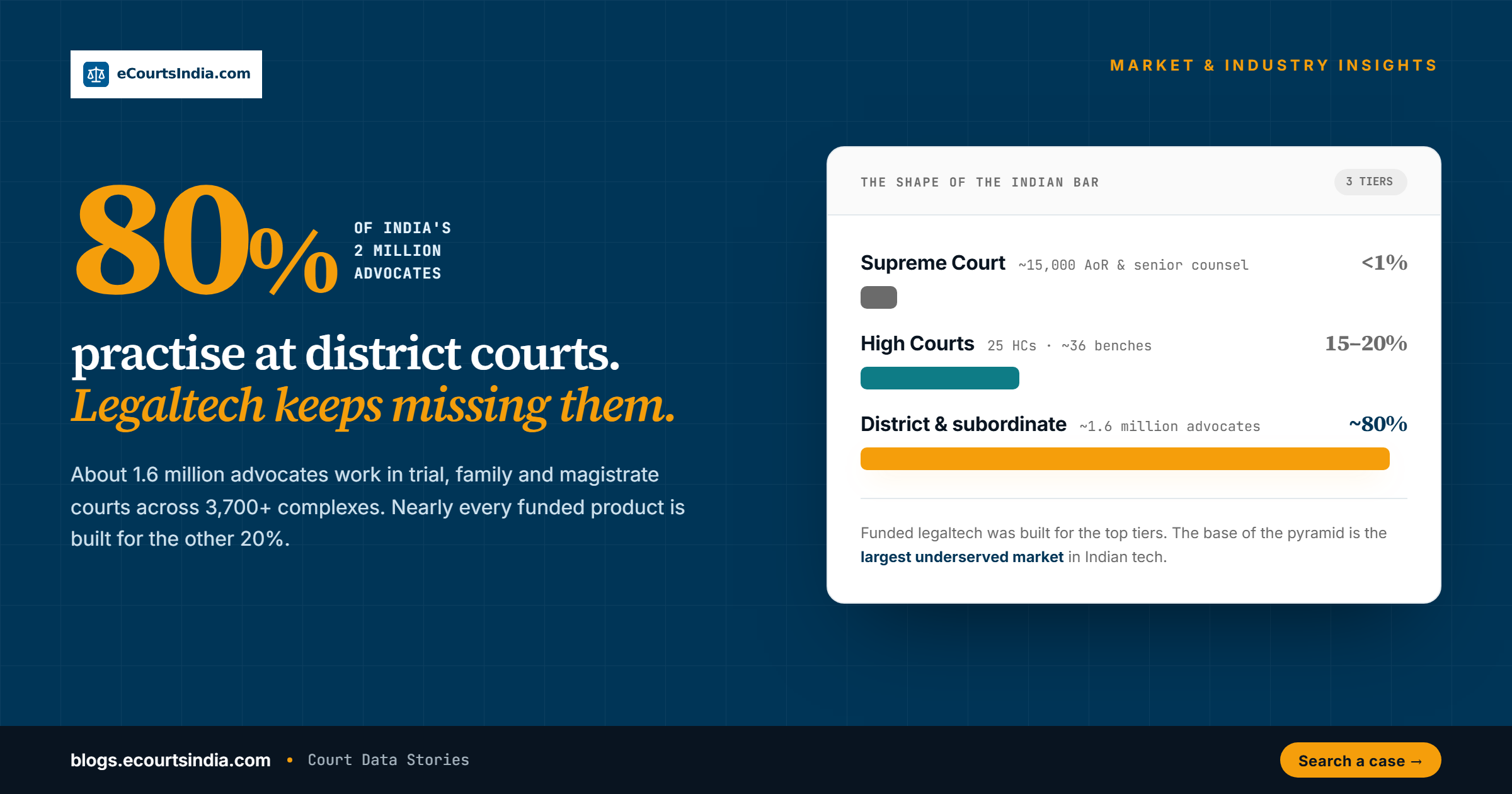
About 80 percent of India’s roughly 1.7 to 2 million advocates, close to 1.6 million, practise at district and subordinate courts, yet almost every funded legaltech product targets the top 20 percent. Legaltech keeps missing them because of structural gaps in data, language, distribution channels, payment methods, and investor incentives, not because the market is small.
There are approximately 2 million (about 20 lakh) enrolled advocates in India, per Ministry of Law and Justice figures, with a large share confirmed in the Bar Council’s ongoing verification drive. An estimated 80 percent (roughly 1.6 million) practise at district and subordinate courts. They appear in trial courts, subordinate criminal courts, family courts, consumer commissions, rent controllers, and magistrate courts across 3,700+ court complexes in every state and union territory.
Nearly every funded Indian legaltech product has been built for the other 20 percent.

This is one of the largest underserved professional markets in Indian technology. And it has been invisible to the funded legaltech cohort for reasons that are structural, not accidental.
The shape of the Indian bar
| Court tier | Approximate advocate population | Share of bar |
|---|---|---|
| Supreme Court of India | ~3,000+ Advocates-on-Record, senior counsel, and regular SC practitioners | <1% |
| High Courts (25 HCs across 41 bench/seat locations) | ~3-4 lakh advocates with HC practice | ~15-20% |
| District and subordinate courts | ~16 lakh advocates | ~80% |
These tiers are not fungible. The district-court advocate and the Supreme Court senior counsel do not use the same tools, do not charge the same rates, do not have the same client base, and do not work in the same language. A product designed for one tier typically does not migrate to the other.
Who the district-court advocate actually is
Some rough but useful numbers, pieced together from bar association surveys, state directorates, and field interviews.
- Practice size: Sole practitioner or 2 to 5 person chamber. Not a firm.
- Annual professional income: Wide range. Median estimates place it in the ₹3 lakh to ₹12 lakh band for practising advocates below the HC tier, depending on state and specialisation.
- Active matters: 30 to 200 live matters at any time.
- Primary tools: WhatsApp, physical diary, a junior assistant taking notes at the court. eCourts portal on a shared laptop. Occasionally IndianKanoon for judgment lookups.
- Working language: Hindi, Marathi, Tamil, Telugu, Bengali, Kannada, Malayalam, Gujarati, Punjabi, and other scheduled languages more often than English.
- Willingness to pay for software: Real, but capped. ₹200 to ₹500 per month if the product saves at least two hours a week.
Why incumbents priced themselves out of this market
Manupatra and SCC Online, the two legacy research incumbents, set annual subscription prices at approximately ₹15,000 to ₹50,000 a year. For a Tier-1 firm associate, that is a rounding error. For a district-court advocate, that is a quarter’s rent. Incumbents did not price maliciously. They priced for the customer they could actually close: urban firms and chambers. The pricing was rational. The consequence was that 80 percent of the market was priced out and left to rely on free tools.
Modern legaltech is quietly repeating the same mistake. A SaaS product targeting Tier-1 firms at ₹5,000 per seat per month is 10x to 25x above what a district-court advocate will pay. Different wrapper, same exclusion.
Why product teams keep missing the district-court advocate
Five structural reasons. All fixable, none accidental.
- Data gap. District-court data is harder to aggregate than HC data. Most funded legaltech companies never got past the HC tier because their pipeline could not ingest trial-court records at scale.
- Language gap. The district-court advocate works in Indian languages. Most product and engineering teams in Bangalore and Gurgaon build in English.
- Channel gap. You do not reach district-court advocates through LinkedIn or Google Ads effectively. You reach them through bar associations, court-complex meetings, regional WhatsApp groups, and word of mouth.
- Payment gap. This buyer prefers UPI, monthly billing, easy cancellation. Most SaaS billing stacks assume enterprise procurement.
- Investor gap. A Tier-1 firm logo on your pitch deck raises money. 500 district-court advocates in Jabalpur do not. VCs historically reward the former.
What a district-court-first product actually looks like
Picture the daily workflow of a trial-court advocate in, say, Muzaffarpur or Pune or Madurai. Morning: check today’s cause list across two or three courts where they have matters listed. Travel to court. Note new dates. Note any orders passed. Lunchtime: update the client, usually on WhatsApp. Afternoon: draft a reply or a written statement, often longhand. Evening: research a point for tomorrow.
A product serving this advocate well has roughly these features.
- Daily cause-list alert for every court where they have a matter listed, pushed as a simple message before court opens.
- Hearing-date tracker per case, with automatic updates when the court reschedules.
- Order download, in PDF, the moment an order is uploaded by the court.
- Client update templates in the advocate’s working language, pre-filled with case status.
- Past-judgment search across trial and appellate courts for the specific section or act under which they are arguing.
- Drafting assist in Hindi, Marathi, Tamil, or Bengali.
None of these are impossible. None are expensive to deliver once the underlying data layer exists. What is missing is a product team that treats this buyer as primary rather than secondary.
The market math
Assume 1.6 million district-court advocates. Assume a 5 percent penetration into a product at ₹300 per month. That is 80,000 paying users at ₹3,600 per user per year, or about ₹28.8 crore in recurring revenue from a single segment, ignoring any enterprise API revenue layered on top. At 10 percent penetration, it is about ₹57.6 crore. These are not fantasy numbers. They are what Zerodha-style distribution looks like when the product is priced for the market it serves.
What this means for investors
The district-court advocate is arguably the most overlooked vertical SaaS buyer in India. Investors have chased the Tier-1 firm, the in-house counsel, and the startup GC because the ACV is visible and the sales cycle is short. The advocate-at-scale buyer requires a different playbook: freemium acquisition, language-native product, and court-data infrastructure underneath. Whoever solves this wins the largest paid user base in Indian legaltech.

What this means for eCourtsIndia
Our daily active user base today includes a large population of district-court advocates, because they were always going to be our core user. Our job is to give them cause-list alerts, hearing notifications, case tracking, and judgment search at a price point that reflects their economic reality. The data layer we are building is the prerequisite for any district-court-first product, including ours.
If Indian legaltech finds its Zerodha moment in the next five years, it will come from this segment, not from the roughly 14,000 law firms that most of the category is currently courting.
Try the platform free: ecourtsindia.com/search. Find a lawyer: ecourtsindia.com/lawyer.
Related reading
Sources
- Bar Council of India: enrolment data by state.
- Ministry of Law and Justice: district court infrastructure reports.
- Harshith Viswanath, The LegalTech Thesis: Mapping India’s LegalTech Ecosystem, March 2026.
- Ken Research, 2024: India Legaltech Outlook.
Frequently Asked Questions
What percentage of India’s lawyers practise at district courts?

About 80 percent. Of India’s roughly 1.7 to 2 million enrolled advocates, around 1.6 million practise at district and subordinate courts across 3,700+ court complexes, appearing in trial courts, family courts, consumer commissions, and magistrate courts. They form the largest segment of the bar. You can search these courts on eCourtsIndia.
Why does legaltech keep missing district-court advocates?
Five structural reasons: a data gap because trial-court records are hard to aggregate, a language gap because advocates work in Indian languages while teams build in English, a channel gap because you reach them through bar associations not LinkedIn, a payment gap because they prefer UPI and monthly billing, and an investor gap. Tools like cause-list tracking help close it.
How much will a district-court advocate pay for legal software?
Their willingness to pay is real but capped, roughly ₹200 to ₹500 per month if the product saves at least two hours a week. Legacy incumbents priced annual subscriptions at ₹15,000 to ₹50,000, which excluded this segment. A product priced for their economic reality, with tools like case search, fits the budget.
What does a district-court-first legal product look like?
It delivers daily cause-list alerts for every court where the advocate has a matter, hearing-date tracking with automatic reschedule updates, instant order downloads, client update templates in the working language, and past-judgment search by section or act. See how daily cause lists work and read our whitespace plays.
How big is the district-court advocate market?

Assume 1.6 million district-court advocates. At 5 percent penetration of a product priced at ₹300 per month, that is 80,000 paying users, or about ₹28.8 crore in recurring revenue from one segment. At 10 percent penetration it reaches about ₹57.6 crore, before any enterprise API revenue. Explore the eCourtsIndia API.